




Over 90% of people who start affiliate marketing quit within the first year.
Not because affiliate marketing does not work. It does. The global affiliate marketing industry crossed $20 billion in 2026 and is growing at 14 to 18 percent annually. Brands are spending more on affiliate partnerships than ever before and that spending is going to real people with real audiences, not to giant media corporations.
The reason most beginners quit is simpler and more honest than most guides will admit. They expected income in week two. They got nothing by month two. They concluded it does not work and moved on.
This guide is written for the person who wants to understand what affiliate marketing actually is before starting, what realistic results look like at every stage, what the most common mistakes are and why they happen, and what specific steps to take today to build something that actually pays over time.
No income claims. No overnight success stories. Just the honest version of how this works.
What Affiliate Marketing Actually Is and What It Is Not
At its core, affiliate marketing is a performance-based partnership. A company wants more customers. You help them find those customers by recommending their product or service to your audience. When someone buys through your unique referral link, you earn a commission. The company pays only for results, not for effort. You earn only when you deliver a sale or a qualified action.
That is the whole model. Everything else is just the details of how to execute it well.
What affiliate marketing is not is a passive income button you switch on. The passive part comes later, after months of building content and trust. In the beginning, it is active work with delayed results. Understanding this before starting is the difference between treating it like a real business and treating it like a lottery ticket.
The commissions vary dramatically by industry and program. Physical product programs like Amazon Associates typically pay 1 to 5 percent per sale because margins on physical products are thin. Software, SaaS tools, and digital products pay significantly more, often 20 to 50 percent per sale, and many offer recurring commissions every month for as long as the customer stays subscribed. For anyone starting out, software and digital product programs offer the strongest income potential for the amount of content required.
Why Affiliate Marketing Still Works in 2026
Every year since 2015, someone publishes an article declaring affiliate marketing dead. Every year, the industry grows.
Here is the simple reason it keeps working. People search for recommendations before spending money. They always have and they always will. When someone is deciding between two AI tools, they search for honest comparisons. When someone is about to buy a course, they look for genuine reviews from people who have used it. When someone needs help choosing a marketing platform, they read what other marketers think about it.
That search behavior funds affiliate marketing. As long as people spend money online and research before buying, the person who creates genuinely helpful content about the right products in the right niche earns commissions from that content.
What has changed in 2026 is the quality threshold. Generic affiliate content that just lists product features and drops a link does not convert the way it did in 2019. Readers are more sophisticated and have more options. The affiliate content that converts now is honest, specific, and clearly written by someone who actually understands the product category. That higher bar is good news for beginners who are willing to put in the work because it pushes out the lazy competition.
The Three Types of Affiliate Marketing: Only One Recommended for Beginners
Unattached Affiliate Marketing
This is when someone promotes a product they have no connection to, no experience with, and no real knowledge about. Pure advertising. Pay to run ads, drive traffic to an affiliate link, collect commissions. No content, no audience, no trust required.
The problem for beginners is that this approach requires upfront advertising spend, sophisticated understanding of paid traffic, and often significant testing budget before turning profitable. Most beginners lose money here before they learn enough to make money. Not recommended to start here.
Related Affiliate Marketing
This is when someone creates content in a general area related to the products they promote but has not personally used the specific products. A fitness blogger who promotes protein supplements they have not tested. A marketing blogger who recommends tools they have only read about.
This approach works when the content creator has genuine knowledge of the broader category even if they have not tested the specific product. The risk is recommending something that turns out to be poor quality, which damages trust with the audience.
Involved Affiliate Marketing
This is the approach with the highest conversion rates and the most sustainable long-term business. The affiliate promotes only products they have genuinely used, understands well, and can recommend from real experience. Their content reflects actual knowledge and first-hand perspective.
Involved affiliate marketing builds the kind of trust that turns readers into repeat visitors and one-time buyers into regular customers. The conversion rates are higher because the recommendation is credible. The long-term income is more stable because the audience trusts the source.
For beginners, starting with involved affiliate marketing and only promoting products in categories where there is genuine knowledge and experience is the recommended approach. The income starts slower but compounds more reliably.
Choosing the Right Niche: The Decision That Determines Everything
Niche selection is the most important decision in affiliate marketing and the one beginners spend the least time on.
A niche needs three things to work as an affiliate business. First, real search demand. People need to be actively searching for information in this space. Second, products worth promoting. The niche needs affiliate programs that pay meaningful commissions on products people actually buy. Third, sustainable interest from the creator. Creating content consistently for 12 to 18 months in a niche you have no interest in is nearly impossible.
The niches that consistently produce the strongest affiliate income are those where people spend money to solve real problems or improve their situation. Marketing tools, AI software, personal finance, online education, health and wellness, and business productivity all fit this profile. These are spaces where people actively research before buying and where affiliate commissions are meaningful.
The mistake most beginners make is choosing a niche based entirely on commission rates without checking whether they have enough genuine knowledge or interest to create months of content in that space. High commissions in a space you know nothing about produce low-quality content that does not rank and does not convert.
The right niche sits at the intersection of genuine interest or knowledge, real search demand, and products with meaningful commissions. Finding that intersection before starting saves enormous amounts of wasted time.
How to Find and Join Affiliate Programs
Direct Programs
Many software companies and SaaS tools run their own affiliate programs directly. These often pay the highest commissions because there is no network taking a cut. To find them, go to the website of any tool in the niche and look for “Affiliate Program,” “Partner Program,” or “Refer and Earn” links in the footer. Apply directly through the company.
Affiliate Networks
Networks aggregate programs from hundreds of companies in one place. ShareASale, CJ Affiliate, Impact, and PartnerStack are the most widely used. Creating one account gives access to hundreds of programs. These are useful for finding programs in categories where direct programs are not obvious.
What to Look for in an Affiliate Program
Commission rate: physical products typically pay 1 to 10 percent while digital products and SaaS tools pay 20 to 50 percent or more. Cookie duration: how long after someone clicks the link can they buy and still generate a commission. 30 days is standard. 90 days or more is excellent. Recurring commissions: some SaaS programs pay every month for as long as the referred customer stays subscribed. These recurring commissions compound significantly over time and are worth prioritising.
Payment threshold and method: understand the minimum payout and how and when commissions are paid before investing time in a program.
The Content That Actually Converts in 2026
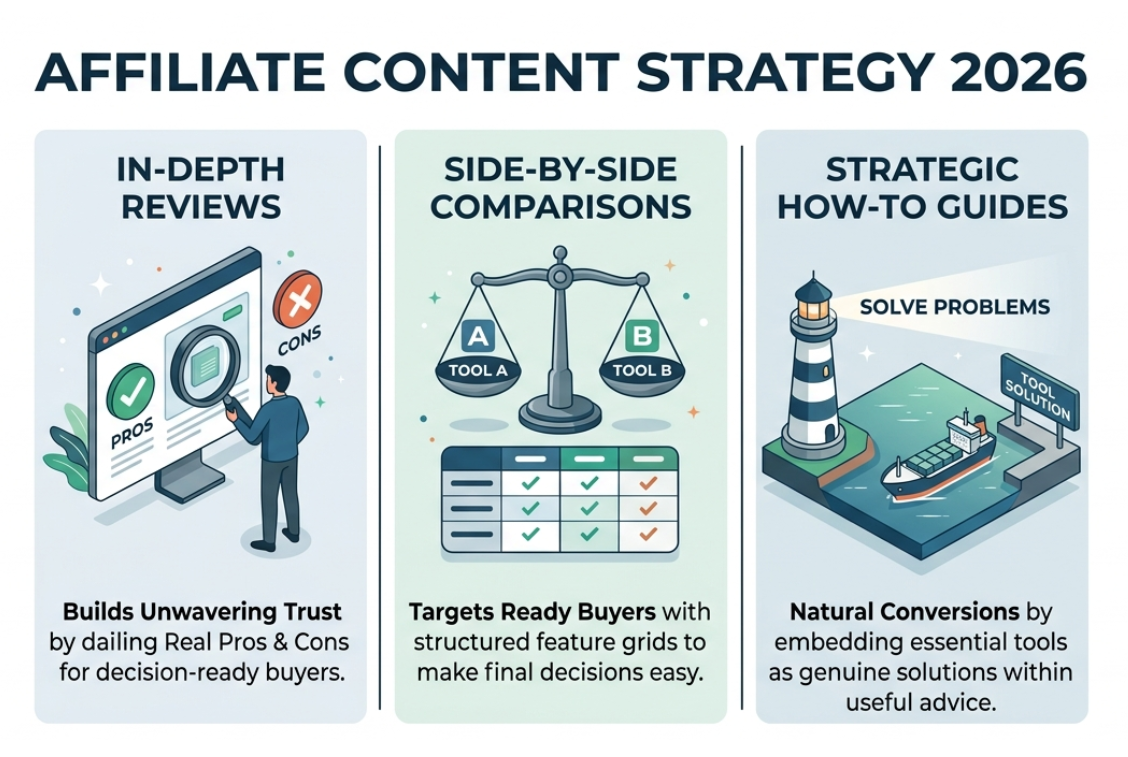
Affiliate marketing lives and dies on content quality. Here are the content types that drive the most affiliate conversions.
In-Depth Product Reviews
A detailed, honest review of a specific product with real information about what it does well, what it does poorly, who it is right for, and who it is not right for. This is the highest-converting affiliate content format because it targets people who are already in decision mode. Someone searching for a specific product review has usually narrowed their choice to two or three options and needs the final push in the right direction.
The key word is honest. Including real limitations, real downsides, and real scenarios where the product would not be the right choice builds more credibility than a purely positive review. Readers can tell the difference between someone who tested a product and someone who wrote about it from the sales page.
Comparison Posts
Comparing two or three competing products directly is extremely high-converting because it targets searchers who are already choosing between specific options. “Tool A vs Tool B” or “Tool A vs Tool B vs Tool C” posts attract people moments before they make a buying decision.
Good comparison posts are structured and specific. Side-by-side tables showing features, pricing, and who each option is best for allow readers to make quick decisions. The more specific and accurate the comparison, the more useful it is and the more it converts.
How-To Guides with Tool Recommendations
Guides that teach someone how to accomplish a specific task, and naturally recommend a tool as part of the solution, convert well because the recommendation is embedded in genuinely useful content. “How to set up email marketing for a new blog” naturally leads to recommending specific email tools. “How to use AI for content creation” naturally leads to recommending AI writing tools.
The key is that the tool recommendation must genuinely serve the reader’s goal. Forced or irrelevant tool recommendations in the middle of a guide reduce credibility and conversion rates.
The Mistakes That Kill Beginner Affiliate Marketers
Promoting Too Many Products at Once
Beginners see multiple affiliate programs and sign up for all of them. They scatter links across every post regardless of relevance. Readers can tell when every piece of content is trying to sell them something. Trust collapses. Conversions stay near zero.
The approach that works is depth over breadth. A small number of genuinely understood, genuinely recommended products promoted consistently and honestly in relevant contexts outperforms a scattered collection of links across unrelated content.
Choosing Products for Commission Rate Rather Than Fit
A 50% commission on a product your audience would never buy earns nothing. A 20% commission on a product your audience genuinely needs earns real money. The commission rate is irrelevant if the product does not match the audience.
Expecting Results Before Building Trust
The sequence in affiliate marketing is always the same. Build audience. Build trust. Earn commissions. Trying to reverse this by pushing affiliate links before an audience trusts the source produces nothing. Most beginners earn their first real commission three to four months after starting consistent content creation. Some take six months. This timeline is normal and does not mean the approach is failing.
Not Disclosing Affiliate Links
This is both a legal requirement in most countries and a trust builder when done honestly. Including a short disclosure statement near affiliate links, explaining that a commission may be earned at no extra cost to the reader, does not reduce conversion rates. Research consistently shows it does not. And it protects the creator from regulatory issues while demonstrating transparency that actually builds credibility.
Quitting Before the Compounding Starts
Affiliate income compounds. The tenth post earns more than the first. The fiftieth post earns more than the tenth. Each piece of content that ranks adds to the total potential for commissions. Stopping after twenty posts means stopping before the compound effect becomes meaningful.
What Realistic Affiliate Income Looks Like
These numbers are honest estimates based on consistent content creation in a mid-competition niche. They are not guarantees. They are what consistent, quality-focused affiliate marketers who do not quit typically see.
Months 1 to 3: Income is near zero. This period is for building content, getting indexed by Google, and starting to earn trust. The right focus here is publishing quality posts consistently and not checking affiliate dashboards daily.
Months 3 to 6: First commissions start appearing. Small amounts. Possibly 500 to 2,000 rupees per month. This is the proof that the model is working, not a full income yet.
Months 6 to 12: Income grows as content compounds. Pages that ranked on page 2 move to page 1. Posts that were being crawled start getting clicked. Monthly commissions in the range of 5,000 to 20,000 rupees become realistic with consistent publishing and the right products.
Month 12 and beyond: With 40 to 60 quality posts in a focused niche, with some posts ranking well and earning consistent traffic, monthly affiliate income in the range of 20,000 to 60,000 rupees becomes achievable. The top end depends heavily on the commission rates of the programs and the purchase rate of the audience.
These numbers do not include AdSense, sponsored content, or other revenue streams that typically develop alongside affiliate income. Combined income for a well-run content site at month 18 to 24 is often significantly higher than affiliate commissions alone.
Starting Today: The Exact First Steps
Step 1: Choose one niche where there is genuine knowledge and interest and where meaningful affiliate programs exist. Do not try to cover multiple niches at once.
Step 2: Find two or three affiliate programs in that niche that offer meaningful commissions, reasonable cookie windows, and products the target audience would genuinely buy. Apply to them.
Step 3: Research the five questions people ask most frequently about that niche. These become the first five blog posts. Each post should fully answer one question, be written from genuine knowledge, and naturally recommend a product where it fits.
Step 4: Publish consistently. Two posts per week is sustainable for most people with a regular job. One post per week is the minimum for meaningful progress. Less than that and Google does not index the site as frequently, which slows ranking timelines.
Step 5: Add affiliate links naturally within content where they fit. Never force a link into content where it does not serve the reader. Every forced link that does not convert is a missed trust-building opportunity.
Step 6: Disclose clearly. Place an affiliate disclosure statement at the top or near the beginning of any post containing affiliate links. Keep it simple and honest.
Step 7: Track what works. After three months, look at which posts are getting the most traffic and which are generating the most clicks on affiliate links. Create more content similar to what is working. Improve or update posts that are not.
The One Thing That Separates Affiliates Who Earn from Those Who Do Not
It is not the niche. It is not the specific programs. It is not even the content format.
The single biggest predictor of whether someone earns from affiliate marketing is whether they build genuine trust with a specific audience over time.
Trust comes from being honest when something has a downside. From recommending a cheaper option when it genuinely serves the reader better. From writing about a topic because it helps someone, not because there is a commission attached. From being consistent enough that readers come back and bring others.
The affiliates earning meaningful income in 2026 are not the cleverest link placers. They are the most trusted voices in their specific niches. They recommend things because the things are genuinely good. They admit when something is not worth buying. And their audiences buy through their links because they trust that the recommendation is honest.
That trust cannot be automated. It cannot be shortcut. But it can be built by anyone willing to create genuinely useful content consistently over time. That is the whole opportunity.
Quick Summary Table
| Stage | Timeline | Focus | Realistic Income |
|---|---|---|---|
| Building | Month 1–3 | Content creation, indexing | Near zero |
| Growing | Month 3–6 | Rankings improving, first sales | $30 – $100 |
| Compounding | Month 6–12 | Traffic growing, consistent sales | $100 – $500 |
| Scaling | Month 12+ | Multiple posts ranking, growing list | $500 – $1000 |
FAQs
Q: How long does it take to earn from affiliate marketing?
Most beginners see their first commissions between month 3 and month 6 with consistent content publishing. Meaningful monthly income typically develops between month 6 and month 12. This timeline depends heavily on content quality, publishing consistency, and niche competitiveness.
Q: Do I need a website to start affiliate marketing in 2026?
A website gives the most control and the best long-term SEO results. However, affiliate marketing can also be done through YouTube, newsletters, and Instagram. A website is recommended as the primary platform because it is the only one where the creator fully owns the audience and the content.
Q: How much money can a beginner realistically earn from affiliate marketing?
Most beginners who publish consistently earn their first 500 to 2,000 rupees per month by month 3 to 6. By month 12 with consistent publishing in a focused niche, 20,000 to 60,000 rupees per month from affiliate income becomes realistic. These figures assume consistent quality content creation, not occasional posting.
Q: Is affiliate marketing still worth starting in 2026?
Yes. The affiliate marketing industry exceeded $20 billion globally in 2026 and is still growing. More brands are running affiliate programs than ever and commission rates for digital products and SaaS tools remain strong. The opportunity is real for creators willing to build genuine trust with a specific audience over time.
Q: What is the biggest mistake beginners make in affiliate marketing?
Quitting too early. Most beginners expect income within the first 30 to 60 days. When it does not arrive, they conclude the model does not work and stop. In reality, the 3 to 6 month mark is when the first results typically appear for beginners publishing consistently. The people who succeed are almost always the ones who treated the first six months as pure investment without expecting short-term returns.