


Most SEO guides in 2026 still read like they were written in 2019. Same advice. Same keywords. Same recycled tips about meta descriptions and keyword density.
Here is the reality. Google released a major core update in March 2026 and it changed things again. Sites that were coasting on old tactics got hit. Sites publishing original, experience-backed content went up. The gap between generic SEO content and genuinely useful content has never been wider.
This guide covers what actually works right now. Not theories. Not best guesses. What Google itself is rewarding in 2026, what it is punishing, and the specific steps you can take this week to start moving in the right direction.
What Google’s March 2026 Core Update Actually Changed
This is the part most SEO articles skip because they were written before the update landed. Google’s March 2026 Core Update rolled out over 19 days and caused significant ranking shifts across almost every industry.
The clearest pattern from the data: original, experience-driven content went up in rankings. Summary-style content and low-quality AI-generated content went down. Sites that demonstrated real first-hand knowledge on their topics saw improvements. Sites publishing generic information that could have been written by anyone about anything saw drops.
Three things became more important after this update.
First, E-E-A-T got stricter. According to Search Engine Journal, 73% of top-ranking content after the March 2026 update shows real first-hand knowledge or documented use cases. Writing about a tool you have never used, a strategy you have never tried, or an industry you have no real connection to is increasingly a ranking liability.
Second, content depth now matters more than content length. A focused 1,500-word post that fully answers one specific question now outperforms a padded 3,500-word post covering five topics shallowly. Google’s systems have gotten better at measuring whether a page genuinely satisfies the query or just looks like it does.
Third, authority signals are being evaluated at both the domain level and the author level. Who wrote this? What else have they written? Does the website have a consistent editorial voice and clear topic focus? These questions matter more than they did twelve months ago.
Step 1: Understand What Search Intent Actually Means in 2026
Search intent is the reason behind a search. Not just what someone typed but what they actually want from the results.
Google in 2026 has become extremely precise at matching results to intent. If your content does not match the intent behind the keyword you are targeting, rankings will not come regardless of how technically optimised everything else is.
There are four intent types that matter for content strategy.
Informational intent means the person wants to learn something. “How does affiliate marketing work” or “what is search intent SEO” are informational queries. These are best served by clear, educational guides that teach rather than sell.
Commercial intent means the person is researching before spending money. “Best AI writing tools 2026” or “Claude AI vs ChatGPT for marketers” are commercial queries. These need honest comparisons and specific recommendations backed by real analysis.
Transactional intent means the person is ready to act. “Merlin AI pricing” or “sign up Emergent AI” are transactional. Short, specific, direct pages work best here.
Navigational intent means the person wants a specific website. Not useful for most content strategy decisions.
The practical step before writing anything: search the target keyword on Google and study what is ranking. Not just the titles but the actual structure, length, and format of the top five results. If Google is ranking 2,000-word comparison posts, a 500-word explainer will not compete. If Google is ranking short direct answers, a 4,000-word essay will not either. Match the format to the intent first. Everything else comes after.
Step 2: Keyword Research Without Spending Money
Paid keyword tools are useful when you have traffic already and want to scale. When starting out, they are not necessary. Here is a completely free process that works.
Google Autocomplete
Type a topic into Google Search and stop before pressing Enter. The suggestions that appear are real searches happening right now. These autocomplete terms are often low-competition because they are too specific to appear in paid keyword databases. Write down every relevant one.
People Also Ask
After any search, scroll down to the People Also Ask box. Each question is a real query with real search volume. These questions also reveal exactly what related topics Google considers relevant to the main query. Using these questions directly as subheadings in a blog post helps Google understand that the content covers the topic comprehensively.
Related Searches
The eight related search suggestions at the bottom of every results page show variations of the original query that real users type. Including these naturally throughout an article helps Google understand full topic coverage without keyword stuffing.
The Long-Tail Strategy for New Websites
New websites have no domain authority. Competing for broad high-volume keywords against established sites that have been publishing for years is a losing game at the start.
Long-tail keywords fix this. Specific, detailed phrases attract smaller audiences but those audiences have stronger intent and convert at higher rates. Instead of targeting “SEO tips” where Ahrefs, HubSpot, and Backlinko dominate, target “SEO tips for new blogs with no backlinks 2026” or “how to rank a blog post without buying links.” Smaller audience, real ranking potential, and the person searching is exactly the right reader.
For new websites, target keywords where the existing results look weak. Short articles with no clear structure. Old posts from 2021 that have not been updated. Generic content with no specific data. These gaps are winnable.
Step 3: Write Content Google and AI Systems Both Want to Cite
This is where most content advice fails in 2026. Writing for Google and writing for AI Overview citation are different objectives that happen to share a lot of common ground.
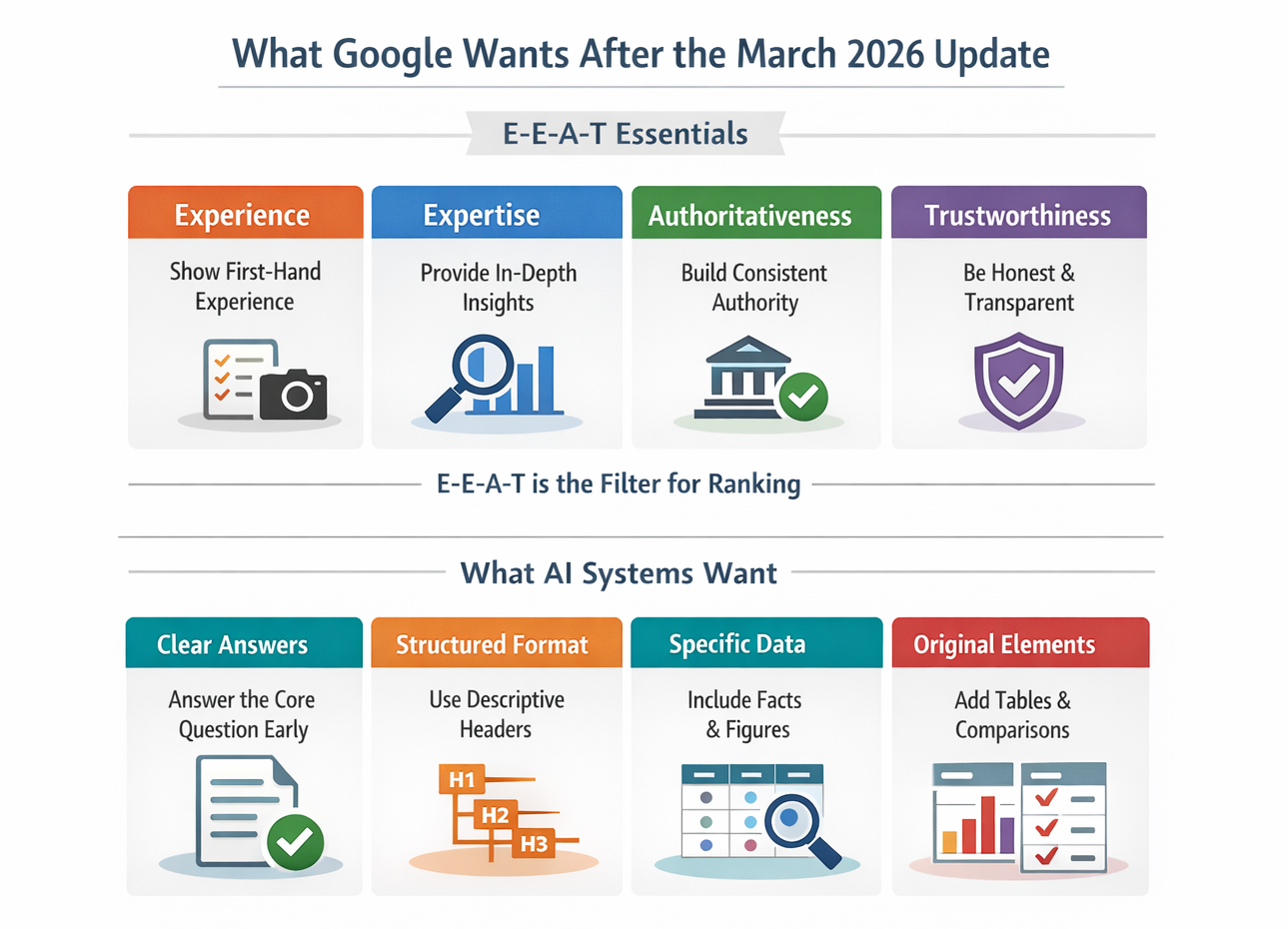
What Google Wants After the March 2026 Update
E-E-A-T is not optional anymore. It is the filter through which Google evaluates whether a piece of content deserves to rank at all.
Experience means showing that you have actually done the thing you are writing about. Not “affiliate marketing is a great way to earn passive income” but “here is what happened when I started affiliate marketing on a new website with no audience and no budget.” The second version signals experience. The first signals someone who read about it somewhere.
Expertise means going deeper than surface level. Not defining what keyword research is but explaining which types of keywords work at which stages of website growth, why long-tail keywords convert better for new sites, and where most beginners waste time in the process.
Authoritativeness builds over time through consistent publishing, internal linking between related posts, and mentions from other websites. It cannot be faked and it cannot be rushed. But it compounds significantly after six to twelve months of consistent work.
Trustworthiness comes from honesty. Including the downsides of a strategy. Admitting when something is uncertain. Citing sources for specific claims. Not every claim needs a citation but specific statistics and data points should be attributed.
What AI Systems Want: Structure and Specificity
Content that appears in Google AI Overviews consistently shares specific traits. Clear structured formatting with headers that answer distinct questions. Direct answers in the first two paragraphs. Specific data points that can be cited. Comprehensive topic coverage rather than narrow isolated posts.
For every blog post, the core question should be answered clearly within the first 150 words. The structure should allow someone scanning only the H2 subheadings to understand what the full article covers. And at least one original table, comparison, or structured element should be included because structured content dramatically increases the chance of appearing as a featured snippet.
Step 4: On-Page SEO That Actually Moves Rankings in 2026
What Matters
Title tag: Include the primary keyword, stay under 60 characters, and give a reason to click beyond just describing what the post is about. “How to Rank on Google in 2026” is better than “A Comprehensive Guide to Google SEO.”
Meta description: Under 155 characters. Includes the primary keyword. Reads like a two-line advertisement, not a content summary. Give people a specific reason to choose this result over the others on the page.
Content structure: One H1 for the main title. H2 for major sections. H3 for subsections within those sections. This hierarchy tells both Google and readers exactly how the content is organised and makes it easier for AI systems to extract specific answers.
URL slug: Short, clean, keyword-included. /how-to-rank-on-google-2026 works. A URL with twelve words and the year buried in the middle does not.
First paragraph: Mention the primary keyword naturally within the first 100 words. This confirms to Google that the content actually covers what the title promises.
Internal links: Two to four internal links to relevant posts on the same website. This helps Google understand how content is connected and keeps readers on the site longer, which improves engagement signals.
Image optimisation: Every image should have a descriptive file name before uploading, an alt text that describes what is in the image and includes a relevant keyword naturally, and a title that matches the image content.
What Does Not Matter As Much As People Think
Keyword density has no magic number. Writing naturally about a topic produces appropriate keyword frequency without deliberate repetition.
Exact keyword matching is not required. Google understands synonyms and related terms. Write naturally.
Word count targets are irrelevant. Write what the topic requires. No more. No less.
Step 5: Content Structure That Keeps Readers and Signals Quality
How content is structured matters as much as what it contains. Here is what works.
Start with a hook that acknowledges the reader’s situation directly. The first three sentences determine whether someone continues reading or goes back to the results page. Do not start with definitions. Start with something the reader immediately recognises as relevant to their problem.
Answer the core question early. Do not make readers scroll through five paragraphs of background before getting to useful information. Give the essential answer within the first section and provide the depth and context below it.
Use subheadings as navigation. Readers scan before they read. Every H2 and H3 subheading should make the structure of the article clear to someone who reads only the headings.
Include at least one table or comparison. Structured data like tables dramatically improves the chance of appearing as a featured snippet in search results. Featured snippets appear above all other organic results. For a new website trying to compete with established sites on domain authority, earning a featured snippet for a specific query levels the playing field completely.
End with a clear takeaway. Summarise the key points in three to five sentences. Then give the reader one specific next action.
H2: Step 6: Topical Authority: The Strategy That Compounds Over Time
Topical authority is the single most powerful strategy available to a new website in 2026 and the one most people are not using deliberately.
It means being recognised by Google as a comprehensive, reliable source on a specific topic rather than a website with scattered posts on unrelated subjects. Google gives significantly more ranking power to websites that demonstrate deep, organised coverage of a topic area.
Building topical authority requires creating interconnected content clusters. A cluster consists of one pillar post covering a topic broadly, supported by multiple related posts going deeper on specific aspects, all internally linked to each other. Over time as more posts are added to a cluster and they link to each other, Google begins treating the entire cluster as authoritative on that topic. New posts added to an established cluster rank faster and easier than the first posts did because the existing cluster lends them credibility.
For a marketing-focused website with four content categories, this means every post should clearly belong to one category cluster, should link to related posts in the same cluster, and should be internally linked from the category’s most important posts as well.
The compounding effect of this approach takes six to twelve months to fully develop. Once it does, it becomes very difficult for competitors to displace because authority is distributed across dozens of interlinked posts rather than concentrated in a single page.
Step 7: Getting Backlinks Without Paying or Begging
Backlinks remain one of Google’s strongest ranking signals in 2026. But the way to get them has changed fundamentally.
Paying for backlinks results in penalties and deindexing. Spammy comment and directory links are detected and ignored. The only backlinks that matter are earned links from websites that link because the content is genuinely worth referencing.
Create Content Worth Linking To
Original comparison tables, specific data points with clear attribution, honest tool reviews that include real limitations, and comprehensive how-to guides are the types of content other bloggers and journalists naturally reference. A detailed comparison post with original structured tables is exactly this type of content. Other writers in the same niche will find it, reference it in their own posts, and link back to it without being asked.
Use HARO
Help A Reporter Out at helpareporter.com is free. Journalists and bloggers post daily requests for expert sources across every topic. When a request matches genuine knowledge, responding quickly with a specific, useful, well-written answer often results in the response being quoted and the source website being linked to. One HARO placement from a real publication drives both SEO authority and direct referral traffic.
Reach Out to Products Being Reviewed
Emailing the companies whose products appear in published reviews and letting them know a detailed review exists often results in the company sharing it on their social media, linking to it from their affiliate resources page, or featuring it in their partner materials. Most SaaS companies maintain partner showcase pages and are willing to link to quality reviews. This costs nothing but the time to write one email per company.
Guest Posting on Relevant Sites
Finding small to mid-size marketing blogs that accept contributor posts through a search for “write for us marketing blog” and pitching a specific article idea tailored to that audience produces real backlinks from relevant websites. One guest post per month over six months builds a meaningful backlink profile that compounds with the topical authority being built on the main website simultaneously.
Step 8: Technical SEO Basics That Cannot Be Ignored
Technical SEO has become more demanding after the March 2026 update. These are the elements that directly affect ranking ability.
Page speed matters more than ever. Sites that load in under three seconds retain 53% more mobile visitors. A 100 millisecond delay in load time causes a measurable drop in conversion rate. Caching plugins, compressed images, and minimal unnecessary scripts are the core fixes for most WordPress sites.
Core Web Vitals are now critical. Google measures three specific metrics. LCP, Largest Contentful Paint, should be under 2.5 seconds. INP, Interaction to Next Paint, measures how fast a site responds to user interactions and became a ranking factor in the 2026 update. CLS, Cumulative Layout Shift, measures whether page elements move unexpectedly while loading. Failing these metrics causes ranking drops regardless of content quality.
HTTPS is required. Sites still running on HTTP rather than HTTPS are at a direct ranking disadvantage. An SSL certificate is standard with all major hosting providers.
Structured data and schema markup help Google understand what type of content each page contains. Adding FAQ schema to every blog post is one of the highest-return technical SEO actions available. It takes five minutes per post using a standard SEO plugin and significantly improves the chance of appearing in featured snippets and AI Overviews.
Sitemaps and indexing: submitting a sitemap through Google Search Console ensures Google knows about all published pages. After publishing each new post, using the URL Inspection tool in Search Console to request indexing speeds up the time it takes for the post to appear in search results.
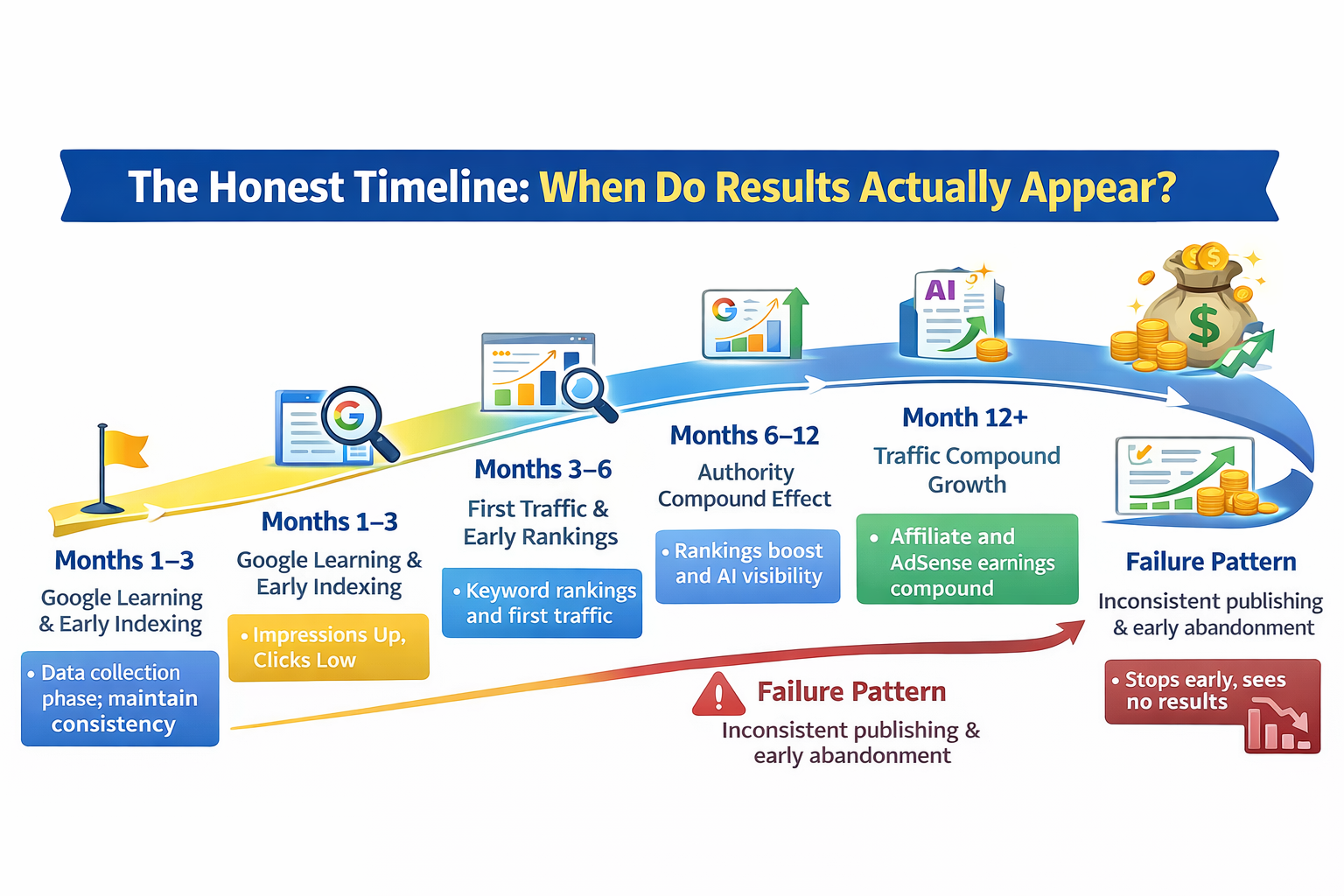
The Honest Timeline: When Do Results Actually Appear?
Months 1 to 3: Google is learning about the website. Impressions grow in Search Console but clicks remain low. Some long-tail posts begin appearing on page 2 or 3. This period is normal and should not trigger strategy changes. Keep publishing.
Months 3 to 6: First real traffic arrives. Posts targeting low-competition long-tail keywords begin ranking on page 1. Daily visitors might reach 50 to 200 by the end of month 6 if publishing is consistent and content quality is maintained.
Months 6 to 12: Topical authority starts compounding. New posts rank faster because the existing cluster lends them credibility. Some posts begin appearing in AI Overviews and featured snippets. This is where consistent publishing pays back measurably.
Month 12 and beyond: With consistent publishing, a real organic asset has been built. Traffic has compounding momentum. Affiliate conversions become meaningful. AdSense revenue grows. This is where the investment of the first year pays back over time.
The websites that fail are the ones that publish ten posts, see no results after two months, and stop. The websites that succeed treat the first six months as pure investment and keep publishing regardless of what the numbers show in the short term.
SEO Checklist for Every Blog Post
Use this before publishing anything.
Before writing:
Search the keyword on Google and check what is ranking format, length, and intent match
Identify whether the intent is informational, commercial, or transactional
Check People Also Ask for related questions to use as subheadings
Confirm the keyword difficulty is manageable given current domain authority
While writing:
Primary keyword appears naturally in the first 100 words
H1 title is under 60 characters and includes primary keyword
H2 and H3 subheadings create a clear scannable structure
Content answers the core question directly within the first two paragraphs
At least one specific data point or statistic is included with attribution
An honest limitation or downside is mentioned where relevant
At least one table or structured comparison is included
Before publishing:
Meta title is under 60 characters with primary keyword
Meta description is under 155 characters with a reason to click
URL slug is short and includes the primary keyword
Two to four internal links added to relevant existing posts
All images have descriptive file names, alt text, and titles
FAQ schema added using the SEO plugin
The Bottom Line
SEO in 2026 is harder to game than it was in 2018. The shortcuts are gone and the update history makes clear they are not coming back. Buying links gets sites penalized. Thin content loses rankings. Generic AI-generated posts that add nothing new are actively being filtered out after the March 2026 update.
What works is what has always worked at a fundamental level. Understanding what people are actually looking for. Creating the most genuinely useful, specific, honest answer to their question. Building real authority through consistent publishing over time. These things compound. They always have. The difference in 2026 is that the competition at this level is much thinner because most people are still trying shortcuts that stopped working two years ago.
Start with one post. Do the intent research. Write something specific and honest that goes deeper than what is already ranking. Publish it. Then do it again next week. That is the entire strategy.
FAQs
Q: How long does it take to rank on Google in 2026?
Most new pages take 3 to 6 months to reach page one for low-competition long-tail keywords. Competitive terms may take 6 to 12 months or longer. Consistent publishing targeting specific low-difficulty keywords is the fastest legitimate path to rankings for new websites.
Q: Did Google’s March 2026 update hurt small blogs?
The March 2026 Core Update hurt sites publishing generic, thin, or AI-generated content with no original value. Small blogs publishing honest, experience-based, specific content that fully answers search queries were generally unaffected or saw improvements. The update specifically rewarded original, depth-first content.
Q: Do backlinks still matter for SEO in 2026?
Yes. Backlinks remain a top ranking signal. However Google in 2026 evaluates contextual relevance more than volume. One relevant editorial backlink from a real website in the same niche outweighs dozens of directory or comment links. Earning backlinks through genuinely useful content is the only approach that works long-term.
Q: Does AI-generated content rank on Google in 2026?
Google does not penalise AI-assisted content that is genuinely helpful and accurate. What the March 2026 update penalised was low-quality AI-generated content with no original insight, first-hand experience, or genuine information gain. AI content that adds something new, demonstrates expertise, and fully satisfies search intent continues to rank.
Q: What is the single most important SEO factor in 2026?
Search intent alignment. Content that matches exactly what the searcher wants, in the format they expect, with the depth they need outperforms content that is technically optimised but misses the intent. Getting intent right is the foundation everything else builds on.