


Most content strategies are not strategies. They are bursts.
A team gets excited, publishes ten posts in two weeks, sees a small traffic bump, gets busy with something else, and the publishing stops for a month. Then someone notices traffic dipped and the cycle starts again. Stop, start, stop, start.
Orbit Media’s 2025 annual blogger survey found that 67% of marketers who publish on a consistent schedule report strong results, compared to just 24% who publish sporadically. That gap, 67% versus 24%, is not about who writes better content. It is about who built a system and who did not.
A content engine is the opposite of a burst. It is a repeatable system that takes a topic from idea to published post to measured result, on a predictable rhythm, without depending on motivation, inspiration, or someone remembering to do it. The output is not “we published a lot this month.” The output is “we know exactly what gets published every week, why, and what happens to it after.”
This post is the complete blueprint for building that system. Not a content calendar template. Not a list of content ideas. An actual engine, the kind that keeps running whether or not anyone feels like writing that day, and the kind that compounds traffic month over month instead of spiking and fading.
Why Most Content Strategies Fail Before They Start
Before building the engine, it helps to understand exactly why the burst pattern is so common and so damaging.
Most early stage teams publish randomly, then stop, then restart after a panic meeting. This creates a stop start pattern that kills compounding results.
The compounding effect is the entire point of content marketing, and the burst pattern destroys it. Here is why. Search engines track how often your site is updated. When you publish consistently, you are training Google and other crawlers to return frequently and index your new content quickly. A consistent cadence means your pages get discovered faster, which helps your latest content appear in search results sooner.
When publishing stops and starts, the opposite happens. Crawlers that learned to expect weekly content from your site, then stopped seeing it, slow down how often they check. The next burst of content gets indexed more slowly than it would have if the cadence had never broken. Traffic spikes after each post but fades quickly. Google Search Console shows delayed indexing. Content ideas are inconsistent or scattered. If any of these sound familiar, the rhythm needs tightening.
The second reason burst publishing fails is strategic, not technical. A team publishes weekly across blog and social, yet sales qualified outcomes stay flat. A review shows assets are mostly top funnel and weakly connected to decision stage content.
This is the pattern in burst publishing specifically. Bursts tend to produce a pile of similar, unconnected posts, often all targeting the same broad awareness stage, with no system connecting them to each other or to a measurable outcome. The content exists. It does not compound, because compounding requires structure, and structure requires a system, not a sprint.
The Five Components of a Content Engine
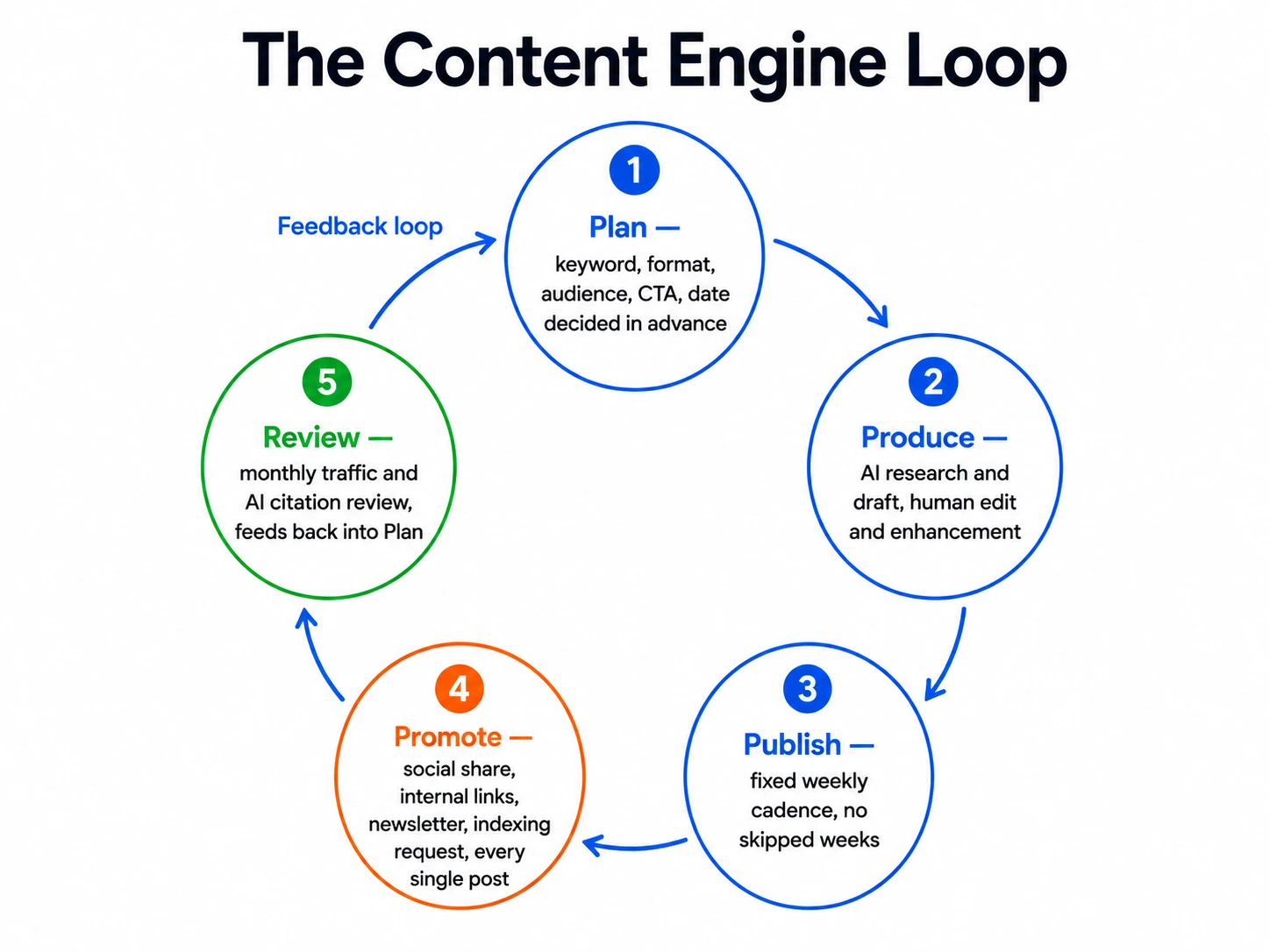
A content engine has five components that operate in a continuous loop. Plan, produce, publish, promote, review. Each component feeds the next, and the review stage feeds back into planning, which is what makes the system a loop rather than a one-time process.
Most content operations have one or two of these components working reasonably well and the rest missing entirely. The team is good at producing content but has no review process. Or they publish consistently but never promote beyond the publish button. The engine only works when all five components are running, because a missing component breaks the loop and the system reverts to bursts.
Plan
Planning is where the topic, the keyword target, the content format, and the publishing date are decided, ahead of time, for a meaningful stretch of the calendar. Not a vague list of ideas. A specific schedule.
A content calendar is a planning system that tracks content topics, owners, channels, dates, and goals. The editorial calendar is the publishing view focused on topics, timing, and audience relevance.
The planning stage should answer, for every piece of content: what keyword or topic does this target, what format does it take, who is it for, what is the next step you want the reader to take, and when does it publish. If any of these answers is “we will figure that out later,” the content is not actually planned, it is a placeholder.
Produce
Production is where the content gets made. This is the stage where AI tools have changed the economics most dramatically, but the production stage is not just writing. It includes research, drafting, editing, formatting, schema markup, and image creation.
The best setup combines AI handling research, drafting, and scheduling logistics with a human reviewing the quarterly plan, approving the schedule, and making final calls on topic priority. This combination produces the best ratio of output volume to traffic results.
The critical detail in production is consistency of process, not just consistency of output. If every post goes through the same five steps in the same order, every post gets the same quality floor. If production is ad hoc, every post is a gamble.
H3: Publish
Publishing sounds like the simple step, but it is where most of the cadence damage happens. Publishing on a predictable schedule, even if that schedule is once per week rather than five times per week, is more valuable than publishing more frequently but unpredictably.
If you publish every Tuesday for six months, crawlers learn that schedule. The key is not volume. It is dependability. Missing posts regularly is worse than publishing less often but staying consistent.
This means the publishing stage of your engine needs a hard commitment to a specific cadence that your production capacity can actually sustain. A schedule you cannot keep is worse than no schedule, because it trains crawlers and readers to expect something that then does not arrive.
Promote
Promotion is the stage most content engines skip entirely, treating publish as the finish line. It is not. A post that is published and never promoted relies entirely on organic discovery, which for a new or growing site can take weeks or months.
Promotion in a content engine is systematic, not occasional. Every published post triggers a fixed set of promotion actions: sharing on the relevant social platforms, internal linking from related existing posts, inclusion in an email newsletter if one exists, and submission to Google Search Console for indexing.
None of these actions are complicated. The reason they get skipped is that they happen after the “real work” of writing is done, and without a system, the energy for the post has already moved on to the next thing. Building promotion into the engine as a non negotiable step, the same way publishing is non negotiable, is what makes the difference.
Review
Review is the stage that turns the engine from a content factory into a learning system. Without review, the engine produces output. With review, the engine produces output and gets smarter about what to produce next.
Run monthly performance reviews and quarterly strategic resets based on path level outcomes. Review path level performance, identify one winning pattern, and update default templates. Record one keep, one stop, and one next test decision. Repeat monthly so improvements compound with every cycle.
The review stage in 2026 has an additional dimension that did not exist a few years ago. Two surfaces require two measurement tracks, reviewed on the same cadence. Traditional organic clicks, conversions, keyword rankings, and category page performance, reviewed monthly with trends acted on over 60 to 90 days. And LLM visibility, citation frequency across ChatGPT, Perplexity, and Google AI Overviews, mention consistency across different prompt variations, and sentiment of how your brand is being described.
Running a consistent set of prompts monthly and tracking what changes is enough to spot meaningful shifts in AI visibility. The goal is not a perfect correlation between the two tracks. It is making content decisions with the full picture in front of you, not just half.
Setting Your Publishing Cadence – How Much Is Actually Right
One of the most common mistakes in building a content engine is choosing a publishing frequency based on ambition rather than capacity, and then breaking the schedule within a month because it was never sustainable.
Publishing frequency should match your domain authority and production capacity. Sites with domain rating under 30 see the best ROI at 8 to 15 posts per month. Higher authority sites can push 30 to 50 plus.
For a new or smaller site, this means somewhere between two and four posts per week is the realistic target, not the daily publishing schedules that some AI content tools market as the default. The reason lower authority sites do not benefit proportionally from higher volume is that each post needs time to be indexed, evaluated, and ranked, and a site without established authority has a slower evaluation cycle per post. Flooding that cycle with volume does not speed it up.
The more useful finding is buried a layer deeper. Operations publishing anywhere from 8 to 200 posts per month found that the ones with the best organic traffic growth were not necessarily publishing the most. They were publishing on a smarter schedule, one that matches publishing cadence to keyword opportunity windows, not arbitrary calendar slots.
This is the distinction between a calendar and an engine. A calendar says “post on Monday, Wednesday, Friday because that is the schedule.” An engine says “this keyword cluster has an opportunity window right now because a competitor’s content just went stale, so we prioritise that cluster this month, on our standard cadence, rather than publishing something disconnected just to fill the Friday slot.”
The practical recommendation: choose the lowest cadence you can sustain without ever missing a scheduled publish for at least three consecutive months. If that number is two posts per week, start there. A consistent two posts per week for six months produces more compounding value than a chaotic five posts per week that collapses into zero for three weeks every quarter.
Building the Production Workflow – Where AI Fits
The production stage is where a content engine either becomes sustainable or becomes a burden that eventually breaks the cadence. This is also where AI tools have changed what is realistically achievable for a small team or solo operator.
We have seen content operation setups where everything was automated including topic selection, and the output was technically consistent but strategically aimless. Consistent mediocrity, published on schedule.
This is the warning that matters most when integrating AI into a content engine. Full automation, including topic selection, produces a schedule that never breaks but content that never compounds, because nobody is making the strategic judgment calls that connect each post to an actual opportunity.
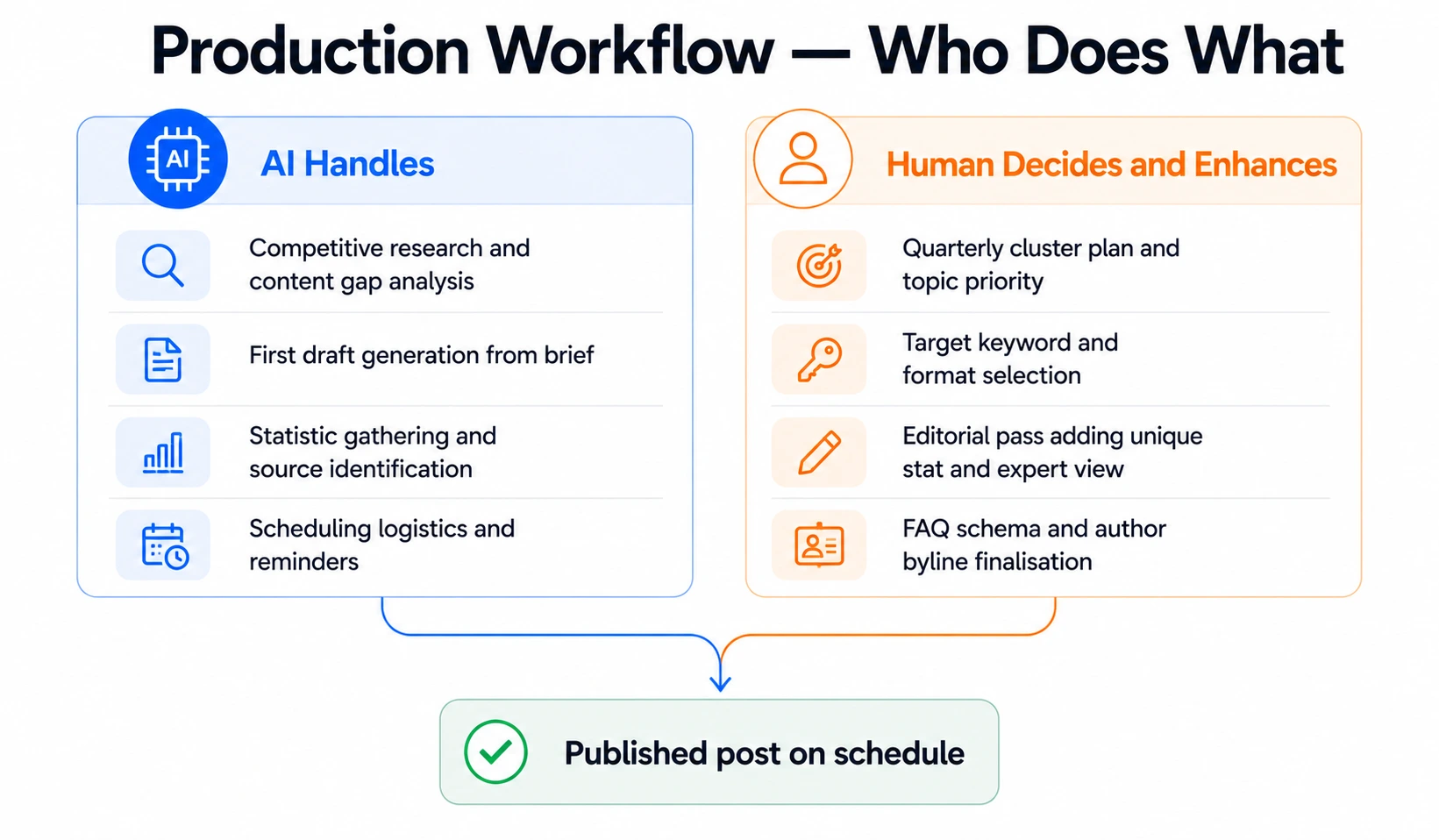
The production workflow that avoids this problem splits responsibilities clearly. AI handles research, drafting, and scheduling logistics. A human reviews the quarterly cluster plan, approves the schedule, and makes final calls on topic priority.
“If you want to run research and drafting across Claude, ChatGPT, and Gemini from one place to compare outputs before committing to a draft, Merlin AI lets you query all three from a single dashboard.”
In practical terms, this means your production workflow for each post should look like this. A human, during the planning stage, has already decided the topic, target keyword, and format based on a quarterly cluster plan. AI then handles the research phase, gathering competitive analysis, relevant statistics, and structural gaps in existing top-ranking content. AI produces the first draft based on this research and a brief that specifies the target keyword, audience, format, and required sections.
A human then performs the editorial enhancement pass, which is the step that determines whether the content performs well or underperforms. This pass adds a unique statistic, an expert perspective or first-person observation, a FAQ section with schema, and a substantive author byline. Finally, the post moves to the publish and promote stages of the engine on the predetermined schedule.
This workflow keeps the schedule reliable because the time intensive research and drafting steps are fast, while preserving the quality signals that come from human judgment and experience, which both Google’s ranking systems and AI citation systems reward.
The Promotion System – Making Every Post Work Harder
Promotion is the component of a content engine that compounds the value of everything else. A post that is well researched, well written, and well-structured but never promoted is leaving most of its potential traffic on the table, especially in its first few weeks before organic rankings develop.
The promotion system within a content engine should be a fixed checklist applied to every single post, not a list of options to consider when there is time. Five actions belong on this checklist.
Internal linking from related existing content is the first and most important. Every new post should be linked from at least two to three older, relevant posts on the site, and should itself link back to the pillar content and related cluster posts within its topic area. This is not optional promotion, it is structural, and it directly affects both traditional rankings and topical authority signals.
Indexing request submission to Google Search Console should happen immediately after publishing, every time, with no exceptions. This is a thirty second action that affects how quickly the post becomes visible in search results.
Social distribution across the platforms relevant to your audience should be templated, not improvised. A consistent format, post the link with a specific framing on the platform where your audience is most active, means this step takes minutes rather than requiring fresh creative thinking for every post.
Email newsletter inclusion, if your operation has a newsletter, should be a default inclusion rather than a decision made each time. Newsletter subscribers are typically your highest intent audience and the easiest source of early engagement signals that help a new post gain traction.
Cross platform syndication, where appropriate, distributes the same core content to other publications or platforms. Distributing content to a wide range of publications can increase AI citations significantly compared to only publishing on your own site, making syndication relevant for AI visibility, not just traffic.
The key insight about this promotion checklist is that it should take roughly the same amount of time for every post, regardless of how the post performs. It is a fixed cost of publishing, built into the engine, not a variable response to how excited the team feels about a particular piece.
The Review Cycle – Where the Engine Gets Smarter
The review stage is what separates a content engine from a content factory. A factory produces output at a consistent rate. An engine produces output at a consistent rate and uses what it learns from that output to improve what gets produced next.
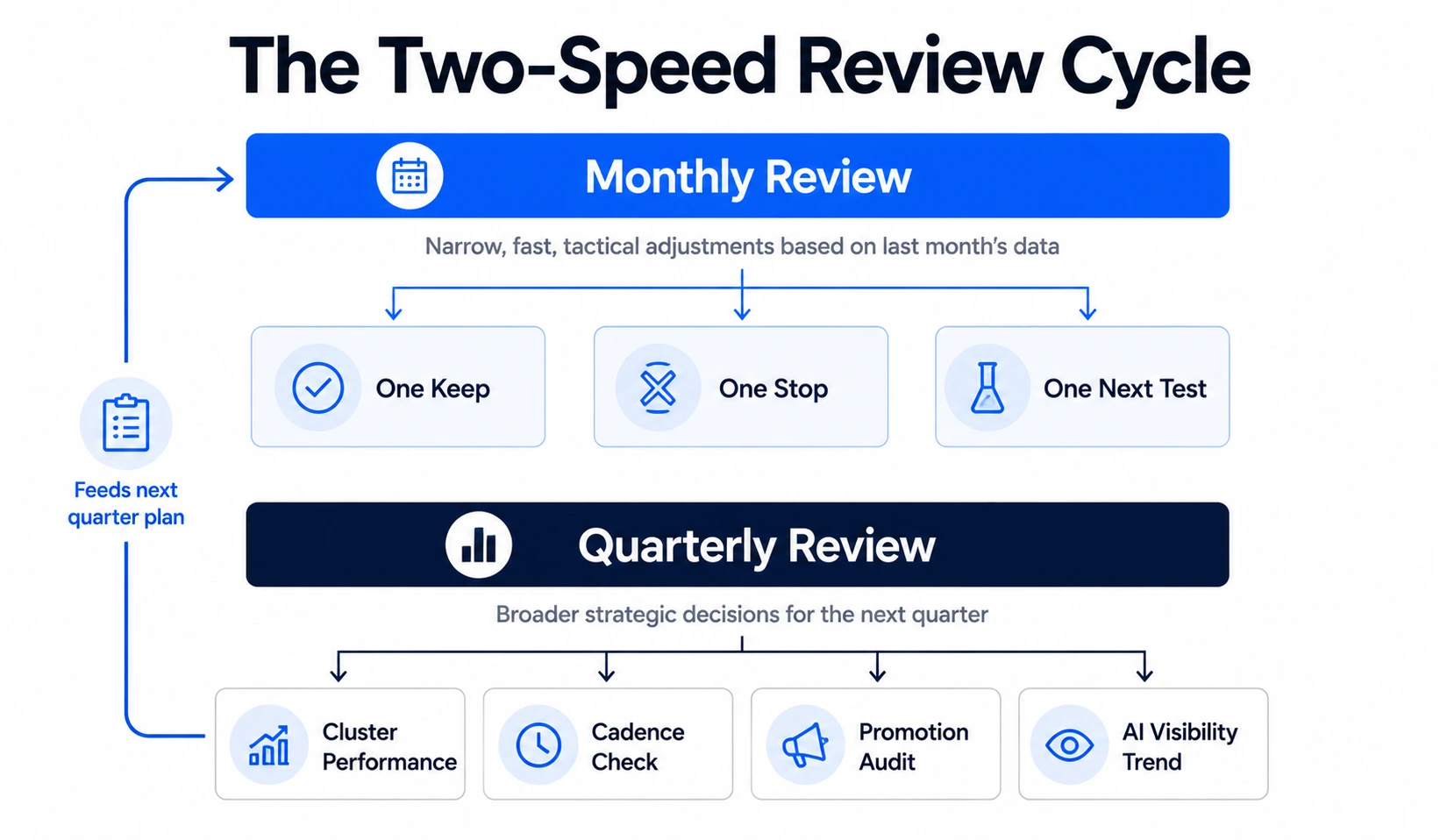
The review cycle in a content engine operates at two frequencies. A monthly review and a quarterly review, each with a different purpose.
H3: The Monthly Review
The monthly review looks at the posts published in the previous month and asks specific, narrow questions. Which posts gained traction fastest in terms of impressions and clicks in Google Search Console. Which posts, if any, appeared in AI search results when the standard set of tracking prompts was run in ChatGPT, Perplexity, and Google AI Mode. Which posts received the most social engagement or newsletter clicks.
From these observations, the monthly review produces three specific outputs. One keep: a pattern that worked and should be repeated in the next month’s content. One stop: something that consistently underperforms and should not be repeated. One next test: a single specific change to try in the coming month, based on the keep and stop observations.
This is deliberately narrow. The monthly review is not a strategic overhaul. It is a small, consistent adjustment based on real data, repeated every month so improvements compound with every cycle.
H3: The Quarterly Review
The quarterly review operates at a higher level. It looks at the full quarter’s content output against the original quarterly plan and asks whether the topic clusters chosen at the start of the quarter produced the expected results, whether the publishing cadence was maintained without gaps, whether the promotion checklist was consistently applied, and whether the AI visibility tracking shows any shift in citation frequency or sentiment across the quarter.
The quarterly review is where larger strategic decisions happen. Should the next quarter’s content focus shift to a different topic cluster based on what performed. Should the publishing cadence change based on whether the current one was sustainable. Are there new query types or AI platforms that need to be added to the tracking process.
This cadence balances execution speed with strategic stability. Monthly reviews keep the engine tuned without disrupting the schedule. Quarterly reviews allow for genuine strategic shifts without those shifts happening so frequently that the engine never has time to show results before changing direction again.
Common Reasons Content Engines Break Down
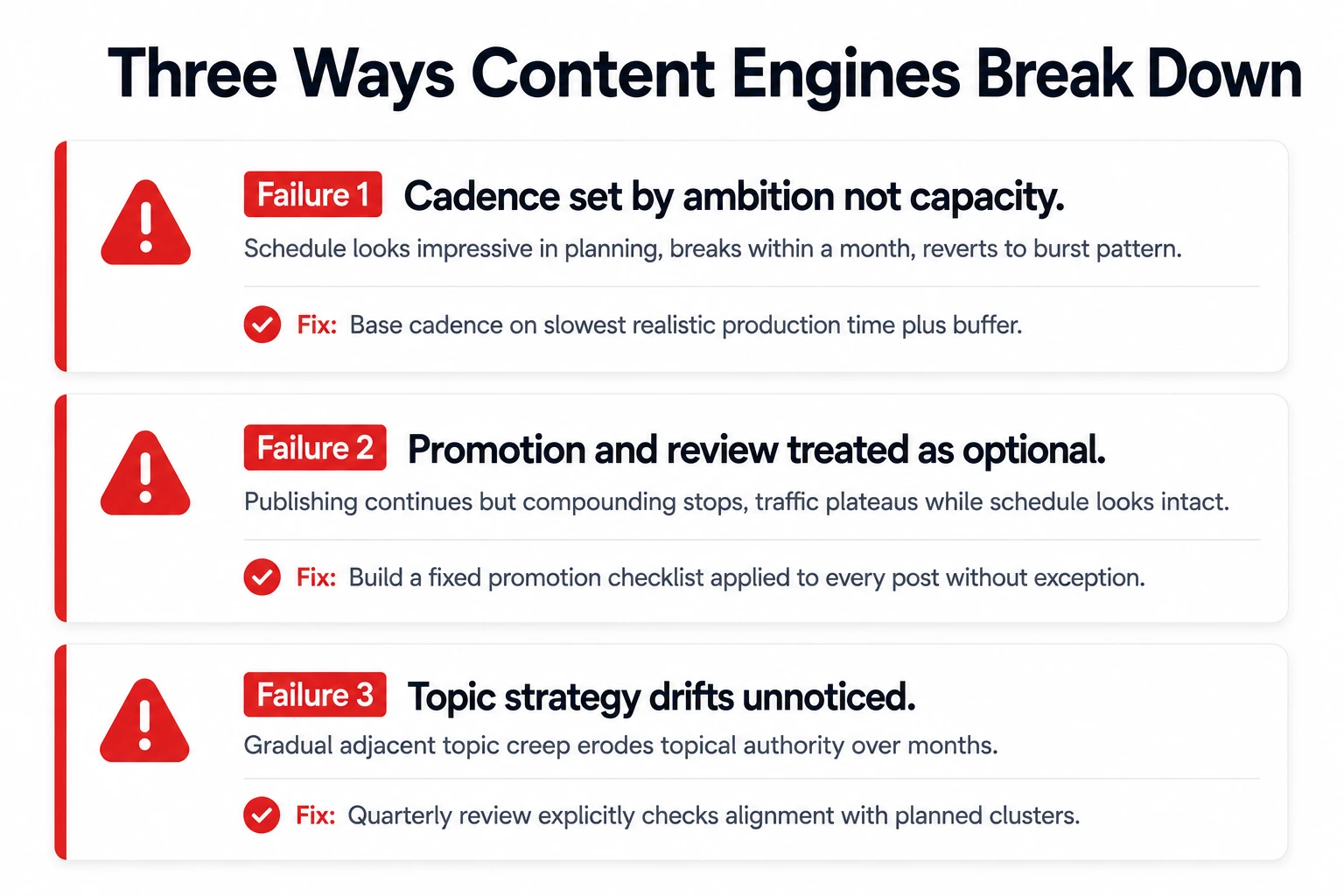
Understanding why content engines fail after initial setup is as important as building them correctly in the first place. Three failure patterns appear consistently.
The Cadence Was Set by Ambition, Not Capacity
The most common failure is choosing a publishing frequency that looked impressive in the planning meeting but that the actual production capacity could not sustain past the first month. When the cadence breaks, it rarely gets reset to a sustainable lower frequency. It just stops, and the engine reverts to the burst pattern.
The fix is built into the planning stage from the start. Choose the cadence based on the slowest realistic production time per post, multiplied by the team’s actual available hours, with a buffer for the inevitable weeks where something goes wrong. If that calculation produces one post per week, the engine should run at one post per week, not the three posts per week that felt more ambitious in the planning meeting.
Promotion and Review Get Treated as Optional
When time pressure hits, the components of the engine that feel most skippable are promotion and review, because skipping them does not immediately stop the publishing schedule from continuing. The content still gets published. It just stops compounding.
This failure is harder to notice than a missed publishing date because the schedule looks intact from the outside. But three months into a content engine that has quietly dropped promotion and review, the traffic results will look like a content engine that has been running for three weeks, because the compounding mechanisms that turn consistent output into growing traffic have not been operating.
The Topic Strategy Drifts Without Anyone Deciding It Should
Over months of consistent publishing, it is easy for the topic focus to gradually drift, one slightly adjacent topic at a time, until the content cluster that was originally planned has become a scattered collection of loosely related posts. This happens gradually enough that no single decision feels like the cause, but the cumulative effect is the loss of the topical authority that a focused cluster would have built.
The quarterly review is the safeguard against this. By explicitly checking whether the quarter’s output still aligns with the planned topic clusters, drift gets caught and corrected before it accumulates across multiple quarters.
Starting Your Content Engine This Week
The temptation when building a content engine is to design the complete system before publishing anything. This produces beautiful documentation and zero published content. The better approach is to start with a minimal version of all five components and improve each one through the review cycle.
Start with one channel, one audience, and one realistic weekly or biweekly cadence. Build around capacity, not ambition.
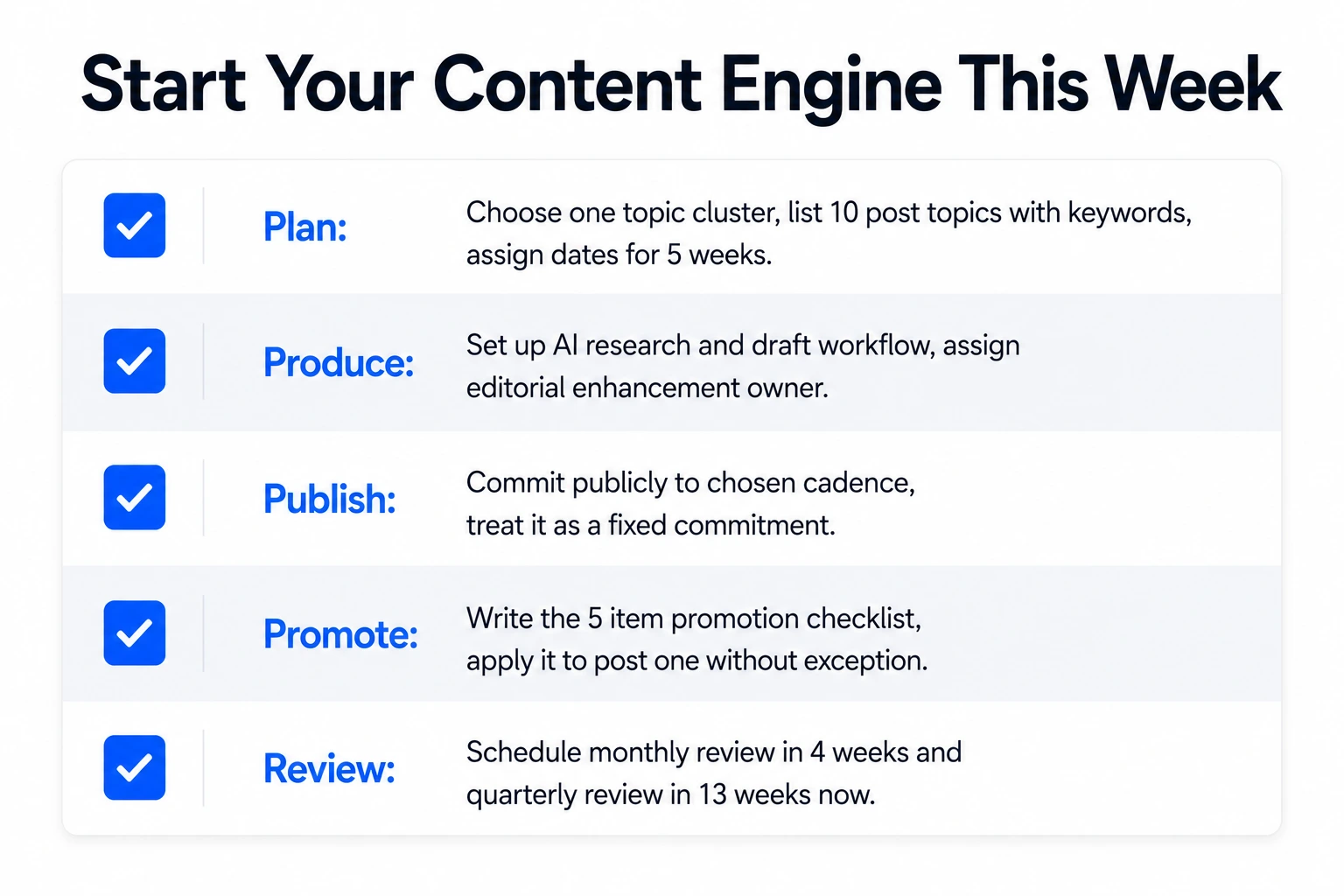
For the plan component this week: choose one topic cluster, list ten specific post topics within that cluster with target keywords and assign each one a publishing date over the next five weeks at your chosen cadence.
For the produce component this week: set up the AI research and drafting workflow for the first post, and identify who will do the editorial enhancement pass and how long it realistically takes.
For the publish component this week: commit to the cadence publicly, even if only within your own team, so that missing it carries the weight of a broken commitment rather than a quiet schedule slip.
For the promote component this week: write down the five item promotion checklist and apply it to the first post without exception, even if it feels like overkill for a single post. The point is building the habit before the volume makes it feel necessary.
For the review component this week: set a calendar reminder for the monthly review four weeks from now, and a separate reminder for the quarterly review thirteen weeks from now. The engine does not produce a review on its own. The review has to be scheduled with the same seriousness as the publishing cadence.
CONCLUSION:
The gap between 67% of consistent publishers reporting strong results and 24% of sporadic publishers reporting the same is not a gap in talent, budget, or content quality. It is a gap in systems.
A content engine is not complicated. Five components, plan, produce, publish, promote, review, running in a continuous loop at a cadence your team can actually sustain. The difficulty is not understanding the system. It is choosing a cadence honestly, building the promotion checklist into the default workflow rather than treating it as optional, and protecting the review cycle even when the schedule feels tight.
Boring systems often beat heroic bursts. The content marketing landscape in 2026, with AI search adding a second visibility track to monitor alongside traditional rankings, rewards the operations that show up consistently more than it ever has before. Build the engine. Set the cadence honestly. Protect the loop. The compounding takes care of the rest.
FAQs
Q: What is a content engine in digital marketing?
A: A content engine is a repeatable system that moves content from idea to published post to measured result on a predictable rhythm, made up of five connected components: plan, produce, publish, promote, and review. Unlike a content calendar, which is a schedule, a content engine is a closed loop where the review stage feeds insights back into planning, allowing the system to improve continuously rather than producing disconnected bursts of content.
Q: How often should I publish content for SEO in 2026?
A: Publishing frequency should match domain authority and production capacity. Sites with domain rating under 30 see the best return on investment at 8 to 15 posts per month, roughly two to four posts per week. Higher authority sites can sustain 30 to 50 or more. The most important factor is dependability rather than volume. A consistent schedule that never gets missed for at least three months produces stronger compounding results than a higher frequency schedule that breaks down.
Q: Why does consistent publishing matter more than publishing volume?
A: Orbit Media’s 2025 survey found 67% of marketers who publish consistently report strong results compared to 24% who publish sporadically. Search engine crawlers learn a site’s publishing pattern and visit more frequently when that pattern is predictable, helping new content get indexed and ranked faster. Inconsistent publishing causes crawlers to slow their visit frequency, meaning even high volume bursts get indexed more slowly than they would under a steady cadence.
Q: How should AI tools fit into a content engine workflow?
A: AI tools should handle research, drafting, and scheduling logistics, while humans handle strategic decisions including quarterly topic planning, keyword and format selection, and editorial enhancement. Fully automating topic selection alongside production tends to produce technically consistent but strategically aimless content. The most effective workflow uses AI for speed in research and drafting while preserving human judgment for the decisions and quality additions that determine ranking and AI citation performance.
Q: What should a content promotion checklist include?
A: An effective content promotion checklist applied to every published post should include internal linking from at least two to three related existing posts and linking back to relevant pillar or cluster content, immediate submission to Google Search Console for indexing, templated social media distribution to relevant platforms, inclusion in email newsletters by default, and cross platform syndication where appropriate, which research shows can significantly increase AI citation frequency compared to publishing only on your own site.