


Something changed in March 2026 that most SEO guides have not caught up with yet.
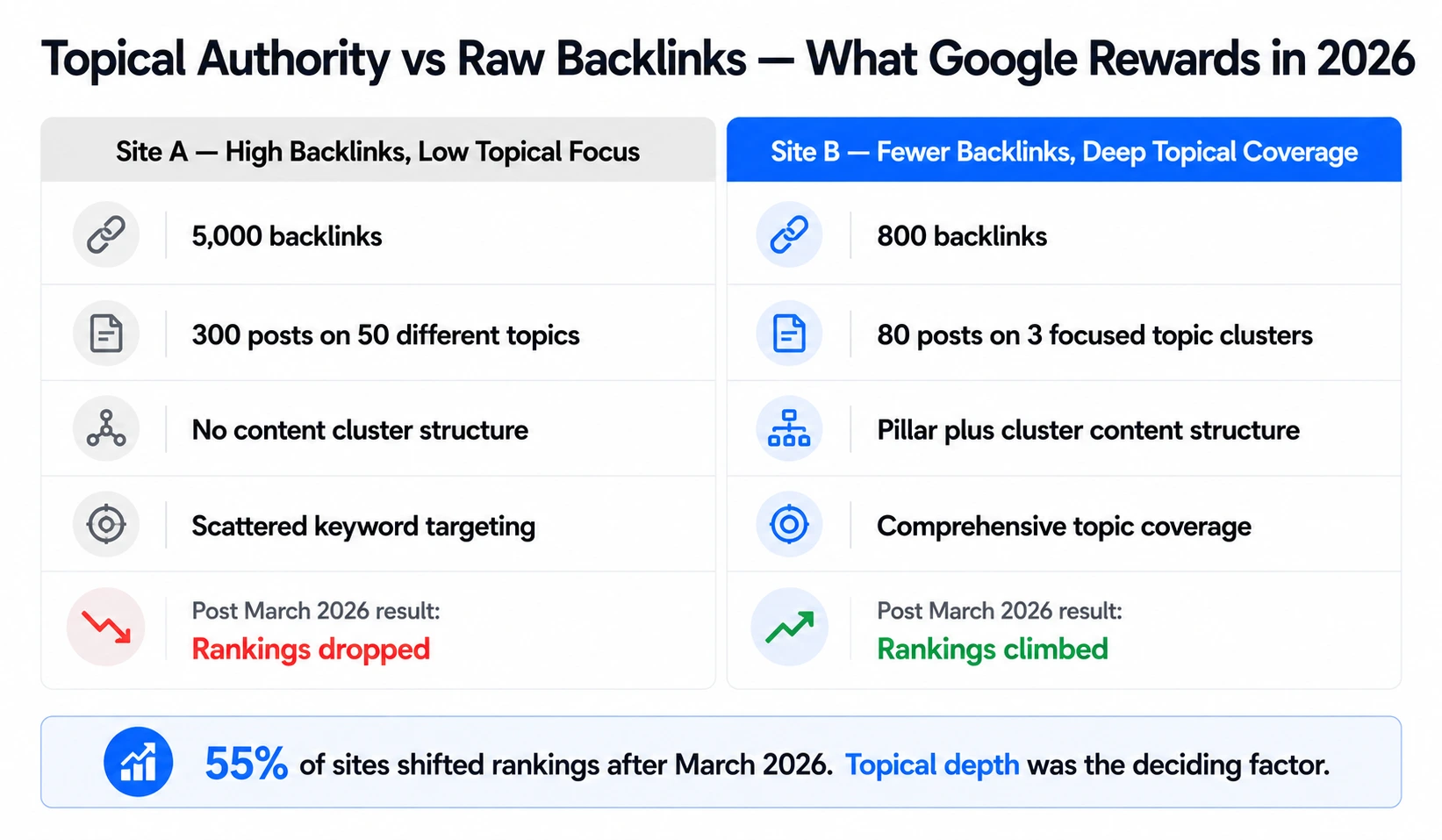
Google’s March 2026 Core Update made E-E-A-T signals the primary ranking factor, with 55% of websites experiencing ranking shifts. Those with deep topical authority climbed. Those with scattered or thin content fell.
If your rankings dropped after that update, or if you have been publishing consistently without seeing the traction you expected, the cause is almost never what most people assume. It is not your meta tags. It is not your page speed. It is not your backlink count.
If your rankings drop, fluctuate, or never scale, the real issue is usually weak topical authority, not backlinks or content volume.
Topical authority is the concept that most content sites are missing in 2026. Not because it is complicated. Because most people still think about SEO as a keyword game when Google has shifted to evaluating it as a subject matter expertise game.
In 2026, the most sustainable competitive advantage in search is not the next backlink or the perfectly optimised title tag. It is becoming so comprehensively authoritative on a specific subject that both Google and AI systems default to citing you whenever that subject is relevant.
This post explains exactly what topical authority is, why it matters more in 2026 than it ever has, how Google and AI systems evaluate it, and the specific step by step process for building it on any content site regardless of age, domain authority, or budget.
What Is Topical Authority?
Topical authority means becoming the most trusted and complete source on a specific subject, not just ranking for a few keywords. In 2026, search engines and AI tools reward websites that cover a topic deeply, connect related content clearly, and consistently solve user problems.
The definition sounds simple. The implication is significant. Google is no longer asking “does this page use the keyword enough?” It is asking “does this website understand everything a user needs to know about this subject?”
Modern SEO prioritises structure, intent, and content relationships. Instead of asking “Did I use the keyword enough?”, topical authority asks “Did I answer everything a user needs to know about this topic?” This change explains why some pages rank with fewer backlinks and why older tactics fail in 2026.
This is the shift that explains results that seem to defy conventional SEO wisdom. New websites with zero backlinks are outranking established players in 2026. A site publishing its first 30 posts can outrank a domain with five years of history and thousands of backlinks, provided those 30 posts comprehensively cover a narrow topic while the established site’s content is scattered across unrelated subjects.
A website with strong topical coverage can outperform a high-authority site that lacks focused, interconnected content.
This is not theoretical. It is the documented pattern behind the ranking shifts that followed Google’s March 2026 update.
Why Topical Authority Matters More Than Backlinks in 2026
Backlinks still matter. Anyone who tells you they do not is selling you a shortcut. But the relationship between backlinks and rankings has changed in a specific and measurable way.
Backlinks still matter, but they are no longer enough on their own. Many sites focus heavily on link-building while ignoring content depth and relevance. In many cases, a website with strong topical coverage can outperform a high-authority site that lacks focused, interconnected content.
The reason for this shift is not arbitrary. It reflects how Google’s evaluation systems have evolved. Google has become better at understanding what a site is actually about, how comprehensively it covers that subject, and whether users find it genuinely useful for the full range of questions they have on a topic. Backlinks are an external credibility signal. Topical authority is an internal expertise signal. Both matter, but the balance has shifted.
If you look at your backlink profile and you are trying to find link opportunities, only look at the ones that are relevant to your topic. Do not go adding backlinks wildly. Focus on the topics that are important for you, and the strategy that is important for you. It will have a much greater effect than just adding them blindly.
The second reason topical authority now outweighs raw backlink count in many cases is the AI search dimension. AI systems like ChatGPT and Perplexity are trained to cite the sources with the clearest, most comprehensive, most consistently accurate coverage of each topic area. A site with 50 deeply interconnected posts on AI marketing will be cited by ChatGPT and Perplexity for AI marketing queries far more reliably than a site with 500 posts scattered across every marketing topic, regardless of how many backlinks the broader site has accumulated.
By 2027, topical authority will increasingly intersect with AI-generated answers and multimodal search. Authority will determine which sources are cited or summarised.
That trajectory has already started. Building topical authority now is building the asset that determines your AI search visibility for the next three to five years.
How Google Actually Evaluates Topical Authority
Understanding the mechanism matters because it tells you exactly what to build. Google does not have a single “topical authority score” that you can see in any tool. It evaluates topical authority through a combination of signals that collectively answer one question: does this site demonstrate deep, structured, consistent expertise on this subject?
Semantic Relationships Between Pages
Algorithms look for internal linking patterns, semantic relationships between pages, and consistent use of entities to detect true subject expertise. The pillar-cluster model supports this by organising your content into one central pillar page supported by detailed, interlinked articles.
When Google crawls your site and finds that your posts are connected to each other in a structured way, that they reference each other where relevant, and that the connections reflect genuine semantic relationships rather than random link placement, it builds a map of your content ecosystem. A site where 15 posts all clearly belong to the same topic cluster sends a fundamentally different signal than a site where 15 posts cover 15 unrelated topics.
Entity Recognition
Google understands content through entities, the specific people, places, tools, concepts, and organisations mentioned in your content and how they relate to each other. A post about AI SEO that naturally and accurately references Google AI Overviews, ChatGPT, E-E-A-T, Perplexity, and GEO signals to Google that the author understands the subject’s full ecosystem. A post that mentions only one or two of these entities in passing signals surface level knowledge.
Entity SEO deals with how Google perceives your brand as something, not merely a website. Take the same brand name everywhere. Develop an elaborate About Us page. Be specific on what you offer and who you are. Include author bios with credentials.
Comprehensiveness of Topic Coverage
Most businesses target only primary keywords and ignore the broader user journey. They miss related queries like comparisons, FAQs, and implementation guides.
Google evaluates whether your content covers the full range of questions a user might have on a topic, not just the high-volume primary keywords. A site that answers the obvious questions but leaves the adjacent questions unanswered is less authoritative than a site that covers the entire question space around a topic.
E-E-A-T Signals
To win in this environment, you cannot just scratch the surface. You must demonstrate E-E-A-T, which stands for Experience, Expertise, Authoritativeness, and Trustworthiness. You need to prove to the algorithm that you understand the entire ecosystem of your topic.
These signals include visible author credentials, first person experience reflected in the content, original data and research, accurate citations, and consistent accurate coverage of a topic over time. A site that publishes about AI marketing every week for a year, each post accurate and comprehensive, builds a trust record that one excellent post cannot replicate.
The Pillar and Cluster Model – The Foundation of Topical Authority
The practical structure for building topical authority is the pillar and cluster content model. Every serious guide to topical authority in 2026 points to this structure as the core implementation framework.
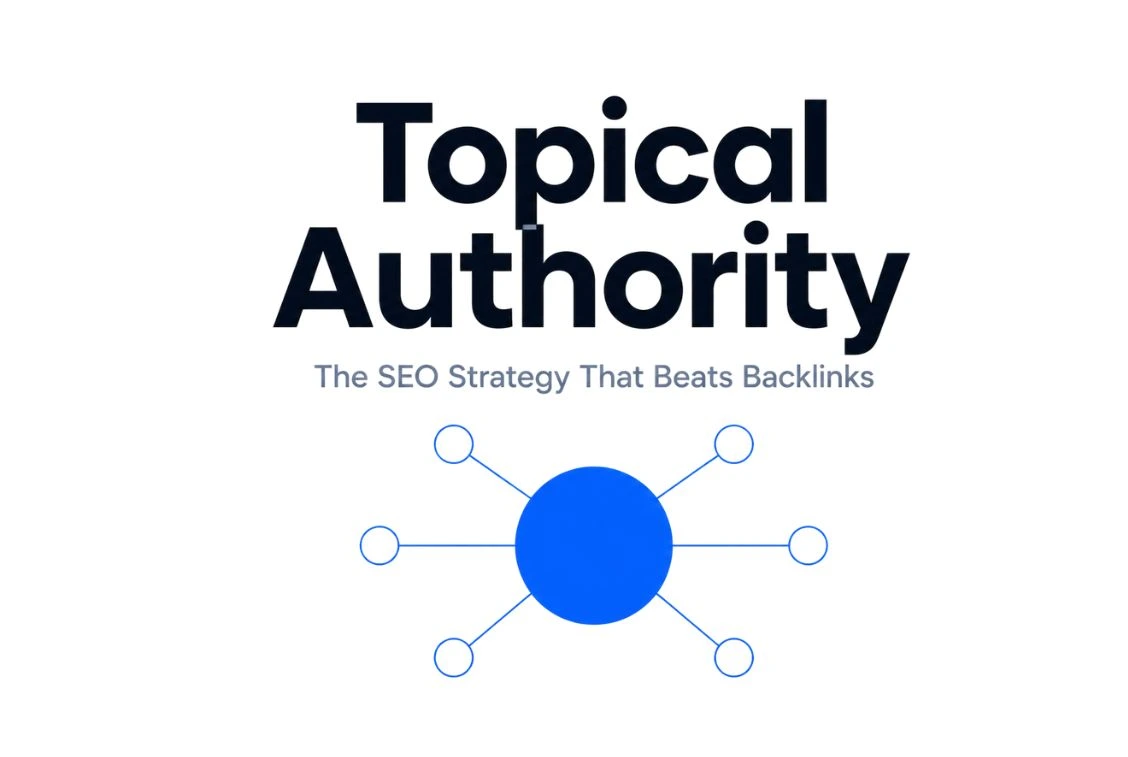
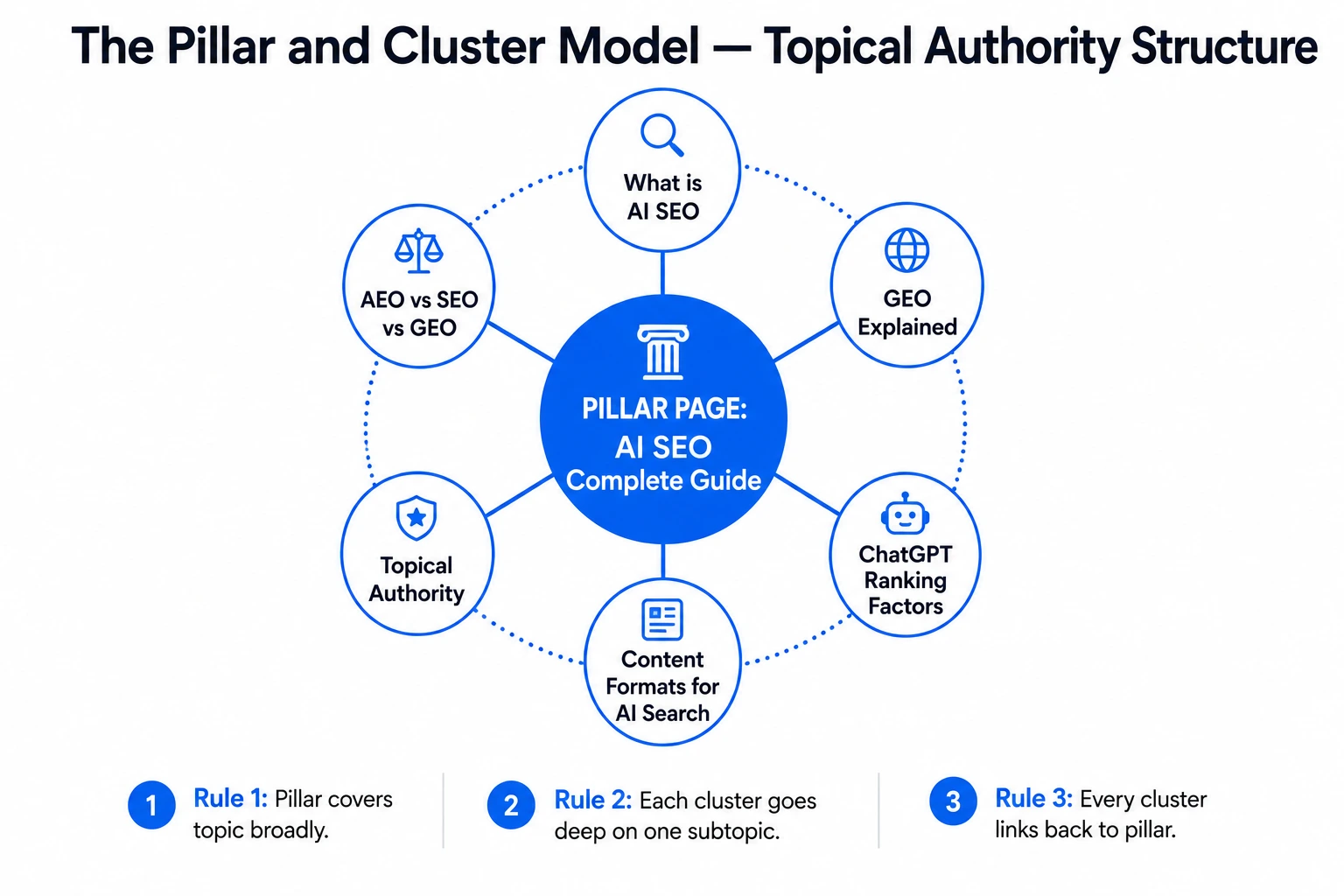
The pillar-cluster model organizes your content into one central pillar page supported by detailed, interlinked cluster articles. The pillar page covers the topic broadly. The cluster pages answer specific, deep-dive questions within that topic. When you organize your content this way, you make it incredibly easy for Google to crawl your site and understand your hierarchy. You are not just a blog. You are an encyclopedia.
The pillar page is a comprehensive overview of the main topic. It covers the full subject at a high level, defines key terms, links to every cluster post, and serves as the authoritative reference point for the entire topic on your site. It is typically 3,000 to 5,000 words and answers the broadest version of the main question.
The cluster posts are the detailed, specific answers to individual questions within the topic. Each one covers a single subtopic thoroughly, links back to the pillar page, and links to related cluster posts where relevant. The goal is not to repeat what the pillar page covers but to go deeper on each specific aspect.
Together, these elements make it easier for search engines to crawl entire clusters, understand their connections, and reward your site with greater visibility.
A content site in the AI marketing niche, for example, might build a pillar page on AI SEO that covers all major aspects of the topic broadly, supported by cluster posts on AI Overviews, GEO, ChatGPT ranking factors, content formats for AI search, and topical authority itself. Each cluster post links back to the pillar and to related cluster posts. Google can crawl this structure and immediately understand that this site has comprehensive expertise on AI SEO specifically.
How to Build Topical Authority – The Step-by-Step Process
The theory is clear. The implementation is where most sites fail, usually because they try to do too much too broadly rather than too little too deeply.
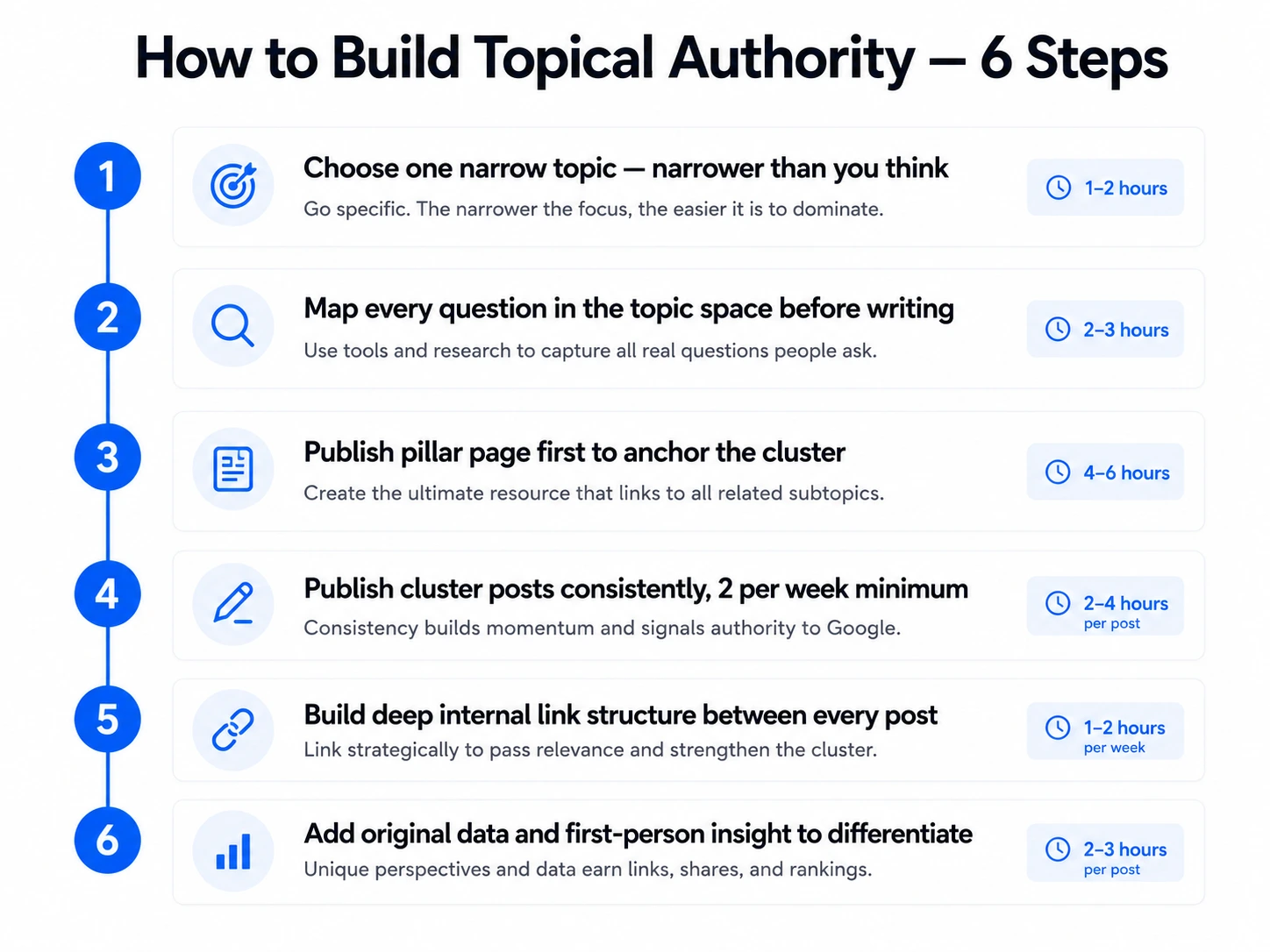
Step 1 – Choose One Narrow Topic First
Topical authority grows best when expansion is intentional and aligned with existing expertise. In 2026, many sites fail during scaling because they expand too fast or into unrelated topics.
The most common mistake is choosing a topic that is too broad. “Digital marketing” is not a topic you can build authority on with 50 posts. “AI marketing for solo content creators” is a topic where 50 focused posts can make you the most comprehensive resource available.
The narrower your initial topic focus, the faster you build authority, and the faster Google recognises it. Smaller sites often win by focusing on narrow topics that large brands ignore. Large sites cannot publish 80 posts on a narrow sub-topic because it does not fit their editorial strategy. That gap is your opportunity.
Step 2 – Build a Topic Map Before Publishing
Before publishing a single post, map every question a person could ask about your chosen topic. Use Google’s People Also Ask results, Perplexity research, autocomplete suggestions, and Reddit threads to identify the full question space.
Group these questions into clusters. Each cluster becomes one topic area. The broadest questions in each cluster become pillar content. The specific questions become cluster posts. The map gives you a content plan that, when complete, signals comprehensive topical coverage to Google’s systems.
Building topical authority requires planning content as a system, not as standalone posts. This mindset shift is essential for sustainable SEO growth.
Step 3 – Publish the Pillar Page First
The pillar page anchors everything. Publish it before the cluster posts. It should comprehensively cover the main topic, define key terms, preview the subtopics that cluster posts will address, and include internal links to cluster posts as they are published over time.
This sequence matters because the pillar page gives Google an immediate understanding of what topic your site is claiming authority on. Cluster posts published without a pillar to anchor them send a weaker structural signal.
Step 4 – Publish Cluster Posts Consistently
Topical authority today is not built slowly over years. It is built through focused bursts.
Consistent publishing within a topic cluster signals to Google that your expertise is active and growing. A site that publishes two cluster posts per week on the same topic for three months builds a more coherent topical signal than a site that publishes one post per month on twenty different topics over two years.
Every cluster post should answer one specific question thoroughly, link back to the pillar page, link to two or three related cluster posts, and include a FAQ section with schema markup targeting the specific questions within that post’s subtopic.
Step 5 – Internal Linking as the Nervous System
Internal linking is the nervous system of your website. It connects the brain to the muscle. Every time you link a cluster page back to your pillar page, you are passing authority up the chain.
Every new cluster post should link to the pillar and to related existing cluster posts. Older cluster posts should be updated to link to newer posts where relevant. The internal link structure is how Google understands the relationships between your content and how topical authority flows through your site.
This is also one of the most underinvested areas in most content sites. A site that publishes 50 posts but links them only loosely is leaving significant topical authority signal on the table compared to a site with the same 50 posts that are deeply and intentionally interlinked.
Step 6 – Add Original Data and First-Person Experience
Sites that publish benchmarks, AI SEO case studies, or proprietary insights will gain disproportionate visibility. First-hand experience and original data will see stronger weighting.
Topical authority is not just about coverage. It is about having something to say that nobody else does. Original research, documented case studies, and genuine first-person observations differentiate your coverage from the many other sites that may cover the same topics at a surface level.
One original statistic from your own experience or research, published within your topic cluster, creates a citation anchor that other sites link to and that AI systems must reference because the data exists nowhere else. This is the compounding layer that turns topical coverage into genuine authority.
Topical Authority and AI Search – The Dual Benefit
Building topical authority in 2026 produces two simultaneous benefits that reinforce each other: stronger traditional Google rankings and higher AI citation frequency.
AI systems like ChatGPT and Perplexity are trained to cite the sources with the clearest, most comprehensive, most consistently accurate coverage of each topic area. Topical authority is the concept that captures this: the depth and breadth of your coverage of a specific subject, as evaluated by both Google’s content quality systems and the citation behaviour of AI language models.
When a user asks ChatGPT about AI marketing strategies, the model retrieves candidate pages and evaluates which ones comprehensively cover the topic. A site with a pillar page on AI marketing plus 20 interconnected cluster posts covering every aspect of the subject will score higher on relevance and completeness than a site with one general post on the topic, regardless of how well that one post is written.
This is why topical authority investment has a higher return than almost any other SEO activity in 2026. It simultaneously improves your Google rankings, your AI Overview citation frequency, your ChatGPT visibility, and your Perplexity citation rate, all from the same content investment.
The practical implication is that every cluster post you publish within your topical authority structure is doing more SEO work than an isolated post on a random topic. It strengthens the pillar, signals topical expertise to Google, adds to the comprehensive coverage that AI systems evaluate, and creates another internal link opportunity that passes authority through your site.
How Long Does Topical Authority Take to Build?
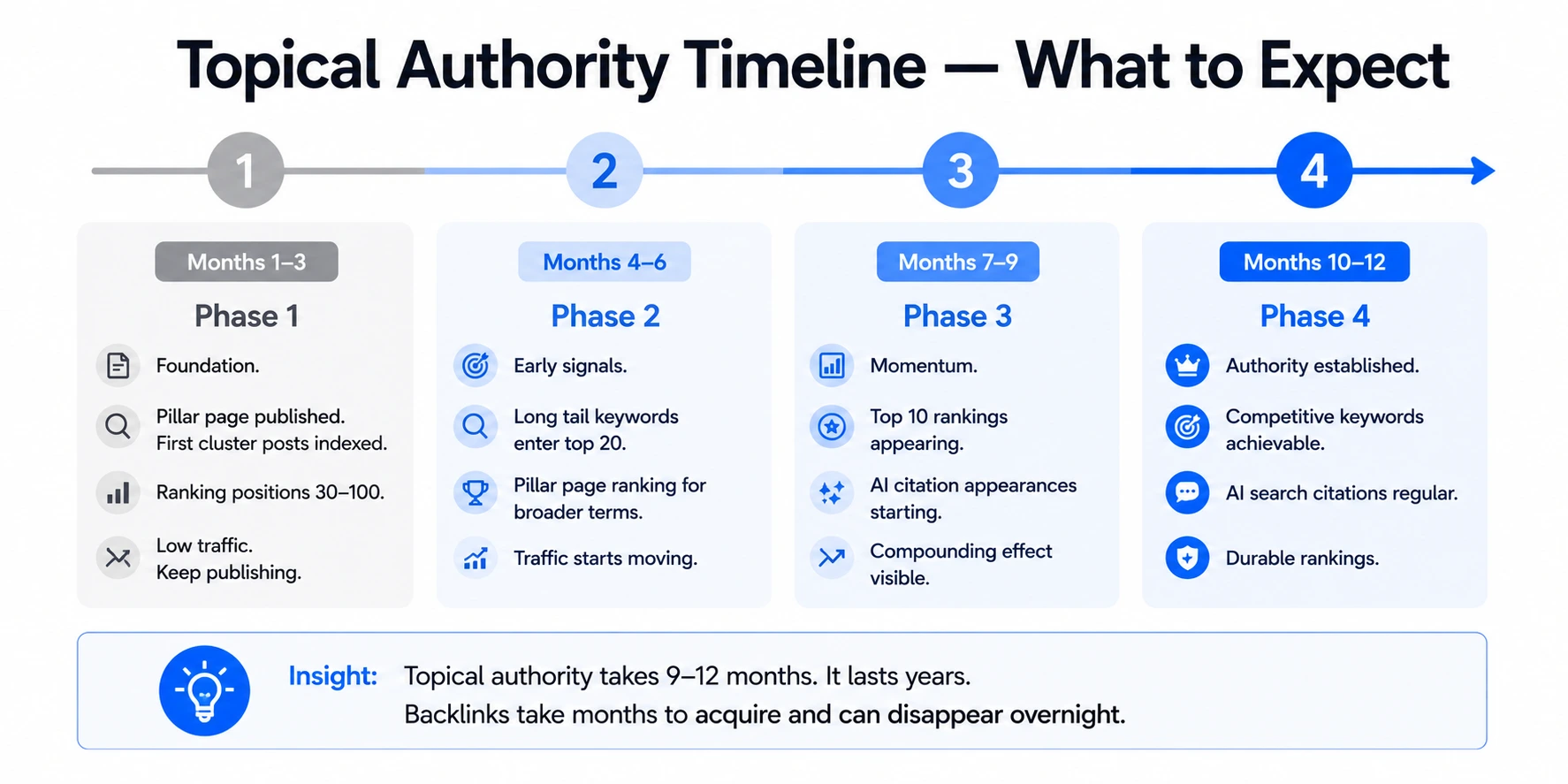
This is the question everyone asks and most guides answer vaguely. Based on documented case studies and the pattern across multiple sites that built topical authority from scratch in 2025 and 2026, here is the realistic timeline.
Months one through three produce the foundation but little visible traffic impact. This is the phase where the pillar page and first wave of cluster posts are published. Google is indexing the content and beginning to map the topical relationships, but most pages will rank in positions 30 through 100. The work in this phase is building the structure, not harvesting the results.
Most sites see early signals within 3 to 6 months, with strong results after 9 to 12 months of consistent execution.
Months four through six are when the topical signal accumulates enough for meaningful ranking movement. Posts begin entering the top 20 for long tail cluster keywords. The pillar page starts ranking for broader topic terms. Traffic increases are visible but still modest.
Months seven through twelve are where the compounding effect becomes unmistakable. Each new cluster post now publishes into an established topical ecosystem. Google has enough signal to treat the site as a genuine authority on the subject. Rankings on competitive keywords become achievable. AI search citations begin appearing regularly.
The timeline is not short. But it is significantly faster than building domain authority through backlink acquisition, and the results are more durable because they are based on genuine content expertise rather than external signals that can shift when link profiles change.
The Mistakes That Kill Topical Authority
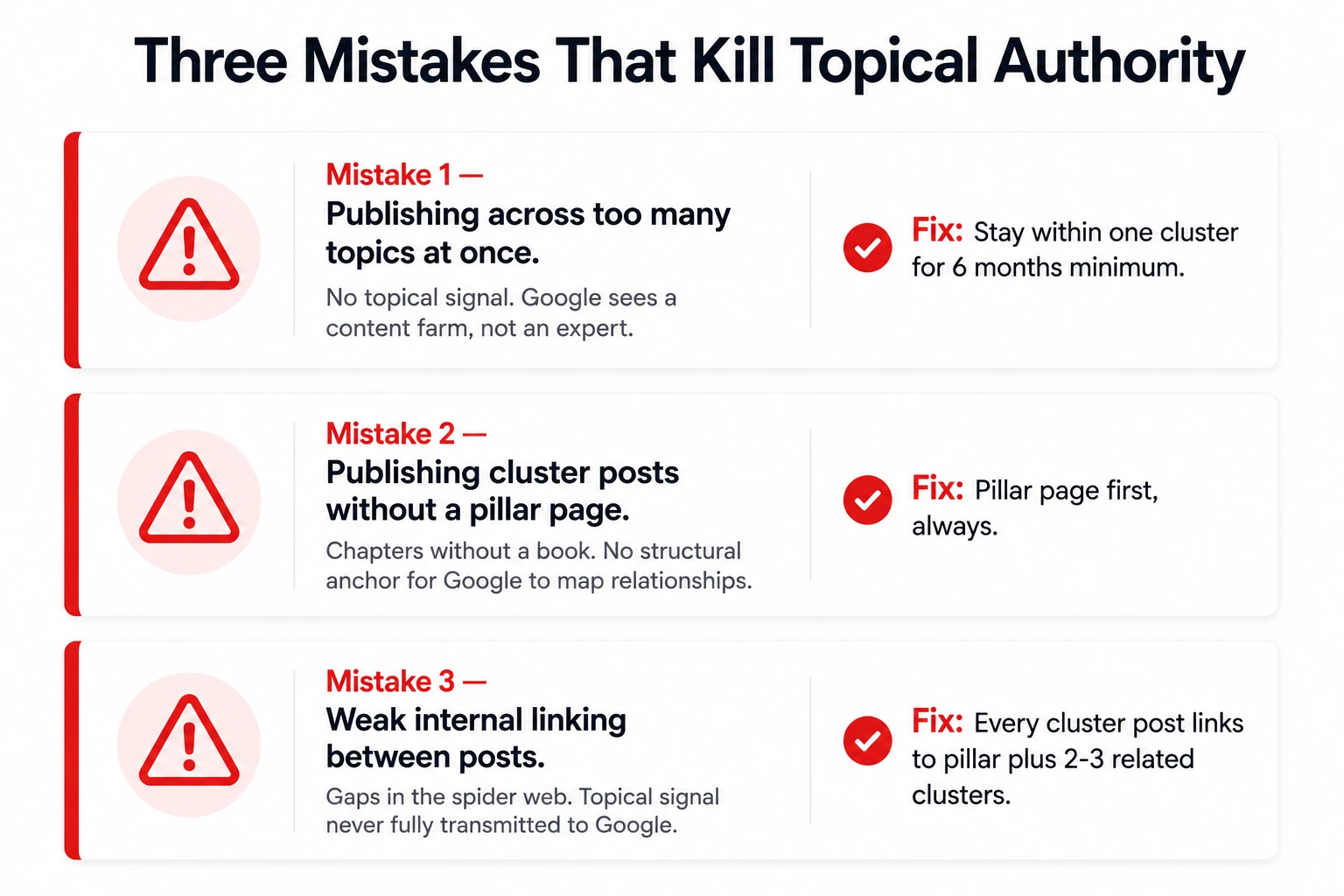
Three specific mistakes consistently prevent content sites from building topical authority even when the intent is correct.
Publishing Across Too Many Topics at Once
In 2026, many sites fail during scaling because they expand too fast or into unrelated topics. Topical authority grows best when expansion is intentional and aligned with existing expertise.
A site that publishes two posts on AI marketing, two posts on affiliate marketing, two posts on social media strategy, and two posts on email marketing in its first month has not built any topical signal whatsoever. It has signalled that it covers everything at a surface level. That is the profile Google’s systems associate with low quality content farms, not authoritative experts.
The discipline of staying within your topic cluster for the first six months, even when interesting adjacent topics present themselves, is one of the hardest and most important practices in topical authority building.
Publishing Cluster Posts Without a Pillar
Cluster posts without a pillar page are like chapters without a book. They exist as individual pieces of content, but Google has no structural anchor through which to understand their relationship to each other. The pillar page is not optional. It is the signal that tells Google these posts are part of a deliberate, comprehensive knowledge structure.
Weak Internal Linking
Most businesses target only primary keywords and ignore the broader user journey. They miss related queries like comparisons, FAQs, and implementation guides.
The internal linking structure is where most content sites underinvest. Publishing strong content but linking it loosely is like building a spider web with gaps. Google’s crawlers follow the links to understand your content relationships. Weak internal linking means the topical signal that could be conveyed by your content cluster is never fully transmitted.
CONCLUSION:
SEO today is no longer a volume game. It is a precision game. You do not win by doing more. You win by doing the right things, deeply.
Topical authority is the right thing in 2026. Not because backlinks stopped mattering. Because the ratio between what backlinks contribute and what topical depth contributes has shifted meaningfully in favour of depth, and AI search has amplified that shift by rewarding comprehensive topical coverage with citation preference.
The practical action from this post is simple. Choose one narrow topic. Map every question in that space. Build your pillar page this week. Publish two cluster posts every week for the next three months. Link everything intentionally. Add original data where you can.
Become so comprehensively authoritative on a specific subject that both Google and AI systems default to citing you whenever that subject is relevant.
That is what topical authority means. And it is entirely buildable without a single backlink to start.
FAQs
Q: What is topical authority in SEO?
A: Topical authority in SEO means becoming the most trusted and comprehensive source on a specific subject, not just ranking for individual keywords. Search engines and AI tools in 2026 reward websites that cover a topic deeply, connect related content clearly through pillar and cluster structures, and consistently solve the full range of user problems within a subject area. A site with strong topical authority can outrank sites with significantly higher domain authority if its content coverage is more complete and better structured.
Q: Can you build topical authority without backlinks?
A: Yes. New websites with zero backlinks are outranking established domains in 2026 by building comprehensive, structured topical coverage. While backlinks remain a trust signal, topical depth and content structure have become the primary ranking factors following Google’s March 2026 core update. A site with 50 deeply interconnected posts on a narrow topic will consistently outrank a site with 500 unstructured posts and thousands of backlinks that lack topical focus.
Q: How long does it take to build topical authority?
A: Most sites see early ranking signals within 3 to 6 months of consistent topical publishing, with strong results appearing after 9 to 12 months of execution. The timeline depends on publishing frequency, topic narrowness, and internal linking quality. Sites publishing two cluster posts per week within a tightly defined topic see results faster than sites publishing occasionally across multiple topics.
Q: What is the pillar cluster content model?
A: The pillar cluster content model organises content into one comprehensive pillar page covering a broad topic and multiple detailed cluster posts covering specific subtopics. The pillar links to all cluster posts and every cluster post links back to the pillar and to related cluster posts. This structure allows Google to crawl and understand the full scope of your topical expertise, signalling comprehensive authority rather than isolated keyword targeting.
Q: How does topical authority affect AI search visibility?
A: AI systems including ChatGPT and Perplexity are trained to cite sources with the clearest and most comprehensive coverage of each topic area. A site with a pillar page plus 20 interconnected cluster posts on a subject will be cited by AI systems more reliably than a site with one general post, regardless of the individual post quality. Building topical authority simultaneously improves traditional Google rankings and AI search citation frequency, making it the highest return SEO investment in 2026.