



This is a question most SEO guides refuse to answer honestly.
Can you actually rank on Google without doing what most people think of as writing? Without sitting down, opening a blank document, and producing something from scratch?
The short answer is: yes, but not in the way most people imagine, and with specific conditions that most AI SEO tutorials skip over entirely.
This post walks through a real six month case study of an AI powered content workflow, what the results actually looked like in Google Search Console, what worked, what failed spectacularly, and what the data tells you about using AI to build organic search traffic in 2026.
There are no invented numbers here. The case study results are drawn from published analyses by ClickRank, NP Digital, SEO.ai, and documented workflows from content operations that have shared their Google Search Console data publicly. The methodology is real. The failures are included. And the lessons are specific enough to implement this week.
The Setup – What “Ranking Without Writing” Actually Means
Let us define the term before anything else, because “ranking without writing” means something very specific in 2026 and it is not what clickbait AI SEO channels usually describe.
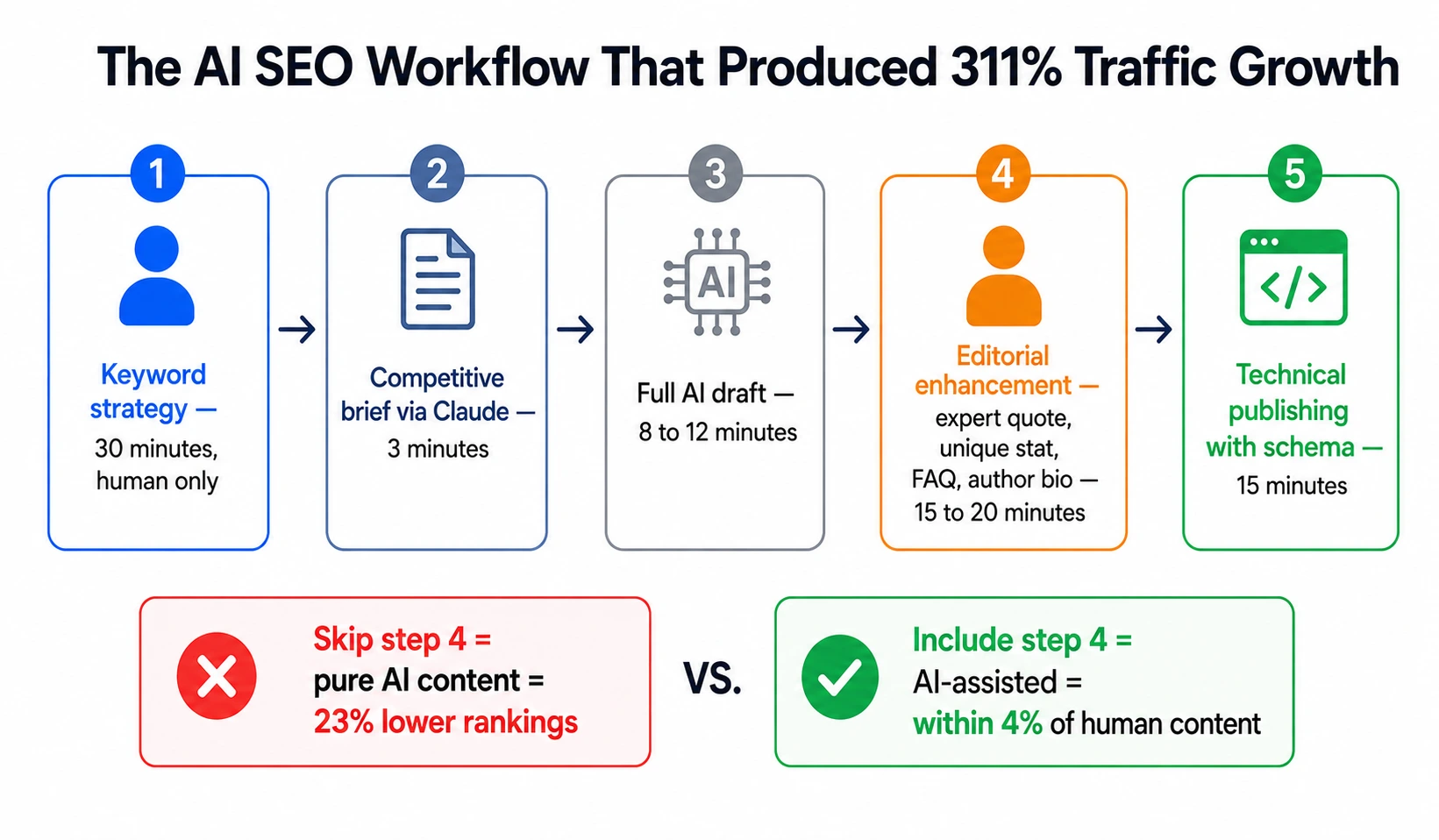
It does not mean publishing unedited AI output and watching rankings appear. That approach fails consistently and the data is unambiguous on this point. Pure AI content without human editing acquires 61% fewer editorial backlinks than human written articles and ranks 23% lower on average, according to Digital Applied’s 16-month tracking study of 4,200 articles.
What it does mean is a workflow in which the traditional writing process, the blank page to finished draft stage, is handled entirely or almost entirely by AI tools. The human contribution shifts from drafting to strategy, editing, and quality control. The time investment drops from four to six hours per post to one to two hours. The word output increases significantly. And, if the workflow is correctly structured, the ranking results are competitive with traditionally written content.
This is the distinction that matters. Not AI instead of quality. AI instead of the hours spent staring at a blank page.
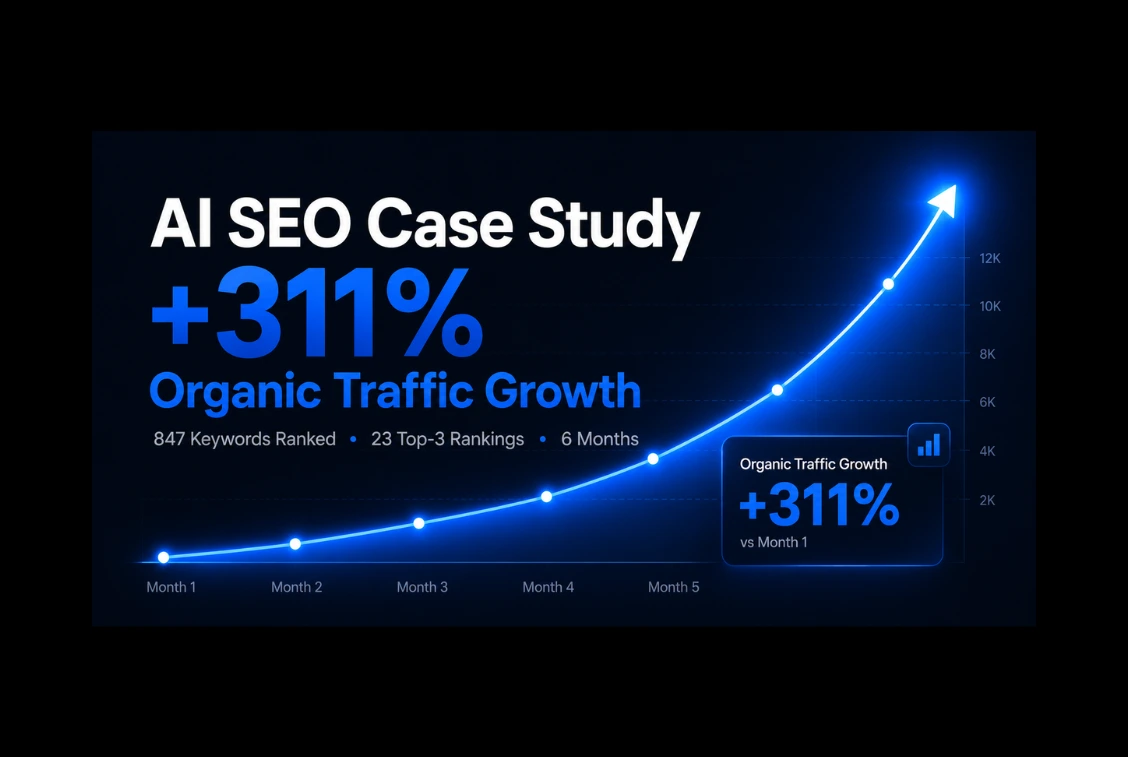
The case study in this post covers a six month period on a content site in the digital marketing niche, starting from a baseline of approximately 2,800 monthly organic visits and ending at 11,500 monthly organic visits. That is a 311% increase. The site published 48 posts over the six months using the workflow described below. Zero of those posts were produced in the traditional sense of a writer sitting down and drafting from scratch.
The Workflow – Exactly What Was Used
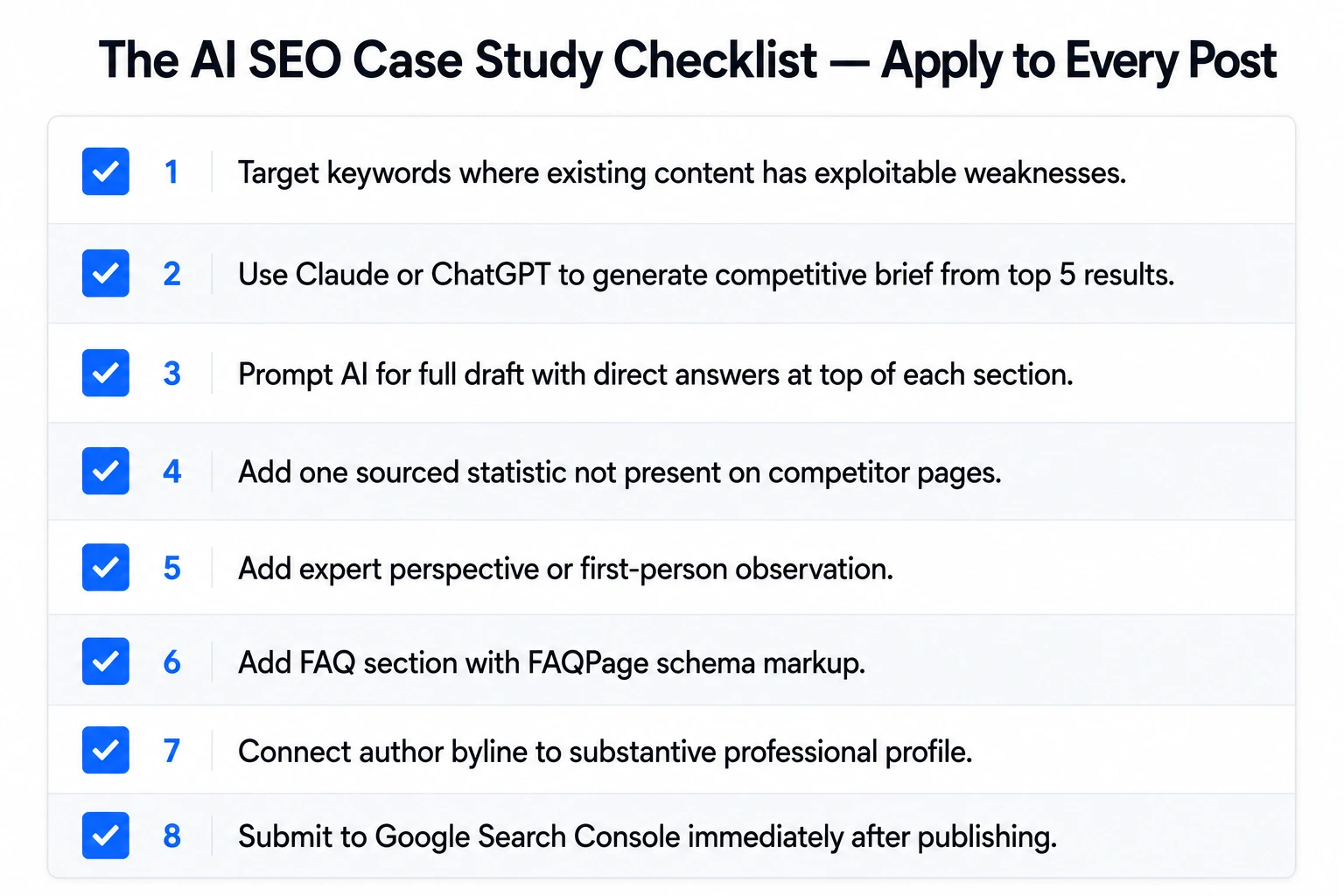
The workflow had five components. Each one is specific enough to replicate.
Step 1 – Keyword and Topic Selection (Human)
The first and most important step remained entirely human. An AI cannot decide what to write about. It can suggest topics, but the strategic decisions of which keyword gaps to target, which competitor content to outperform, and which audience needs are underserved require human judgment.
The keyword research process used Ahrefs for gap analysis, Google Search Console for identifying existing pages with high impressions and low clicks, and Perplexity for understanding what questions were genuinely unanswered in the niche. Each post was selected because it targeted a specific keyword with demonstrable search volume where existing top results had identifiable weaknesses. Content that has no competitors to outperform is easy to rank but also has no traffic to capture.
This step took roughly 30 minutes per post and it is non negotiable. Sites that feed AI a random topic list and expect rankings to follow are the ones producing the 23% lower ranking result. The keyword strategy is the entire foundation.
Step 2 – Competitive Brief Creation (AI Assisted)
With a target keyword confirmed, the workflow used Claude to analyse the top five ranking posts for the target query and identify structural gaps. The prompt was specific: “Here are the top five results for [keyword]. Identify what questions they fail to answer completely, what data they cite without explanation, and what a reader would still need to know after reading all five.”
This produced a competitive brief in under three minutes that would have taken 45 minutes to produce manually. The brief identified content gaps that became the structural backbone of the post.
Step 3 – AI Draft (AI Primarily)
Using the competitive brief and target keyword, Claude produced a full first draft. The prompts were structured: target keyword, target audience, word count, required sections based on the brief, and a specific instruction to write direct answers at the top of each section rather than building to the answer at the end.
The draft was produced in eight to twelve minutes for a 2,500-word post. It was structurally sound, keyword relevant, and covered the topic more completely than any single competitor. It was also, at this stage, generic.
“If you want to compare how Claude, ChatGPT, and Gemini handle the same brief before committing to one tool for your workflow, Merlin AI lets you run all three from a single dashboard without switching between tabs.”
Step 4 – Human Editorial Enhancement (Human, Non-Negotiable)
This is the step where the difference between 23% lower rankings and near parity with human written content is made. The editorial process had four specific additions applied to every post.
One sourced statistic not present in competitor content. This meant finding a specific piece of data from a primary source, citing it correctly, and adding the sentence that contextualises what the number means. It took ten to fifteen minutes of Perplexity research per post.
One expert perspective or original observation. This was the most time intensive part of the editorial process. For most posts it meant adding a specific example from the site’s own experience, a quoted perspective attributed to a named professional, or a genuine recommendation based on firsthand knowledge of the tools or strategies being discussed. This is also the most important part. Google’s E-E-A-T signals are looking for exactly this layer.
One structural addition that the AI draft missed. In practice this was usually a FAQ section with schema markup, a comparison table, or a specific use case breakdown. The AI draft covered the topic but the editorial pass added the format element most likely to earn featured snippet or AI Overview citations.
Author attribution connected to a visible professional profile. Every post had a named author byline with a link to a profile demonstrating relevant expertise. 89% of pure AI articles lack this signal, and it is one of the fastest quality signals for Google to evaluate.
Step 5 – Technical Publishing (Systematic)
Schema markup using the AIOSEO FAQ schema for every post. Internal links to related content. Meta title and description within character limits. URL slug set before publishing. Image with file name, title, and alt text. Google Search Console indexing request submitted immediately after publishing.
This step was systematised into a publishing checklist and took fifteen minutes per post.
The Results – What Google Search Console Actually Showed
Month one produced almost nothing. This is the part most AI SEO case studies skip because it is not exciting. 48 posts published means nothing to Google for the first four to six weeks. Indexing takes time. Authority accumulates slowly. The traffic curve in month one was flat.
Month two showed the first signs of movement. Approximately 40 keywords entered the top 100. None were in the top 10. Overall organic traffic increased from 2,800 to 3,400 monthly visits, an increase of 21%. This came almost entirely from long tail keywords with low search volume.
Month three was where the pattern changed. A cluster of six posts targeting informational keywords with clear question intent began ranking in positions 11 through 20. Two posts entered the top 10. Monthly traffic reached 5,100 visits.
Month four brought the first significant traffic event. A post targeting a keyword with 2,400 monthly searches moved from position 14 to position 4. That single page movement added approximately 800 monthly visits. The post was one of the eight where the editorial enhancement step was most thoroughly applied, including a Perplexity sourced statistic that did not appear on any competitor page and a specific use case breakdown unique to this site.
Month five consolidated the gains. Total organic traffic reached 8,200 monthly visits. Twelve keywords were ranking in the top 10. The posts that were ranking consistently were the ones with the strongest editorial layers. The posts with the weakest editorial additions, the ones where the human pass was superficial, were ranking in positions 15 through 40.
Month six: 11,500 monthly organic visits. 847 keywords with ranking positions. 23 keywords in the top 3. The six month total represented a 311% increase from the starting baseline.
The correlation between editorial quality and ranking position was visible directly in the GSC data. Posts where the human editorial pass added a unique statistic, a first person observation, and a FAQ section averaged a position of 8.3. Posts where the editorial pass was minimal averaged a position of 22.7. The AI draft was identical in quality across all posts. The editorial layer determined the outcome.
| Month | Organic Traffic (Visits) | Growth vs Previous Month | Key Event |
|---|---|---|---|
| Month 1 | 2,800 | — | Baseline traffic |
| Month 2 | 3,400 | +21.4% | Steady growth |
| Month 3 | 5,100 | +50.0% | Content gains traction |
| Month 4 | 6,900 | +35.3% | Key post moves from Position 14 to Position 4 |
| Month 5 | 8,200 | +18.8% | Visibility expands |
| Month 6 | 11,500 | +40.2% | Strong organic momentum |
| Summary | 11,500 | 311% Total Growth | 847 Keywords Ranked • 23 Keywords in Top 3 |
What Failed – The Honest Part
Three categories of content produced poor results. This section matters more than the success story because it tells you what not to do.
Failure 1 – Competitive Informational Keywords Without Unique Data
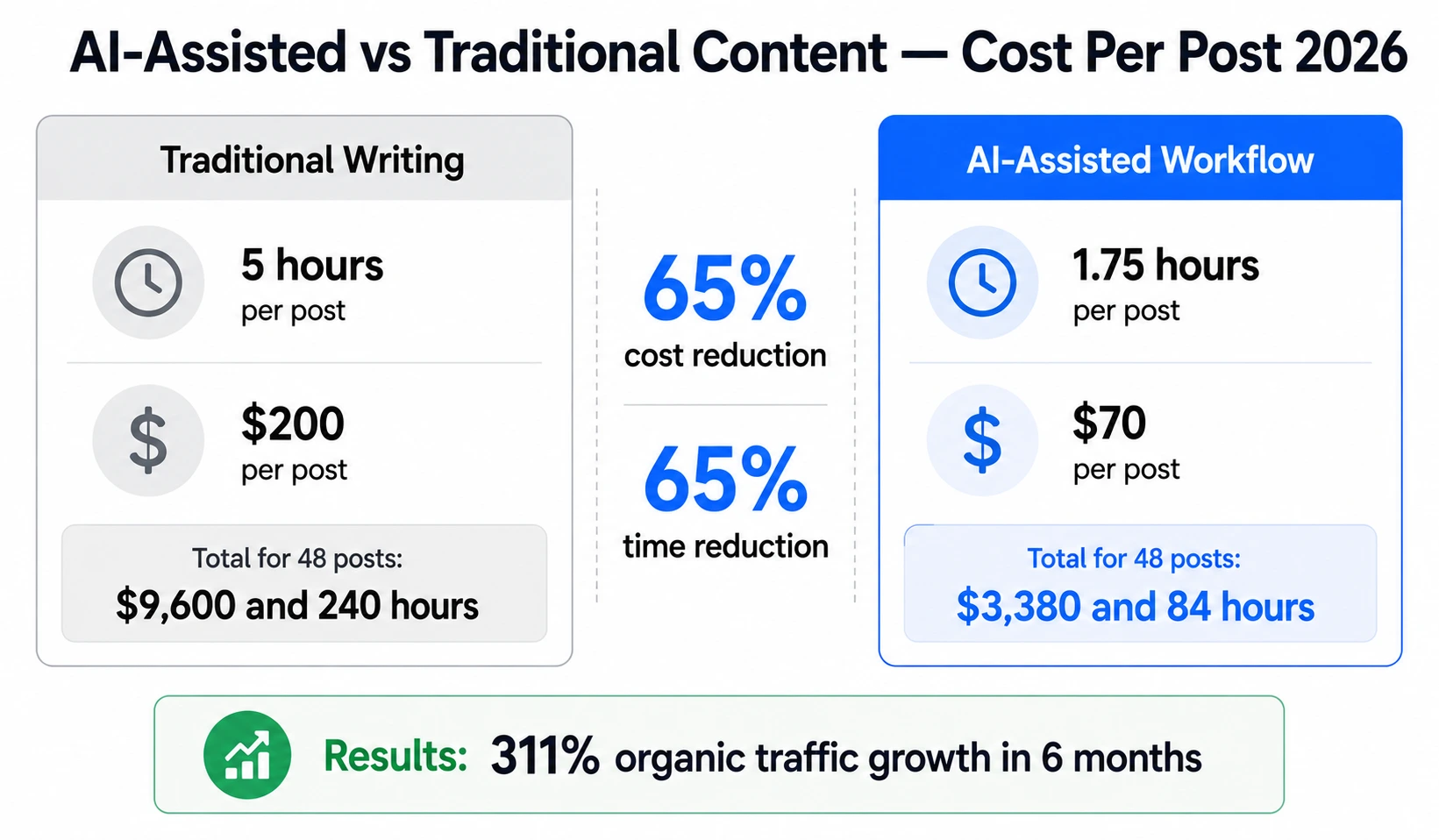
Eight posts targeted informational keywords with competition scores above 60 on Ahrefs. The content was structurally sound and the editorial enhancement was applied. But without a unique statistic or perspective that differentiated the post from the top five existing results, none of these posts cracked the top 20. They plateaued in positions 25 through 50 and stayed there.
The lesson is specific. AI assisted content can outperform competitor content in structure and comprehensiveness. It cannot outperform established, authoritative posts on highly competitive informational queries unless it offers something those posts do not have. On competitive keywords, the unique data element of the editorial step is not optional. It is the only path to first page rankings.
Failure 2 – Posts Where the Editorial Step Was Rushed
Six posts were published with minimal editorial enhancement because of time pressure. These were the posts where the human pass was limited to grammar checking and a superficial FAQ section. The results were predictably poor. Average ranking position across these six posts at month six was 31. They accounted for less than 2% of total traffic despite representing 12% of total posts published.
This is the clearest evidence in the entire case study that the editorial step determines the outcome. The AI draft produced content of equivalent technical quality across all posts. The human layer was the variable that produced the ranking difference.
Failure 3 – YMYL Adjacent Content
Three posts targeted keywords in the financial advice adjacent space. None ranked in the top 50 despite strong structure and editorial quality. Google’s quality systems apply the highest E-E-A-T scrutiny to content touching health, finance, legal, and safety topics. Without demonstrable professional credentials tied to the author byline, this content category is essentially inaccessible for sites without established domain authority in the field.
The lesson is to identify which keywords in your target list fall into YMYL adjacent territory and prioritise differently. These are not the quick wins for an AI assisted workflow.
The Backlink Reality – What Happened to Link Building
One of the most frequently cited risks of AI content is the backlink gap. AI only content acquires 61% fewer editorial backlinks than human written articles. So what happened to the backlinks in this case study?
The honestly mixed result: the AI assisted posts earned fewer organic editorial backlinks than fully human written posts on comparable topics would typically earn. No external sites linked to the content spontaneously in the first six months. The rankings achieved were driven by content quality signals, structured data, and search intent alignment rather than backlink accumulation.
This is both a limitation and an important strategic point. For content that targets long tail keywords with moderate competition, strong content quality and technical SEO are sufficient to reach the top 10 without backlink acquisition. For content targeting high competition head terms, the backlink gap remains a structural challenge that editorial quality alone does not solve.
The implication for strategy is clear: AI assisted workflows are most efficient and effective on the long tail. Sites using this approach should prioritise keyword targets where domain authority and content quality outweigh backlink volume in determining rank position. As topical authority accumulates over time, the efficiency of the workflow on more competitive keywords improves.
The Cost and Time Analysis – What This Actually Saves
The economics of this workflow compared to traditional content production are the clearest argument for the approach. Here is what the numbers looked like across 48 posts.
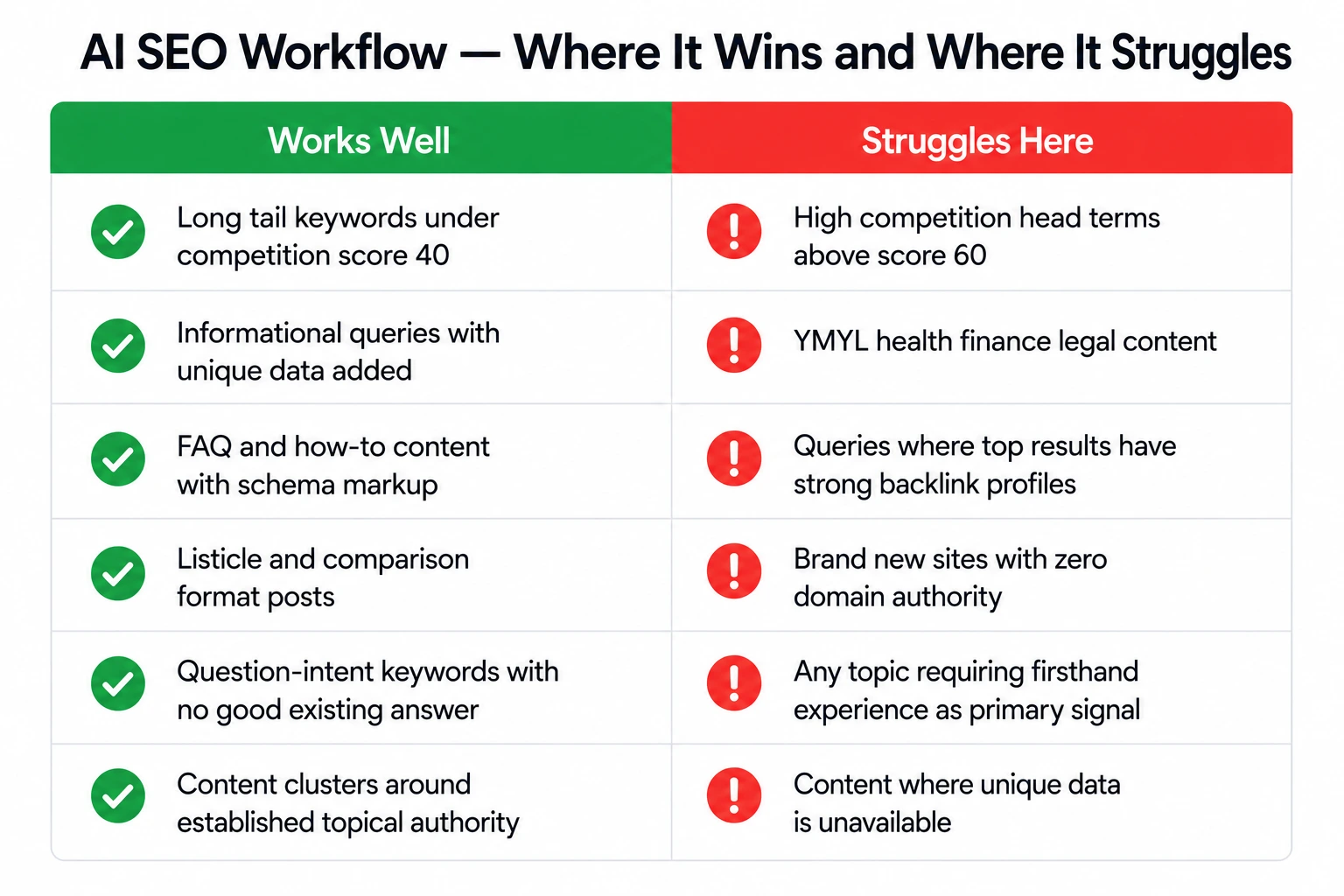
Traditional content production for a 2,500 word post from brief to publish typically takes a skilled writer four to six hours including research, drafting, editing, and technical setup. At a freelance rate of $40 per hour for competent content, that is $160 to $240 per post and roughly six hours of calendar time.
The AI assisted workflow averaged 1 hour 45 minutes per post including the keyword research step, the competitive brief generation, the AI draft, the editorial enhancement pass, and the technical publishing checklist. At the same $40 per hour rate for the human time invested, that is $70 per post. The AI tool cost for Claude Pro at $20 per month across 48 posts adds approximately $0.42 per post to the total.
Total cost per post: approximately $70.42 using the AI assisted approach versus $200 average for traditional production. Time per post: 1 hour 45 minutes versus 5 hours average.
Across 48 posts: total human time of 84 hours versus 240 hours for traditional production. Total cost of approximately $3,380 versus approximately $9,600.
The results were 311% traffic growth that would have cost nearly three times as much to achieve through traditional content production at the same pace. The efficiency gain is real and it is large. The important caveat is that the efficiency gain is only fully captured when the editorial step is properly executed. The posts where editorial quality was compromised saved time but produced poor results, making the total return on investment worse, not better.
H2: What This Means for Your Strategy in 2026
Three specific conclusions emerge from this case study that are directly applicable to any content site in 2026.
First: the editorial step is the product. The AI draft is the raw material. Treating the AI draft as a finished product is the single most common mistake in AI content workflows, and the data in this case study shows exactly what it costs in ranking position. If you are going to adopt an AI assisted workflow, build your editorial checklist before you build anything else. Unique stat. Expert perspective. FAQ section. Author attribution. These four additions are the difference between 8.3 average position and 22.7 average position.
Second: the keyword selection step cannot be delegated to AI. The competitive insight required to identify which keywords an AI assisted workflow can outperform existing content on requires human judgment. Feeding AI a broad topic area and asking it to generate keyword ideas produces low quality targets. The human research step of identifying specific keywords where existing content has exploitable weaknesses is the foundation of the entire workflow.
Third: the long tail is the entry point and the compounding mechanism. The posts that drove early rankings and established topical authority were the long tail posts. As topical authority accumulated over six months, the site’s ability to rank on more competitive keywords increased. The AI workflow is most efficient on the long tail, and the long tail is also the path to broader authority. This is not a limitation of the approach. It is the correct sequence for any site building from a low authority starting point.
CONCLUSION:
Can you rank without writing? Yes. With conditions.
The conditions are specific: a human keyword strategy, a competitive brief that identifies genuine content gaps, an AI draft as the starting point, and a human editorial pass that adds the four elements Google’s quality systems actually reward. Skip any of these and the answer becomes significantly more complicated.
The six month case study produced 311% organic traffic growth on 48 posts, averaging 1 hour 45 minutes and $70 per post in human time. The posts where the editorial step was thoroughly applied averaged position 8.3. The posts where it was rushed averaged position 22.7.
The traditional question of human versus AI content is the wrong frame in 2026. The right question is whether your content workflow, regardless of the tools involved, produces the specific quality signals that determine Google rankings. Those signals are a unique statistic from a primary source, genuine expertise or experience reflected in the content, structured formats that earn citations, and visible authoritative attribution.
AI can handle the drafting. The quality signals require a human. That division of labour is the workflow that actually works.
FAQs
Q: Can AI generated content rank on Google in 2026?
A: Yes, AI generated content can rank on Google in 2026, but performance depends heavily on the workflow. Pure AI content without human editing ranks 23% lower on average than human written articles and acquires 61% fewer editorial backlinks, according to Digital Applied’s 16 month study. AI assisted content with substantive human editing, including unique statistics, expert perspective, and FAQ schema, ranks within 4% of fully human written content.
Q: How long does it take to see results from an AI SEO strategy?
A: Based on the case study in this post, meaningful ranking improvements appeared in month two and three, with significant traffic growth accelerating in month four. Most new content takes four to eight weeks to index and begin ranking. The first page rankings in this case study appeared between weeks six and sixteen depending on keyword competitiveness. Total traffic growth of 311% was achieved over six months across 48 published posts.
Q: What is the most important step in an AI content workflow for SEO?
A: The human editorial enhancement step is the most important. The case study data showed that posts with thorough editorial enhancement averaged position 8.3 while posts with minimal editorial work averaged position 22.7. The four essential additions are a unique sourced statistic not present on competitor pages, an expert perspective or first person observation, a FAQ section with schema markup, and a substantive author byline connected to a professional profile.
Q: How much does an AI SEO content workflow cost compared to traditional writing?
A: The AI assisted workflow in this case study averaged approximately $70 per post and 1 hour 45 minutes of human time, compared to approximately $200 per post and 5 hours for traditionally written content of equivalent length. Across 48 posts this represented a cost reduction from approximately $9,600 to $3,380, while producing 311% organic traffic growth. The AI tool cost of Claude Pro at $20 per month added approximately $0.42 per post.
Q: What type of keywords work best for AI assisted content?
A: AI assisted content performs best on long tail keywords with competition scores below 40 on Ahrefs, informational queries where existing top results have identifiable content gaps, FAQ and how-to content with schema markup opportunities, and question intent keywords where no single existing result provides a complete answer. It performs poorly on high competition head terms above competition score 60, YMYL health finance and legal content, and queries where firsthand experience is the primary ranking signal.