


The debate has been going on for two years. Does AI content rank on Google? Is human writing still necessary? Should you be worried?
Now we have real data. And the answer is more nuanced and more actionable than either side of the argument will admit.
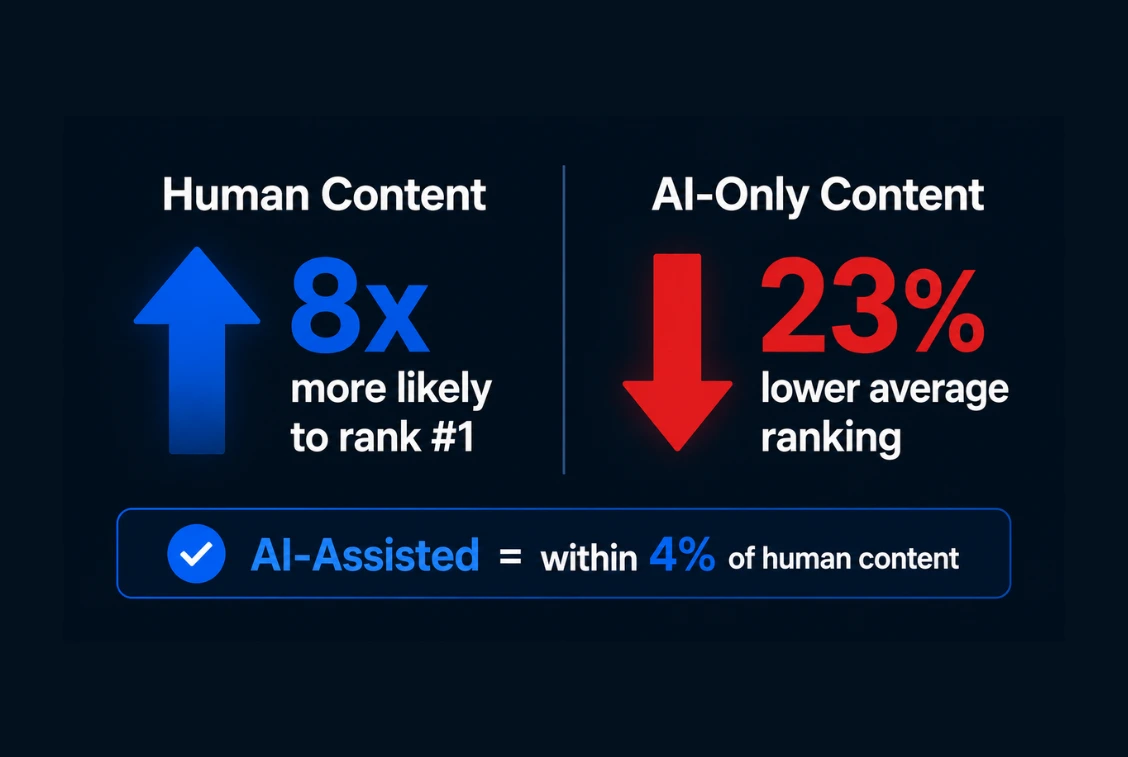
A Semrush study analysing 42,000 blog pages across 200,000 URLs tied to 20,000 keywords found that human-written pages dominate top Google rankings, while AI content appears in lower page one positions. Human-written content is 8x more likely to secure the top ranking than pure AI-generated content.
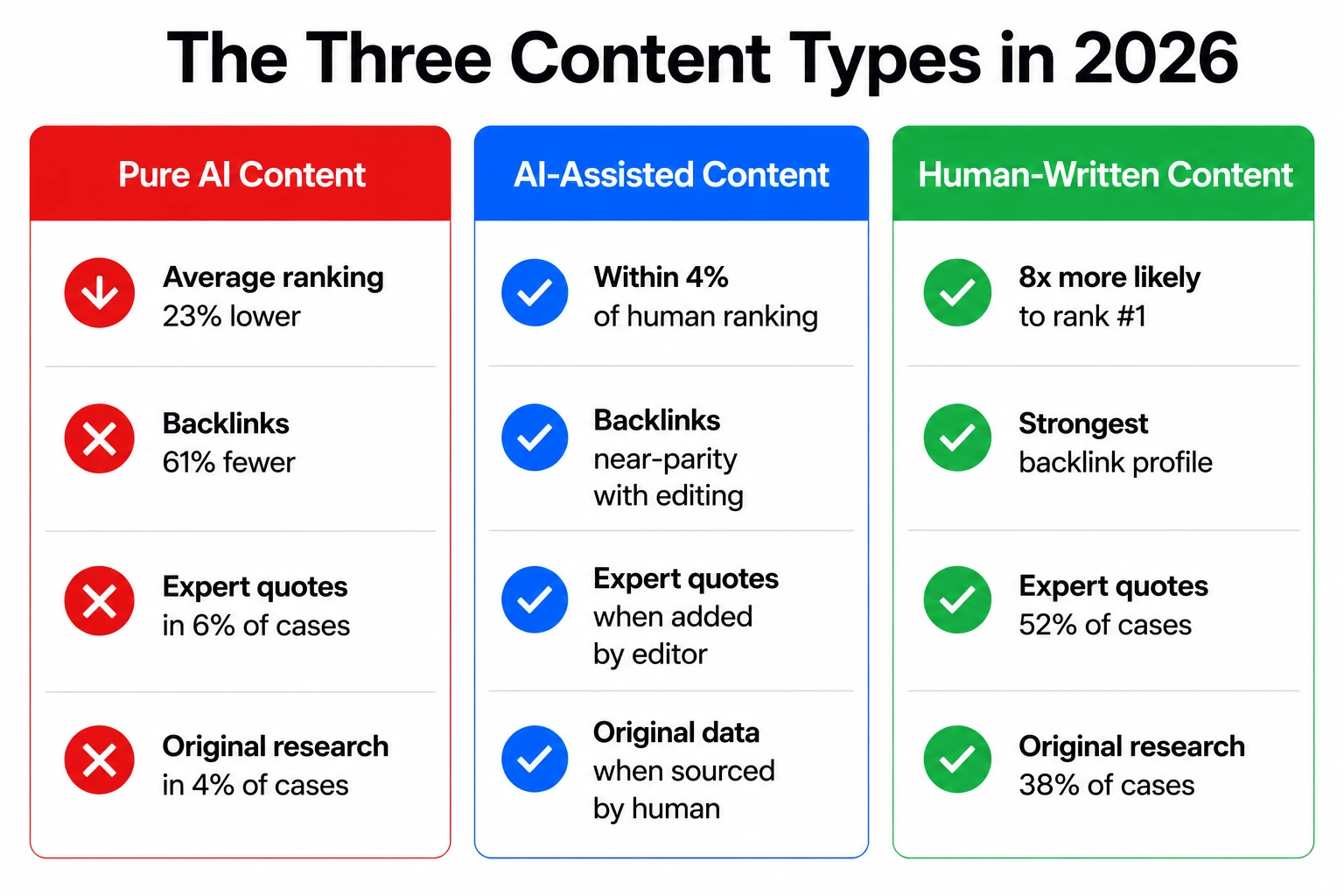
But here is the finding that changes the entire conversation. AI-assisted content AI-drafted with substantive human editing, original data, and expert attribution performed within 4% of fully human-written content on median ranking position. The real variable is not who wrote the content. It is editorial quality.
Pure AI content ranked 23% lower on average than human-written articles across 4,200 articles tracked over 16 months. The gap accelerated after Google’s March 2026 core updates.
This is the complete picture of what Google actually rewards in 2026. Not AI or human as a binary choice but a specific set of quality signals that determine which content earns top rankings regardless of how it was produced.
What the Research Actually Shows – The Three Content Categories
Before analysing why the rankings differ, it helps to understand how researchers in 2026 have categorised content. Most serious studies now use three categories rather than the simple AI versus human binary that dominated earlier debates.
Pure AI content is content generated by an AI tool and published without substantive human editing. This means the AI draft was cleaned up for grammar and formatting but not meaningfully revised, enhanced with original insight, or enriched with expert attribution or original research.
AI-assisted content is content where AI plays a significant role in research, drafting, or structuring but a human editor makes substantive contributions adding original perspective, incorporating expert quotes, inserting proprietary data, and refining the argument beyond what the AI produced.
Fully human-written content is content researched, drafted, and edited entirely by human writers, with AI used only for minor tasks like grammar checking or keyword research.
Digital Applied’s 16-month study tracking 4,200 articles across 140 domains found that AI-assisted content nearly matched human writing, while pure AI content consistently underperformed, with the gap accelerating after March 2026’s core updates.
The strategic implication is significant. The question is not whether to use AI in your content process. It is where in the process AI adds value and where human expertise is non-negotiable.
Why Pure AI Content Underperforms – The Specific Signals
Google does not penalize content for being AI-generated. This is not a technicality it is a fundamental fact that affects how you should think about the entire debate. Google has clearly stated that it focuses on the quality of content, not the method used to create it. Google’s Helpful Content System and E-E-A-T framework are the real ranking standards.
So if Google is not penalising AI content directly, why does pure AI content rank 23% lower on average? The answer is in the specific quality signals that pure AI content consistently fails to produce.
The E-E-A-T Gap
One analysis found that 89% of AI-only articles lacked an identifiable expert author, compared to just 29% of human articles. AI content included original research in only 4% of cases, versus 38% for human content. Human articles featured expert quotes 52% of the time; AI articles, just 6%.
These are not minor differences. They are precisely the signals Google’s E-E-A-T framework Experience, Expertise, Authoritativeness, Trustworthiness is designed to detect and reward. An AI cannot tell your readers that it personally tested a tool and found it underwhelming. It cannot interview a subject matter expert. It cannot conduct original research that no other source has published. Each of these missing signals is a gap between AI-generated content and the quality standard Google’s systems are built to identify.
The Backlink Gap
AI-only content acquired 61% fewer editorial backlinks than human-written articles on comparable topics. Backlinks remain a top-three ranking signal, making this the single most structurally damaging measurable consequence of unedited AI publishing.
This finding deserves careful attention because it explains something that confuses many content marketers. Pure AI content can be technically excellent well-structured, keyword-targeted, readable. But it consistently fails to attract the editorial backlinks that other writers and journalists naturally link to when they find genuinely original, insightful, or data-rich content. Because pure AI content rarely contains original insight, unique data, or a perspective that could not be found elsewhere, other writers have no reason to cite it. And without backlinks, even technically sound content struggles against human-written competitors that have earned genuine editorial citations.
The Behavioural Signal Gap
Human content tends to earn better behavioral signals: longer time on page, deeper scroll depth, lower bounce rates, and more social shares. Google measures how users interact with content after clicking from search results. When users land on a page, read for two minutes, scroll deeply, and do not immediately return to the search results, that signals to Google that the page was genuinely useful. When users land, skim, and return the bounce signal Google registers the opposite.
Pure AI content, because it tends to be comprehensive but generic, produces weaker engagement signals on average. It covers topics but rarely provides the genuine insight, specific example, or original perspective that makes a reader stop, read carefully, and stay.
Why AI-Assisted Content Nearly Matches Human Writing
The most practically important finding in recent research is not that human content outperforms pure AI content. That result is intuitive. The important finding is that AI-assisted content with substantive human editing performed within 4% of fully human-written content on median ranking position.
This near-parity result has direct implications for every content operation in 2026. It means that the productivity gains from AI drafting typically three to five times faster first drafts can be captured without the ranking penalty associated with pure AI publishing, provided the human editing layer is genuinely substantive rather than cosmetic.
The key word is substantive. The studies consistently show that the editorial process determines the outcome. AI-assisted content that closes the E-E-A-T gaps adding expert quotes, incorporating original data, attributing claims to identifiable sources, and layering genuine first-person insight performs nearly as well as content written entirely by humans. AI-assisted content that only corrects grammar and formatting without adding any of these elements performs similarly to pure AI content.
What Makes AI-Assisted Content Work
The businesses producing the strongest content in 2026 are using AI to move faster without lowering the bar. AI handles research, drafts, and formatting. Humans handle strategy, insight, and the final product. The speed gain is real. The quality standard does not change.
The specific editorial additions that close the ranking gap between AI-assisted and human-written content are: adding a named expert quote with visible credentials, incorporating one or more statistics that are not widely reproduced on competitor pages, adding a first-person observation or recommendation that reflects genuine experience with the topic, and ensuring the author byline is connected to a visible professional profile that demonstrates relevant expertise.
None of these additions require abandoning AI drafting. They require that the human editor treats the AI draft as a starting point rather than a finished product.
What Google’s March 2026 Update Changed
Google’s March 2026 core update is the single most important recent event for understanding the current AI versus human content landscape. The ranking divergence between pure AI content and human-written content accelerated after the March 2026 core updates.
The update elevated several specific signals that directly disadvantage pure AI content while rewarding the editorial quality markers associated with human and AI-assisted writing. Page experience signals including Core Web Vitals and Interaction to Next Paint benchmarks became direct ranking factors. E-E-A-T signals received increased weighting. And the Helpful Content System became more precise in identifying content created primarily for ranking rather than primarily to serve users.
AI content often matches keywords but misses nuance, context, and intent depth. Once Google reassesses usefulness, weak pages lose visibility. Core updates amplify quality checks, which causes thin or generic AI pages to lose rankings fast. Human content maintains trust, experience, and engagement signals that remain stable during updates.
The practical consequence for content strategy is that the March 2026 update narrowed the window in which pure AI content could survive without editorial enhancement. Sites that were generating AI content at scale without meaningful human editing saw volatility and ranking losses in the weeks following the update. Sites with consistent editorial processes maintained or improved their positions.
The Volatility Pattern
There is a consistent pattern in how pure AI content performs across Google’s update cycle. AI-only content tends to rank reasonably well shortly after publication it is technically sound, keyword-targeted, and structurally clean. But it consistently loses positions after core updates, when Google reassesses the genuine usefulness and authority of the pages it has been serving. Human-written and AI-assisted content with genuine E-E-A-T signals shows less volatility and more stable long-term rankings because the quality signals that protect rankings during updates are present from the start.
Where Human Content Still Has an Irreplaceable Advantage
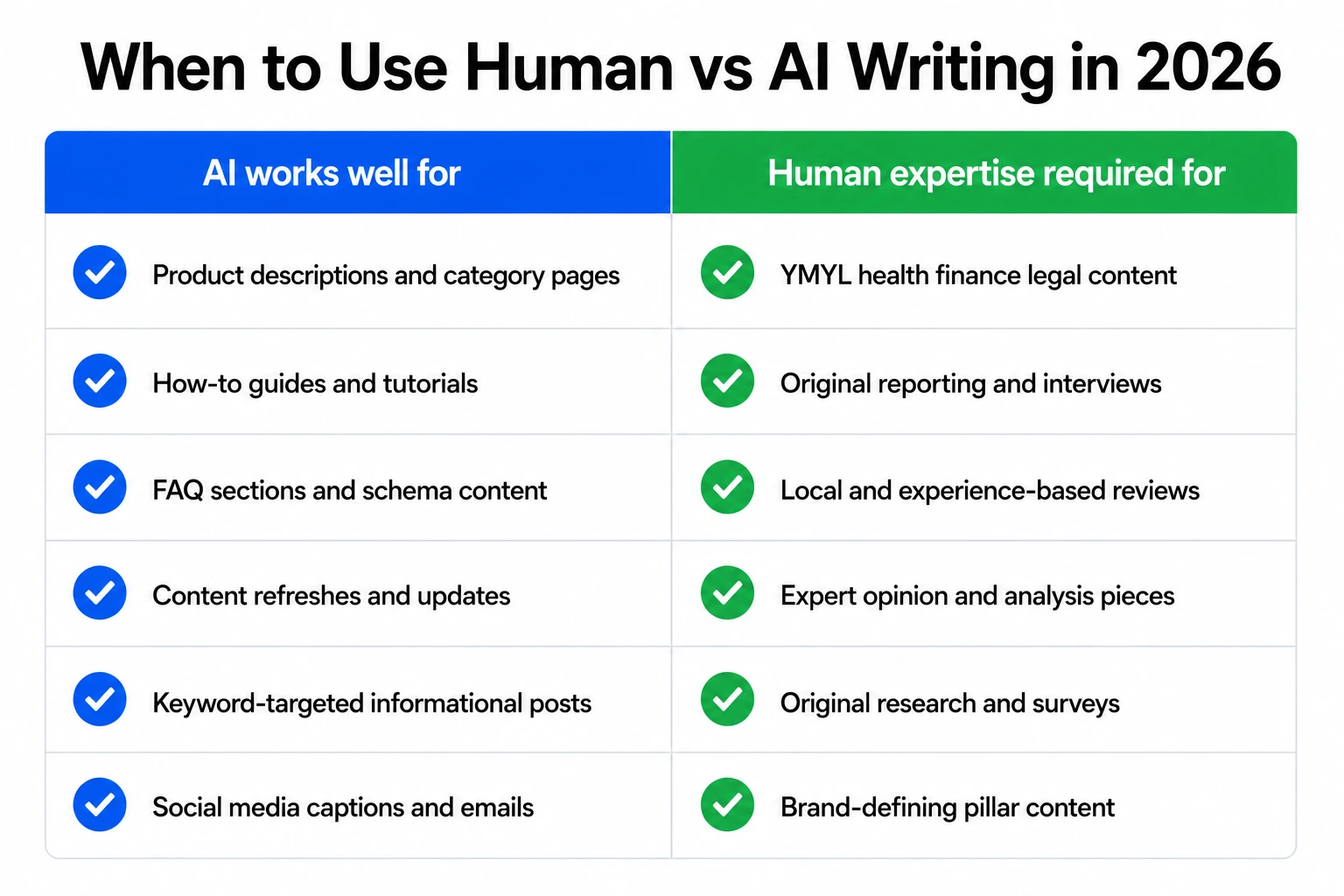
Even with an ideal AI-assisted workflow, there are specific content types and query categories where human writing maintains a structural advantage that AI enhancement cannot fully bridge.
YMYL content Your Money or Your Life covering health, finance, legal, and safety topics requires demonstrable first-hand expertise and professional credentials. Google’s quality systems apply the highest scrutiny to YMYL content, and the E-E-A-T gap between AI-generated and genuinely expert-authored content is most pronounced in these categories.
Local and experience-based content cannot be meaningfully produced by AI. A restaurant review that mentions the specific corner table near the window, the wait time on a Tuesday evening, and the way the lighting changes the atmosphere is fundamentally different from an AI-generated description of the menu. Google’s systems have become increasingly capable of distinguishing between content based on genuine experience and content that describes an experience it never had.
Original reporting and investigative content interviews with sources, primary research, on-the-record quotes, and firsthand observations cannot be produced by AI at all and represents the content category with the widest and most durable ranking advantage for human writers.
In 2026, the debate is no longer AI vs human content it is about valuable content vs low-quality content. The websites winning today are those combining AI efficiency with human expertise, real insights, and strategic SEO execution.
The Hybrid Workflow: What the Top-Ranking Sites Actually Do
The sites consistently occupying the top positions across competitive keywords in 2026 are not the sites producing the most content or the fastest content. They are the sites with the most reliable editorial process. That process, in its most common form, follows a consistent pattern.
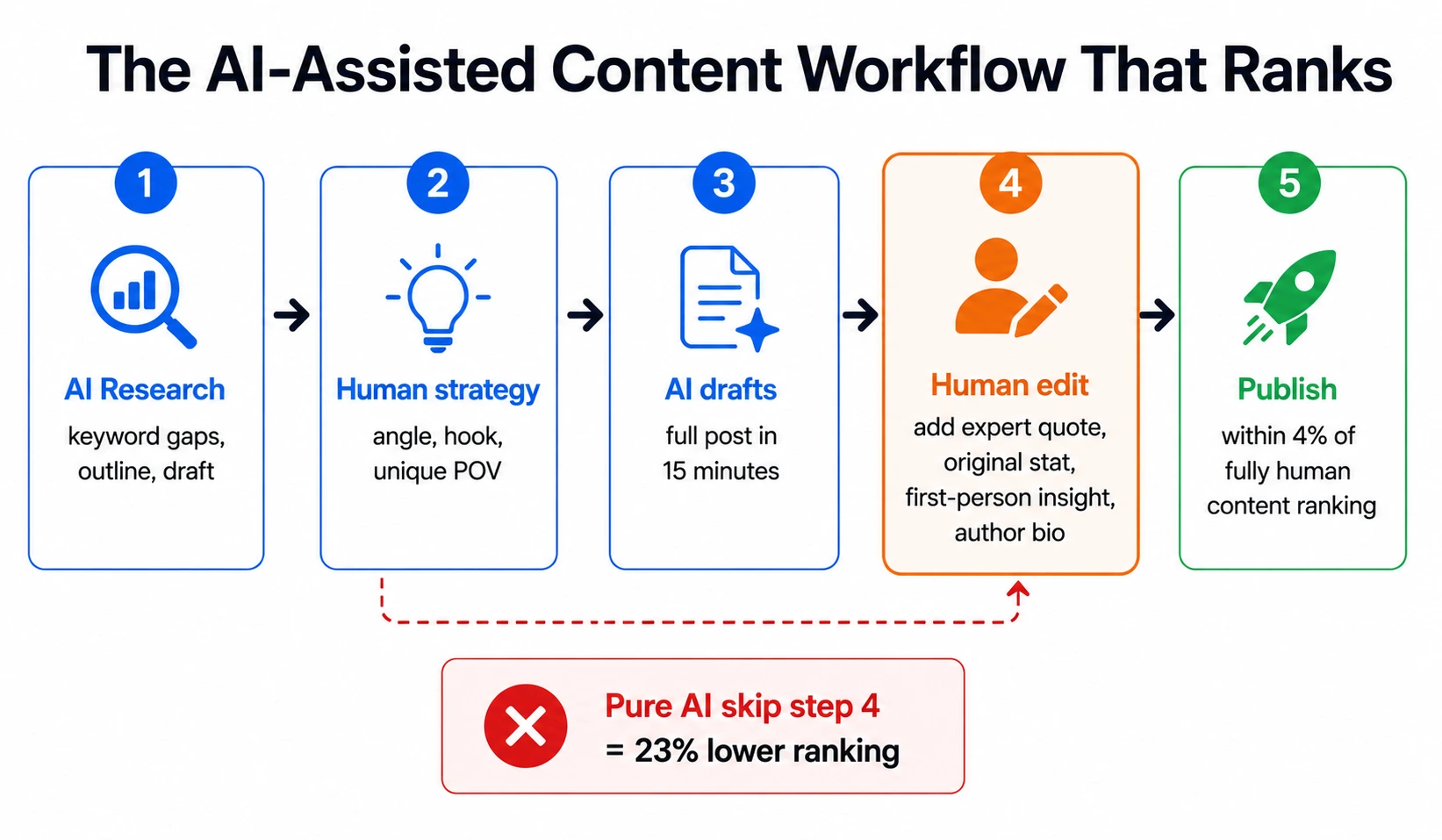
Step one is strategy and targeting. A human decides what to write based on keyword research, competitive gap analysis, and audience understanding. This strategic layer determining what content will serve a specific audience need better than existing results is where human judgement is irreplaceable. AI can assist with keyword research and competitor analysis, but the strategic decision about which angle to pursue and what unique value the post will deliver requires human understanding of the audience.
Step two is AI research and drafting. With a clear brief, AI tools produce a first draft efficiently. This draft covers the topic structure, incorporates target keywords naturally, and produces a complete document in a fraction of the time a human draft would require.
“If you want to access multiple AI models Claude, ChatGPT, and Gemini from one dashboard to compare drafts and research outputs, Merlin AI lets you run them side by side without switching between tabs.”
Step three is human editorial enhancement. This is the step that determines whether the content performs at the AI-assisted level within 4% of human writing or at the pure AI level 23% lower on average. The human editor adds: one or more expert quotes with visible credentials; at least one statistic that is specific, sourced, and not reproduced on every competitor page; a first-person recommendation, observation, or experience that the AI cannot provide; and author attribution connected to a professional profile that demonstrates relevant expertise.
Step four is technical optimisation. Schema markup, internal linking, meta data, and page experience signals are applied. These technical factors work in service of content quality, not in replacement of it.
Step five is tracking and refresh. Published content is monitored in Google Search Console for impressions, click-through rate, and ranking position. Pages showing high impressions and low CTR are candidates for AI-assisted updates. Pages showing ranking loss after core updates are candidates for editorial reinvestment. The refresh cycle keeps content fresh a signal that independently improves AI citation frequency while protecting ranking positions over time.
The AI Visibility Dimension – How This Affects AI Search
The human versus AI content debate has an additional dimension in 2026 that most analyses underweight: AI search visibility. Appearing in Google AI Overviews, ChatGPT answers, and Perplexity citations is increasingly as important as ranking in traditional search results.
Tracking AI visibility alongside traditional rankings is now standard for the strongest content operations in 2026. Appearances in AI Overviews, ChatGPT citations, and voice search responses are becoming as important as Page 1 rankings. Content built for both environments performs best.
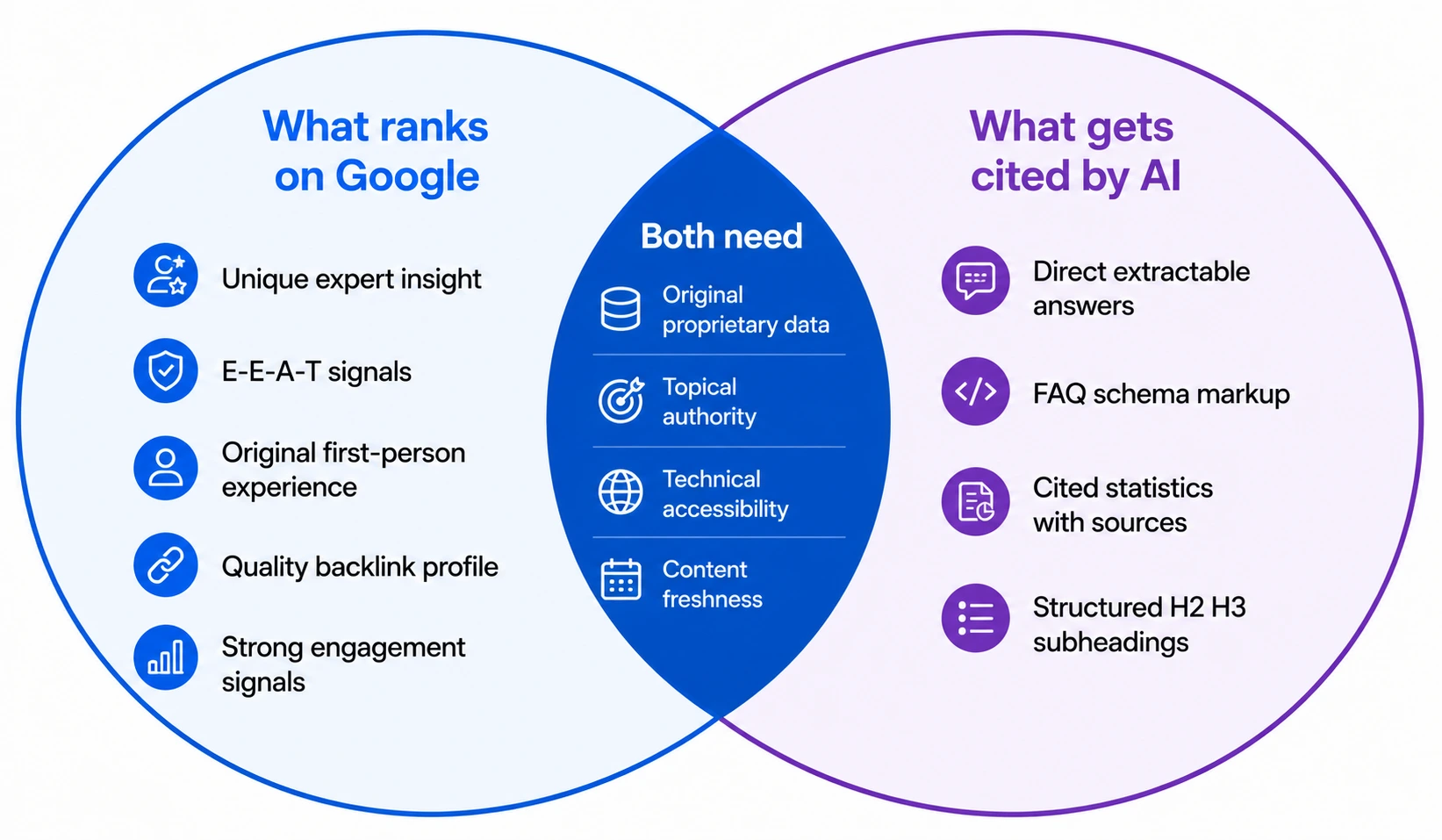
The content characteristics that earn AI citations overlap significantly with the characteristics that produce strong Google rankings: direct answers, structured formats, cited statistics, and demonstrable expertise. But there is one important difference. AI citation systems weight original data and branded web mentions more heavily than traditional Google rankings do. Content that contains a unique proprietary statistic one that can only be sourced from your site creates a mandatory citation signal for AI systems that no amount of on-page optimization can replicate.
This means the investment in original research, which produces the E-E-A-T signals that protect Google rankings, simultaneously produces the unique data signals that drive AI search citations. The two goals are not in competition. They are served by the same editorial practice.
The Practical Action Plan: What to Do This Week
The research converges on a clear set of priorities. Here is the specific sequence of actions that reflects the current evidence.
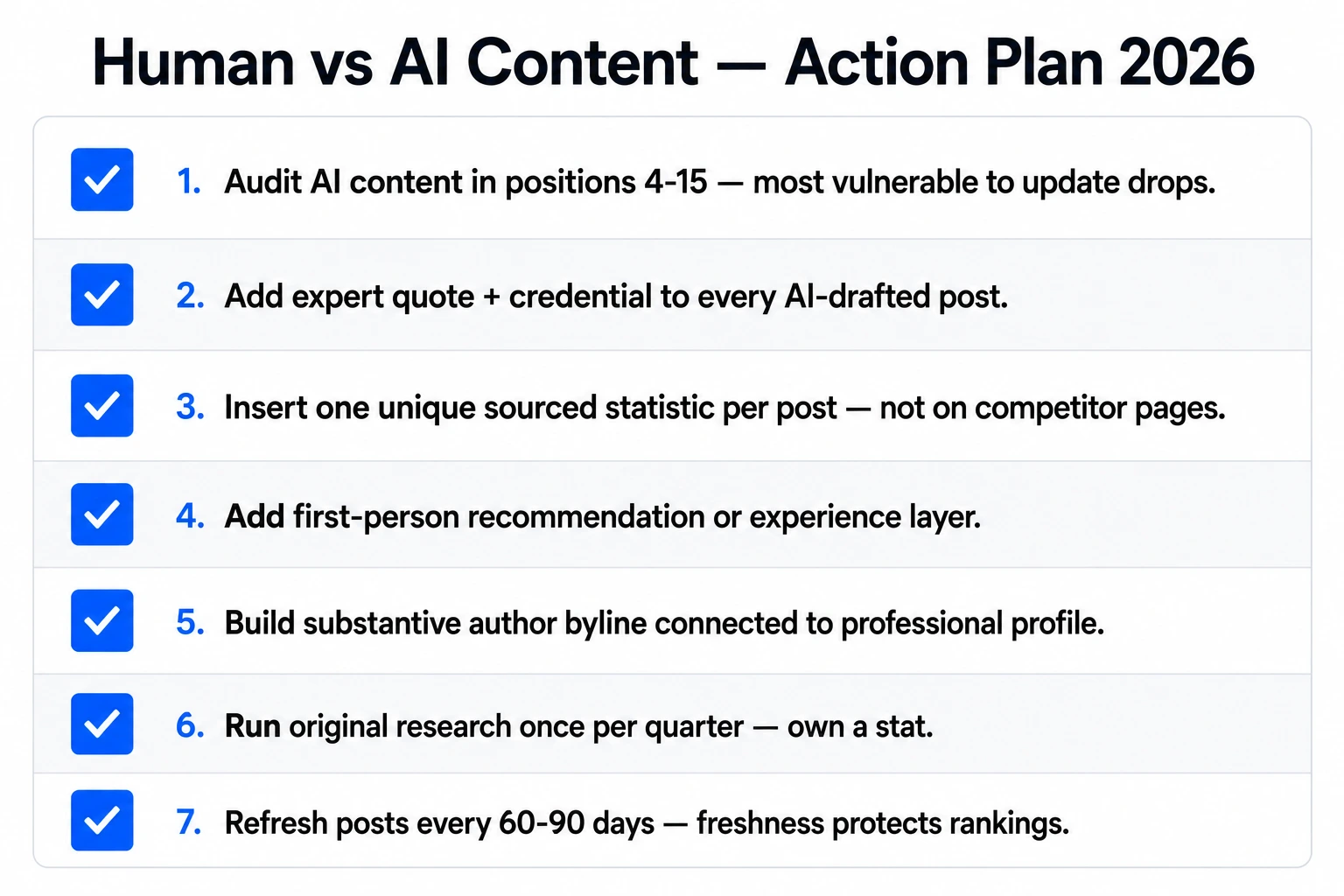
Audit your existing AI content first. If you have been publishing AI-generated content without substantive human editing, identify the pages that are ranking in positions 4 through 15. These are the pages most vulnerable to losing positions at the next core update. Apply the editorial enhancement process to them: add an expert quote, source a specific statistic, add a first-person recommendation, and ensure the author bio is substantive and visible.
Do not abandon AI in your workflow. The near-parity finding for AI-assisted content is the most important practical result from recent research. The productivity gains from AI drafting are real. The quality standard does not have to be compromised. The key is treating the human editing step as non-negotiable rather than optional.
Invest in original research. A single piece of original data a survey result, a benchmark study, a proprietary analysis creates E-E-A-T signals that protect rankings, generates natural editorial backlinks, and produces the mandatory citation signals that drive AI search visibility simultaneously. The return on investment from original research is higher in 2026 than at any previous point in SEO history.
Build your author bylines. 89% of AI-only articles lacked an identifiable expert author. This is a gap you can close immediately. Every post on your site should have an author byline connected to a profile that demonstrates relevant expertise, credentials, or experience. This applies whether the content was AI-drafted or human-written.
Refresh before republishing. Rather than publishing new AI content at scale, consider applying editorial enhancement to your existing content library. The freshness signal from a substantive update one that adds new data, expert perspective, and structural improvements improves both Google rankings and AI citation frequency.
CONCLUSION:
The data from 2026 is clear enough to act on. Human-written content dominates the top-ranking positions. Pure AI content consistently underperforms. AI-assisted content with genuine human editorial enhancement nearly matches human writing at a fraction of the cost.
In 2026, the real competition is not human vs AI. It is AI-only vs AI plus human. The hybrid approach achieves near-parity with human writing at a fraction of the cost.
Google does not reward human authorship as a category. It rewards the specific quality signals that human expertise produces: original insight, demonstrable experience, expert attribution, unique data, and the engagement behaviour of readers who found what they were looking for. AI can accelerate the process of producing those signals. It cannot replace the human contribution that generates them.
The sites that will dominate Google rankings in the next 12 months are not the ones producing the most AI content or the most human content. They are the ones with the most reliable editorial process using AI for speed and humans for the quality signals that algorithms and readers both require.
FAQs
Q: Does AI content rank on Google in 2026?
A: AI content can rank on Google in 2026, but pure AI content without human editing ranks 23% lower on average than human-written articles, according to a 16-month study of 4,200 articles by Digital Applied. Google does not penalise content for being AI-generated it penalises low-quality content regardless of how it was produced. AI-assisted content with substantive human editing performs within 4% of fully human-written content on ranking position.
Q: Is human content better than AI content for SEO?
A: For ranking in top positions, human-written and AI-assisted content outperforms pure AI content. Human content is 8x more likely to rank number 1 than pure AI content, according to Semrush’s April 2026 study of 42,000 blog pages. However, AI-assisted content AI-drafted with human editing, expert quotes, and original data nearly matches human-written content in ranking performance at significantly lower production cost.
Q: What is the biggest disadvantage of AI content for SEO?
A: The biggest structural disadvantage of pure AI content for SEO is the backlink gap. AI-only content acquires 61% fewer editorial backlinks than human-written articles on comparable topics, according to Digital Applied’s 2026 research. Backlinks remain a top-three Google ranking signal. AI content also lacks the E-E-A-T signals expert authorship, original research, first-person experience that Google’s quality systems are designed to detect and reward.
Q: What is the best content strategy for Google rankings in 2026?
A: The best content strategy in 2026 is the hybrid AI-assisted approach: use AI for research and first drafts, then apply substantive human editing to add expert quotes with visible credentials, original sourced statistics, first-person recommendations, and a professional author byline. This approach achieves near-parity with fully human-written content in Google rankings while capturing the three to five times speed advantage of AI drafting.
Q: Did Google’s March 2026 update affect AI content rankings?
A: Yes. Google’s March 2026 core update accelerated the ranking divergence between pure AI content and human-written or AI-assisted content. The update elevated E-E-A-T signals, page experience factors, and the Helpful Content System’s ability to identify content created primarily for ranking rather than for users. Sites relying on unedited AI content at scale saw volatility and ranking losses after the update, while sites with consistent editorial processes maintained or improved their positions.