


Not all content is treated equally by AI search engines. And in 2026, that distinction matters more than it ever has.
Google AI Overviews now appear in over 25 percent of all searches. ChatGPT processes 2 billion queries daily. Perplexity handles 780 million monthly queries. And the single biggest factor separating the content that gets cited in these AI-generated answers from the content that gets ignored is not keyword optimisation, domain authority, or publishing frequency.
It is format.
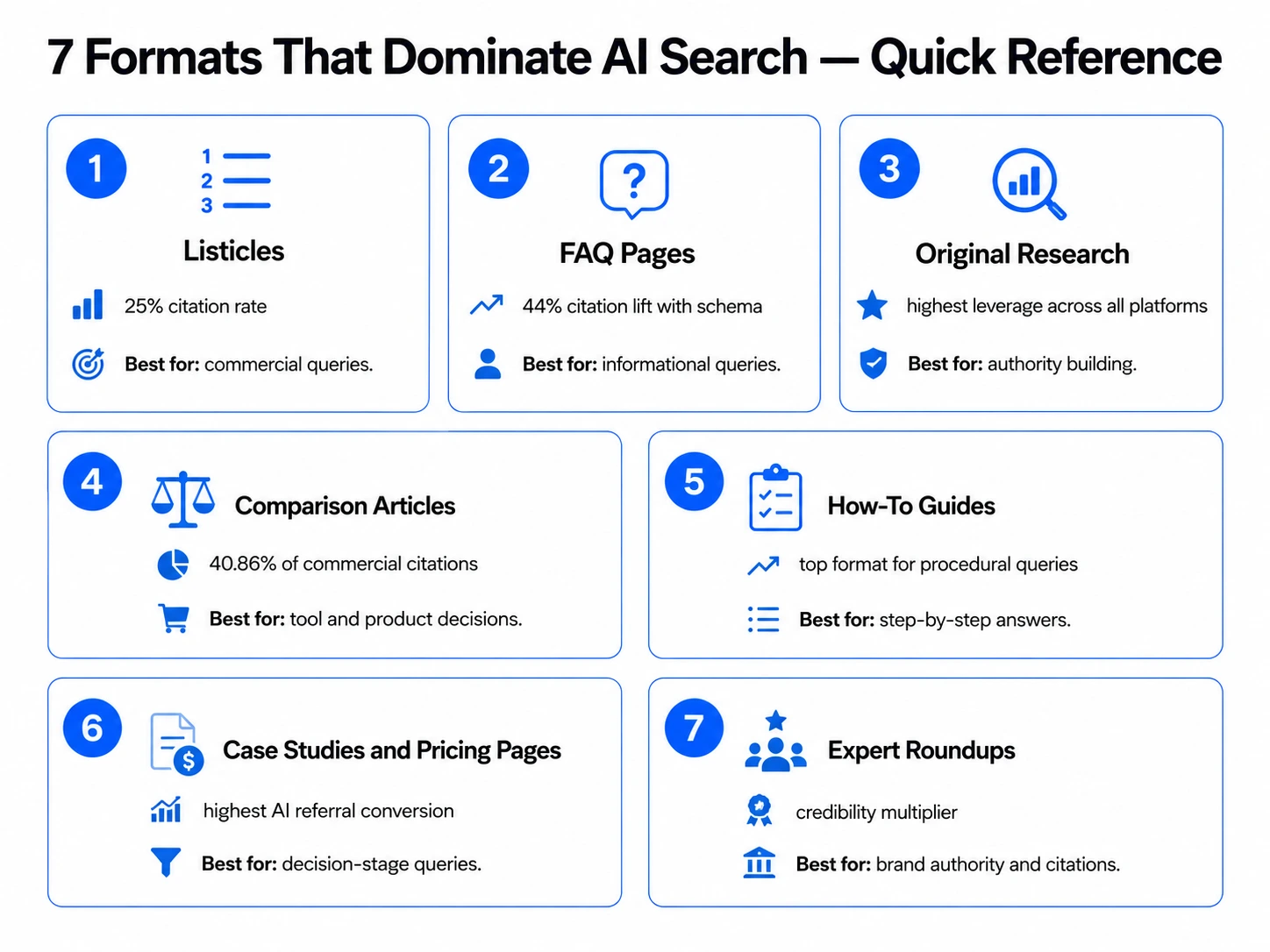
A Wix study analysing AI Mode, ChatGPT, and Perplexity citations found that listicles have a 25 percent citation rate more than double the 11 percent rate for standard blog posts and opinion pieces. BrightEdge found that sites implementing structured data and FAQ blocks saw a 44 percent increase in AI search citations. And Leapd’s analysis confirmed that original data and proprietary research are the highest-leverage content type across all three major AI platforms.
The pattern is consistent across every major research study from 2025 and 2026: AI search engines have strong format preferences, and those preferences are different from what Google’s traditional algorithm rewards. A site that has spent years optimising for featured snippets and informational blog posts may find itself largely invisible in AI-generated answers, while a competitor with a fraction of the domain authority but better-structured content consistently gets cited.
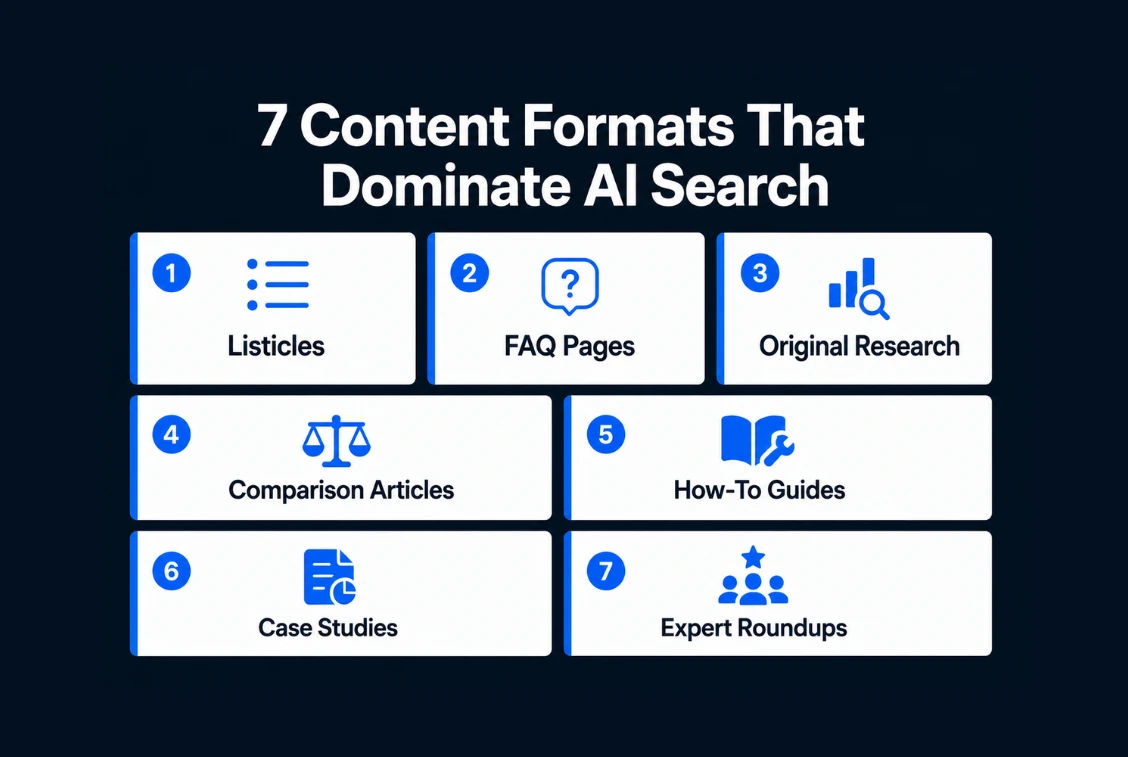
This post covers the seven content formats that AI search engines cite most reliably, the data behind each one, what makes each format work for AI extraction, and real examples of how each format should be structured so you can implement them immediately.
Why Format Matters More Than Keywords in AI Search
Before getting to the seven formats, it helps to understand why format matters so much in the first place.
Traditional Google search uses keyword matching and hundreds of ranking signals to decide which pages should appear for which queries. Format matters, but only as one input among many. A poorly formatted post with excellent backlinks can still rank.
AI search works differently. AI language models use a process called retrieval-augmented generation RAG to evaluate candidate pages and decide what to cite. The model retrieves content, measures how well it can extract a direct, coherent answer from the page, and then decides whether to cite it. Content that is easy to extract scores higher. Content that buries answers in narrative prose, uses no structural signals, or requires reading the whole document for context scores lower.
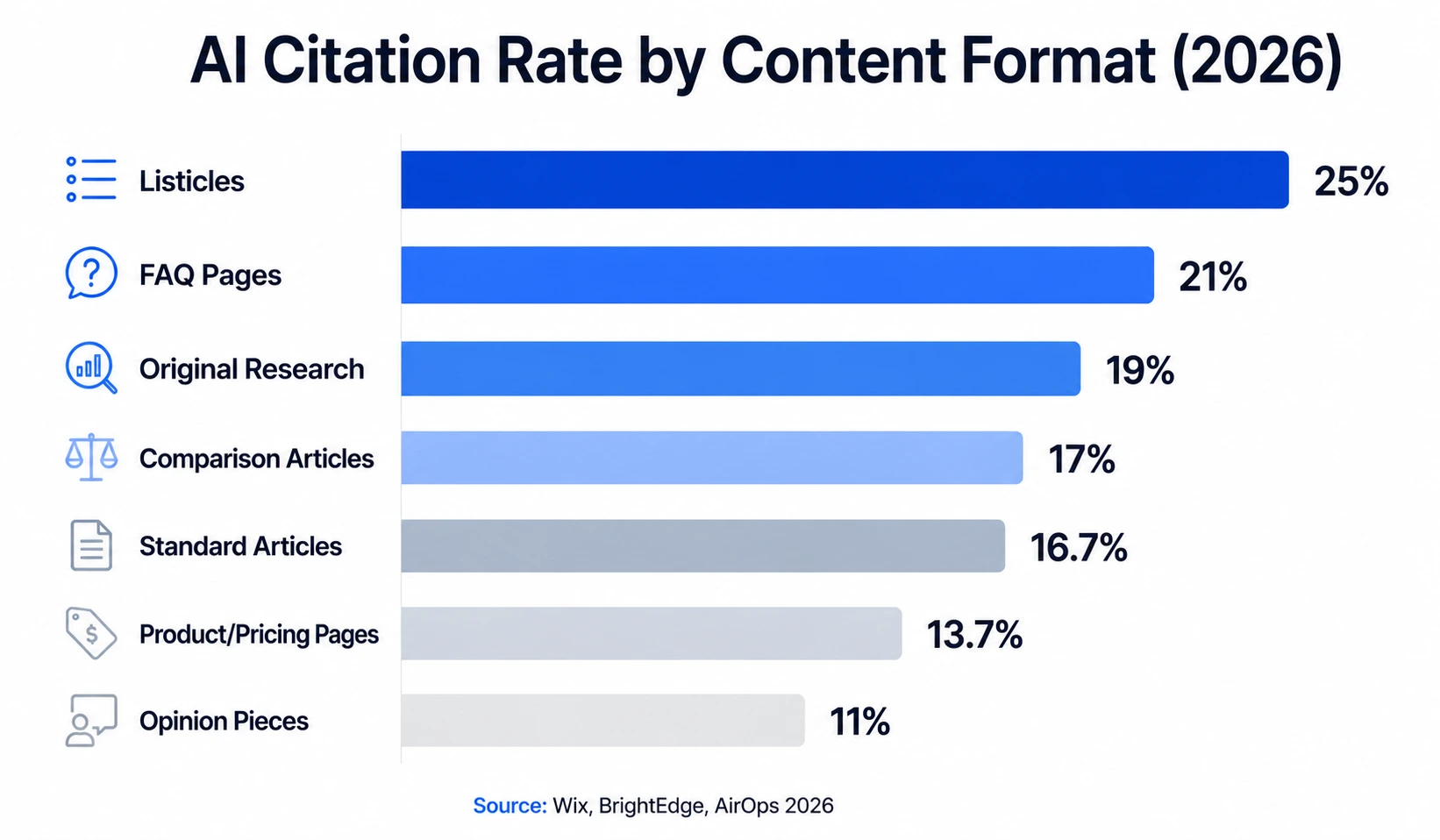
Listicles at 21.9 percent, articles at 16.7 percent, and product pages at 13.7 percent are the most common citation types in AI Mode, ChatGPT, and Perplexity, according to Wix’s March 2026 analysis. LLMs cite different content types for different intents 45.48 percent of informational queries cite articles, while 40.86 percent of commercial queries cite listicles.
This format-intent alignment is the core strategic insight. The right format for your content depends on the intent behind the query you are targeting. Get the format wrong and your content will be retrieved but not cited appearing in the model’s evaluation process but discarded before the answer is generated.
Sites implementing structured data and FAQ blocks saw a 44 percent increase in AI search citations, according to BrightEdge research. That single statistic represents one of the highest-leverage optimisation changes available to most content sites in 2026.
Format 1 – Listicles and Ranked Lists (25% Citation Rate)
Listicles are the single most-cited content format across AI search engines. Listicles sit at a 25 percent citation rate compared to blogs and opinion pieces at 11 percent, according to Exposure Ninja’s CMO data.
The reason listicles dominate is structural. AI language models extract information by identifying discrete, clearly bounded units of content. A numbered list gives the model exactly that each item is a self-contained unit with a clear boundary. The model can extract item three without needing items one and two for context. That extractability is what drives the citation advantage.
But not all listicles perform equally. The listicles that AI search engines cite most reliably share specific structural characteristics.
Each item needs a descriptive H3 subheading, not just a number. “3. Perplexity AI Best for real-time research with citations” is far more extractable than “3. Perplexity AI.” The subheading gives the model the summary it needs to decide whether this item is relevant to the query being answered.
Each item needs two to four sentences of substantive content below the heading. A listicle where every item is a single sentence provides too little context for the model to cite confidently. The sweet spot is enough to fully address the item without requiring the reader to follow a link to get the real information.
Aside from standard blog pages, “best,” “top,” and “vs” content tends to drive the highest AI traffic according to Exposure Ninja’s 2026 analysis. This is the keyword-level expression of the same principle: queries beginning with “best” and “top” trigger commercial intent, and commercial intent queries favour listicle formats in AI citations at a rate of 40.86 percent.
Real example of a well-structured list item:
1. Perplexity AI – Best Free Tool for Verified Research
Perplexity AI is an AI search engine that searches the live web and returns answers with clickable citations for every claim. Unlike ChatGPT, it includes sources directly in the answer rather than requiring users to follow up for verification. It is free to use for most queries and processes 780 million monthly searches as of 2026. Perplexity is particularly well suited for fact-checking, competitive research, and any workflow where source attribution matters.
That structure descriptive heading, direct answer in sentence one, supporting detail, practical application is the formula that AI extraction systems are built to recognize and cite.
Format 2 – FAQ Pages and FAQ Schema (44% Citation Lift)
FAQ content is the format most deliberately engineered for AI extraction, and the data reflects that. Sites implementing structured data and FAQ blocks saw a 44 percent increase in AI search citations, according to BrightEdge research. Websites with author schema are three times more likely to appear in AI answers, and schema markup adoption rose 35 percent from 2023 to 2026 across the web.
FAQ schema does two things simultaneously. It tells search engines that specific sections of your content are intended as question-and-answer pairs making them eligible for direct extraction. And it structures your content in the exact format that AI systems use internally when generating answers to conversational queries.
The most important structural rule for FAQ content: the answer must be complete within two to four sentences. AI systems evaluate FAQ answers by asking whether the user’s question would be fully resolved by the answer alone, without visiting the page. An FAQ answer that says “see the section below for more details” fails this test completely. The answer needs to stand alone.
Content structured for featured snippets is more likely to be cited in AI-generated answers. Using concise definitions, clear headers, and step-by-step lists makes content easier for AI tools like Google’s AI Overviews, ChatGPT, and Perplexity to extract and summarise, according to Semrush’s 2026 optimisation guide.
The practical implementation: add a FAQ section to every post with five to ten questions. Use the exact phrasing users type into search not polished marketing language. Implement FAQPage schema using AIOSEO or your preferred plugin. Keep answers between 40 and 80 words. Start every answer with a direct response to the question, not with “it depends” or “great question.”
Real example of a well-structured FAQ answer:
Q: What is the best content format for AI search in 2026?
A: Listicles have the highest AI citation rate at 25 percent, according to Wix’s 2026 analysis of AI Mode, ChatGPT, and Perplexity. FAQ pages with schema markup produce a 44 percent citation lift according to BrightEdge. For commercial queries, comparison articles and listicles outperform standard blog posts. For informational queries, structured articles with clear H2 subheadings perform best.
That answer under 80 words, cites data, starts with a direct response, stands completely alone is what FAQ content for AI search looks like.
Format 3 – Original Research and Proprietary Data
Original data and proprietary research are the highest-leverage content type across all three platforms ChatGPT, Perplexity, and Google AI Overviews according to Leapd’s 2026 citation analysis.
The logic is straightforward. AI systems synthesise answers from multiple sources. When they encounter information that exists in only one place a proprietary survey, an original experiment, a unique benchmark study that source becomes necessary rather than optional. The model cannot get your original data anywhere else, so if it wants to include that information in an answer, it has to cite you.
Content with statistics, citations, and quotations achieves 30 to 40 percent higher visibility in AI responses, according to Superlines’ 2026 analysis of AI search statistics. Every piece of original research you publish is a citation magnet both because it contains unique data and because other sites that cite your research create additional authority signals that AI systems recognize.
The bar for “original research” is lower than most marketers assume. You do not need a formal academic study. A survey of your own audience, a benchmark based on your own client data, an analysis of publicly available data that has not been compiled in this specific way before all of these qualify. What matters is that the data is specific, attributed, and not available in an identical form on another site.
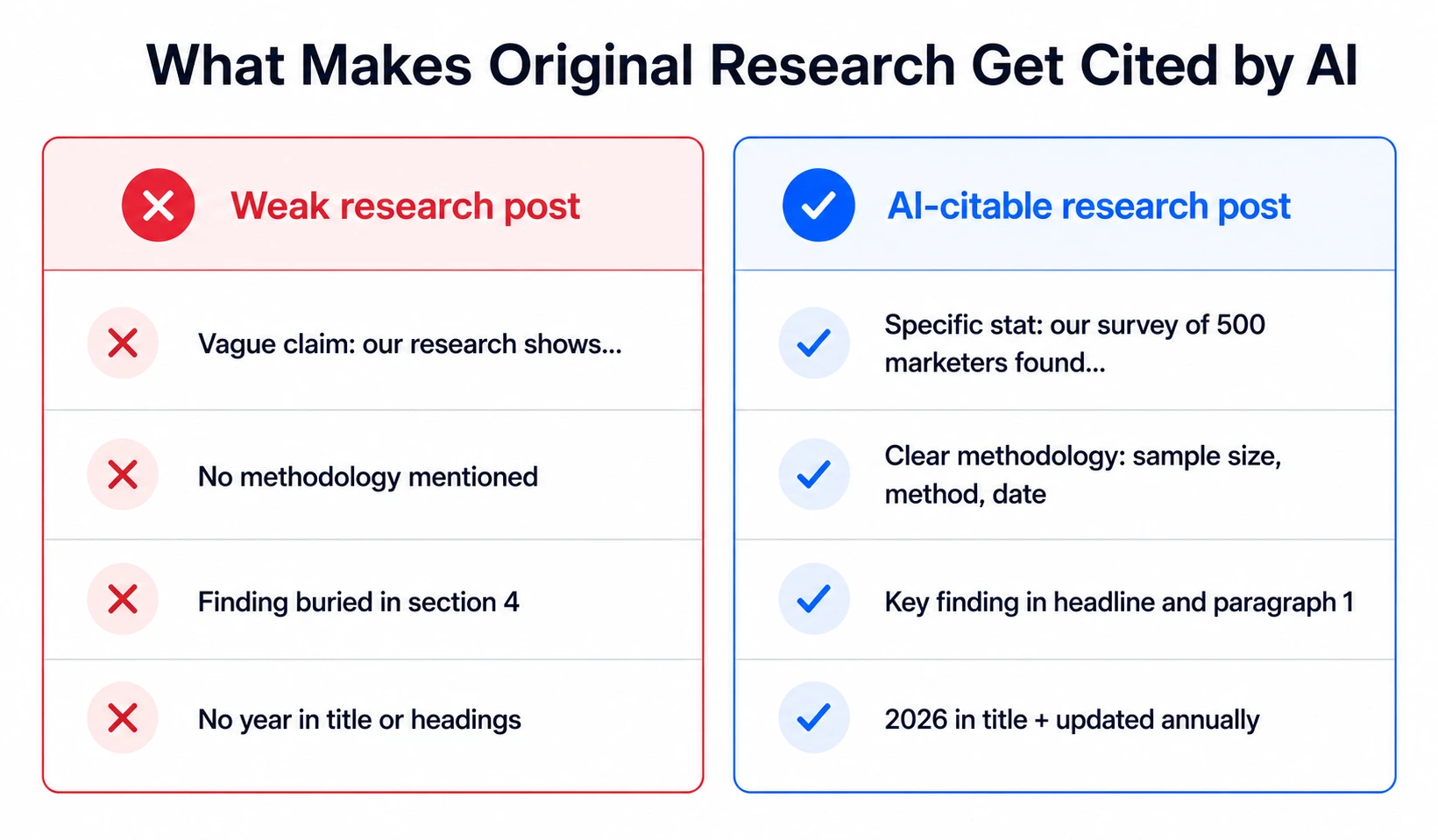
The structural requirements for original research posts differ slightly from other formats. The key finding needs to appear in the headline and within the first paragraph, not buried in the methodology section. Statistics need clear attribution not just “according to our research” but “our survey of 500 affiliate marketers in India found.” Methodology needs to be transparent enough that another researcher could verify your approach.
Visible year signals including “2026” in titles and headings improve citation rates by approximately 30 percent, according to Leapd’s analysis. For research posts specifically, including the year in the title and updating annually is the single most efficient freshness signal available.
Format 4 – Comparison Articles (The Commercial Intent Winner)
40.86 percent of commercial queries cite listicles, making comparison and versus content the dominant format for product and tool discovery in AI search, according to Wix’s March 2026 analysis.
Comparison articles “Tool A vs Tool B,” “X alternatives to Y,” “which is better for Z” are the commercial equivalent of listicles for informational queries. They match the intent of users who are close to a decision and need a structured evaluation rather than a general overview.
AI systems cite comparison articles heavily for commercial queries because the format naturally produces extractable judgements. A well-structured comparison tells the user which option wins on specific criteria, at what price, and for what use case. That structure maps perfectly to the synthesized answers AI generates for “what is the best tool for X” queries.
Aside from blog pages, “best,” “top,” and “vs” content drives the highest AI traffic according to Exposure Ninja’s 2026 research. This is not coincidental. The “vs” keyword signals a comparison intent query, and comparison intent queries are exactly where AI search engines look for structured comparison content to cite.
The structural requirements for comparison articles are specific. The comparison needs a clear winner stated early not buried in a conclusion after 3,000 words. Each tool or option needs its own H3 section covering the same set of criteria consistently. A summary table comparing key attributes gives the model a compact, extractable format alongside the narrative detail. And the recommendation needs to specify the use case: “X wins for high-volume users on a flat budget; Y wins for anyone who needs scheduling and creation in one dashboard.”
What does not work is false balance a comparison that refuses to make a recommendation and hedges everything with “it depends.” AI systems evaluating comparison content for citation look for decisive, specific guidance. Content that provides it gets cited. Content that avoids it gets passed over in favour of a source that commits to an answer.
Format 5 – How To Guides with Numbered Steps
How-to content is the most consistently cited format for procedural queries searches where the user needs to do something rather than know something. For informational queries, step-by-step tutorials with clear action-based headings and Q-and-A formats perform best, according to SEMrush’s 2026 AI content optimization guide.
The structural advantage of numbered step content is identical to listicles: each step is a self-contained unit that AI can extract without the surrounding context. But how-to guides have one additional advantage they match procedural query intent precisely. When a user asks ChatGPT “how do I get cited in Google AI Overviews,” the model is actively looking for step-by-step content to structure its answer around. A numbered how-to guide is the format that wins this query type.
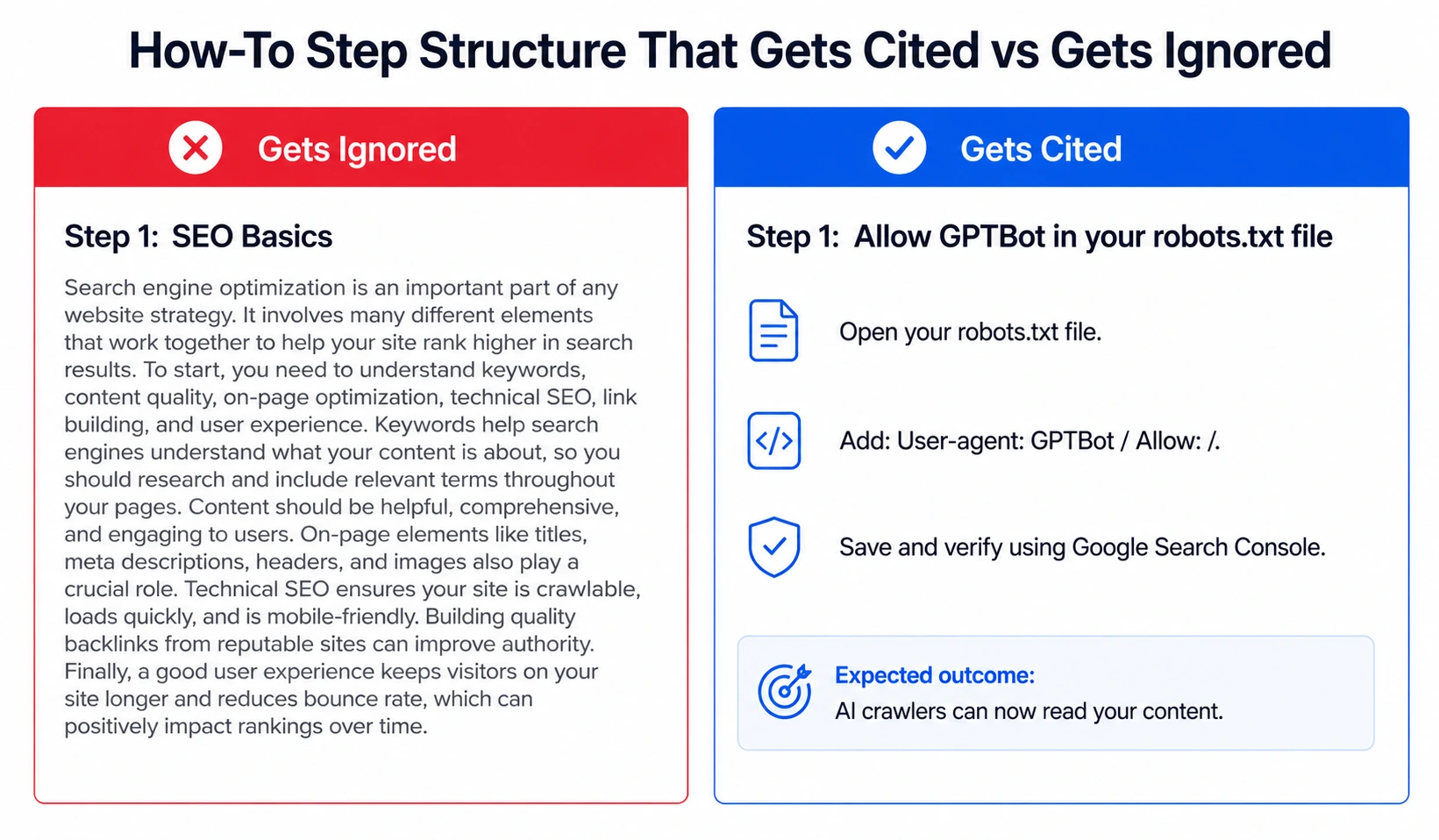
LLMs do not read like humans. They extract clear, structured, and skimmable chunks of content, according to SEMrush’s optimization guide. For how-to content specifically, this means each step needs a specific action in the heading not “Step 1: SEO” but “Step 1: Allow AI crawlers in your robots.txt file.” The action verb makes the step extractable as a standalone instruction.
The recommended how-to structure for AI citation: a numbered list of steps with action-verb headings, two to four sentences per step explaining what to do and why, and a brief summary of the expected outcome at the end. Steps should be ordered by logical dependency what you do first, not what sounds most impressive first.
One common mistake in how-to content is optimising steps for length rather than clarity. A step that takes three paragraphs to explain what can be said in four sentences will be passed over by AI extraction in favour of a more concise source. Brevity per step, with depth added through the number of steps, is the right balance.
Format 6 – Case Studies and Pricing Pages
This is the finding that surprises most content marketers. Case studies and pricing pages outperform top-of-funnel “what is” or “how to” guides for driving AI-referred traffic, according to Leapd’s 2026 citation analysis.
The reason is intent alignment. The users who arrive at a site via AI search citation are typically further along in their research or decision process than typical organic search visitors. They are not looking for a general introduction. They are evaluating whether a specific product, tool, or approach is right for their situation. Case studies and pricing pages answer exactly that question.
AI search traffic converts at 14.2 percent compared to Google’s 2.8 percent, showing this traffic is dramatically more valuable, according to Exposure Ninja’s 2026 analysis. The content formats that drive AI-referred traffic are therefore disproportionately valuable because the visitors they attract are already in decision mode.
For case studies specifically, the format needs to be structured rather than narrative. A case study written as a story “Company X came to us with a problem, and over the next six months we worked to understand their needs” is hard to extract. A case study structured as a problem-approach-result framework, with the result stated in the headline, gives AI systems the extractable evidence they need.
For pricing pages, the key structural requirement is transparency. AI systems cite pricing pages when the pricing information is directly readable. A pricing page that says “contact us for pricing” provides nothing to cite. A pricing page that shows specific plan names, prices, feature comparisons, and a recommendation for which plan fits which use case is highly citable and matches the commercial intent queries where AI search is most active.
The combination of these two formats case studies proving real-world results and pricing pages making costs transparent creates the highest-converting AI citation opportunity available to most content and marketing sites.
Format 7 – Expert Roundups and Quote-Based Content
Direct quotes from experts signal credibility to AI systems. AI systems check author qualifications before citing content, according to Dataslayer’s 2026 analysis of ChatGPT citation behaviour.
Expert roundups posts that collect insights from multiple named experts on a shared topic are cited by AI systems for two compounding reasons. First, they contain direct quotations from identifiable authorities, which AI systems treat as credibility signals. Second, they appear in the “authoritative list” format that accounts for 41 percent of ChatGPT’s citation weighting according to Onely’s research.
The structural requirement for expert roundups is that expert credentials must be visible in the content, not just in a bio at the bottom. “According to [Name], a [specific credential] at [organisation]” is the citation-ready format. An unattributed quote from “a marketing expert” provides nothing for the AI to anchor its credibility assessment to.
Brands are currently 6.5 times more likely to be cited through third-party sources like review sites, news, and forums than through their own brand domains, according to Superlines’ 2026 analysis. Expert roundups essentially create a third-party validation structure within your own content each quoted expert is an external voice contributing to your page’s perceived authority.
For content marketers building a new site or trying to establish credibility quickly, expert roundups have a secondary benefit: they attract natural backlinks from the experts who are featured, and those experts often share the post with their own audiences generating exactly the kind of branded web mentions across multiple platforms that AI visibility research consistently identifies as a top citation driver.
Platform-Specific Format Preferences – What Changes by Platform
The format advice above applies broadly across AI search. But the three major platforms ChatGPT, Perplexity, and Google AI Overviews have distinct preferences worth understanding.
ChatGPT favours Wikipedia and encyclopaedic content at 47.9 percent of top citations, Perplexity heavily cites Reddit at 46.7 percent, and Google AI Overviews prefer YouTube and multi-modal content at 23.3 percent, according to Averi’s analysis of 680 million citations.
Only 11 percent of domains are cited by both ChatGPT and Perplexity meaning they are effectively different ecosystems requiring different optimization strategies, not a single unified AI search audience.
For ChatGPT specifically, encyclopaedic and structured content performs best. Posts that are comprehensive, neutral in tone, and structured like a reference document complete with definitions, context, and cited data match the Wikipedia-style preference that dominates ChatGPT’s citation patterns. Listicles and comparison articles work well here because they mirror the encyclopaedic structure of curated reference content.
For Perplexity, community-sourced and debate-driven content performs disproportionately well. Perplexity averages 21.87 citations per response the highest of any major AI platform meaning the competition for each individual citation slot is lower than on ChatGPT. Perplexity favours content with structured H2 and H3 headings organized around specific questions, visible statistics, named sources with verifiable methodology, and content that cites other authoritative sources. Expert roundups and original research with clear attribution are particularly well-suited to Perplexity’s citation preferences.
For Google AI Overviews, Google is more likely to pull data from Wikipedia, YouTube, Reddit, and Quora for AI Overview responses, according to Ahrefs’ June 2025 analysis. Multi-modal content posts that include video embeds, original images, or infographics has a structural advantage for Google AI Overviews specifically. FAQ schema and How-to schema are the most impactful structured data types for AI Overview citations.
If you want to test how your content is cited across multiple AI platforms without switching tabs, Merlin AI lets you query ChatGPT, Claude, and Gemini from one dashboard simultaneously.”
How to Audit Your Existing Content Against These Formats
Knowing which formats work is only useful if you apply the knowledge to your actual content. Here is a practical audit process.
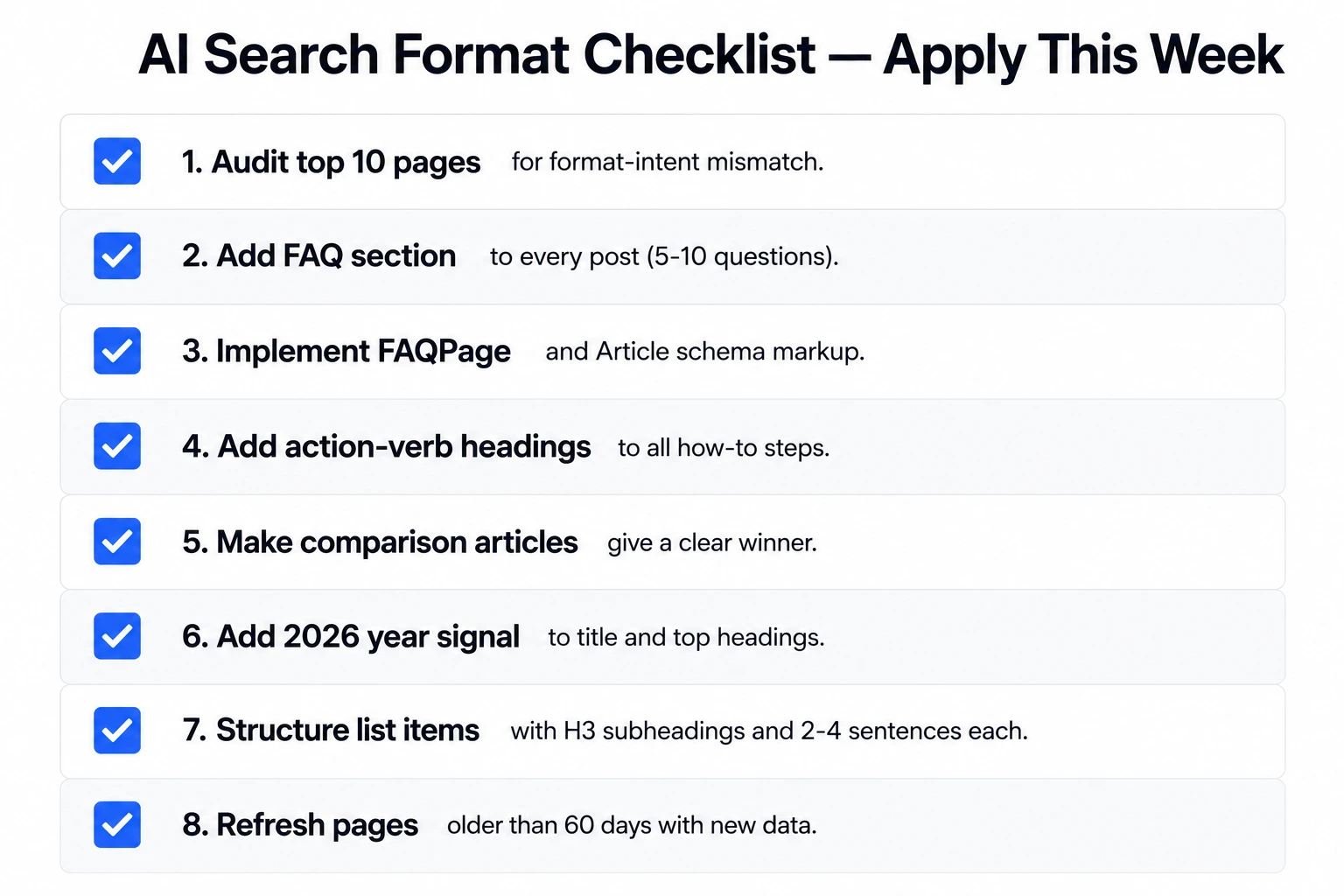
Take your ten highest-traffic pages and evaluate each against three questions. First: what format is this page currently? If it is a standard narrative blog post with no list structure, no FAQ section, and no comparison element, it is likely underperforming its authority level in AI citations regardless of its Google ranking.
Second: what is the query intent this page targets? If the intent is informational, the post needs structured article or FAQ format. If the intent is commercial comparing tools, finding the best option for a specific use case the post needs list or comparison format. Mismatched format and intent is the most common reason well-ranked pages fail to get AI citations.
Third: what is the extractability of this page’s key information? Open the page and try to identify a single sentence or two-sentence block that answers the primary question the post addresses. If you cannot find one, neither can an AI system. That is the first thing to fix.
After auditing, prioritise your retrofits by traffic volume and intent mismatch. A high-traffic informational page with no FAQ section is your highest priority. A comparison page that does not make a clear recommendation is your second. A how-to page with vague, unactionable step headings is your third.
Pages updated within 60 days are 1.9 times more likely to appear in AI answers, according to BrightEdge research. This means the act of retrofitting your format updating the post to add FAQ sections, restructure headings, and add schema markup doubles as a freshness signal that directly improves AI citation probability.
CONCLUSION:
Format is the fastest lever you have for improving AI search visibility in 2026. Unlike domain authority, which takes years to build, or branded web mentions, which require ongoing PR work, content format is something you can change this week.
The priority order is clear. Audit your highest-traffic pages for format-intent mismatch. Add FAQ sections with schema markup to every post. Restructure list content with descriptive H3 subheadings and substantive per-item content. Make comparison articles decisive. Make how-to guides action-verb specific. Invest in at least one piece of original research per quarter.
Around 93 percent of AI search sessions end without a website click, making answer visibility more important than traditional rankings alone. The formats in this post are not just citation optimization they are the formats that make your content useful enough to be the answer, not just a link on a results page.
The sites winning AI search visibility in 2026 are not necessarily the ones with the largest content libraries or the highest organic rankings. They are the ones whose content is structured to be cited, extracted, and delivered as a direct answer. Format is what makes that possible.