


SEO changed more in 2025 and 2026 than it did in the previous decade combined.
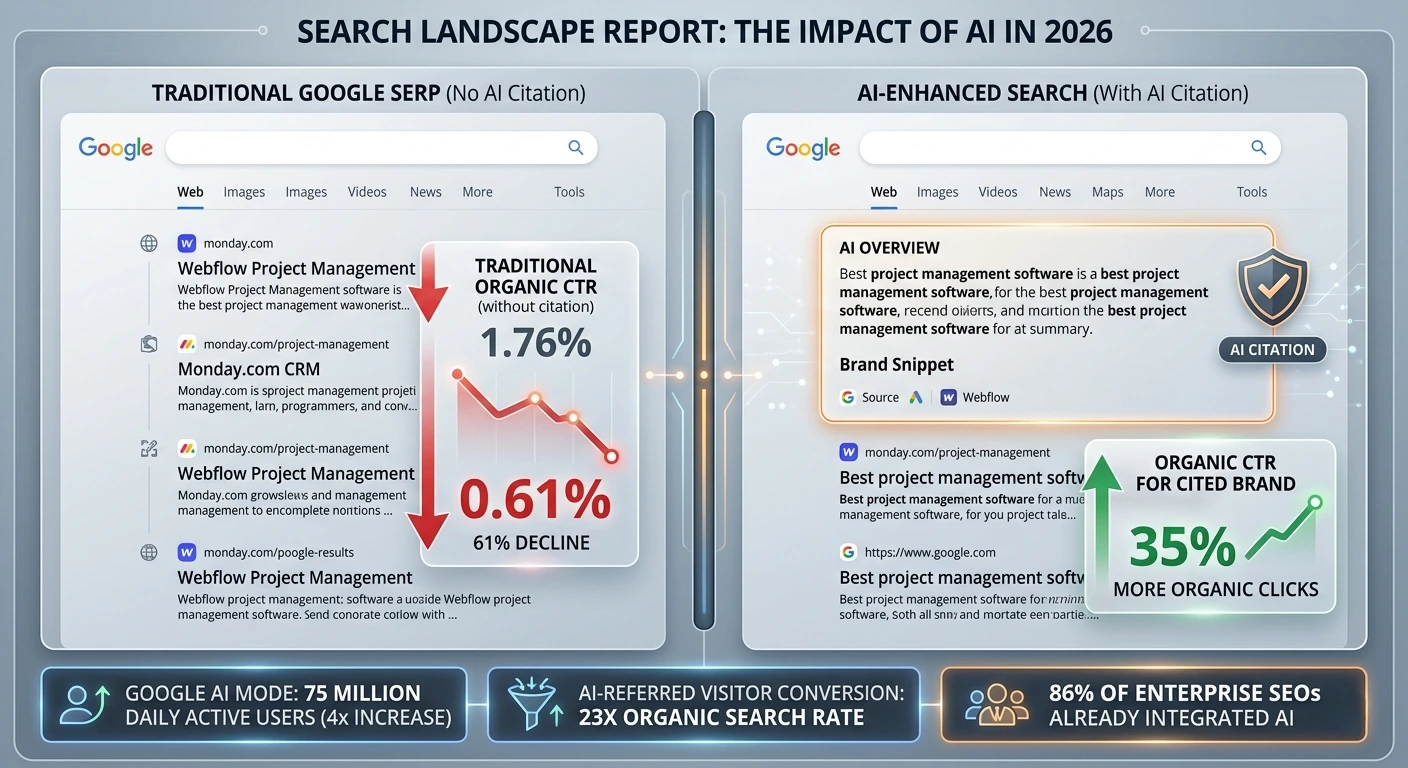
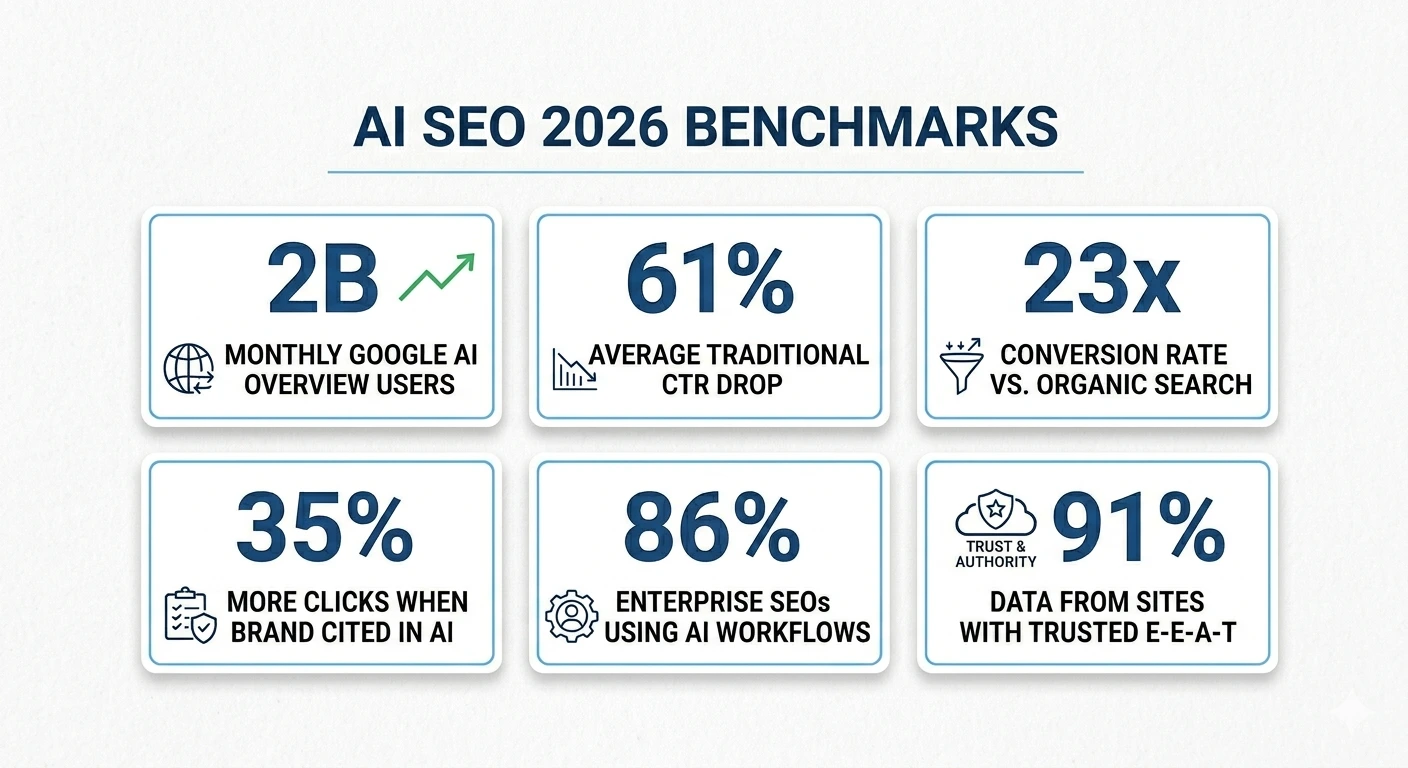
Google AI Overviews now appear in up to 48 percent of all search queries and reach 2 billion monthly users globally. ChatGPT receives over 5 billion monthly visits and has become the fourth most visited website in the world. Meanwhile, organic click-through rates have dropped by 61 percent when AI Overviews appear on the page.
If you are still using the same SEO playbook from 2022 or 2023, you are not just falling behind. You are operating in a fundamentally different search environment than the one your strategy was built for.
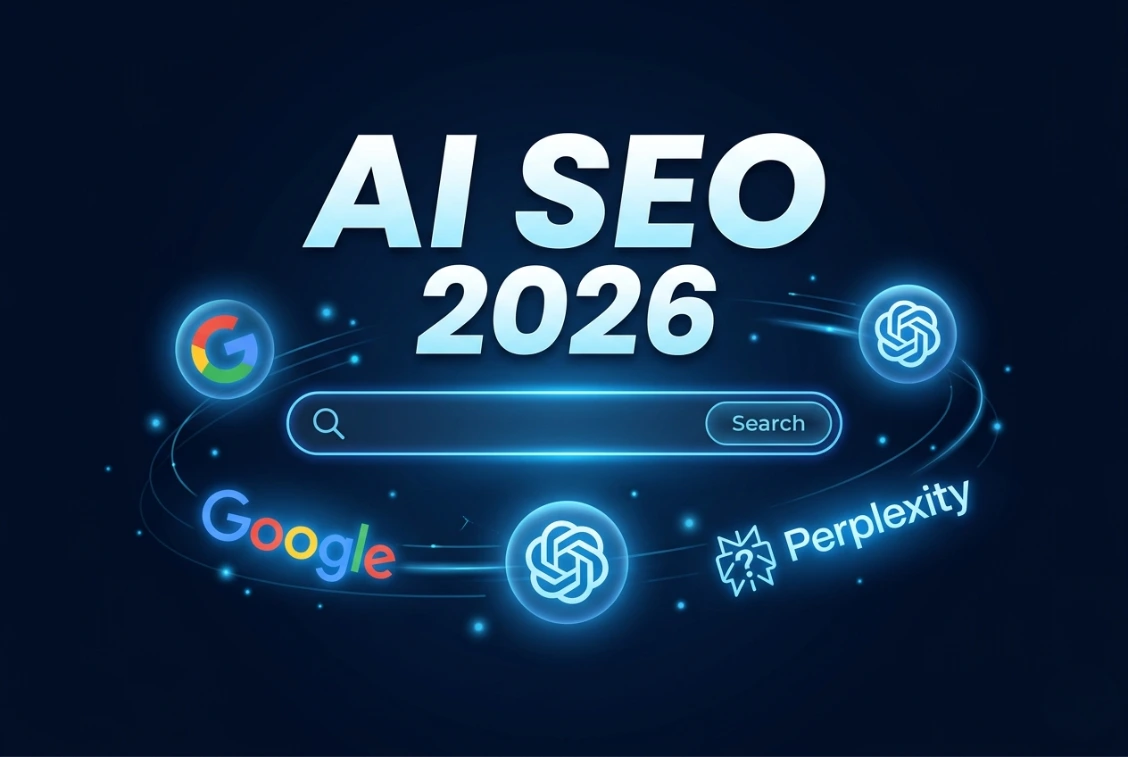
AI SEO is the practice of optimizing content, so it performs in both traditional search engines like Google and the new generation of AI-powered search platforms including Google AI Overviews, ChatGPT Search, and Perplexity. It is not a replacement for traditional SEO. It is an expansion of it.
This guide covers everything from the absolute basics to advanced strategy. Whether you are just starting out or already running an established blog, by the end of this post you will know exactly what AI SEO is, why it matters more than ever in 2026, and the specific steps to implement it on your site.
What Is AI SEO?
AI SEO refers to two related but distinct things, and most guides conflate them in a way that causes confusion. It is worth separating them clearly.
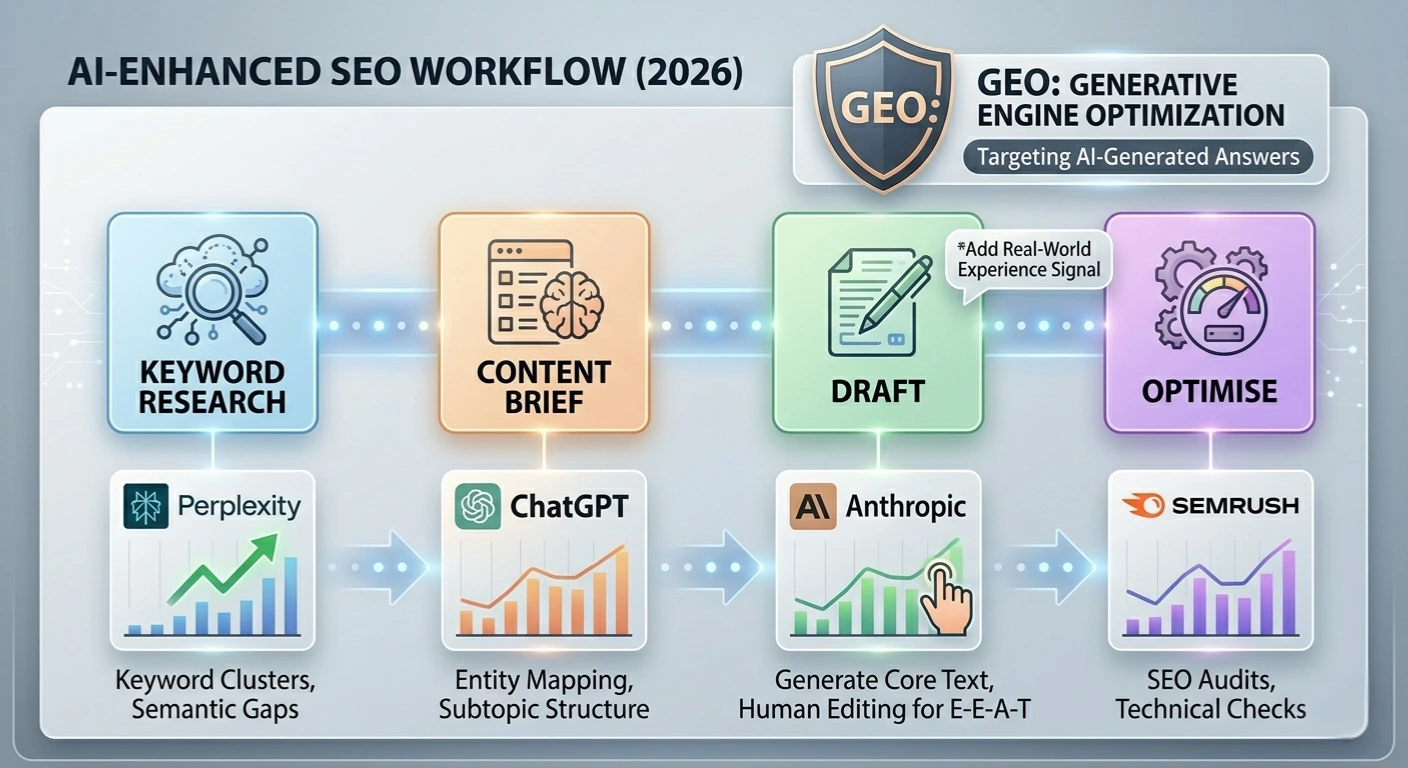
The first meaning is using AI tools to improve your SEO. This includes using tools like ChatGPT, Claude, Perplexity, and purpose-built SEO platforms to conduct keyword research faster, generate content briefs, write and optimise posts, analyse competitors, and automate technical audits.
The second meaning is optimising your content to appear in AI-generated search results. This includes appearing in Google AI Overviews, being cited by ChatGPT Search when users ask questions in your niche, showing up in Perplexity answers, and being referenced by Google AI Mode.
Both matter. But the second one is where most marketers have the largest untapped opportunity in 2026, because the majority of content creators are still only thinking about traditional Google rankings.
The short version: AI SEO is the practice of making your content visible and credible to both traditional search algorithms and AI language models, so that when a user asks a question in any search environment, your content is the source that gets cited, quoted, or ranked.
Why AI SEO Matters More Than Ever in 2026
Before getting into strategy, the data tells a story that makes the urgency clear.
Google AI Overviews appear in up to 48 percent of all search queries as of March 2026. Google AI Mode has reached 75 million daily active users, up 4x since its launch in May 2025. When an AI Overview appears on a search results page, the organic click-through rate for traditional results drops from 1.76 percent to 0.61 percent – a 61 percent decline.
That number alone should make every content creator stop and re-evaluate their traffic strategy.
But here is the counterintuitive part. Brands that are cited inside AI Overviews earn 35 percent more organic clicks and 91 percent more paid clicks. Being cited in AI results does not reduce your traffic. It dramatically increases it. The penalty only falls on sites that are visible on the page but not cited in the AI answer.
The conversion data is equally compelling. AI-referred website visitors convert at 23 times the rate of organic search visitors. This means that while AI search may drive lower raw traffic volume than traditional search, the visitors who arrive via AI citations are dramatically more valuable on a per-visit basis.
Additionally, 86 percent of enterprise SEO professionals have already integrated AI into their workflows, and 82 percent plan to increase their investment in 2026. The AI SEO tools market is projected to grow from 1.2 billion dollars in 2024 to 4.5 billion dollars by 2033. The competitive gap between businesses that understand AI SEO and those that do not is widening every quarter.
How AI Search Works – What You Need to Understand
To optimise for AI search, you need to understand how it works differently from traditional search.
Traditional Google rankings use hundreds of signals to determine which pages should rank for which queries. Keywords, backlinks, page authority, technical health, user experience – all of these combine into a ranking score. The goal is to get the highest score on the most relevant queries.
AI search works differently. AI language models do not rank pages in the traditional sense. They synthesise information from multiple sources and generate a direct answer. When choosing which sources to include in that answer, they look for different signals than traditional algorithms do.
What AI Models Look For
Semantic depth over keyword density. AI systems understand context and intent. They are not matching exact keyword strings. They are looking for content that comprehensively answers the question, covers related concepts, and demonstrates genuine understanding of the topic.
Content depth and readability. Research shows that content depth – measured by word count, sentence count, and structural completeness – correlates significantly with how often a piece is cited in AI answers. Readability also matters. Pages that are clear and easy to parse are cited more frequently.
Authority signals beyond backlinks. Traditional SEO heavily weights backlinks as an authority signal. AI citation patterns weight branded web mentions much more heavily. Position Digital research from 2026 found that branded web mentions have a correlation of 0.664 with AI Overview appearances, compared to 0.218 for backlinks. Mentions of your brand in news articles, on social media, in forums, and on third-party sites matter more for AI visibility than they do for traditional rankings.
Source credibility and E-E-A-T. Google’s E-E-A-T principles – Experience, Expertise, Authoritativeness, and Trustworthiness – have become more important in the AI era, not less. AI systems prefer to cite sources that demonstrate real-world experience and verified expertise. Generic AI-written content that lacks any indication of genuine human knowledge is significantly less likely to be cited.
Technical accessibility. AI crawlers need to be able to access and read your content. 46 percent of ChatGPT bot visits begin in reading mode, which means they access a plain HTML version of your page with no CSS, JavaScript, or images. If your content depends on JavaScript to load or is blocked by bot filters, AI systems cannot read it.
The Three Search Environments You Need to Optimize For
In 2026, SEO means optimising for three distinct environments simultaneously.
Traditional Google organic search remains the dominant channel. Google still processes approximately 14 billion search queries per day. ChatGPT, by comparison, handles around 37.5 million daily – a ratio of 373:1 in Google’s favour. Traditional SEO is not dead. It remains essential.
Google AI Overviews and AI Mode represent the evolving version of Google itself. These features already reach 2 billion monthly users and appear in up to 48 percent of queries. Optimising for these means structuring your content so Google’s AI can extract clear, citable answers from it.
Third-party AI search platforms including ChatGPT Search, Perplexity, and Google Gemini represent an emerging and rapidly growing channel. ChatGPT holds 64.6 percent market share among AI search platforms. As of early 2026, Perplexity recently surpassed the United States as its largest market in India, following a partnership with Airtel that drove 640 percent user growth. These platforms are growing fast and converting visitors at dramatically higher rates than traditional search.
| Feature | Traditional Google Search | AI Search (ChatGPT, Gemini, Perplexity) |
| Ranking Logic | Score-based ranking of individual pages. | Information synthesis and direct answer generation. |
| Content Priority | Keywords, backlinks, and page authority. | Semantic depth, context, and readability. |
| Authority Signals | Backlinks (Correlation: 0.218). | Branded web mentions (Correlation: 0.664). |
| Primary Goal | High placement for relevant queries. | Citation in AI-generated overviews. |
| Technical Focus | UX, Page Speed, and Technical Health. | Plain HTML accessibility (46% bot visits in reading mode). |
| E-E-A-T | Important for quality assessment. | Critical; favors human experience over generic AI text. |
| Market Volume | ~14 billion daily queries. | ~37.5 million daily queries (ChatGPT). |
| Growth Status | Dominant established channel. | Rapid growth; higher conversion rates than traditional search. |
Generative Engine Optimization (GEO) – The New Frontier
If AI SEO is the broad category, Generative Engine Optimization or GEO is the specific discipline within it that targets AI-generated answers directly.
The GEO market is currently valued at 886 million dollars and is projected to reach 7.3 billion dollars by 2031, representing a 34 percent compound annual growth rate. Companies implementing GEO strategies are reporting 300 to 500 percent return on investment within 6 to 12 months, and controlled tests have shown that GEO-style content changes increase visibility in generative engine responses by up to 40 percent.
GEO converts at 4.4 times the rate of traditional SEO. That is the single most important number to understand about why GEO deserves a dedicated strategy in 2026.
How to Implement GEO in Practice
Write in extractable formats. AI systems look for content they can lift directly into an answer. This means using clear, direct sentences that answer specific questions without requiring context from surrounding paragraphs. Subheadings that mirror the exact questions users ask. Definitions that appear near the top of sections. Lists that provide structured, scannable information.
Use entity-based content structure. AI systems understand content through entities – the people, places, things, and concepts mentioned in a piece and how they relate to each other. Content that weaves relevant entities together naturally signals to AI that it is a comprehensive, authoritative source on a topic. A post about AI SEO should naturally reference Google, Perplexity, ChatGPT, AI Overviews, E-E-A-T, and related concepts, not as keyword stuffing but as genuine contextual knowledge.
Build branded mentions across the web. Because branded web mentions correlate more strongly with AI citations than backlinks do, proactively earning mentions of your brand on high-authority sites, forums, social platforms, and industry publications becomes a core GEO strategy. PR, social media activity, guest contributions, and community participation all feed directly into AI visibility in ways that traditional link building does not.
Ensure technical AI accessibility. Check that your site allows AI crawlers through your robots.txt file. Avoid bot blocking rules that would prevent ChatGPT or Google’s AI systems from reading your content. Ensure your core content loads in HTML without requiring JavaScript execution. Pages with slow load times or CAPTCHA blocks are much more likely to be abandoned by AI crawlers before they finish reading.
Using AI Tools to Improve Your Traditional SEO
Beyond optimising for AI search results, using AI tools in your SEO workflow is one of the most significant efficiency upgrades available to content marketers in 2026.
Companies using AI for SEO publish 47 percent more content per month. AI-driven SEO can boost organic traffic by 45 percent and conversion rates by 38 percent for content sites. Nearly 70 percent of companies report better returns after integrating AI into their SEO and content workflows.
Keyword Research
AI tools change keyword research from a manual, time-intensive process into a fast, iterative one. You can give Claude or ChatGPT your niche, audience, and existing top-performing content and ask it to generate keyword clusters you have not covered, identify semantic variations around your target terms, and flag emerging questions in your topic area that have low competition because they are new.
Combine this with Perplexity for live research into trending questions and real-time data, and you have a keyword research workflow that takes 30 minutes instead of three hours.
Content Creation and Optimization
AI is most valuable in the content workflow not as a replacement for human writing but as a research and structuring partner. Use it to build comprehensive content briefs before you write, to check whether your draft covers all the subtopics a comprehensive piece should include, and to refine individual sections for clarity and directness.
The critical rule: AI outputs require human editing for experience signals. Google’s E-E-A-T criteria specifically reward content that demonstrates real firsthand experience. An AI cannot tell your readers that you personally tested a tool and found it underwhelming. That layer of genuine experience, added by a human, is what separates rankable content from the generic AI-written content that Google’s systems are increasingly able to identify and discount.
Technical SEO Audits
AI has made technical SEO significantly more accessible for non-technical content creators. You can now describe your site’s architecture to an AI tool, paste sections of your HTML or your sitemap, and ask it to identify technical issues, check your structured data implementation, and review your robots.txt file. Tasks that previously required a developer can now be handled by a content creator with good AI prompts.
AI SEO Strategy – A Step-by-Step Framework for 2026
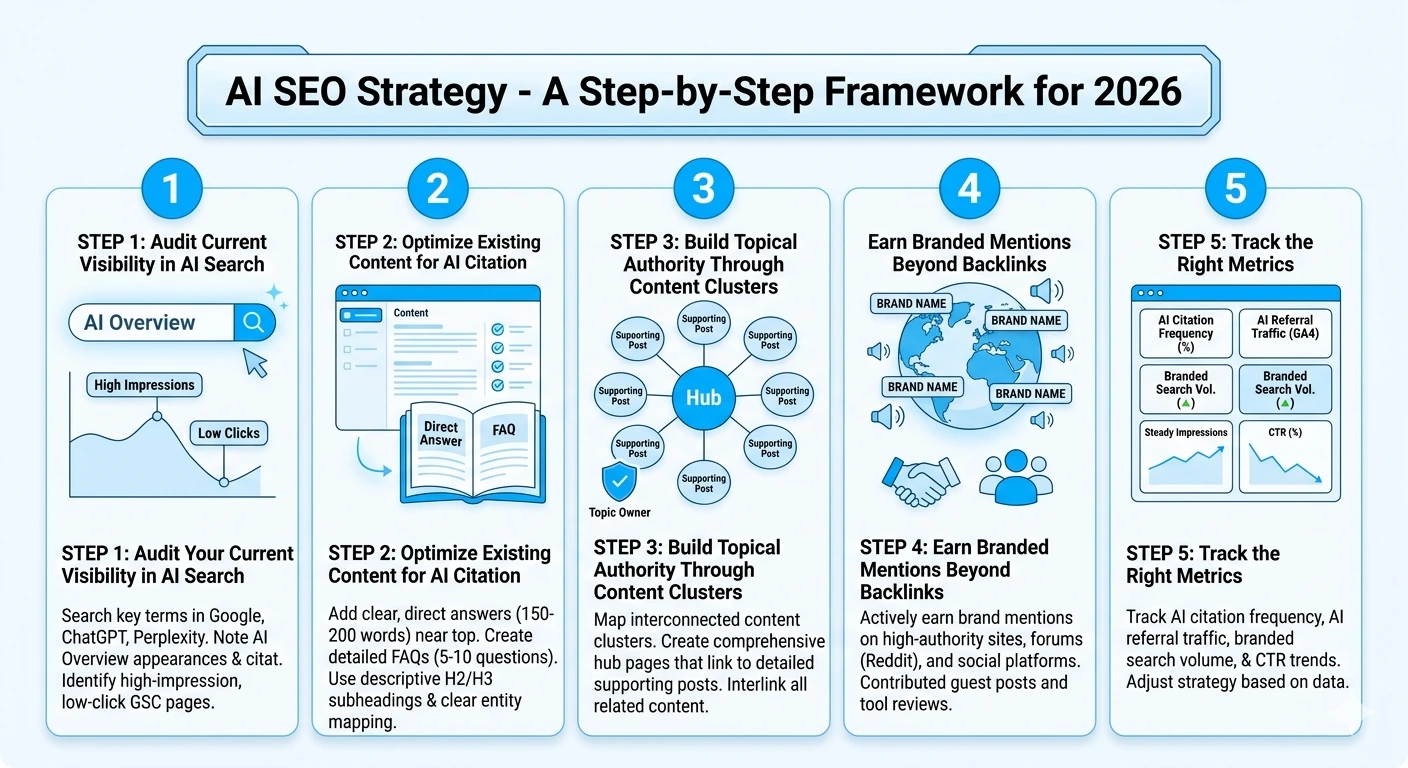
Here is the complete AI SEO framework I recommend, built from current research and real-world implementation patterns.
Step 1: Audit Your Current Visibility in AI Search
Before optimizing, understand your current position. Open Google and search your most important keywords. Note whether AI Overviews appear and whether your content is cited in them. Search the same queries in ChatGPT and Perplexity. Note whether your brand or content is mentioned at all.
Use your Google Search Console data to identify pages with high impressions but low clicks. These are your highest priority optimization targets because Google is already showing your content to users, but users are not clicking, often because an AI Overview is answering the question before they need to.
Step 2: Optimize Existing Content for AI Citation
Take your ten highest-traffic pages and apply the following changes to each.
Add a clear, direct answer to the page’s primary question within the first 150 to 200 words. AI systems specifically look for direct, extractable answers. Add an FAQ section at the bottom of the page with five to ten specific questions answered in two to four sentences each. FAQ content is highly extractable and frequently cited by both Google AI Overviews and ChatGPT.
Ensure each page has clear, descriptive H2 and H3 subheadings that match the language of questions users actually ask. Add your primary entity clearly your expertise, your site’s topic, your brand so AI systems can correctly categorize and cite your content.
Step 3: Build Topical Authority Through Content Clusters
AI systems reward topical depth more than individual page quality. A site that has fifteen interconnected posts on AI marketing, all linking to each other and covering the full spectrum of the topic, will be cited more reliably than a site with one excellent post surrounded by unrelated content.
Map your content clusters. Identify the pillar topic you want to own for example, AI marketing, affiliate marketing, or SEO tools. Build a hub page that covers the topic broadly and links to detailed supporting posts on every major subtopic. Interlink all supporting posts back to the hub page and to each other where relevant.
Step 4: Earn Branded Mentions Beyond Backlinks
This is the most underrated AI SEO strategy in 2026. Because branded web mentions correlate more strongly with AI citations than backlinks do, actively earning your brand name mentions across the web is direct AI SEO work.
Practical ways to do this include contributing guest posts to niche publications, actively participating in relevant Reddit threads and online communities, getting your tool reviews and mentions on industry-relevant sites, and building a presence on platforms like LinkedIn and X where your content can be shared and referenced by others.
Step 5: Track the Right Metrics
Traditional SEO tracked rankings and organic traffic. AI SEO requires tracking additional metrics.
AI citation frequency how often your content appears in AI Overviews or ChatGPT answers for your target queries. This can be tracked manually by checking your key queries weekly in AI search platforms. AI referral traffic visits from ChatGPT, Perplexity, and Gemini visible in your Google Analytics or GA4 traffic sources. Branded search volume whether more people are searching your brand name directly, which indicates growing brand recognition that feeds AI visibility. Click-through rate trends in GSC if your impressions are steady but CTR is falling, AI Overviews may be absorbing the clicks you previously received.
Common AI SEO Mistakes to Avoid
Understanding what not to do saves as much time as knowing what to do.
The biggest mistake is treating AI-generated content as finished content. Fully AI-written posts that have not been edited for genuine experience, accuracy, and original perspective consistently underperform against well-researched, human-edited content. Google’s systems are increasingly able to identify surface-level AI content and treat it as lower quality. AI-written pages now appear in over 17 percent of top search results, but the ones that hold those positions are the ones that combine AI efficiency with human expertise.
The second major mistake is ignoring AI search entirely and focusing only on traditional rankings. Pages that rank in position 3 to 10 on traditional Google are at the highest risk of losing traffic to AI Overviews because they are visible enough to be displayed but not prominent enough to be cited. If you are ranking in positions 4 through 10 for important keywords, those pages need AI SEO optimisation urgently.
The third mistake is blocking AI crawlers without realising it. Many sites have aggressive bot blocking rules set up for security or bandwidth reasons that inadvertently block AI indexing bots. Check your robots.txt file for rules that might block GPTBot, Google-Extended, Anthropic, or Perplexity’s crawlers if you want to appear in AI search results.
The Best AI SEO Tools in 2026
You do not need expensive enterprise tools to implement AI SEO. Here are the most useful tools at different budget levels.
For research and content creation, Perplexity AI is the most practical tool for real-time, cited research that feeds directly into blog content. It searches live sources, extracts data, and provides citations that you can verify and include in your writing. It is the tool that makes content research three times faster.
For keyword and competitor analysis, free tools including Google Search Console, Google’s People Also Ask results, and Google Autocomplete remain the most reliable sources of real search query data. Combined with AI-assisted analysis, these free sources generate more actionable keyword insights than most paid tools.
For content optimisation, the combination of Claude for deep analytical tasks and structured writing, ChatGPT for fast drafts and rewrites, and your existing SEO platform for technical checks covers the majority of content SEO workflows at minimal cost. If you want to access multiple AI models Claude, ChatGPT, Gemini and more from one dashboard without switching tabs, Merlin AI gives you all of them in one place.
For tracking AI visibility, manual checking of your key queries in Google AI Mode, ChatGPT, and Perplexity is the most reliable method for smaller sites. Larger operations should integrate AI visibility monitoring into their regular reporting.
The Future of AI SEO Beyond 2026
The trajectory is clear. AI-driven answer engines are growing faster than any previous shift in search behaviour. Experts project that by 2030, AI answer engines could capture a significant percentage of the traditional search market.
But the core principle underlying SEO is not changing. The sites that win are the ones that provide the most genuinely useful, credible, and complete answers to real questions. Traditional SEO rewarded this with rankings. AI search rewards this with citations. The goal has always been the same. Only the mechanism of reward has changed.
The businesses that will dominate in AI search are those that invest in genuine expertise, build real authority across multiple platforms, create content that demonstrates actual experience, and make that content technically accessible to AI systems.
Traditional SEO is not dead. Google still processes 373 times more queries per day than ChatGPT. Rankings still matter. Links still matter. Technical health still matters. The smart strategy in 2026 is not to abandon traditional SEO but to expand your optimization strategy to include the growing AI search channel because that channel is where the highest-converting traffic now comes from.
CONCLUSION:
AI SEO is not a future trend you need to prepare for. It is the current reality of how search works in 2026.
Google AI Overviews reach 2 billion users monthly. AI search converts at 23 times the rate of organic traffic. Brands cited in AI results earn more clicks, not fewer. The gap between sites that understand AI SEO and those that do not is widening every month.
The good news is that the fundamentals still apply. Comprehensive content, genuine expertise, clear structure, technical accessibility, and a recognizable brand these are exactly what AI systems look for when choosing what to cite. If you have been building a quality content site the right way, you already have most of what you need. The AI SEO layer is about ensuring those systems can find, read, and trust what you have already built.
Start with your Google Search Console data today. Find the pages with high impressions and low CTR. Those are your AI SEO quick wins. Optimise them for direct, extractable answers. Add FAQ sections. Build your content clusters. Earn your brand mentions.
The search landscape changed. The winning strategy did not.
FAQs
Q: What is AI SEO?
A: AI SEO is the practice of optimising content to perform in both traditional search engines and AI-powered search platforms like Google AI Overviews, ChatGPT Search, and Perplexity. It also refers to using AI tools to improve SEO workflows including keyword research, content creation, and technical audits.
Q: Does AI SEO replace traditional SEO?
A: No. Traditional SEO remains essential in 2026. Google still processes approximately 14 billion search queries daily, compared to ChatGPT’s 37.5 million. AI SEO expands traditional SEO strategy to include optimization for AI-generated results, but does not replace the fundamentals of rankings, backlinks, and technical health.
Q: How do I get my content cited in Google AI Overviews?
A: To improve your chances of being cited in Google AI Overviews, write content with clear direct answers near the top of each page, add comprehensive FAQ sections, use descriptive H2 and H3 subheadings that mirror real user questions, build topical authority through interconnected content clusters, and earn branded mentions across the web. Technical accessibility ensuring AI crawlers can read your content is also essential.
Q: What is GEO in SEO?
A: GEO stands for Generative Engine Optimisation. It is the practice of specifically optimising content to appear in AI-generated answers from platforms like Google AI Overviews, ChatGPT, and Perplexity. GEO differs from traditional SEO in that it focuses on content being cited inside AI answers rather than ranking in traditional search results. Research shows GEO delivers 4.4 times higher conversions than traditional SEO.
Q: What are the best AI SEO tools in 2026?
A: The most useful AI SEO tools in 2026 include Perplexity AI for live cited research, Claude and ChatGPT for content creation and optimisation, Google Search Console for tracking impressions and identifying AI optimisation opportunities, and standard SEO platforms like Semrush for keyword and competitor analysis. Google’s own People Also Ask results and Autocomplete remain excellent free sources of AI-friendly keyword data.