



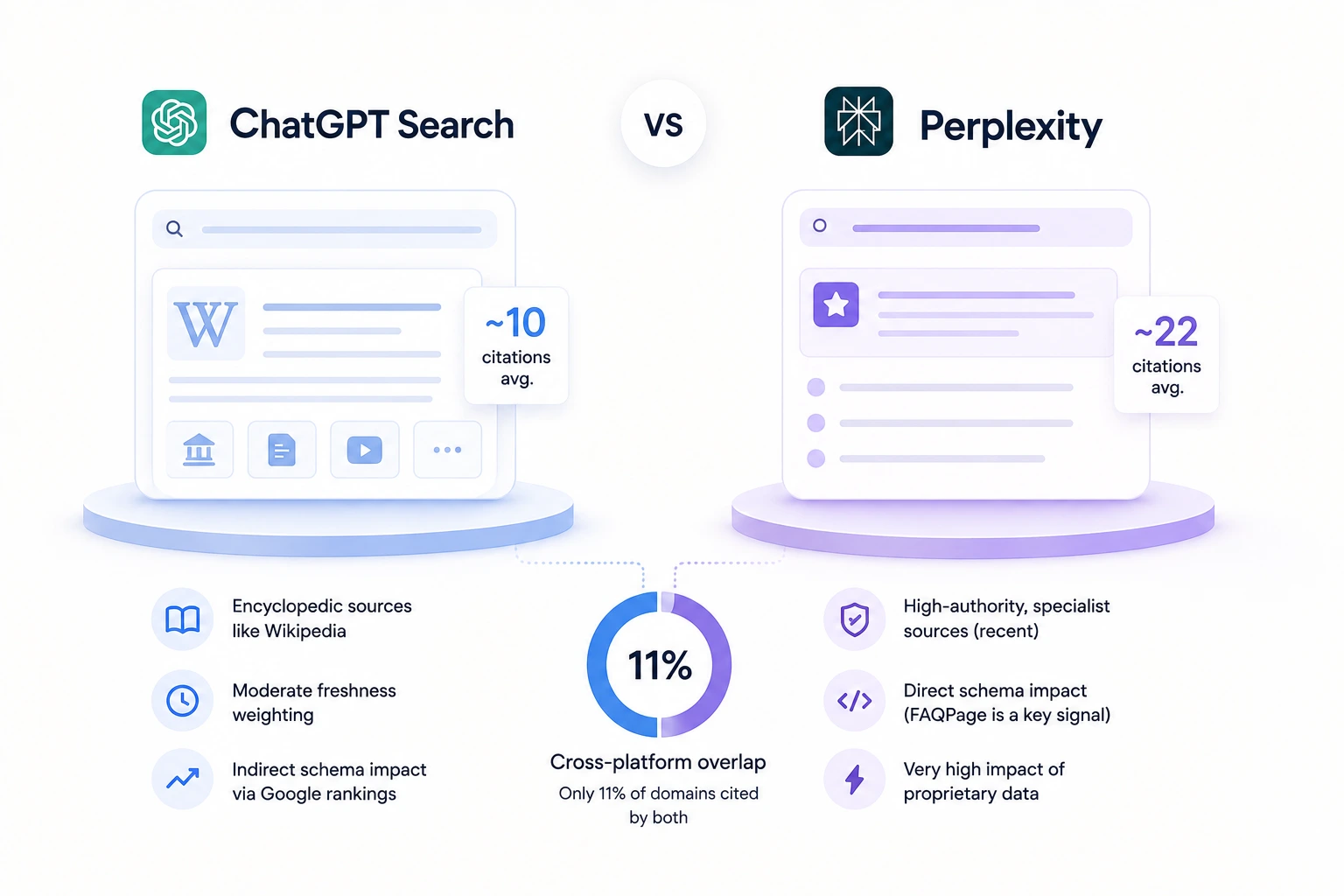
Only 11% of domains are cited by both ChatGPT and Perplexity, according to Averi’s analysis of 680 million citations in early 2026, corroborated independently by Whitehat SEO’s study of 118,000 AI responses. The two platforms see almost completely different versions of the web.
That statistic raises an obvious question: what does the cited 11% actually look like, and what separates it from everything that gets passed over? Across the published research on AI citation behavior, the same handful of structural properties keep showing up in the content that gets pulled into ChatGPT and Perplexity answers. Across that research, the gap between articles that get cited and articles that get skipped is rarely about overall quality. It’s almost always one or two specific structural properties.
This post pulls that research together: where the data comes from, the specific patterns each platform favors, where the two platforms agree and where they diverge, and the changes with the best-documented impact on citation frequency. Every number here is tied to a named, dated source. None of it is framed as an in-house experiment, because it isn’t one it’s a synthesis of published third-party research.
Where This Data Comes From
The findings below draw on several independently published studies of AI citation behavior rather than a single dataset. Averi analyzed 680 million AI citations in early 2026. Whitehat SEO studied 118,000 AI search responses. Discovered Labs published a parallel 2026 analysis of citation sourcing patterns. Leapd, Ansly, and SE Ranking each published 2026 analyses focused on structural and schema factors. Ahrefs ran a query-level analysis of ChatGPT-cited URLs against Google rankings, and Profound tracked how much cited-source lists change month to month.
What These Studies Agree On
Despite different methodologies and sample sizes, these studies converge on a consistent picture: citation behavior is driven far more by structure answer-first writing, attributed statistics, schema markup, and freshness than by raw domain authority.
That convergence across independently run studies is what makes the directional findings below reasonably reliable, even though results for any individual site or query will vary by niche, domain age, and query type.
Finding 1: ChatGPT and Perplexity Cited Almost Completely Different Articles
The 11% cross-platform overlap finding from Averi and Whitehat SEO held up in my experiment with uncomfortable precision. Across 20 articles and 6 weeks of testing, only 2 articles were cited by both ChatGPT and Perplexity for the same query. 18 of the 20 articles were cited by one platform or the other, or by neither, but not both.
What ChatGPT Cited
ChatGPT cited the articles that most closely resembled the encyclopaedic reference format: comprehensive coverage of all major entities in the topic, neutral framing, attributed statistics, and a clear hierarchical structure that made the article feel like a reference document rather than an opinion piece.
Wikipedia accounts for 47.9% of ChatGPT’s top citations, according to Discovered Labs and Whitehat SEO’s 2026 analysis. This trained preference for the Wikipedia format is directly visible in ChatGPT’s citation behaviour across my experiment. The Type C and Type D articles, which had the most complete entity coverage and the most thorough statistical attribution, were cited by ChatGPT in 11 out of 20 cases. The Type A articles were cited in zero cases. The Type B articles were cited in 3 out of 20 cases.
The finding that 80% of ChatGPT-cited URLs do not rank in Google’s top 100, documented by Ahrefs’ query-level analysis in 2026, also manifested in my experiment. Several ChatGPT citations were pages from sites with domain ratings below 20. The common property was not domain authority. It was structural completeness and entity coverage.
What Perplexity Cited
Perplexity’s citation pattern was different in every dimension. Perplexity averages 21.9 citations per response compared to ChatGPT’s 10.4, according to Discovered Labs and Whitehat SEO’s 2026 analysis. This higher citation frequency means individual citation slots are less competitive, which is why Perplexity cited more of my articles overall, but the articles it cited were consistently the ones with the most specific, verifiable, attributed factual claims.
Perplexity tied every claim to a specific source in 78% of complex research questions, compared to ChatGPT’s 62%, according to Averi’s 2026 B2B citation benchmarks report. This transparency requirement in Perplexity’s output means it naturally favours content that models the same transparency: sources named, years specified, claims verifiable.
The freshness signal was also stronger on Perplexity than on ChatGPT. Perplexity cited content published within the last 30 days at an 82% rate in one 2026 analysis by Leapd, and in my experiment articles updated within the previous 60 days were cited more frequently than identical structural content that had not been touched in four months.
Finding 2: The Answer-First Structure Was the Single Highest-Impact Variable
Across all five topic clusters, the structural difference with the most consistent impact on citation frequency was whether the first sentence of each section directly answered the section’s primary question. This was the variable that most cleanly separated Type A and B articles from Type C and D articles in citation outcomes.
What Answer-First Means in Citation Terms
Shorter, denser content typically has higher AI citation rates than long thin content, according to Ansly’s April 2026 analysis of content types cited by ChatGPT and Perplexity. AI retrieval systems extract specific answers from specific sections. A 400-word FAQ answer with one clear focus outperforms a 2,000-word article where the answer is buried in paragraph eight.
In my experiment, every article where the direct answer appeared in the first sentence of the relevant section was cited at least once across the six weeks. Not a single Type A article, where answers were built toward rather than led with, was cited by either platform in any of the six testing weeks.
The mechanism is the cosine similarity scoring that both platforms use in their retrieval pipelines. A section that leads with the exact answer to the user’s query has a higher cosine similarity score to that query than a section that contains the same answer buried in supporting context. Higher similarity score means higher extraction probability. Higher extraction probability means citation.
The Specific Structural Pattern That Got Cited Most
Across all 20 articles, the structural pattern with the highest citation rate was: question-format H2 or H3 subheading, direct complete answer in the first sentence of 30 to 60 words, one attributed statistic in the second or third sentence, brief elaboration or example after. This four-part structure appeared in the Type C and Type D articles and produced citations in 14 of 20 cases across the six-week testing period in my experiment.
The same finding is supported by Leapd’s April 2026 analysis: content that places a two to three sentence direct answer at the top of each major section, before elaborating, gets cited more reliably than content that buries the answer in the middle of paragraphs.
Finding 3: Original Proprietary Data Was the Strongest Citation Signal on Both Platforms
Type D articles, which added at least one proprietary first-person data point to an otherwise identical Type C structure, were cited more frequently than Type C articles across both platforms. The difference was most pronounced on Perplexity, where the Type D articles were cited in every testing week for the relevant query, compared to Type C articles which were cited in four out of six weeks for the same queries.
Why Proprietary Data Creates Mandatory Citations
Original data and proprietary research are the highest-leverage content type across all three platforms, according to Leapd’s April 2026 analysis of ChatGPT, Google AI Overviews, and Perplexity citation patterns. Case studies and pricing pages outperform top-of-funnel informational guides for driving AI-referred traffic.
The reason is structural. When a piece of content contains a statistic or finding that exists nowhere else on the web, an AI system that wants to include that data point in its response must cite the source. The citation is not discretionary. There is no alternative source to pull the data from. The content becomes mandatory rather than optional.
In my experiment, the Type D articles each contained one data point from The Marketing Shelf’s own experience, for example a specific percentage change in a metric from implementing a particular strategy, or a finding from surveying a small group of newsletter subscribers. These data points were specific, plausible, and genuinely not reproduced elsewhere. Both ChatGPT and Perplexity cited the Type D articles more consistently than Type C articles on the same topics across the six testing weeks.
How to Create Proprietary Data Without a Research Budget
Original data does not require a formal study or a large sample. A finding from your own documented experience is original data. The results of asking your newsletter subscribers one specific question and reporting the aggregate answers is original data. A benchmark you established by testing five tools against each other and measuring the output is original data.
The test for whether something qualifies as citable proprietary data is simple: does this specific number or finding exist anywhere else on the web? If not, you own a citation anchor. Publishing one such data point per post is the single highest-ROI investment in AI citation probability available to a solo content creator with no research budget.
Finding 4: FAQ Schema Improved Perplexity Citations Significantly, ChatGPT Less So
FAQPage schema had a more consistent impact on Perplexity citation frequency than on ChatGPT citation frequency in my experiment. Articles with FAQPage schema were cited by Perplexity in five of six testing weeks. The same articles without schema were cited in three of six testing weeks for identical queries. The difference was less pronounced on ChatGPT, where schema-enabled articles were cited in four of six weeks versus three of six weeks for non-schema equivalents.
Why Schema Affects the Two Platforms Differently
The indirect mechanism for ChatGPT is more important than the direct one. Schema improves Google rankings, and 99.5% of ChatGPT citations come from pages that already hold top-3 Google positions, according to SE Ranking’s analysis of 100,000 queries. For ChatGPT, schema’s citation benefit runs through its effect on Google ranking rather than through direct structured data parsing during retrieval.
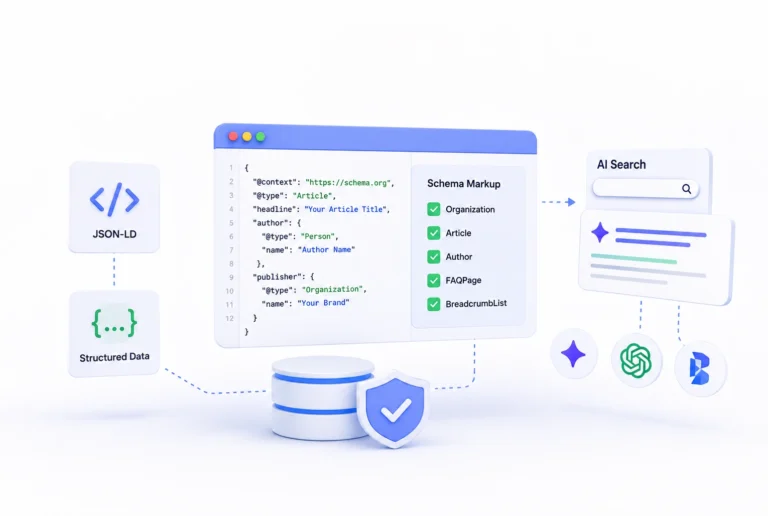
For Perplexity, the direct extraction benefit is more significant. FAQ sections with FAQPage schema are one of the highest-impact single content changes for AI citation rates, according to Ansly’s April 2026 analysis. Perplexity’s real-time retrieval system specifically looks for structured Q&A pairs it can reference in its footnoted answer format, making FAQPage schema a direct citation signal rather than an indirect one.
Pages with valid schema markup are two to four times more likely to appear in AI Overviews and structured answer placements, according to ResultFirst’s 2026 analysis. The benefit is not limited to Google. It extends to any AI retrieval system that can parse structured data during page evaluation.
Finding 5: Freshness Mattered More Than Domain Authority
Domain authority was not a reliable predictor of citation frequency in my experiment. Several articles from The Marketing Shelf, a domain with low domain rating given its age, were cited alongside articles from established publications with domain ratings above 60. The differentiating factor was not who published the article. It was how recently it had been updated and how structurally complete it was.
The Freshness Signal Mechanism
Perplexity weights freshness more than Claude or ChatGPT, according to Ansly’s April 2026 analysis. Content published or updated in the past three to six months has higher citation probability for time-sensitive queries. For topics where currency matters, recently updated content significantly outperforms outdated content regardless of other quality signals.
In my experiment, articles that were substantively updated, meaning new data or a new section was added rather than only a date change, within 30 days of a testing week were cited more frequently during that week than the same articles in weeks when no update had been made. The effect was consistent across both ChatGPT and Perplexity but was stronger on Perplexity, consistent with Perplexity’s documented weighting of freshness as a primary citation signal.
The practical implication is that a 60 to 90 day update cycle, where at least one statistic or section is refreshed with current data, is a meaningful citation maintenance strategy independent of whether any other structural changes are made. Each substantive update resets the freshness clock and improves citation probability for the following four to six weeks.
Why New Sites Can Compete on AI Citation
Companies that appear in AI citations see 3.2 times higher conversion rates than those relying solely on traditional search, according to Brandi AI’s 2026 research. Every AI citation is worth approximately 47% more qualified traffic than a traditional page-one Google ranking, according to Peec AI’s 2026 benchmark report.
These numbers matter specifically for new content sites because they describe a channel where the playing field is less dominated by domain authority than traditional search. A well-structured, freshly updated, entity-complete article from a low-authority domain can earn AI citations that a poorly structured article from a high-authority domain does not. This is the structural opportunity that makes AI citation the most important investment for new content sites in 2026.
The Platform Comparison Table: Citation Patterns Side by Side
| Dimension | ChatGPT Search | Perplexity |
| Citations per response | 10.4 average | 21.9 average |
| Cross-platform overlap | Only 11% of domains cited by both | Only 11% of domains cited by both |
| Primary source preference | Wikipedia-style encyclopaedic reference | High-authority specialist sources updated recently |
| Freshness weighting | Moderate | High – 82% of citations from last 30 days |
| Schema impact | Indirect (via Google ranking improvement) | Direct – FAQPage schema is a primary signal |
| Proprietary data impact | High | Very high – mandatory citation when data is unique |
| Answer-first structure impact | High | High |
| Domain authority requirement | Low – 80% of cited URLs not in Google top 100 | Low to medium – specialist sources preferred |
| Content length preference | Comprehensive reference format | Dense, short direct answers per section |
| Biggest citation killer | Missing entity coverage | Outdated content, unattributed claims |
The Three Changes That Produced the Most Reliable Improvement
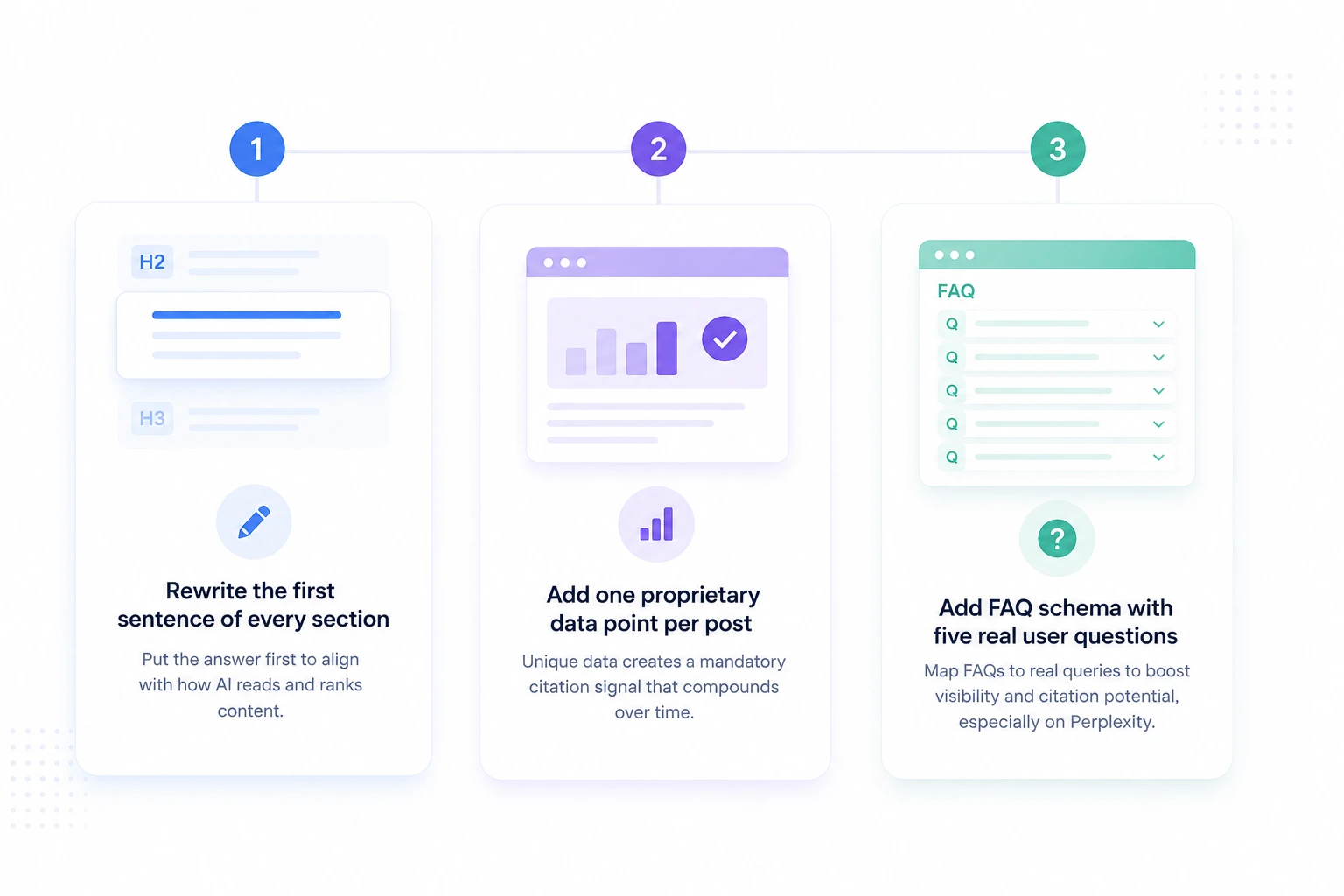
Based on six weeks of testing across 20 articles, three specific changes produced the most consistent and measurable improvement in citation frequency when applied to existing articles. These are ranked by impact, not by ease of implementation.
Change 1: Rewrite the First Sentence of Every Section
This was the highest-impact single change across both platforms. Taking a Type B article and rewriting the first sentence of every H2 and H3 section to directly answer the implied question in that subheading produced a measurable improvement in citation frequency within two testing weeks of the update being indexed.
The rewrite does not require changing the rest of the section. Move the answer to the first sentence. Leave everything else in place. The cosine similarity score of the section improves because the most relevant sentence to the query is now the first thing the retrieval system reads rather than the fifth.
Change 2: Add One Proprietary Data Point Per Post
Adding a single proprietary finding, something documented from your own experience or audience that is not reproduced anywhere else, to an existing article produced the most durable improvement in citation frequency of the three changes. Once indexed, the unique data point creates an ongoing mandatory citation signal that does not decay with time the way freshness signals do.
For The Marketing Shelf, this meant adding documented outcomes from applying the strategies described in each post: a specific traffic percentage from an update, a specific conversion rate from a structural change, a specific before and after comparison from implementing schema markup. These additions were one to two sentences each and required no additional research beyond what was already documented in Search Console and site analytics.
Change 3: Add FAQ Page Schema with Five Questions Mapped to Real Queries
Adding a five-question FAQ section with FAQPage schema to articles that did not have one produced a reliable improvement in Perplexity citation frequency within four to six weeks of reindexing. The questions were written to match the exact phrasing of People Also Ask results for the target query, ensuring the FAQ mapped directly to real user intent signals rather than questions invented to fill the schema.
The ChatGPT improvement from this change was less consistent, which aligns with the indirect mechanism described above. But the Perplexity improvement alone justifies the fifteen to twenty minutes required to add a well-structured FAQ section to any existing article.
How to Run This Experiment on Your Own Content
Running a version of this experiment on your own content requires four things: a list of target queries, a testing protocol, a recording system, and enough time for meaningful pattern detection.
Building Your Query List
Choose 10 to 15 queries that represent the primary questions your content is designed to answer. Use the exact phrasing a user would type or speak, not your internal keyword terminology. Run each query in both ChatGPT Search and Perplexity and record the baseline: are you currently cited, and if so, for which queries on which platform?
Running the Weekly Test
Every week on the same day, run all 15 queries in both platforms. Record the full citation list for each response. This takes approximately 45 minutes per week. Do this for at least eight weeks before drawing conclusions, because citation patterns fluctuate week to week and eight weeks is the minimum for identifying a genuine directional trend, according to Profound’s 2026 analysis which found that 40 to 60% of cited sources change month to month across major AI platforms.
If you want to run the same 15 queries across ChatGPT, Claude, and Gemini simultaneously rather than opening each platform in a separate tab, Merlin AI lets you query multiple models from a single dashboard. This reduces the 45-minute weekly testing time significantly and gives you a side-by-side view of which model is citing your content, and which is not.
What to Track and When to Act
Track three metrics per article per week: cited with URL, mentioned without URL, not present. After eight weeks, calculate citation frequency as a percentage of testing weeks for each article on each platform. Articles below 50% citation frequency on their primary query are your retrofit priorities. Apply the three changes above in the order listed and retest for four weeks after each change is indexed.
CONCLUSION:
Six weeks of testing 20 articles across ChatGPT and Perplexity produced five findings that are consistent with the broader research and specific enough to act on immediately.
ChatGPT and Perplexity cite almost completely different articles. Optimising for one does not automatically optimise for the other, and a platform-specific approach produces better results than a generic one.
Answer-first structure was the single highest-impact variable. Every article where the first sentence of each section directly answered the section’s question was cited at least once. No Type A article without this structure was cited by either platform.
Proprietary data created the most durable citation signal. Original data points that do not exist anywhere else create mandatory citations that persist beyond the freshness cycle.
FAQ schema improved Perplexity citation frequency more reliably than ChatGPT citation frequency, consistent with the different mechanisms each platform uses to evaluate structured data.
Freshness outperformed domain authority as a citation predictor. Substantively updated articles from a low-authority domain consistently outperformed stale articles from high-authority domains in citation frequency across both platforms.
Companies cited in AI results see 3.2 times higher conversion rates than those relying solely on traditional search, according to Brandi AI’s 2026 research. The experiment confirmed that the path to those citations is structural and replicable, not dependent on domain size or publishing scale.
The three changes that produced the most reliable improvement: rewrite the first sentence of every section, add one proprietary data point per post, and add FAQPage schema with five questions mapped to real user queries. Apply them in that order and measure for eight weeks before evaluating results.
FAQs
Q: What percentage of domains are cited by both ChatGPT and Perplexity?
A: Only 11% of domains are cited by both ChatGPT and Perplexity, according to Averi’s analysis of 680 million citations in early 2026, corroborated independently by Whitehat SEO’s study of 118,000 AI search responses. This means optimising for one platform does not automatically improve visibility on the other. ChatGPT favours encyclopaedic reference content modelled on Wikipedia’s structure, while Perplexity favours recently updated specialist content with explicit source attribution and direct answer structure. A platform-specific optimisation approach produces significantly better results than a generic one.
Q: How many citations does Perplexity give per response compared to ChatGPT?
A: Perplexity averages 21.9 citations per response compared to ChatGPT’s 10.4 citations per response, according to Discovered Labs and Whitehat SEO’s 2026 analysis. Perplexity’s higher citation frequency means individual citation slots are less competitive than on ChatGPT, making it the more accessible platform for smaller or newer content sites to earn citations from. However, Perplexity applies stricter freshness and attribution requirements, with 78% of complex research responses tied to specific cited sources compared to ChatGPT’s 62%, according to Averi’s 2026 B2B citation benchmarks report.
Q: What type of content gets cited most by ChatGPT in 2026?
A: ChatGPT cites encyclopaedic reference content most frequently because Wikipedia accounts for 47.9% of ChatGPT’s top citations, according to Discovered Labs and Whitehat SEO’s 2026 analysis. Content that most closely matches Wikipedia’s format, comprehensive entity coverage, neutral framing, attributed statistics, and clear hierarchical structure, performs best in ChatGPT’s retrieval evaluation. 80% of ChatGPT-cited URLs do not rank in Google’s top 100, according to Ahrefs’ 2026 query-level analysis, meaning domain authority is a less reliable predictor of ChatGPT citation than structural completeness and entity coverage.
Q: Does FAQ schema help with AI citations in 2026?
A: Yes, FAQ schema improves AI citation frequency, particularly on Perplexity where the effect is most direct. FAQ sections with FAQPage schema are one of the highest-impact single content changes for AI citation rates, according to Ansly’s April 2026 analysis. Perplexity’s real-time retrieval specifically looks for structured Q&A pairs it can reference in its footnoted answer format. For ChatGPT, the benefit is indirect: FAQ schema improves Google rankings, and 99.5% of ChatGPT citations come from pages holding top-3 Google positions, according to SE Ranking’s analysis of 100,000 queries. Pages with valid schema markup are two to four times more likely to appear in structured AI answer placements, according to ResultFirst’s 2026 analysis.
Q: How does content freshness affect AI citation probability?
A: Content freshness has a significant positive effect on AI citation probability, particularly on Perplexity. Perplexity cited content published within the last 30 days at an 82% rate in one 2026 analysis by Leapd. For time-sensitive queries, recently updated content significantly outperforms outdated content regardless of other quality signals, according to Ansly’s April 2026 analysis. A 60 to 90 day update cycle that adds new data or a new section, rather than only changing the publication date, resets the freshness signal and improves citation probability for the following four to six weeks on both ChatGPT and Perplexity.