


ElevenLabs is the best AI voice generation platform available in 2026 for realistic text-to-speech, expressive voice cloning, and multilingual audio production. That statement comes with one important qualification: it is the best if voice quality is your primary consideration and you understand how the credit system actually works before subscribing.
The platform hit approximately $500 million in annual recurring revenue in early 2026, making it one of the fastest-growing AI infrastructure companies in the world. The reason for that growth is simple: the voices genuinely sound human in a way that no competing platform consistently matches. YouTubers, podcasters, audiobook publishers, course creators, and developers have adopted ElevenLabs as their default audio production layer because the quality gap between ElevenLabs and everything else is real and audible.
The catch, and there is a real one, is the credit system. One independent reviewer tracked their actual usage for 30 days and found their effective cost was 2.8 times the advertised per-character rate due to failed generations and regenerations. That is not a bug. It is what happens when you use a credit-based platform for long-form production without understanding how credits are consumed before you start.
This review covers what ElevenLabs actually does well, what it does badly, who it is genuinely worth paying for, who should look at alternatives, and the honest pricing picture including what you will actually spend each month rather than what the plan page advertises.
What ElevenLabs Actually Is – Before the Feature List
ElevenLabs is a voice technology platform, not a simple text-to-speech tool. The distinction matters because most people arrive expecting a straightforward interface where you paste text and download audio. That is one thing ElevenLabs does. It is not the full picture.
The Two Platforms Within ElevenLabs
ElevenLabs operates two distinct product lines in 2026. ElevenLabs Creative is the platform most creators, podcasters, YouTubers, and publishers use. It handles text-to-speech narration, voice cloning, multilingual dubbing, sound effects, and audio projects. If you are researching ElevenLabs for content production, this is the product you are evaluating.
ElevenLabs Agents is a separate platform for developers building AI-powered conversational voice systems, including customer support agents, phone call automation, and real-time interactive voice applications. Agents prioritises low latency and conversational turn-taking over maximum voice realism. Most creators evaluating ElevenLabs have no use for the Agents platform and should not let its complexity influence their evaluation of the creative side of the product.
H3: The Company Background
ElevenLabs was founded by Piotr Dabkowski and Mati Staniszewski, who launched the platform in 2022. The company raised $80 million in January 2024 and has since scaled to hundreds of millions in annual recurring revenue. That financial trajectory matters for platform stability: ElevenLabs is not a tool that will disappear overnight, which makes it a reasonable infrastructure investment for creators and businesses building long-term audio workflows.
The platform now supports over 29 languages and has become the default reference point in the AI voice space against which all competitors are measured, according to multiple independent 2026 reviews. Being the benchmark is a genuine competitive position, not just a marketing claim.
ElevenLabs Features
The features that matter most for a content creator or small business evaluating ElevenLabs are voice quality, voice cloning, multilingual support, and the ElevenLabs Studio project management environment.
Voice Quality: The Genuine Differentiator
Voice quality is where ElevenLabs earns its reputation. The generated speech sounds remarkably natural, with realistic pauses, emotional delivery, and human-like pronunciation that older text-to-speech tools never achieved. This is not a marginal improvement over competitors. It is audible in the first thirty seconds of a comparison test.
ElevenLabs runs several models with different quality and speed tradeoffs. Flash v2.5 is the fastest model, optimised for real-time applications where latency matters more than maximum realism.
Turbo v2.5 sits in the middle, balancing generation speed and quality for bulk production. Multilingual v2 is the highest-quality model for non-English languages, supporting over 29 languages with the most natural-sounding results. For most narration work, Multilingual v2 is the model worth paying for, and it is also the most credit-intensive.
The voice library includes thousands of pre-built voices across different ages, genders, accents, and styles. The practical problem with the library is that popular voices like “Adam” are so widely used across content that experienced listeners can identify them immediately. For professional audio work, the voice library is a starting point, not the destination. Voice cloning is where the serious production value lives.
Voice Cloning: Impressive but Demanding
ElevenLabs voice cloning is the most realistic AI voice cloning available in 2026 when configured correctly. The qualification in that sentence is important: when configured correctly. Most users who report poor cloning results are providing audio samples that do not meet the technical requirements the platform needs to produce a good clone.
Professional Voice Cloning, available on Creator and above plans, requires clean, high-quality source audio recorded in a controlled acoustic environment. Background noise, room reverb, compression artifacts, and inconsistent microphone distance all degrade clone quality in ways that ElevenLabs cannot compensate for algorithmically.
One critical review tracked a 50,000-word audiobook project using a custom voice clone and required 347 regenerations before achieving acceptable consistency, a direct consequence of audio samples that were recorded on consumer-grade equipment in a home office.
Instant Voice Cloning, available on Starter and above plans, creates a clone from shorter samples but produces less accurate results. It is suitable for internal workflows where some variance is acceptable, not for commercial voiceover work where listeners will compare the clone to the original voice.
Multilingual Dubbing
Multilingual dubbing is one of ElevenLabs’ most commercially valuable features for content creators with international audiences. Upload a video or audio file, select the target language, and ElevenLabs generates a dubbed version that preserves the speaker’s voice characteristics while speaking in the new language.
The result is meaningfully better than adding a separate translated voiceover because the dubbed voice sounds like the same person, not a different voice actor.
The dubbing quality varies by language. English, Spanish, French, German, and Portuguese produce the strongest results. Languages with significantly different phonetic structures from English require more careful review before publication.
For a content creator publishing YouTube videos in English who wants to expand into Spanish or French markets without hiring translators and voice actors, the dubbing feature alone can justify the subscription cost.
ElevenLabs Pricing
ElevenLabs pricing is credit-based, and the headline monthly price tells only part of the story. Understanding how credits work before subscribing is the single most important thing you can do to avoid the billing frustration that appears consistently across independent reviews.
The Plan Structure
The free plan includes 10,000 monthly credits, MP3 downloads, access to multiple models, limited Studio functionality, and three active voice slots. This is one of the more generous free tiers in the AI voice category and is sufficient for testing voice quality and evaluating the interface before committing to a paid plan.
The Starter plan runs $5 per month, making it the lowest-cost entry to commercial use. The Creator plan at $22 per month is the sensible starting point for serious content creators because it includes Professional Voice Cloning, which is the feature that separates hobbyist use from professional production work.
The Pro plan at $99 per month and Scale plan at $330 per month are designed for businesses and agencies with high-volume production requirements. The Business plan at $1,320 per month targets enterprise customers.
For most creators, podcasters, and YouTubers evaluating ElevenLabs, the Creator plan at $22 per month is the right entry point.
The Credit System – What It Actually Costs
Credits are consumed when audio is generated. The exact credit cost per character varies by model. Flash v2.5 consumes fewer credits per character than Multilingual v2. Regenerating a generation that did not sound right consumes the same credits as the original generation. Failed generations in some edge cases also consume credits.
The practical consequence is that a user running long-form narration, frequently regenerating sections that do not sound right, and using the higher-quality models will spend credits faster than the plan’s monthly allocation suggests. The 2.8 times effective cost figure documented in one independent review represents an intensive production scenario rather than typical casual use, but it is a real risk for creators producing audiobooks, long-form podcasts, or high-volume narration content.
Budget 30 to 50 percent above your expected credit consumption when estimating actual monthly costs until you have two to three months of real usage data to reference.
| Plan | Monthly Price | Credits | Voice Cloning | Best For |
| Free | $0 | 10,000/month | Instant only | Testing and evaluation |
| Starter | $5/month | 30,000/month | Instant only | Occasional personal projects |
| Creator | $22/month | 100,000/month | Professional Voice Cloning | Podcasters, YouTubers, course creators |
| Pro | $99/month | 500,000/month | Professional Voice Cloning | Agencies and high-volume producers |
| Scale | $330/month | 2,000,000/month | Professional Voice Cloning | Large content operations |
| Business | $1,320/month | 11,000,000/month | Professional Voice Cloning | Enterprise and platform integration |
Note: Credit costs per character vary by model. Verify current plan pricing at elevenlabs.io before subscribing as pricing is updated periodically.
Honest Pros and Cons – What Independent Testing Shows
What ElevenLabs Does Better Than Anyone Else
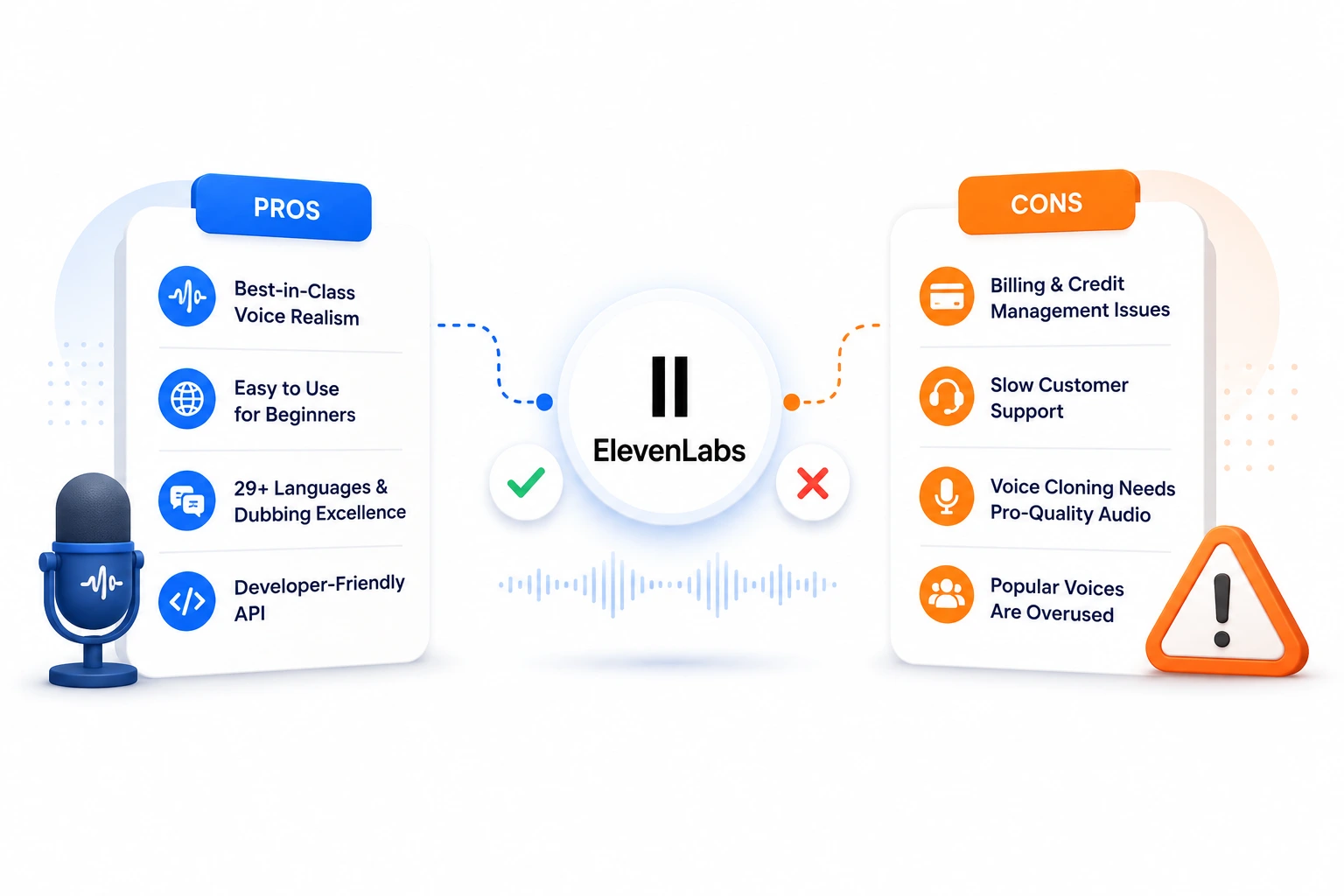
Voice realism is the clearest strength. An independent audio-generation scoring by DIY AI in May 2026 gave ElevenLabs an overall rating of 8.9 out of 10, with its highest marks going to voice realism, clone similarity, emotion range, and API support. The gap between ElevenLabs voice quality and the nearest competitor is audible to most listeners without technical training.
The interface is beginner-friendly despite the platform’s depth. Even first-time users can generate their first voiceover within minutes of creating an account. The dashboard is uncluttered, the generation workflow is intuitive, and the voice library is easy to navigate. Getting started does not require a tutorial.
Multilingual support at 29-plus languages with high quality results on major European languages makes ElevenLabs the strongest single platform for creators building international content workflows. The dubbing feature, specifically the ability to dub existing video and audio while preserving voice characteristics, has no direct equivalent at comparable quality in any competing platform as of mid-2026.
The API is well-documented and developer-friendly, making ElevenLabs a practical backend choice for applications that need programmatic voice generation. The API’s reliability and documentation quality is consistently cited in developer reviews as one of the platform’s underrated strengths.
What ElevenLabs Gets Wrong
The billing complaints that appear consistently across independent reviews are the most significant operational weakness. The gap between the G2 rating and the Trustpilot rating for ElevenLabs tells you something real: this is a company that makes an excellent product and a frustrating billing experience. Downgrading mid-billing cycle, managing credit consumption across a team, and understanding exactly how many credits a specific project will consume before starting all require more attention than most subscription software demands.
Customer support is slow for complex issues. Email-only responses take five to fourteen days for technical problems, and the AI chatbot is described as useless for non-standard issues in multiple independent reviews. For a creator on a production deadline, a technical problem with ElevenLabs can cause real schedule disruption.
Voice cloning quality is inconsistent without professional audio setup. Users who expect to clone their voice from a smartphone recording or a webcam microphone will be disappointed. The platform’s capabilities are real but they require investment in recording quality that is not mentioned prominently in the marketing.
Popular pre-built voices, particularly “Adam,” are overused across the creator ecosystem to the point of being recognisable. For creators producing commercial content, relying on library voices risks an output that sounds identical to dozens of other creators in the same space.
Who Should Use ElevenLabs – The Use Case Breakdown
ElevenLabs is worth paying for in specific situations and genuinely not worth it in others. The platform’s strength is so concentrated in voice quality that if voice quality is not your primary need, a cheaper alternative probably serves you better.
ElevenLabs Is Worth It For
Podcasters and YouTubers who need narration without hiring a voice actor will find the Creator plan at $22 per month the most cost-effective professional narration solution available. The time saved versus recording, editing, and mastering your own voice narration for long-form content pays for the subscription within the first month for most creators producing regular audio content.
Audiobook producers converting long-form text to audio will find ElevenLabs the strongest available option for realism and consistency across a book-length project, provided the voice cloning setup is done correctly with professional-quality source audio.
Content creators building international audiences who want to dub existing English content into Spanish, French, Portuguese, or German will find the multilingual dubbing feature uniquely valuable. The quality gap between ElevenLabs dubbing and competitor dubbing tools is particularly pronounced for European languages.
Developers building applications that need programmatic voice generation will find the API reliable, well-documented, and capable of handling production workloads across the model range.
If ElevenLabs fits your workflow, you can test the free plan with 10,000 credits monthly before committing to a paid subscription.
ElevenLabs Is Not Worth It For
Casual users who need a voiceover once a month or less will find the free plan sufficient for their needs and the paid plans expensive relative to their usage volume. The credit system is poorly suited to very infrequent use because unused credits do not roll over on most plans.
Businesses that need flat-rate unlimited pricing for predictable budgeting will find ElevenLabs’ credit model frustrating. PlayHT offers a flat-rate unlimited option that removes the per-generation anxiety for high-volume, cost-sensitive operations.
Creators who expect professional voice cloning results from consumer-grade audio equipment will be disappointed. If you are not prepared to invest in a decent microphone and a controlled recording environment, the cloning feature will underdeliver against expectations regardless of how good the underlying technology is.
ElevenLabs vs Competitors – How It Compares in 2026
ElevenLabs vs Speechify
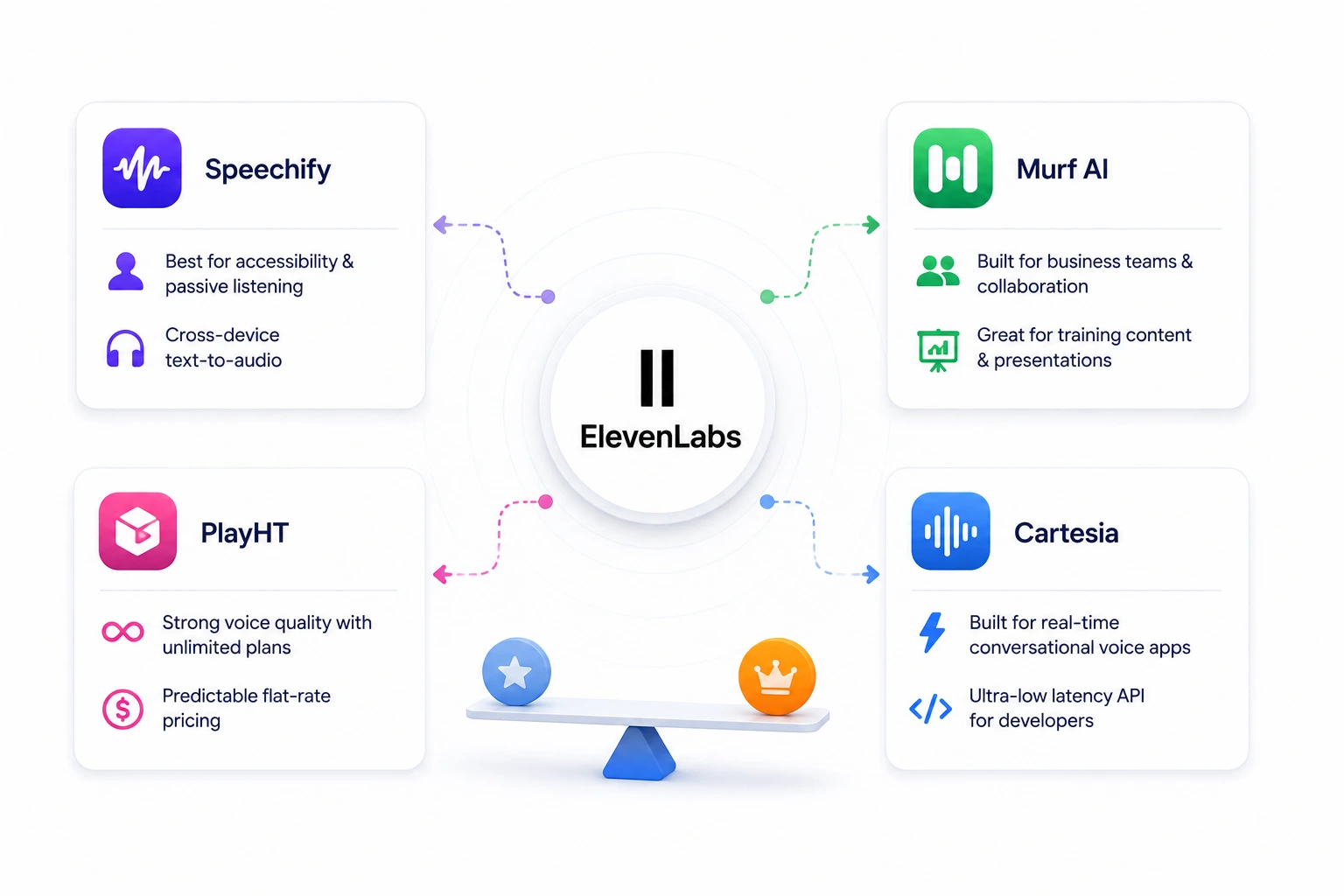
Speechify is stronger for accessibility use cases, passive listening, and cross-device text-to-audio conversion where the primary goal is consuming content rather than producing professional audio. ElevenLabs is stronger for narration production, voice cloning, and multilingual dubbing. They serve meaningfully different use cases and the comparison is less direct than it appears.
ElevenLabs vs Murf AI
Murf AI is more focused on business use cases, particularly team collaboration, training content creation, and presentation voiceovers. Its interface is designed for non-technical business users who need to produce audio assets as part of a broader content workflow. ElevenLabs generally delivers stronger voice quality and cloning realism, but Murf’s collaboration features and business-oriented interface make it a better fit for teams where multiple people need access to the audio production workflow.
ElevenLabs vs PlayHT
PlayHT is the strongest direct competitor to ElevenLabs for creators who need voice quality approaching ElevenLabs but prefer predictable flat-rate pricing. PlayHT’s unlimited plans remove the credit anxiety that affects ElevenLabs users working on long-form content at volume. If ElevenLabs’ credit system is the primary objection after evaluating voice quality, PlayHT is the alternative worth testing.
ElevenLabs vs Cartesia
Cartesia targets a different audience: developers building real-time conversational voice applications where ultra-low latency is the primary requirement. If you are building a voice agent, phone call system, or interactive voice application, Cartesia’s API performance is purpose-built for that use case in a way that ElevenLabs Creative is not. For creative audio production, Cartesia is not a relevant alternative.
The FTC and Legal Compliance Note
Voice cloning sits in a sensitive regulatory area that ElevenLabs users need to understand before using the feature commercially. The US Federal Trade Commission has publicly warned about AI-enabled voice cloning risks, specifically the potential for misuse in impersonation and fraud. ElevenLabs requires users to confirm consent when cloning voices, but the responsibility for using cloned voices legally and ethically sits with the user, not the platform.
Using a cloned voice commercially requires explicit consent from the person whose voice is being cloned. Using a voice clone to create content that misrepresents the original speaker is a legal and ethical violation regardless of the platform’s terms. Businesses should treat cloned voices as governed assets with documented consent records, not as creative presets that can be deployed across any use case.
SynthID, Google’s AI content watermarking system, now embeds invisible markers into AI-generated audio including content from ElevenLabs. This watermark allows the audio’s AI origin to be verified by compatible detection systems. For most legitimate creator use cases this is a non-issue. For any application where the AI origin of audio should not be disclosed, the watermark is a relevant consideration.
CONCLUSION:
ElevenLabs is the strongest AI voice platform available in 2026 if voice quality and cloning realism are your primary requirements. The voices are genuinely human-sounding in a way that competing platforms do not consistently match, the multilingual dubbing feature is uniquely capable for European languages, and the API quality makes it a production-grade infrastructure choice for developers.
The limitations are real and documented. The credit system costs more in practice than the plan prices suggest if you are doing regeneration-heavy work. Customer support is slow for complex issues. Voice cloning requires professional-quality source audio to produce professional results. Popular library voices are overused across the creator ecosystem.
For podcasters, YouTubers, audiobook producers, and course creators who need reliable, high-quality narration without hiring voice actors, the Creator plan at $22 per month is a reasonable investment that most users recover in production time savings within the first month.
Test the free plan first. The 10,000 monthly credits are enough to evaluate voice quality, test the cloning workflow with your own audio, and make an informed decision before committing to a paid subscription.
FAQs
Q: Is ElevenLabs worth it in 2026?
A: ElevenLabs is worth it in 2026 for podcasters, YouTubers, audiobook producers, course creators, and developers who need high-quality AI voice narration or voice cloning. The platform delivers the most realistic AI-generated speech available and supports over 29 languages with strong multilingual dubbing. The Creator plan at $22 per month is the sensible entry point for serious creators. ElevenLabs is less worth it for casual users who need occasional voiceovers, for creators without professional recording equipment for voice cloning, or for businesses that need predictable flat-rate pricing rather than a credit-based model.
Q: How much does ElevenLabs cost in 2026?
A: ElevenLabs uses a credit-based pricing model in 2026. The free plan includes 10,000 credits per month at no cost. The Starter plan costs $5 per month with 30,000 credits. The Creator plan costs $22 per month with 100,000 credits and includes Professional Voice Cloning. The Pro plan costs $99 per month with 500,000 credits. Credit consumption varies by model and generation volume, with real-world costs typically running 30 to 50 percent above the headline plan price for heavy production workflows involving frequent regenerations or high-quality model usage.
Q: What is the difference between ElevenLabs Instant Voice Cloning and Professional Voice Cloning?
A: Instant Voice Cloning is available from the Starter plan upward and creates a voice clone from shorter audio samples with less accuracy. It is suitable for internal workflows where some variance is acceptable. Professional Voice Cloning is available from the Creator plan upward and produces significantly more accurate and consistent results, but requires clean, high-quality source audio recorded in a controlled acoustic environment. Consumer-grade audio recorded on a smartphone or webcam microphone produces poor Professional Voice Cloning results regardless of the underlying technology quality.
Q: What are the main complaints about ElevenLabs in 2026?
A: The three most consistent complaints in independent reviews of ElevenLabs in 2026 are the credit system complexity, slow customer support, and voice cloning quality expectations. The credit-based billing model costs more in practice than plan prices suggest for heavy production workflows, with one reviewer documenting effective costs 2.8 times the advertised per-character rate. Customer support for complex technical issues takes five to fourteen days by email. Voice cloning produces poor results when source audio does not meet professional recording quality standards, a limitation that is not clearly communicated in the platform’s onboarding.
Q: What is the best ElevenLabs alternative in 2026?
A: The best ElevenLabs alternative depends on your specific use case. PlayHT is the strongest alternative for creators who need comparable voice quality but prefer predictable flat-rate unlimited pricing over ElevenLabs’ credit model. Murf AI is better for business teams needing collaboration features and a structured workflow for training and presentation audio. Speechify is stronger for accessibility and personal reading use cases rather than content production. Cartesia is the best alternative specifically for developers building real-time conversational voice applications requiring ultra-low latency API performance.