



The era of “we are exploring responsible AI” is over.
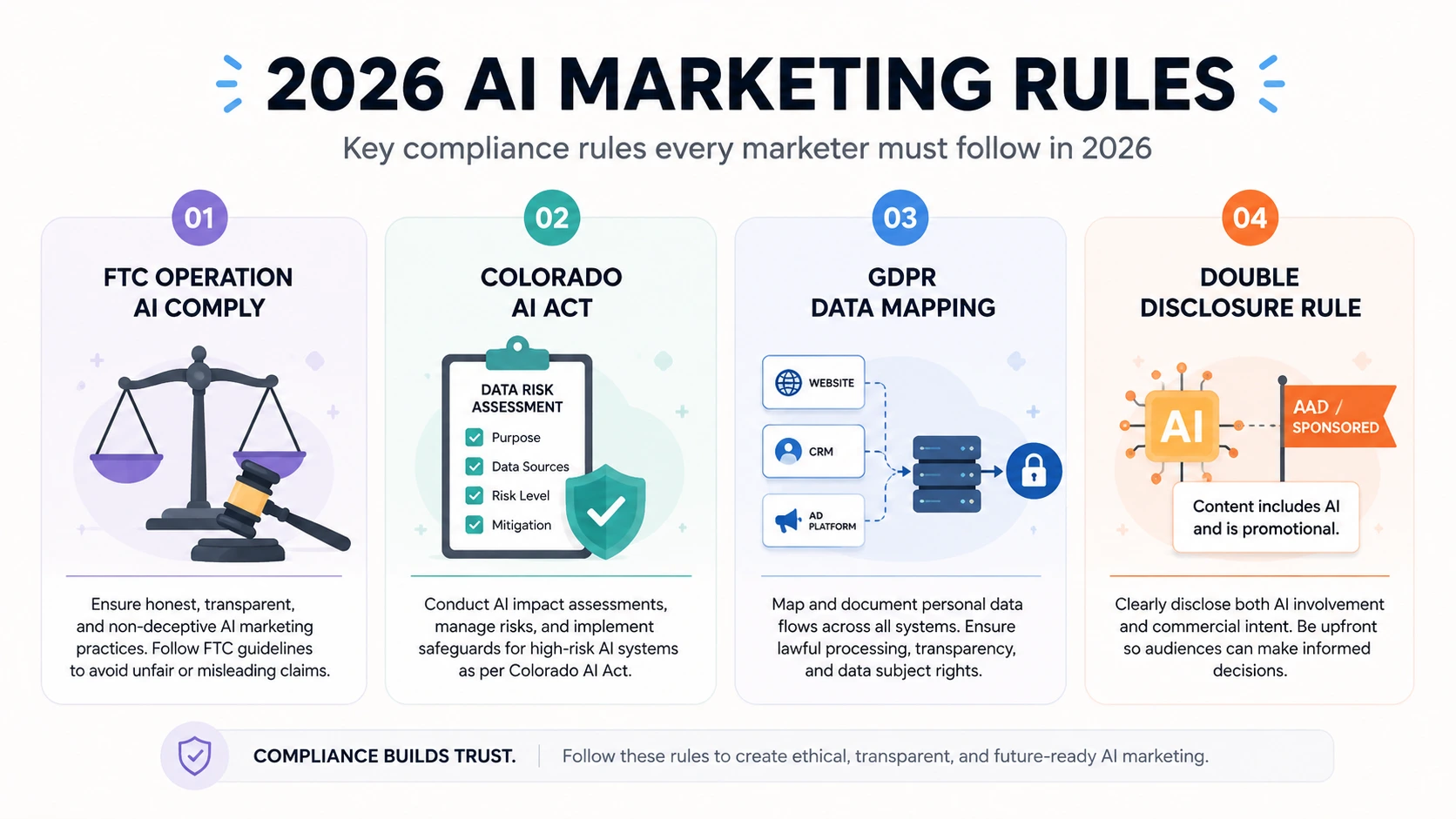
Regulators are not waiting for the marketing industry to self-regulate. The FTC launched Operation AI Comply in 2025, a targeted enforcement action specifically targeting deceptive AI marketing practices. Italy fined OpenAI 15 million euros for GDPR violations in training data processing. Colorado’s AI Act takes effect August 1, 2026, requiring impact assessments for AI-driven ad targeting. California imposes penalties of $5,000 per day for AI disclosure violations, applied to any content consumed by California residents, which effectively means national compliance for any brand operating online.
The regulatory cliff has arrived. And the marketers most exposed are not the ones intentionally cutting corners. They are the ones who deployed agentic AI systems quickly, without auditing what those systems were doing with user data, what they were disclosing, and what claims they were making autonomously at scale.
This post covers the specific compliance, privacy, and disclosure requirements that apply to agentic AI marketing in 2026. Not a general overview of AI ethics. The actual rules, the actual enforcement examples, and the practical steps you need to take if you are using autonomous AI systems in any part of your marketing workflow, from content production and distribution to outreach, personalisation, and advertising.
Understanding this landscape is not optional if you are building a serious marketing operation. It is the foundation that protects everything else you are building.
Why Agentic AI Creates Compliance Risks That Standard AI Tools Do Not
Most AI compliance guidance is written for tool-level AI use: a human prompts a model, reviews the output, and publishes. In that model, the human is the decision-maker and the AI is an assistant. The liability is manageable because a human reviewed each output before it reached an audience.
Agentic AI breaks this model entirely, and the compliance implications are significant.
Autonomous Action Without Per-Step Human Review
An agentic system makes decisions and takes actions without a human approving each step. A marketing agent might autonomously send outreach emails, post content across platforms, adjust ad targeting parameters, or personalise landing pages based on user data, all without a human reviewing each action before it executes.
FINRA has explicitly called out AI agents as a new risk area because they can act autonomously, exceed intended authority, mishandle sensitive data, and create auditability problems if their actions are not logged and reviewed. The same principle applies across all regulated marketing contexts. An agent that takes an action autonomously is still subject to all the same legal requirements as a human taking the same action. The fact that it was automated is not a defence. The brand deploying the agent is responsible for everything the agent does.
Scale Amplifies Both Reach and Risk
A human marketing team might send a few hundred outreach emails a week. An agentic system might send tens of thousands. A human team might publish two pieces of content per day. An agent might publish fifty. The efficiency gain is real. The compliance risk is also real, and it scales at exactly the same rate as the output.
Every piece of AI-generated advertising content an agent publishes is subject to FTC disclosure requirements. Every email an agent sends must comply with CAN-SPAM. Every piece of personalised content an agent creates using user data must comply with GDPR and CCPA. When an agent is producing and distributing at scale, a single compliance gap in the workflow is not one mistake. It is that mistake multiplied by every output the agent produces before the gap is caught.
Auditability Is Now a Legal Requirement, not a Best Practice
Regulators in 2026 expect documented controls, technical safeguards, and evidence of compliance, not aspirational ethics statements. This means every agentic marketing workflow needs to produce an audit trail. Log prompts, outputs, model versions, review decisions, and override reasons. If a regulator asks what your AI agent did, when it did it, and what human oversight was applied, you need to be able to answer with records, not with a description of your intended policy.
FTC Rules for AI Marketing Content in 2026 – What You Are Required to Disclose
The FTC’s approach to AI disclosure is built on a principle that predates AI by decades: consumers have a right to know when they are being marketed to, and they have a right to know when the content they are seeing has been artificially created or when the relationship behind a recommendation is commercial.
The Double Disclosure Rule
In 2026, AI-generated advertising content is subject to what practitioners are calling the double disclosure rule: brands must disclose both the commercial nature of the content and the AI involvement in its creation.
The FTC’s updated Endorsement Guides, clarified in March 2025, explicitly address AI-generated endorsements. The content created by or on behalf of AI agents must disclose both the commercial relationship and the AI involvement in its creation. This applies to sponsored content, influencer campaigns managed by AI agents, affiliate content, and any advertising where AI is materially involved in the creation or distribution.
The practical implication for agentic marketing systems is specific. If your agent is producing affiliate content, sponsored posts, or advertising copy, every output must include both a commercial disclosure and an AI disclosure before it reaches an audience. This is not a recommendation. Under Section 5 of the FTC Act, failure to disclose is a deceptive practice.
AI-Generated Endorsements and Virtual Influencers
The FTC requires specific disclosures for virtual or AI-generated influencer personas. Any AI influencer or virtual persona must disclose its synthetic nature in the bio, reinforce that disclosure per post where the character could be mistaken for a real person, and disclose the commercial relationship with any brand it promotes.
Failure to follow FTC AI disclosure guidelines does not just create legal exposure. Research from Creators Synergy shows that while AI influencers maintain a 2.84% engagement rate, trust collapses the moment a follower feels deceived.
For any brand using AI agents to manage influencer outreach or operating AI-generated personas in any capacity, the compliance requirement is non-negotiable. The FTC treats the brand deploying the agent as responsible for ensuring disclosure compliance, not the platform or the tool.
What “Clear and Conspicuous” Means in Practice
The FTC standard for disclosures is that they must be clear and conspicuous, meaning they must be visible, readable, and positioned so a consumer is likely to notice them before engaging with the content.
A disclosure buried in fine print at the bottom of a post does not meet this standard. A disclosure that appears only in a bio but not in each individual post does not meet this standard for post-level commercial claims.
For agentic systems producing content at scale, the practical solution is building disclosure requirements into the agent’s output template as a non-negotiable step in the workflow. Compliance verification should check disclosure placement before any content is published or distributed.
If disclosure is missing, the submission should be flagged before the output is released. This is not a manual review burden. It is a guardrail built into the system, which is exactly where it belongs.
Privacy Compliance for Agentic AI – GDPR, CCPA, and Data Handling
Privacy compliance for agentic AI marketing is more complex than for static content operations because agents actively process, store, and act on user data as part of their workflow. Understanding exactly where personal data enters and exits your agentic system is the starting point for any privacy compliance assessment.
Where Agentic Systems Create New Privacy Risks
Generative AI introduces privacy risks that traditional data protection frameworks did not anticipate. Models can memorise and reproduce training data. User prompts often contain personal information that flows to third-party providers. AI-generated outputs may include hallucinated personal data. Each of these risks is amplified in an agentic context because the agent is handling data continuously rather than in isolated interactions.
Prompt injection is a specific risk for agentic systems: attackers craft inputs that bypass safety guardrails to extract sensitive data or trigger unauthorised actions. For a marketing agent that has access to customer data, email platforms, CMS systems, and ad accounts, a successful prompt injection could expose significant personal data or trigger actions the agent was never intended to take.
Training data poisoning is a second risk specifically relevant to brands fine-tuning models on their own customer data: malicious actors can introduce corruptions into training datasets that create backdoor behaviours in the model. Any organisation using customer data to train or fine-tune an AI system needs to audit that data for both privacy compliance and security integrity before it enters the training pipeline.
GDPR Requirements for AI Marketing Agents
Under GDPR, using personal data in an AI marketing workflow requires a documented lawful basis, a Data Protection Impact Assessment for high-risk processing, and the ability to respond to subject access requests, deletion requests, and portability requests for data that may have entered the AI workflow.
The practical challenge for agentic systems is that data flowing through an agent may be processed by multiple third-party tools and models, each of which may store or use that data independently. Your GDPR compliance documentation needs to map every data flow through the agentic system, identify every third-party processor the data reaches, and ensure each processor has adequate safeguards and a signed Data Processing Agreement.
Italy’s 15 million euro fine against OpenAI for GDPR violations in training data processing established that regulators will enforce against AI systems with the same seriousness as any other data processing operation. The scale of the fine reflects the scale of the data processing violation, which is exactly the dynamic that makes agentic systems, operating at high volume, a significant GDPR exposure.
HCCPA and State-Level Requirements
California’s penalties of $5,000 per day for violations, applied to any content consumed by California residents, effectively create a national compliance floor for US-based brands. For agentic systems producing personalised content or managing targeted advertising, CCPA requires that consumers can opt out of the sale or sharing of their personal information, that the brand maintains records of data processing activities, and that any AI-driven profiling used for advertising is disclosed in the privacy policy.
Colorado’s AI Act, effective August 1, 2026, adds a specific requirement for impact assessments for AI-driven ad targeting. Tennessee’s Ensuring Likeness Voice and Image Security Act makes unauthorised AI voice cloning a criminal misdemeanor with civil liability for the brand. Any agentic system that generates personalised audio, video, or likeness-based content must verify it has explicit consent from any real person whose voice or image it uses, even if that voice or image is partially modified.
The Practical Compliance Framework – What to Build Into Every Agentic System
Understanding the regulations is not enough. Every agentic marketing system needs specific controls built into it before deployment. These are the non-negotiable elements.
Map Every AI Workflow to the Rules It Must Follow
Before any agentic system goes live, map every action it can take to the regulatory framework that governs that action. For email outreach, the governing frameworks include CAN-SPAM and GDPR. For advertising content, the governing frameworks include FTC truth-in-advertising standards and CCPA. For AI-generated endorsements or affiliate content, the FTC Endorsement Guides apply. For any content involving profiling or personalization, GDPR, CCPA, and potentially Colorado’s AI Act apply.
This mapping exercise reveals which actions require disclosure, which require documented lawful basis, which require prior human approval, and which can be executed autonomously without additional controls. It is the blueprint for where to place human escalation triggers in the workflow and which outputs require compliance review before release.
Build Disclosure into the Output Template, Not the Review Process
Compliance that depends on a human remembering to add a disclosure to each piece of content is not compliance. It is hope. For agentic systems producing content at volume, disclosure must be built into the output template so it is structurally impossible for the agent to produce a compliant output without the required disclosure language.
This means every content template the agent uses includes the appropriate disclosure for that content type. Sponsored content templates include commercial disclosure. AI-generated endorsement templates include AI disclosure. Affiliate content templates include both. The agent does not decide whether to include the disclosure. The template makes it unavoidable.
Log Everything and Retain the Logs
Every action an agentic marketing system takes should be logged with sufficient detail for a compliance audit. This means logging the prompt used, the output produced, the model version and tool used, the timestamp, whether the output went through human review, and the result of that review. These logs are your evidence of compliance if a regulator asks.
Treat AI as a supervised compliance control, not an independent approver. Keep human approval for high-risk, customer-facing, or regulated claims. Log prompts, outputs, model versions, review decisions, and override reasons. Test AI review quality against real policy examples before deployment. Monitor AI-generated and AI-reviewed content after launch, especially on social, influencer, affiliate, and email channels.
Run Quarterly Compliance Audits of Agent Outputs
Agents drift. Regulations change. The combination means that a compliance review conducted at deployment is not sufficient for an ongoing agentic system. Quarterly audits should sample recent agent outputs across each content type, check them against current disclosure requirements, verify that data handling is still within the documented lawful basis, and update the system prompt constraints and output templates wherever gaps are found.
This is the agentic equivalent of the quarterly brand voice review discussed in the brand voice training guide. The same discipline applies. A system deployed without ongoing review is a liability, and in a compliance context, that liability can arrive as a five-thousand-dollar-per-day fine rather than just brand damage.
The Business Case for Ethical AI Marketing – Beyond Compliance
Compliance is the floor, not the ceiling. The marketers treating ethical AI practice as purely a legal obligation are missing the competitive dimension.
Trust Is the Only Currency That Does Not Devalue
Transparency is not just the ethical choice. It is the smart business choice. Ads that are clearly labeled, honestly presented, and genuinely relevant to the user’s conversational context will perform better than ads that blur the line between advertising and AI response. The medium rewards authenticity and punishes deception, not just from a regulatory perspective, but from a performance perspective.
Modern audiences in 2026 value transparency over perfection. The brands that will win long-term reader and customer relationships are the ones that treat disclosure as a trust-building mechanism rather than a legal nuisance. A clear “this content was produced with AI assistance” label does not reduce trust in a brand that consistently delivers genuine value. It increases it, because the audience knows the brand is being honest about its process.
Compliance as a Competitive Differentiator
In a market where most brands are deploying AI agents without fully understanding their compliance obligations, being demonstrably compliant is a differentiator. Enterprise buyers and sophisticated audiences increasingly evaluate the compliance posture of the brands and tools they work with. A brand that can demonstrate documented controls, audit trails, and a structured compliance framework for its AI marketing systems is a brand that is easier to trust and easier to partner with.
The brands that build compliance into their agentic systems now will face a significantly lower cost of adaptation as regulations tighten, which they will. The brands that ignore compliance until enforcement arrives will face the reactive cost of rebuilding systems under pressure, plus whatever penalties the enforcement action produces.
The E-E-A-T Connection
There is also a direct connection between ethical AI marketing practice and search visibility. Google’s E-E-A-T framework specifically rewards trustworthiness, and trustworthiness is demonstrated in part through transparent attribution, accurate claims, and honest disclosure of commercial relationships. A brand that discloses AI involvement in content production, attributes claims accurately, and maintains genuine author attribution for its human contributors is building E-E-A-T signals that a brand hiding its process is not.
In the AI search visibility context, the same principle applies. ChatGPT and Perplexity are trained to cite credible, trustworthy sources. A brand with a documented record of accurate, transparent, compliant content is a more reliable citation candidate than a brand with a history of disclosure violations or inflated claims. Ethical practice and search visibility are not separate goals. They are served by the same underlying commitment to accuracy and transparency.
CONCLUSION:
The regulatory environment for agentic AI marketing in 2026 is no longer ambiguous. The FTC is enforcing. State regulators are enforcing. International regulators are enforcing.
The question for every marketing team using autonomous AI systems is not whether compliance is required. It is whether the systems currently in operation are compliant, and whether the evidence to demonstrate that compliance exists.
The practical starting point is the workflow audit. Map every action your agentic system takes to the regulatory framework that governs it. Build disclosure into output templates rather than trusting human memory.
Log every action with sufficient detail for a compliance review. Place human approval gates at every output that involves regulated claims, personal data, or reputational risk. Review quarterly and update when regulations change.
The brands that do this work now are not just avoiding enforcement risk. They are building the documented, auditable, transparent operations that sophisticated audiences, enterprise partners, and AI search systems increasingly prefer.
In 2026, transparency is the only currency that does not devalue. Build your agentic marketing system on top of it.
FAQs
Q: Do FTC disclosure rules apply to AI-generated marketing content?
A: Yes. The FTC’s updated Endorsement Guides, clarified in March 2025, explicitly apply to AI-generated marketing content. AI-generated advertising content is subject to the double disclosure rule, requiring brands to disclose both the commercial nature of the content and the AI involvement in its creation. The brand deploying the AI agent is responsible for ensuring disclosure compliance, not the platform or the tool. Section 5 of the FTC Act treats undisclosed AI-generated advertising as a deceptive practice when consumers would reasonably expect real human creation.
Q: What are the privacy compliance requirements for agentic AI marketing systems?
A: Agentic AI marketing systems must comply with GDPR if they process data belonging to EU residents, including documenting a lawful basis for processing, completing Data Protection Impact Assessments for high-risk workflows, and mapping every data flow through the system to identify third-party processors. In the US, CCPA requires opt-out rights for data sharing used in advertising, and Colorado’s AI Act effective August 2026 requires impact assessments for AI-driven ad targeting. California’s $5,000 per day violation penalties apply to any content consumed by California residents, creating an effective national compliance floor.
Q: What is the FTC’s Operation AI Comply?
A: Operation AI Comply is an FTC enforcement initiative launched in 2025 specifically targeting deceptive AI marketing practices. It reflects the FTC’s position that existing consumer protection law under Section 5 of the FTC Act applies fully to AI-generated content and AI-managed marketing operations. The operation has targeted brands overstating AI capabilities in marketing materials, undisclosed AI-generated endorsements, and deceptive claims made autonomously through AI marketing systems. The brand deploying the system is held responsible for all claims and disclosures the system produces.
Q: How should agentic AI marketing systems handle disclosure at scale?
A: Disclosure must be built into the output template rather than depending on human memory to add it per output. Every content template the agent uses should include the appropriate disclosure for that content type: commercial disclosure for sponsored content, AI disclosure for AI-generated endorsements, and both for affiliate content. Compliance verification should check disclosure placement before any output is published. The agent should not have the ability to produce a compliant output without the required disclosure language, and every output should be logged with the prompt used, model version, timestamp, and review status for audit purposes.
Q: Does ethical AI marketing practice affect SEO and AI search visibility?
A: Yes, directly. Google’s E-E-A-T framework rewards trustworthiness, which is demonstrated through transparent attribution, accurate claims, and honest disclosure of commercial relationships. AI citation systems including ChatGPT and Perplexity are trained to cite credible and trustworthy sources, making brands with documented records of accurate and transparent content more reliable citation candidates. A brand with a history of disclosure violations or inflated claims faces reduced trust signals from both traditional search algorithms and AI citation systems, while a brand that treats disclosure as a trust-building mechanism builds the E-E-A-T signals that improve long-term search and AI visibility.