



Here is something that happens in almost every content niche every single day.
Five blogs publish articles on the same three topics. They all target the same keywords. They all say roughly the same things in different words. They all compete for the same top three positions on Google. And they all wonder why their traffic is not growing.
The problem is not their writing. It is not their SEO. It is not even their publishing frequency.
It is that they are all researching the same way looking at what already ranks, finding the highest volume keywords, and writing the tenth version of content that already exists. In 2026, that approach is slower, more expensive, and less effective than it has ever been, because everyone has access to the same tools and everyone is doing the same research.
The marketers growing fastest right now are doing something different. They are using AI not to write content faster, but to find content ideas that nobody else has found yet. Topics sitting in the gap between what people are searching for and what currently exists online. Specific questions with real search intent and almost zero competition.
This post covers the exact process. Not theory. Not “use AI for keyword research” generic advice. The specific methods, prompts, and workflows that surface content ideas your competitors have genuinely missed because they are doing their research the same way they have always done it.
Why Most AI Content Research Is Still Generic
Before getting into the method, it helps to understand why most AI-assisted content research produces the same results as manual research.
The standard approach: ask an AI tool to “suggest blog post ideas about [topic].” The AI returns a list of obvious, high-level topics. “10 tips for beginners.” “The complete guide to X.” “How to get started with Y.” These are fine as topic categories. They are useless as competitive advantages because every competitor is generating the same list from the same tool.
The problem is the input. When you give AI a broad topic and ask for ideas, it draws from the most common, most discussed content in its training data which is exactly what your competitors have already published. You are not finding gaps. You are finding the most saturated corners of your niche and then writing about them.
Genuine content gaps require a different kind of input. They come from real search behaviour data, from the questions people are actually typing into Google that nobody has answered properly, and from the space between what exists and what searchers actually need. AI can find this but only if you feed it the right raw material.
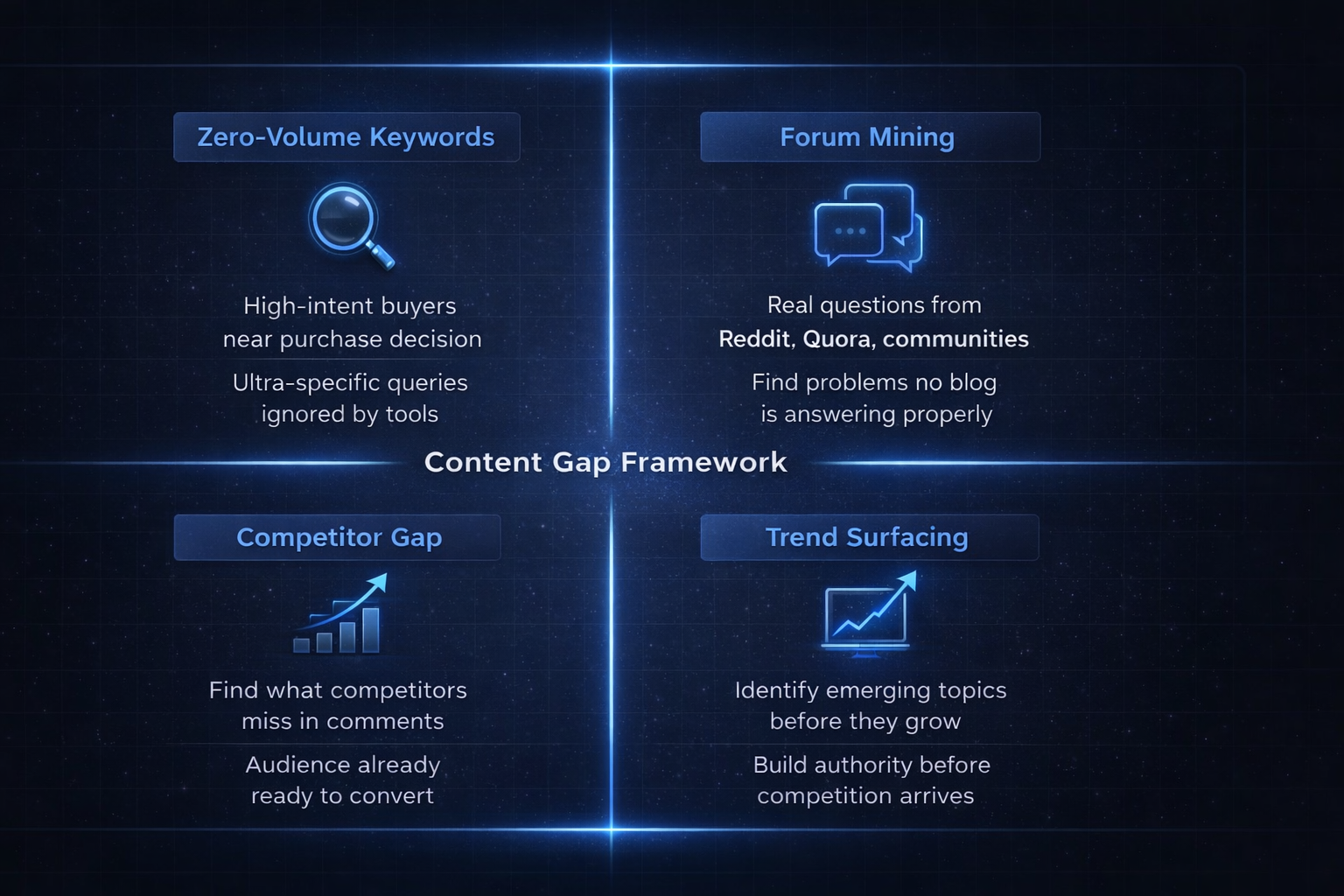
Method 1: The Zero-Volume Keyword Strategy (The Most Underused Approach in Content Marketing)
A 2025 analysis by Ahrefs confirmed something counterintuitive: some of the highest-converting content on the internet targets keywords that show zero monthly searches in keyword tools. This is not an anomaly. It is a systematic opportunity that most marketers walk past every day.
Here is why zero-volume keywords convert so well. Keyword tools report search volume as a monthly average aggregated over the past twelve months. A keyword that gets searched 50 times in December and zero times in the other eleven months shows as zero on an annual average. A keyword that is so specific that it gets searched by 10 highly-motivated buyers per month but never by casual browsers also shows as zero because the tools round below a threshold.
These zero-volume, high-intent keywords are exactly what the majority of your competitors are filtering out of their research. Their process says: minimum 100 searches per month, keyword difficulty under 30. They never see the specific, conversion-ready queries sitting below their threshold.
How to Find Zero-Volume Keywords Using AI
Step 1: Start with a broad topic seed. For a marketing website, this might be “affiliate marketing” or “AI writing tools.”
Step 2: Use this specific prompt in Claude or ChatGPT:
“You are an SEO analyst. For the topic [your topic], generate 40 highly specific long-tail keyword phrases that represent questions a person would ask right before making a purchase decision or right after hitting a specific problem. These should be 5 to 9 words long, ultra-specific, and the kind of queries that would not appear in standard keyword research because they are too specific or too new. Focus on questions that reveal frustration, comparison intent, or a very specific use case.”
Step 3: Take the output and run each keyword through Google’s free autocomplete. Type the phrase into the search bar and note what Google suggests to complete it. Each autocomplete suggestion is a real search that people are making right now.
Step 4: Check Google Search Console for your own site. Under Performance, filter by Impressions. Any query where you have 50 or more impressions and zero or one click is a confirmed real search term that nobody is satisfying well enough. That is a content gap sitting in your own data.
The marketing website in this example one publishing consistently for less than two months found in its own Search Console data that “holo ai marketing tool fundingsports” appeared 32 times. Nobody was searching for this phrase by design. Google was connecting the Holo AI review to these related queries. Each of these unexpected queries is a signal about what readers actually want to understand, and a content gap waiting to be addressed.
Method 2: The Forum Mining Strategy (Stolen Directly From Google’s Own Algorithm Updates)
In 2025, Google rolled out what became known internally as the Hidden Gem update. The change elevated forum content particularly Reddit, Quora, and niche community discussions significantly higher in search results. The reason: Google’s own research showed that people searching for authentic first-hand experiences and specific advice were being better served by forum discussions than by polished blog posts.
This tells you something important. The questions getting discussed in forums are exactly the questions that standard blog content is not answering well enough. These are content gaps hiding in plain sight.
The AI-Powered Forum Mining Process
Step 1: Identify the forums where your target audience actually spends time. For marketing topics this includes Reddit communities like r/juststart, r/bigseo, r/affiliatemarketing, and r/digitalmarketing. For AI tools, communities on Product Hunt and specific Discord servers. For SEO, communities on LinkedIn and Slack groups.
Step 2: Collect the questions being asked in these communities. Look specifically for questions that have many comments but no single clear answer, questions that show up repeatedly with slight variations, and questions where the top-voted comments are contradictory or outdated.
Step 3: Feed these questions into AI with this prompt:
“Here are 15 questions from marketing forums that real people are asking. For each question, tell me: 1) Why existing blog content is failing to answer this properly, 2) What the ideal blog post answering this question would include that most posts do not, 3) Estimate whether this has commercial intent, informational intent, or investigative intent. Output as a table.”
This process consistently surfaces specific, underserved topics that keyword tools never show because the search volume appears too low or too fragmented.
A Real Example of What This Surfaces
In April 2026, a search across affiliate marketing subreddits found this repeated question: “Does the affiliate program commission change after I send the customer if the company changes their terms?” This question appeared in 14 different posts with no clear, comprehensive answer anywhere. It has commercial intent the person asking has an active affiliate programme and is concerned about income stability. A 1,500-word post answering this specifically, covering how affiliate terms changes work, what your legal protections are, and how to evaluate programmes for stability would rank for multiple long-tail variations of this question with essentially zero competition because no established blog has covered it at this level of specificity.
Method 3: Competitor Gap Analysis with AI (The Right Way)
Most competitor analysis in content marketing is too broad to be useful. You look at what your competitors are writing about and try to write a better version. This is a race to the same positions, not a strategy for finding uncrowded territory.
The AI-powered version of competitor gap analysis works differently. Instead of looking at what competitors are writing about, it looks at what their audience is asking that they are not answering.
The Process
Step 1: Identify three to five competitors publishing in your space. For a marketing-focused website, these might be specific blogs rather than large publications — sites of similar size and age targeting similar audiences.
Step 2: For each competitor, collect the comment sections of their ten most-read posts. Comments are gold mines of unanswered questions. A reader who takes the time to comment “but what about X” or “this doesn’t explain Y” is telling you exactly what gap the post left open.
Step 3: Feed the collected comments to AI with this prompt:
“I am going to give you the comment sections from competitor blog posts in the marketing niche. Your job is to identify: 1) The most common questions that the original posts did not answer, 2) The follow-up topics readers wanted but did not get, 3) Specific frustrations that suggest the reader had a more specific situation than the post addressed. Organise these into blog post ideas, ranked by how often the same gap appeared across different posts.”
Step 4: Cross-reference the output with Google Autocomplete. Take each identified gap and type it into Google search. If autocomplete suggests multiple variations, real searches are happening for this topic. If the top results are forums and outdated posts, the gap is confirmed and winnable.
This approach consistently surfaces content ideas that competitors have literally created demand for but not met because their audience asked and nobody answered.
Method 4: The AI Trend Surfacing Method (Get There Before Google Confirms It)
One of the highest-value content positions available to any blog is writing about a topic before it reaches mainstream search volume. This is how smaller sites earn authoritative positions that hold up long after larger sites notice the trend and try to compete.
In 2026, AI tools have become significantly better at identifying topics that are gaining traction in niche communities before they register in standard keyword tools. The signal is always present somewhere in the number of discussions, the velocity of mentions, the way language around a topic is evolving but extracting it manually takes more time than most content teams have.
The AI Trend Detection Prompt Sequence
Prompt 1: “What questions related to [your niche] are people starting to ask in 2026 that they were not asking in 2024? Focus on new tools, new platform changes, new regulations, or new use cases that have emerged in the last twelve months.”
Prompt 2: “For each trend you identified, describe the content gap that exists right now — what is being written about it versus what people actually need to know to act on it?”
Prompt 3: “Rank these emerging topics by how likely they are to reach mainstream search volume within the next six to twelve months, and explain your reasoning.”
The output from this sequence gives you a prioritised list of topics to write about now, before competition develops. Posts written today about topics reaching mainstream in six months will have six months of indexing history, inbound links, and engagement signals before the competition arrives.
What This Looks Like In Practice Marketing Niche Example
Running this prompt sequence in April 2026 for the AI Marketing niche surfaced the following genuinely emerging topics with low to no existing competition:
“How to optimise your content for Google’s AI Overviews” mainstream awareness is only beginning, established guidance is almost nonexistent, and the query volume is growing rapidly as more bloggers notice their content is being cited or ignored in AI Overviews.
“Affiliate marketing with AI-generated product review videos” a combination of affiliate marketing and AI video tools that nobody has addressed comprehensively despite multiple AI video tools launching affiliate programmes in Q1 2026. Tools like Merlin AI make this content creation process significantly faster for affiliate marketers working across multiple channels
“How to use Google Search Console’s new branded queries filter” Google launched this feature in 2026, very few guides exist, and the search intent is highly specific and transactional.
Each of these is a real content gap in April 2026. Each will have meaningfully more competition by October 2026. Writing about them now, with genuine knowledge and specific practical guidance, positions a site as the early authority.
Method 5: Mining Your Own Audience’s Language
The most valuable content ideas you will ever find are already in your own data. Most content creators ignore this completely.
Every comment someone leaves on a post, every reply to a newsletter, every question someone asks in a DM, every query that appears in Search Console these are all signals about what your specific audience needs that your existing content is not providing.
The AI-powered approach to mining this data works as follows.
Collect every question received through any channel over a three-month period. Comments, DMs, email replies, contact form messages. Do not filter collect everything.
Run this prompt: “I am going to give you a list of questions my audience has asked me over the past three months. Cluster these questions by underlying need rather than surface topic. For each cluster, identify: 1) The root problem this audience segment is trying to solve, 2) The content that would best address this problem, 3) The commercial intent level of this cluster are these people about to take action, or are they still learning?”
The output consistently identifies content ideas that are not available anywhere because they are specific to your audience’s exact situation and level. This is content that large publishers cannot produce because they do not have access to your audience’s specific questions. It is also content that converts at extremely high rates because it is answering the exact question the reader has right now.
The Publishing Framework What to Do With These Ideas
Finding content gaps is only valuable if the resulting posts are better than what already exists. The most common mistake after finding a genuine gap is writing a generic post about a specific topic which recreates the original problem.
The Three Criteria Every Gap-Filling Post Must Meet
First: It must answer the specific question more completely than anything that currently ranks. Not longer more complete. If the question is “does affiliate commission change if the company changes terms,” the post must actually answer that question with specific detail, not pad it with background information about how affiliate marketing works.
Second: It must include at least one element that cannot be replicated by a competitor who has not done the same research. This means either original data, a specific example from real experience, a test result, or a genuinely original framework. In 2026, Google’s E-E-A-T evaluation specifically rewards content that demonstrates experience that AI cannot fabricate.
Third: The post must match the intent of the specific query. If someone searches “holo ai marketing tool pricing” they want pricing information. They do not want a 3,000-word introduction to AI marketing tools with pricing buried at the end. Matching intent means getting the specific answer in front of the reader within the first 200 words, then providing the depth that earns the position and builds authority.
The Post Structure That Works for Gap-Filling Content
Paragraph 1: Answer the question directly. Not after context-setting. The answer first.
Paragraphs 2-4: Why this question matters and what happens when people get it wrong. This is where you demonstrate experience specific examples, real consequences, real situations.
Main body: The depth. The complete answer with all the nuance, the caveats, the specific scenarios, the data. This is where you earn the ranking and build trust.
FAQ schema: Five specific questions that arise from the main topic, answered directly. These capture additional search queries and dramatically improve the chance of appearing in featured snippets and AI Overviews.
Internal links: Two to four links to related content on the same site, placed naturally within the text at points where the reader would naturally want more depth on a sub-topic.
The Compounding Effect of Content Gap Strategy
Here is what most marketers miss about this approach. The value does not come from any single post. It comes from building a body of content that covers specific questions nobody else is answering, in a niche where authority compounds over time.
When Google indexes your twentieth specific, well-researched post on AI marketing topics, it begins treating your domain as an authority source on that topic cluster. New posts in the same cluster rank faster and higher than they would as standalone pieces. Google’s topical authority signals compound the twenty-first post benefits from the authority built by the first twenty.
This is why the strategy of writing ten broad posts on “AI marketing tips” produces far less long-term traffic than writing twenty specific posts on specific AI marketing questions that your audience is actually asking. The broad posts compete in crowded territory and never develop topical authority. The specific posts build an interconnected cluster that Google recognises as the most complete resource on those specific topics.
The 2026 State of Affiliate Marketing survey of over 1,000 affiliates confirmed that 81.2% of affiliate marketers who stick with consistent publishing for twelve or more months earn over $20,000 per year. The barrier is not the niche or the competition. It is finding the right specific topics and publishing consistently. The methods in this post remove the first barrier. Consistency is the only remaining variable.
Quick Reference: The AI Content Gap Finding Toolkit
Use this table when planning your next content batch. Every post should start with one of these five inputs before a single word is written.
| Method | Best For | Time Required | Competition Level |
|---|---|---|---|
| Zero-volume keywords | High-intent buyers near purchase | 30 minutes | Near zero |
| Forum mining | Specific problem-solvers | 45 minutes | Low |
| Competitor comment gaps | Audience already primed to convert | 1 hour | Low to medium |
| AI trend surfacing | Early authority positioning | 30 minutes | Zero (for now) |
| Own audience language | Highest conversion rate content | Ongoing | Zero |
The Bottom Line
Most marketers are using AI to do the same research faster. The ones building lasting organic traffic are using AI to do different research to find what their competitors have not found, to answer what their audience has not been answered, and to get to emerging topics before the competition arrives.
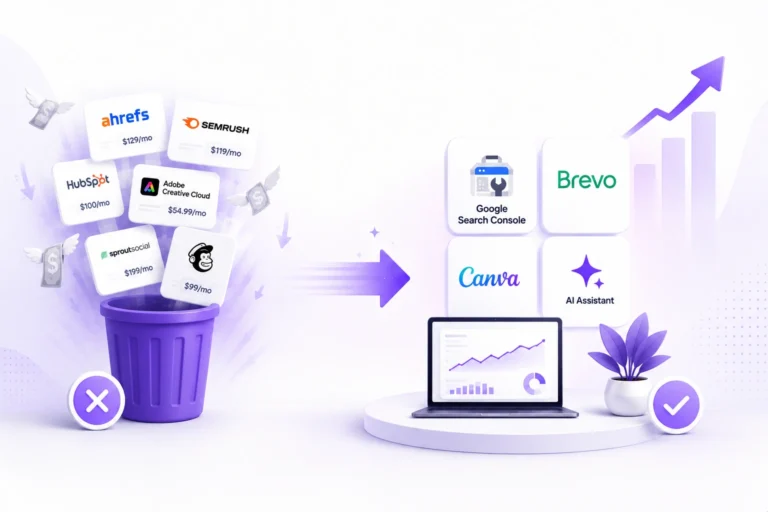
None of the five methods in this post require paid tools. They require clear thinking about where real search intent lives that has not yet been met by clear, specific content. That gap exists in every niche, including yours. The only question is whether you find it first or wait for someone else to.
FAQs
Q: How do I find content ideas that my competitors have not written about yet?
A: Use the five-method approach: mine zero-volume keywords using AI prompts, extract questions from niche forums your competitors ignore, analyse the comment sections of competitor posts for unanswered questions, use AI to surface emerging topics before they reach mainstream volume, and mine your own audience’s questions and DMs for ideas nobody else has access to.
Q: What are zero-volume keywords and why do they matter for content?
A: Zero-volume keywords are search queries that keyword tools report as having no monthly searches because they fall below the reporting threshold. They often represent highly specific buyer-intent searches with almost zero competition. A 2025 Ahrefs analysis confirmed these keywords can yield exceptional ROI because conversion rates are high and competition is nonexistent.
Q: Can AI really find content gaps or does it just suggest obvious topics?
A: Standard AI prompts produce obvious, saturated topics because the AI draws from commonly discussed content. Specific prompts that feed AI raw data forum questions, Search Console queries, competitor comment sections produce genuinely specific, underserved topic ideas that standard keyword research never surfaces.
Q: How long does it take for gap-filling content to rank on Google?
A: Content targeting genuine low-competition gaps with strong search intent typically begins ranking within three to eight weeks for a site with some existing domain authority. For newer sites, the timeline is three to six months. Highly specific zero-competition queries can rank within days of indexing for sites Google already trusts.
Q: What is the difference between content gap analysis and standard keyword research?
A: Standard keyword research finds topics with confirmed search volume and then assesses competition. Content gap analysis starts from the opposite direction-finding specific questions that have real intent but inadequate existing answers, regardless of what keyword tools report. Gap analysis consistently surfaces lower-competition, higher-conversion opportunities that standard research filters out.