


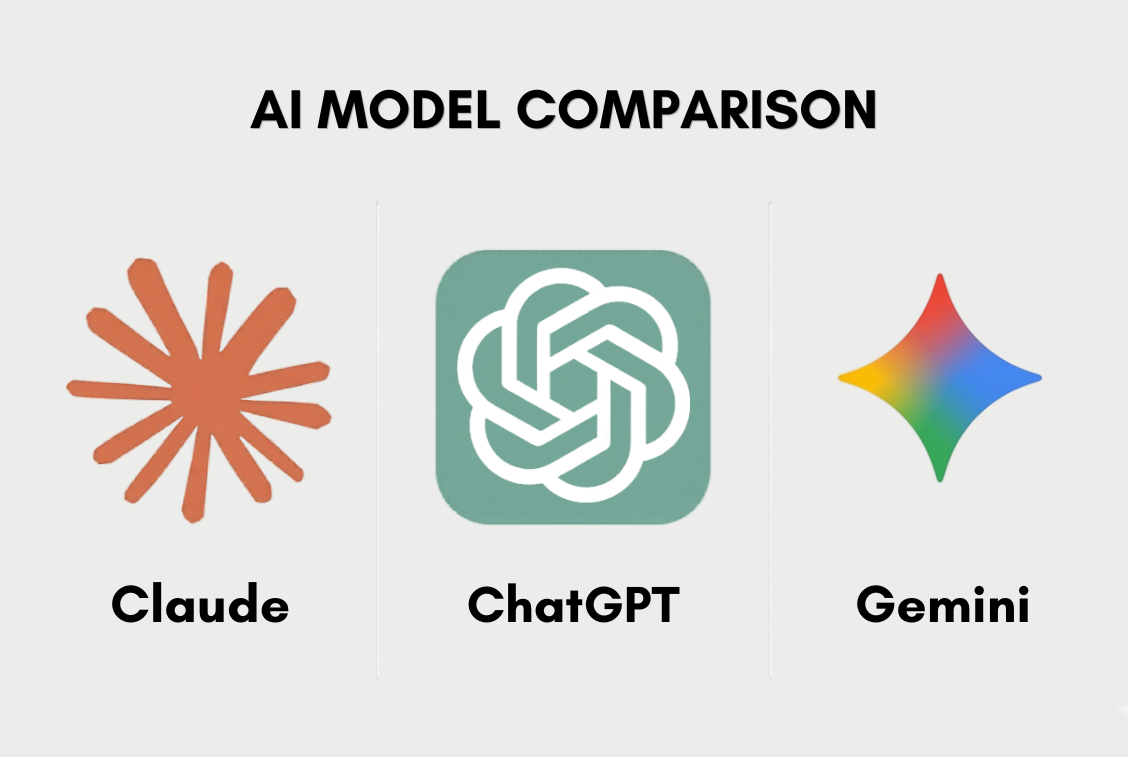
Most comparisons of Claude, ChatGPT, and Gemini are written by developers for developers. They talk about token windows, benchmark scores, and API performance. If you are a marketer or content creator, you close those articles within thirty seconds because none of it tells you what you actually need to know.
Which one writes better blog posts? Which one understands your brand voice? Which one gives you the most useful social media content? Which one is worth paying for? And is there a smarter way to access all three without paying three separate $20 per month subscriptions?
Those are the questions this post answers. No technical jargon. No benchmark tables. Just a straight, practical comparison built specifically for marketers, content creators, and business owners who want AI to actually help them grow.
Where Each AI Stands in 2026
Before comparing them for marketing specifically, here is a quick honest picture of where each tool stands right now.
ChatGPT from OpenAI currently holds 68% of the AI market share with 800 million weekly active users. It is the most widely used AI tool on the planet and the one most people think of first when they hear “AI assistant.” The latest version — GPT-5.4 — is a genuinely capable, versatile tool that handles a very wide range of tasks.
Gemini from Google has grown dramatically in 2026, surging from 5.4% to 18.2% market share — the most significant market shift in generative AI history so far. Gemini 3 Pro now integrates deeply with Gmail, Google Docs, Google Sheets, YouTube, and the entire Google Workspace. If your workflow already lives inside Google tools, Gemini fits in seamlessly.
Claude from Anthropic has carved out a distinct and growing niche among writers, content creators, and knowledge workers who prioritise writing quality, accuracy, and nuanced reasoning over raw versatility. Claude Sonnet 4.6 — the current version — leads on writing quality and produces fewer hallucinations than its competitors. In a blind test across 8 prompts with 134 voters, Claude won 4 out of 8 rounds. And when Claude won a round, it won by 35 to 54 points — significantly wider margins than any other model. That is not a small gap.
All three cost $20 per month for their premium tiers. Which one is worth that $20 for a marketer? That depends entirely on what you need it for. Let us break it down.
Claude vs ChatGPT vs Gemini — Head to Head for 8 Marketing Tasks
1. Writing Blog Posts
This is the most common use case for marketers and content creators. And the results are clear.
Claude consistently produces the most natural, human-sounding blog content of the three. It understands nuance, avoids generic AI patterns like excessive bullet points and robotic phrasing, and maintains a consistent tone throughout a long piece without drifting. In independent testing, Claude prioritised user benefits over technical features, incorporated natural social proof, and maintained concise, reader-first messaging — qualities that matter enormously for content that needs to rank and convert.
ChatGPT is strong at structured, well-organised blog content. Its posts are accurate, logical, and easy to follow. The weakness is that ChatGPT’s writing can feel slightly formulaic — technically correct but lacking the natural flow that makes readers stay on the page.
Gemini’s blog writing is accurate but tends toward functional rather than polished. It works well as a drafting assistant for starting a post but usually needs more human editing to reach the quality level that Claude or ChatGPT produce.
Winner for blog writing: Claude
2. Social Media Content
Social media content needs to feel human, punchy, and natural. Generic AI content stands out immediately on social media and people scroll past it without engaging.
In independent testing across LinkedIn post generation, all three platforms showed a consistent weakness — overuse of emojis particularly the rocket emoji which immediately signals AI generated content. However Claude recovered best from this pattern when given specific instructions about tone. It prioritised user benefits, incorporated natural social proof, and kept messaging concise — all qualities that perform well on LinkedIn and Instagram.
ChatGPT produced technically accurate social content but reviewers described it as uninspiring and lacking organic appeal. Gemini highlighted customer pain points well but its execution was too wordy and heavy on bullet points for natural social media use.
Winner for social media: Claude — with specific tone instructions provided
3. Email Marketing Copy
Email copy needs warmth, personalisation, and a clear call to action. It needs to sound like a real human wrote it — not a corporate AI.
Claude leads here for the same reason it leads in blog writing — it produces more natural, conversational copy that reads like it came from a real person. Its instruction-following is consistent across long documents, meaning if you tell it to write in a specific brand voice it maintains that voice throughout rather than drifting back to generic patterns.
ChatGPT is a close second. It handles email copy well, particularly for structured sequences like welcome emails and promotional campaigns. Its versatility means it can adapt quickly between formal and casual tones.
Gemini is capable but tends toward functional rather than warm in email copy. For marketing emails where personality matters, it requires more editing than the other two.
Winner for email copy: Claude — closely followed by ChatGPT
4. Research and Fact-Finding
For marketers who need to research topics, competitors, industry trends, and statistics before writing, this is where the tools diverge significantly.
Gemini wins this category clearly and it is not even close. Gemini has real-time web access integrated by default, meaning it can pull current news, statistics, pricing, and competitor updates as of today. Its Deep Research feature can run extended research tasks across the web and synthesise findings into structured reports. For competitive analysis, market research, or finding up to date industry data, Gemini is the strongest tool by a significant margin.
ChatGPT with web search enabled is also strong for research tasks, though its real-time search is less seamlessly integrated than Gemini’s.
Claude does not have real-time web access in its standard form. It relies on its training data which has a knowledge cutoff. For research requiring current information, Claude is the weakest of the three.
Winner for research: Gemini — not close
5. Ad Copywriting
Paid advertising copy needs to be punchy, specific, and conversion-focused. Every word needs to earn its place.
ChatGPT performs best for ad copy in independent testing. Its structured, outcome-focused writing style translates well to the short-form, direct copy that works for Facebook ads, Google ads, and display advertising. It understands the mechanics of persuasion — clear value proposition, specific benefit, strong call to action — and executes them consistently.
Claude is strong for longer ad formats like advertorials and native advertising where tone and naturalness matter more. For short punchy ads, Claude can feel slightly too refined and thoughtful compared to ChatGPT’s more direct approach.
Gemini is capable for ad copy but trails both in creative punch for short-form advertising.
Winner for ad copy: ChatGPT
6. SEO Content and Keyword Optimisation
For SEO-focused content that needs to rank on Google, a few specific qualities matter — keyword integration that reads naturally, structured headings that match search intent, and factual accuracy that builds trust.
Claude leads here. Its natural writing style means keywords integrate smoothly without the robotic repetition that tanks readability scores. Its accuracy and minimal hallucination rate mean you are less likely to publish incorrect information that damages credibility. And its ability to maintain consistent tone and argument coherence across long pieces makes it ideal for the 2,000 to 3,000 word posts that perform best in search.
ChatGPT is a capable second choice for SEO content. Its structured approach produces well-organised posts with clear headings and logical flow. The weakness is a slightly higher tendency toward generic phrasing that sophisticated readers — and increasingly Google — can identify.
Winner for SEO content: Claude
7. Strategic Marketing Thinking
Sometimes you do not need content written. You need to think through a strategy — how to position a product, how to respond to a competitor’s move, how to structure a campaign.
ChatGPT wins this category. In the blind test mentioned earlier, ChatGPT won the strategist round — a prompt asking what your first move should be when a competitor launches the same product at a lower price. ChatGPT scored 53% — 25 points ahead of Gemini. Its structured business-oriented reasoning makes it the strongest of the three for strategic marketing thinking and decision-making frameworks.
Claude is strong for analytical reasoning but tends toward thoughtful nuanced responses over quick decisive strategy recommendations. For fast strategic thinking, ChatGPT’s directness is more useful.
Gemini sits in the middle — capable but not the standout performer for pure marketing strategy work.
Winner for strategic thinking: ChatGPT
8. Content Repurposing and Long Document Analysis
Marketers frequently need to repurpose long content — turn a blog post into social media clips, extract key points from a long report, summarise a competitor’s whitepaper, or adapt existing content for different channels.
Claude wins this category decisively. Its 200,000 token context window means it can process extremely long documents in a single session — entire reports, multiple blog posts, lengthy brand guidelines. More importantly, it utilises that large context effectively, maintaining reasoning quality and coherence throughout rather than losing track of earlier content in a long session.
Gemini also has a massive context window — up to 1 million tokens — and is strong for processing large datasets and multimodal content including images and video. For text-heavy content repurposing specifically, Claude edges it on output quality. For repurposing that involves video or image analysis alongside text, Gemini is the stronger choice.
ChatGPT has the smallest context window of the three at 128,000 tokens but compensates with superior memory features that persist across sessions — useful for ongoing projects where you want the AI to remember previous work.
Winner for content repurposing: Claude
Quick Reference: Which AI Wins Each Marketing Task?
| Marketing Task | Winner | Why They Won (Key Strength) |
| 1. Writing Blog Posts | Claude | The most natural, human-sounding flow; understands nuance. |
| 2. Social Media Content | Claude | Best at adapting specific brand tones and prioritizing user benefits. |
| 3. Email Marketing Copy | Claude | Leads in warmth and personalization; reads like a real person. |
| 4. Research & Fact-Finding | Gemini | (Unbeatable) Integrated real-time web access and Deep Research features. |
| 5. Ad Copywriting | ChatGPT | Punchy, conversion-focused, and excels at short-form, direct copy. |
| 6. SEO & Keyword Optimization | Claude | Natural keyword integration without robotic repetition or sacrificing quality. |
| 7. Strategic Thinking | ChatGPT | Structured, business-oriented reasoning and superior strategic frameworks. |
| 8. Content Repurposing | Claude | (Decisive) Massive 200k context window maintains coherence across huge documents. |
Pricing — What Does Each One Actually Cost?
All three premium tiers are priced identically at $20 per month.
ChatGPT Plus — $20 per month. Access to GPT-5.4, web browsing, image generation via DALL-E, code interpreter, and thousands of third-party plugins. The richest feature set of the three at this price point.
Claude Pro — $20 per month. Access to Claude Sonnet 4.6 and Opus 4.6, 200,000 token context window, priority access during peak hours, and the ability to create custom Projects with persistent context. Best writing quality at this price.
Gemini Advanced — $19.99 per month. Access to Gemini 3 Pro, 1 million token context window, real-time web access, Google Workspace integration, and the ability to process video, images, audio, and code. Best for Google-ecosystem users and research-heavy workflows.
All three have free tiers. Gemini’s free tier is the most generous — access to Gemini 3.1 Pro with real-time web access at no cost. Claude’s free tier is functional for light use. ChatGPT’s free tier is the most limited of the three.
The math for paying for all three is $60 per month. For most marketers and content creators, that is too much — especially when you do not need all three features simultaneously.
ChatGPT vs Claude vs Gemini — Full Feature Comparison
| Feature | ChatGPT Plus | Claude Pro | Gemini Advanced |
| Monthly Price | $20 | $20 | $19.99 |
| Primary Model | GPT-5.4 | Claude 4.6 (Sonnet & Opus) | Gemini 3.1 Pro |
| Context Window | 128,000 tokens | 200,000 tokens | 1,000,000 tokens |
| Key Strengths | Richest feature set; agentic coding; DALL-E 3 image generation. | Best natural writing quality; “Projects” for persistent context. | Best for research; deep Google Workspace integration (Docs/Gmail). |
| Free Tier | Most limited; capped access to top models. | Functional for light use; includes persistent memory. | Most generous; access to 3.1 Pro with web search at no cost. |
| Unique Perks | Thousands of 3rd-party plugins; Canvas editing environment. | “Extended Thinking” for complex logic; lowest hallucination rates. | 2TB Google One storage included; video/audio/code processing. |
The Smartest Way to Use All Three Without Paying $60 a Month
Here is what the highest-performing marketers in 2026 actually do — and it is not choosing one AI and ignoring the others.
The most effective approach is using different models for different tasks based on their individual strengths. Use Gemini for research and gathering current information. Use Claude for writing, editing, and content refinement. Use ChatGPT for strategic thinking, ad copy, and structured analysis. Each model operates in its zone of strength and the combined output is significantly better than forcing one model to do everything.
The problem with this approach is cost and friction. Three separate subscriptions at $20 each is $60 per month. And constantly switching between three different browser tabs and three different interfaces adds up to a lot of wasted time and mental energy.
This is exactly why tools like Merlin AI exist. Merlin is a Chrome extension that gives you access to ChatGPT, Claude, Gemini, and more — all in one place, from one keyboard shortcut, on any website you are already using. Instead of paying $60 per month for three separate subscriptions, you access all of them through Merlin’s Pro plan at a fraction of that combined cost.
Press Ctrl+M on any website — Gmail, LinkedIn, Google Docs, anywhere — and your full suite of AI models opens instantly in a sidebar. Switch between Claude, ChatGPT, and Gemini mid-task without leaving the page. Use Claude to draft, Gemini to research, ChatGPT to sharpen strategy — all from one interface.
For marketers who want to leverage all three models without the $60 per month bill and the tab-switching headache, Merlin is the most practical solution available right now.
Which AI Should You Start With Right Now?
If you can only pick one to start with today, here is the honest recommendation based purely on marketing use cases.
Start with Claude if your primary need is writing — blog posts, email copy, social media content, and long-form SEO articles. Claude’s writing quality is the best of the three and its free tier is genuinely usable for getting started without paying anything.
Start with Gemini if your primary need is research — finding current information, analysing competitor content, keeping up with industry news, or working inside Google Workspace. Gemini’s free tier is the most generous of all three and gives you real-time web access at no cost.
Start with ChatGPT if your primary need is versatility — you want one tool that handles a wide range of tasks reasonably well, from writing to strategy to coding to creative work. ChatGPT’s ecosystem of plugins and integrations is the richest of the three and its general-purpose capability is unmatched.
For most marketers and content creators reading this — start with Claude on the free tier. Writing is the foundation of almost every marketing task. Once you have Claude as your writing engine, add Gemini for research, and use ChatGPT for strategy and ad copy when those specific needs arise.
Is Paying $20 Per Month for Any of These Worth It?
For marketers the honest answer is yes — but only if you are using the tool consistently and heavily enough to justify the cost.
The free tiers of all three are genuinely functional for light use. If you are writing one or two pieces of content per week, experimenting with AI for the first time, or just getting comfortable with the tools — start with the free tiers. Gemini’s free tier in particular is surprisingly capable.
Upgrade to a paid plan when you consistently hit the free tier limits and find yourself relying on the tool for daily work. At that point $20 per month pays for itself quickly. One well-written blog post that generates even a single affiliate commission, one email campaign that converts a handful of customers, or a few hours of time saved per week — all of these justify the subscription cost easily.
The Bottom Line — Claude vs ChatGPT vs Gemini for Marketers
There is no single winner. That is the most honest and useful answer this comparison can give you.
Claude is the best AI for writing quality, SEO content, email copy, and long-form content repurposing. If writing is the core of your marketing work, Claude is your primary tool.
ChatGPT is the best AI for strategic thinking, ad copywriting, versatile day-to-day tasks, and the richest integration ecosystem. If you need one AI that handles everything reasonably well, ChatGPT is the most complete choice.
Gemini is the best AI for research, real-time information, Google Workspace integration, and multimodal tasks involving images and video. If your workflow runs on Google tools or requires current information, Gemini is indispensable.
The smartest move is not choosing one. It is knowing which tool to reach for and when — and finding the most cost-effective way to access all three without paying $60 per month for separate subscriptions.
Quick Reference Summary
| Feature / Task | Claude | ChatGPT | Gemini |
| Best For | High-Quality Content & Writing | Versatile Marketing Strategy | Deep Research & Multimodal |
| ✅ Top Strengths | Blog posts, long-form SEO, and natural-sounding email copy. | Ad copywriting, creative brainstorming, and tactical planning. | Real-time market research, competitor analysis, and video/audio. |
| ✅ Technical Edge | Minimal hallucinations; follows complex brand voice instructions. | Massive 3rd-party plugin ecosystem and custom “GPT” agents. | Native Google Workspace integration (Gmail, Docs, Drive). |
| ✅ Document Use | Analyzing/repurposing 100+ page reports or long documents. | Coding technical marketing tools or landing page scripts. | Processing massive datasets or scanning long YouTube videos. |
| ❌ Main Weakness | No real-time web access (limited to training data). | Can sound more “robotic” or generic without heavy editing. | Writing can feel functional/academic rather than warm. |
| ❌ Missing Tools | No native image generation. | No native Google Workspace integration. | Struggles with punchy, short-form conversion copy. |
Want access to Claude, ChatGPT, and Gemini all in one place without paying three separate subscriptions?
Merlin AI gives you all three models plus more through one Chrome extension — accessible on any website with a single keyboard shortcut. Try the free plan with no credit card required.