



There is a moment every non-technical founder knows too well.
You have an idea — a real, genuinely good software idea. You know exactly what it should do, who it is for, and why people would pay for it. But between you and that product sits a $50,000 development agency quote, a six-month timeline, and a developer recruitment process you have no idea how to navigate.
That gap — between the idea and the built product — is exactly what Emergent AI was designed to eliminate.
And in many ways, it does. Emergent reached $100 million in annual recurring revenue just eight months after launch. It has over 1.5 million active builders on the platform. It is backed by Y Combinator, SoftBank, Lightspeed, and Khosla Ventures. These are not numbers you manufacture with marketing. They reflect a platform that is genuinely solving a real problem for a large number of people.
But there is something most Emergent reviews are not telling you clearly enough — the credit system. The way Emergent charges for usage can lead to costs that are significantly higher than the base plan price suggests, and the reasons why are buried in details that are easy to miss during signup.
This review covers everything. What Emergent actually builds, who it works best for, the exact verified pricing as of March 2026, the full honest truth about credits, what real users consistently report after paying for it, and whether it is the right tool for you right now.
What Is Emergent AI?
Emergent AI, built by EmergentLabs Inc., is a full-stack AI-powered application builder that converts plain English descriptions into working, deployed software. You do not write code. You do not drag and drop elements. You simply describe what you want to build — in natural, conversational language — and Emergent’s AI agents handle everything from there.
Everything means: frontend interface design, backend logic, database architecture, user authentication, payment processing integrations, API connections, testing, debugging, and one-click cloud deployment. A live application with a shareable URL can be ready in under thirty minutes for most builds.
The AI powering Emergent includes some of the most capable models currently available. The platform uses a multi-agent system where specialised AI agents handle different parts of the build simultaneously — one for architecture planning, one for frontend code, one for backend logic, one for database design, and one for quality assurance and testing. This parallel approach produces cleaner, more coherent code than single-agent builders which tackle each component sequentially.
The technology stack Emergent generates is real and modern — Next.js, TypeScript, React, FastAPI, and MongoDB. These are not toy templates. They are production-grade frameworks used by professional development teams at serious companies.
Who Is Emergent AI Built For?
Emergent is genuinely useful for several distinct types of users, and being honest about which ones benefit most is important.
Non-technical founders and entrepreneurs with software ideas but no coding background and no budget for a development agency are the primary intended audience. If you have been sitting on an app idea because you thought you needed a developer, Emergent is the most direct solution currently available.
Product managers and operations teams who need internal tools — dashboards, trackers, client portals, reporting systems — without going through a lengthy development process will find Emergent fast and practical for building functional tools in hours rather than weeks.
Early-stage startups that want to build and test a minimum viable product quickly before committing to full development investment will find Emergent particularly valuable. Testing a working product with real users before spending serious money is one of the smartest things a startup can do, and Emergent makes that possible at a fraction of traditional development costs.
Freelancers and agencies who build web applications for clients can use Emergent to dramatically reduce the time and cost of initial builds, then hand off the generated code for customisation and refinement.
Experienced developers who want to use Emergent as a scaffolding tool will also benefit. The GitHub integration means developers can let Emergent generate the foundational 80 percent of an application and then customise the remaining 20 percent in their own development environment.
Who Emergent is NOT ideal for: designers who need precise pixel-level visual control over every interface element. Emergent generates clean, functional layouts, but it is not a visual design tool. If exact design control is your priority over functional output, you will find the prompt-based approach limiting for that specific requirement.
Key Features of Emergent AI
1. Full-Stack App Generation From Natural Language
The headline capability and the one that makes Emergent genuinely impressive. Describe your application in plain English — as detailed or as simple as you want — and Emergent generates a complete working application. One reviewer built a complete appointment booking system with Google Calendar integration, Stripe payment processing, email reminders, and full user authentication entirely through conversation. Simple apps deploy in under ten minutes. More complex multi-feature builds typically take under thirty minutes. Both timelines represent a transformation compared to any traditional development approach.
2. Specialised Multi-Agent System
Unlike single-agent AI builders, Emergent uses dedicated specialised agents for distinct parts of the build process — Builder, Designer, Quality, and Deploy Agents working collaboratively. Architecture planning, frontend code generation, backend logic, database design, and quality assurance all happen through separate specialised agents. The result is cleaner code, fewer conflicts, and more coherent system architecture than platforms where a single AI model handles every aspect of a build sequentially.
3. Self-Healing Debugging
When the AI encounters an error during the build process, it analyses its own output logs, identifies the problem, and attempts to fix it automatically without requiring any input from you. This self-correcting capability is one of the features that genuinely separates Emergent from simpler AI builders. However — and this is critical — when the AI enters a debugging loop, it continues consuming credits with every attempt. This is the source of the most consistent user frustration and we cover it in full detail in the pricing section.
4. Credit Budget Controls Per Project
This is a feature worth highlighting that most reviews overlook entirely. Inside Emergent’s Advanced Controls, you can set a specific credit budget for each project before starting the build. This means you can cap exactly how many credits a single build is allowed to consume, preventing runaway credit usage on complex projects. Using this feature proactively is one of the best ways to manage costs on the platform and avoid the credit burning issues that many users report.
5. Live Preview and One-Click Deployment
Emergent provides a real-time live preview of your application as it builds. Once satisfied, deployment is a single click. The platform handles the entire production environment configuration automatically — backend, database, file storage, and hosting are all bundled in and managed by Emergent. Your application gets a live URL immediately without needing to configure servers, set up hosting accounts, or manage deployment pipelines. Active deployment costs 50 credits per month to keep a live application running.
6. Full Code Ownership and GitHub Integration
Every application you build on Emergent belongs to you completely. You can connect your GitHub account and sync your generated codebase directly to your own repositories at any time. This means you are never locked into the Emergent platform. You can take your code, hand it to a developer, continue building elsewhere, or migrate to any hosting environment you choose. Full code ownership is not standard across all AI builders and its presence here is a significant practical advantage for anyone planning to scale beyond the platform.
7. Build From Existing Code
Emergent is not limited to building from scratch. You can connect your GitHub account and point Emergent at an existing repository. The AI analyses your existing codebase and can extend it, refactor it, add new features, or modernise legacy systems automatically. This capability makes Emergent useful not just for new projects but for improving and upgrading software that already exists.
8. Mobile App Development
Emergent supports mobile app development using React Native and Expo alongside web applications. You can test on physical devices in real time via QR code scanning during the build process — meaning you see your mobile app running on your actual phone as Emergent builds it. Web and mobile deployment are both handled from the same platform and the same prompt-based workflow.
9. Multiple Build Types From One Platform
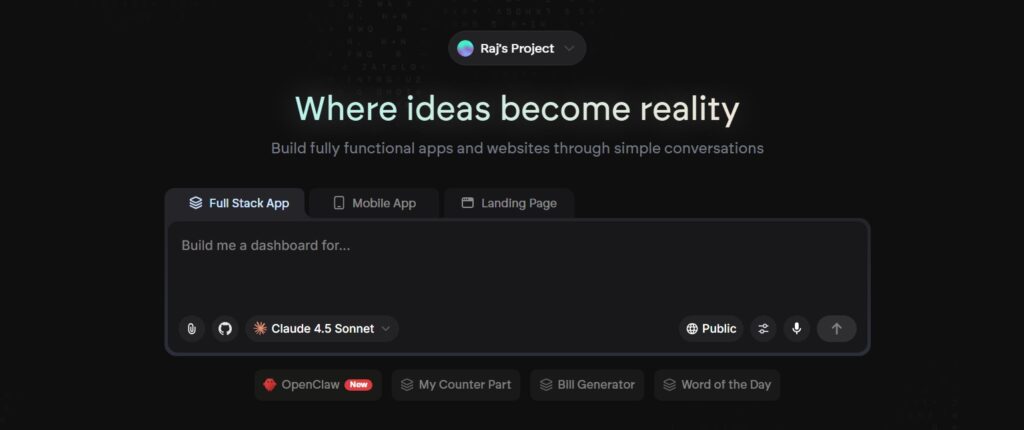
Inside Emergent’s prompt interface you can choose from full-stack web app, mobile app, and landing page build modes. You can also upload a UI screenshot image, a product requirements document PDF, or attach an existing GitHub repository as starting material. The platform adapts its agent configuration based on what you are building. This flexibility means Emergent is not a single-purpose tool — it handles a wide range of build types from one consistent interface.
H3: 10. Third-Party Integrations
Emergent connects natively with a growing range of tools out of the box including Google Sheets, Airtable, Notion, Slack, Stripe, Shopify, Webflow, Zendesk, and GitHub. Stripe payment integration in particular is included by default on Pro plans, meaning payment processing is built directly into applications without additional setup. For founders who want to monetise from day one, this is a direct practical advantage.
Emergent AI Pricing 2026 — Verified, Complete, Honest
This is the most important section in this entire review. Read every word carefully because the credit system is where the majority of user frustration originates — and the reasons why are not clearly explained during signup.
How the Credit System Works
Emergent uses a credit-based pricing model. Credits are the currency that powers everything on the platform. Every code generation action, every test run, every debugging attempt, and every deployment consumes credits. Simple applications typically consume one to two credits per build action. Complex projects with multiple features, iterations, and debugging cycles can consume three to five credits per action — and those actions add up fast.
Here is the important nuance most users miss: chatting with the AI agent itself costs nothing. Credits are only consumed when the AI takes action — writing code, running tests, deploying. Understanding this distinction helps you manage usage more efficiently by planning your builds clearly before triggering actions.
Monthly credits reset with each billing cycle. Top-up credits purchased separately never expire, giving you flexibility when projects demand more resources than your plan provides.
Free Plan
The free plan gives you 10 credits per month and 10 daily credits. It includes access to all core platform features and community resources. To be completely direct — 10 credits per month is enough to understand how the platform works and get a basic feel for the interface. It is not enough to build and deploy a complete, functional application. One reviewer described burning through their credits within minutes of starting their first real build. The free tier is a preview, not a working trial. Go in with that expectation.
Standard Plan — $20 per month
The Standard plan costs $20 per month on monthly billing or $204 per year on annual billing — a 17 percent saving compared to monthly. It includes 100 monthly credits, 10 daily credits, unlimited small projects, Google Sheets and Airtable integrations, mobile app support, GitHub integration, and the Fork feature for collaboration.
Here is the critical thing to understand about the Standard plan before subscribing: keeping a deployed application live costs 50 credits per month on top of whatever you spent building it. That means if you deploy one application on the Standard plan, you immediately spend half your entire monthly credit allowance on deployment hosting alone. The remaining 50 credits is what you have available for building, testing, and modifying your application for the rest of the month.
For users who want to build and actively iterate on one deployed application, the Standard plan can feel tight. For users who build and test without keeping apps permanently deployed, or who use the credit budget controls to manage usage carefully, 100 credits can stretch further.
Pro Plan — $200 per month
The Pro plan costs $200 per month on monthly billing or $2,004 per year on annual billing — again a 17 percent annual saving. It includes 750 monthly credits, all Standard features, premium integrations including Stripe, early access to beta features, a 1 million token context window, custom agent creation tools, priority customer support, and runs on a faster, more powerful machine for quicker build performance.
The jump from $20 to $200 per month is steep. For solo founders and individual creators this price gap leaves a significant void. The Standard plan runs short on credits for serious ongoing work. The Pro plan is powerful but priced for organisations and teams with substantial budgets rather than for individual early-stage builders.
Team Plan — $250 per month
The Team plan costs $250 per month on annual billing for up to five members with a shared pool of 1,250 credits monthly. It includes centralised billing, collaborative workspace, and everything from the Pro tier. This plan is designed for agencies and development teams requiring coordinated workflows with shared resources. Individual users cannot access it and should not consider it.
Top-Up Credits
When you run out of monthly credits, Emergent sells additional credits separately at $10 for 50 credits — approximately $0.16 per credit. These top-up credits never expire, which is genuinely useful for users with variable monthly build needs. However, for users who regularly need top-up credits to finish projects they started, the actual monthly cost of using Emergent ends up notably higher than the base plan price.
The Real Cost Warning
The single most common legitimate complaint across every Emergent review platform we researched is this — credits disappear faster than expected, particularly when the AI enters a debugging loop. When Emergent gets stuck attempting to fix its own mistake, it continues consuming credits with every failed attempt. One user reported their 110 credits not lasting a full day. Another described burning through credits just to fix AI-generated errors with no working application to show at the end.
Emergent has partially addressed this with the credit budget per project feature in Advanced Controls. Using this tool before every build is the single most effective way to prevent runaway credit consumption. Set a credit budget, stick to it, and treat any build that approaches the budget as a signal to pause and reassess your prompt strategy before continuing.

What Real Users Are Saying in 2026
We went through Trustpilot reviews, Reddit threads, hands-on published reviews, and independent user reports from early 2026 to give you the most current and honest picture of real user experience.
The positive experiences are genuinely impressive. One reviewer built four applications with Emergent, with two already live and generating monthly revenue from paying customers. They described the shift from building internal tools to having products that now serve other businesses as a genuinely significant change in how they operate. Another hands-on reviewer who built a complete appointment booking system described the process as watching a real development team work in real time — and described everything coming back green on the AI’s own backend tests as giving them real confidence in what was produced.
The transparency of Emergent’s build process is praised consistently. Unlike black-box tools that just produce an output, Emergent shows you every step the agents are taking. For non-technical users, being able to follow along even without understanding the code creates a sense of control and trust that most competitors do not provide.
The critical feedback is equally consistent and cannot be ignored. The credit consumption issue is the dominant complaint across every platform we reviewed. Multiple users describe credits vanishing far faster than expected. Several describe the AI making repeated mistakes while continuing to charge credits for each failed fix attempt, ultimately leaving them with no working application and no credits remaining.
The free tier is consistently described as misleading by independent reviewers. Multiple published reviews explicitly state that calling 10 credits a free tier misrepresents what is actually possible — it is enough to see how the interface works, not enough to build anything meaningful. Customer support receives mixed feedback, with some users reporting helpful responses and a notable number describing slow resolution times particularly around credit-related issues.
Where Emergent AI Falls Short
The Credit System Is Genuinely Unpredictable
You cannot accurately forecast how many credits a project will consume before starting. Complex builds, unexpected bugs, and debugging loops can consume credits at rates that feel completely disproportionate to the work being done. The credit budget feature helps but does not fully solve the underlying unpredictability.
Deployment Costs Eat Into Monthly Credits
Keeping one deployed app live costs 50 credits per month — half the Standard plan’s entire monthly allowance. Users who want to build and deploy multiple applications on the Standard plan will find credits exhausted quickly through hosting costs alone before they have done any new building.
The Standard to Pro Price Gap Is Too Large
The jump from $20 per month to $200 per month leaves a significant gap for serious individual users who need more than Standard but cannot justify the Pro price. There is no middle-tier option for this segment.
Free Tier Sets Unrealistic Expectations
10 credits per month is a preview, not a trial. Users who sign up expecting to evaluate Emergent meaningfully on the free tier will be disappointed. A genuine free trial with enough credits to complete one small real build would serve users — and Emergent — much better.
Not Designed for Design-First Builders
Emergent generates clean, functional interfaces but does not provide the kind of precise visual control that design-focused builders need. If you care deeply about pixel-perfect custom UI design above functional output, this is the wrong tool for that specific requirement.
Debugging Loops Burn Credits Without Guarantee of Resolution
When the AI gets stuck, credits keep flowing. There is no credit protection for failed debugging attempts. This is the most frustrating aspect of the platform and the source of the majority of its negative reviews.
Is Emergent AI Worth It If You Are Just Starting Out?
This is the honest answer most reviews do not give you.
At $20 per month for the Standard plan, Emergent is accessible. The real question is whether $20 per month gives you what you actually need — and the answer depends entirely on what you are building and how carefully you manage credits.
When Emergent IS worth it for someone starting out:
You want to build and validate a single small, clearly defined application quickly without paying a developer. If your idea is relatively contained — a simple client portal, a basic booking form, a straightforward tracker or dashboard — and you write a detailed, specific prompt upfront, the Standard plan’s 100 monthly credits can cover a first build. Testing a working product with real users for $20 per month before deciding to invest further is genuinely good business sense.
You are technically inclined and want to use Emergent as a scaffolding tool. The GitHub integration means you can generate the foundational structure of an application quickly and then customise in your own environment. This workflow saves significant time even for experienced builders.
You understand the credit system fully before paying. Users who go in knowing how credits work, use the budget controls proactively, and write clear detailed prompts consistently have better experiences than those who sign up without reading the pricing details carefully.
When Emergent may NOT be worth it right now:
You expect to build complex, heavily iterated applications on the Standard plan without budget buffer. The 100 monthly credits minus 50 for deployment hosting leaves limited room for serious building and debugging. Budgeting for occasional top-up credits is a realistic expectation for Standard plan users doing real production work.
You are on an extremely tight budget with no ability to absorb unexpected credit consumption. The unpredictability of credits means your actual monthly cost could exceed the base plan price.
You need reliable, rapid customer support as a baseline. The mixed support reviews mean you cannot rely on quick resolution if you encounter credit or billing problems.
The honest bottom line: Emergent AI represents one of the most genuinely impressive technological achievements in the current wave of AI tools. The ability to go from a plain English description to a fully deployed, production-ready application in under thirty minutes is real — not hype. The $100 million ARR in eight months reflects a platform delivering something people genuinely value.
Go in understanding the credit system, set budget limits per project, write detailed prompts upfront, and treat the Standard plan as a starting point rather than a permanent home for serious production work.
Emergent AI vs The Competition
Emergent vs Lovable
Lovable is Emergent’s closest direct competitor in the full-stack AI app builder space. Lovable is considered more beginner-friendly with a cleaner onboarding experience and stronger focus on visual output quality. Emergent wins on multi-agent system depth, GitHub integration, and mobile app capability. For users who need maximum power and are comfortable with a steeper learning curve, Emergent is the stronger choice. For absolute beginners who want the simplest possible starting experience, Lovable is worth comparing side by side.
Emergent vs Bolt.new
Bolt.new focuses on fast frontend-heavy web applications particularly for React-based projects. Emergent goes deeper on full-stack architecture including backend logic, database design, and payment integration. For applications requiring serious backend depth, authentication, and third-party payment processing, Emergent is the stronger choice. For rapid, lightweight frontend prototypes, Bolt is faster to get started with.
Emergent vs Base44
Base44 offers a visual editor alongside AI generation and is generally considered more accessible for users who want some visual control over their interface. Emergent wins on raw AI capability and full-stack output quality for complex builds. For users who want the deepest AI-driven full-stack generation capability available today, Emergent is the category leader. For users who want more visual control alongside AI assistance, Base44 is a meaningful alternative.
Our Verdict — Is Emergent AI Worth It in 2026?
Emergent AI is the most capable full-stack AI application builder available in 2026 for non-technical users. The technology works. The results are real. Users are building and deploying applications that have paying customers. The $100 million ARR milestone reached in eight months is not a marketing number — it is evidence of a platform delivering genuine value at scale.
The credit system remains the platform’s most significant weakness and the source of nearly all legitimate criticism. The Standard to Pro price gap leaves a large segment of serious solo builders underserved. The free tier undersells what the platform can do rather than demonstrating it properly.
But here is what matters most for your decision. If you have a software idea, no coding background, and no budget for a development agency — there is no better starting point available today. The technology that Emergent has built to handle the full lifecycle of application development through natural language is genuinely remarkable and is only going to get more capable over time.
Start on the free tier. Understand credits before paying. Use the budget controls from day one. Write detailed, specific prompts. And approach the Standard plan as a testing and validation environment rather than expecting it to sustain unlimited production-grade building without budget awareness.
The gap between idea and shipped product has never been smaller. Emergent is one of the primary reasons why.
Quick Summary
❌ Watch out for: Credit burning in debugging loops, 50 credit monthly deployment cost, steep Standard to Pro price gap
❌ Not ideal for: Design-first builders, users expecting fixed predictable monthly costs, very tight budgets without credit buffer
If you have a software idea you have been sitting on because you thought you needed a developer — Emergent is the place to start.
Sign up on the free tier, set a credit budget before your first build, describe your idea clearly and in detail, and see what gets produced. The results will very likely surprise you.