


Here is a number worth sitting with.
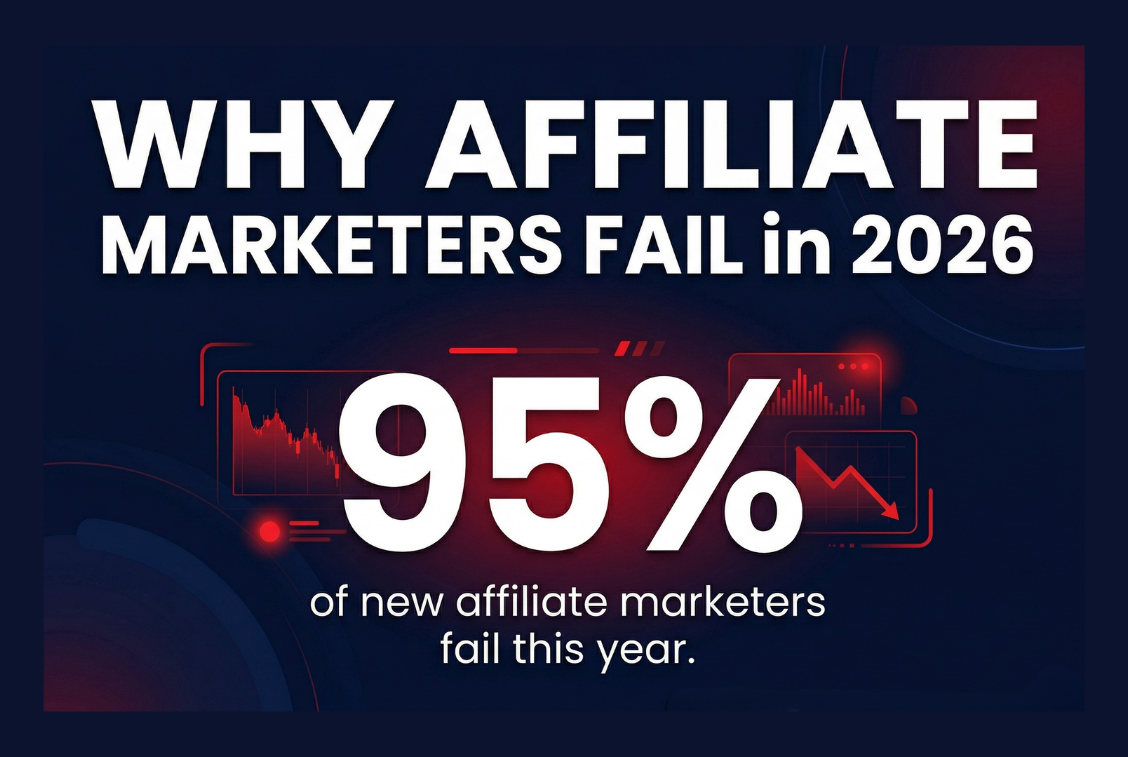
95% of people who start affiliate marketing quit before earning their first paycheck. Not their first thousand. Their first single commission. Zero.
This is not a pessimistic estimate. It is a figure supported by multiple independent analyses of the affiliate marketing industry in 2025 and 2026, including data from Affiverse, which tracks affiliate program performance across thousands of publishers. The affiliate marketing industry crossed $18 billion globally in 2026, with over 80% of brands running active affiliate programs. The opportunity is genuinely enormous. The failure rate is genuinely catastrophic.
And here is what makes it worse. Most of the people in that 95% were not lazy. They were not stupid. They were not missing some secret formula. They failed because they made five specific, identifiable, completely avoidable mistakes.
This post covers all five. Not to discourage anyone from starting. Quite the opposite. Understanding exactly why most people fail is the clearest possible map for how to succeed.
Why Affiliate Marketing Has Such a High Failure Rate in 2026
Before getting into the specific mistakes, it helps to understand the environment that makes those mistakes so costly.
Affiliate marketing in 2026 is not harder than it was in 2018. In some ways it is easier. There are more affiliate programs, better tracking tools, more platforms to create content on, and easier ways to build an audience than ever before.
What has changed is the quality threshold. AI can now generate passable content on virtually any topic in seconds. This means generic surface-level content provides no competitive advantage. The internet is flooded with it. According to industry analysis from Affiverse, the content that succeeds in affiliate marketing in 2026 demonstrates genuine expertise, real personal experience, and a unique perspective that no AI system can fabricate. E-E-A-T signals Experience, Expertise, Authoritativeness, and Trustworthiness now determine which sources Google ranks and which AI systems cite.
In simpler terms: the bar is higher. But the bar is higher for everyone. The person willing to clear it has less competition, not more, because most people are still trying to take shortcuts that stopped working two years ago.
The five mistakes below are the shortcuts. Recognise them. Avoid them.
Mistake 1: Expecting Income Before Building Trust
This is the single most common reason affiliate marketing fails. And it is the one least talked about honestly in most guides.
Most people who start affiliate marketing expect to see money within the first month. Some expect it within the first week. When nothing happens, they conclude either that affiliate marketing does not work or that they are doing something wrong and need a different strategy. So they switch strategies. Then switch again. Then quit.
Industry data from 2026 shows that 95% of affiliates quit around months four to six — right before the point where most affiliates would have started seeing real traction. The compounding effect of content marketing means that the 20th post performs significantly better than the 5th, the 50th better than the 20th. The people quitting at month four are leaving right as the engine is warming up.
The real timeline for a content-based affiliate website looks like this. Months one to three involve near-zero income. This is normal and expected. Google is still learning about the website. Content is being indexed. No traffic means no clicks means no commissions. Months three to six bring the first signs of life. Some posts start ranking for low-competition queries. A handful of clicks appear. Maybe a first small commission. Months six to twelve are where compounding starts. Posts from month one are now established enough to rank higher. New posts benefit from the growing domain authority. Monthly commissions begin to grow meaningfully. Month twelve onwards is where the work of the first year pays back in a way that starts to look like real income.
The people who succeed simply refuse to use income as the measure of success in the first six months. They measure content published, rankings gained, impressions growing in Search Console. These are the leading indicators. Income is the lagging indicator that follows everything else.
Mistake 2: Promoting Products, They Have Never Used
This mistake is becoming more costly with every passing year as audiences become more sophisticated and Google’s algorithms become better at detecting authenticity signals.
An affiliate who promotes a tool they have personally used, understood deeply, and genuinely found valuable writes differently than one who reworded the product’s own sales page. Readers can feel the difference. Conversion rates reflect it. And in 2026, Google’s ability to detect thin, derivative content that adds nothing beyond what the source material already says has improved significantly.
A case study worth understanding happened in late 2025 when a group of affiliate marketers promoted a new AI tool they had never actually tested. The software had serious bugs that damaged user data. The affiliates who promoted it without testing lost their audiences’ trust almost permanently. Refund rates hit 40% on their recommendations. Some of those affiliates are still recovering.
The standard this creates for anyone serious about affiliate marketing is simple. Only promote products in categories where there is genuine knowledge. Only write reviews after actually using the product. Only recommend tools that would still be recommended even if there was no commission attached. This is not an idealistic standard. It is a practical one. Honest recommendations convert better because they include specific real details that generic promotional content never does.
The how-to content that consistently generates the highest affiliate conversion rates in 2026 is content that says “I used this tool for X purpose, here is what it did well, here is where it fell short, and here is exactly who should and should not buy it.” That level of specificity comes only from real experience. It cannot be fabricated convincingly.
Mistake 3: Choosing the Niche for Commission Rate Instead of Fit
This mistake happens in the first week of starting and its consequences play out over the following twelve months.
The thought process looks like this: search for “highest paying affiliate programs,” find programs paying 40 to 50% commission, sign up, start writing content. The problem is that high commission rates exist for a reason. They are usually in competitive niches, for products that require sophisticated sales processes, or in categories where the writer has no genuine expertise or audience fit.
A 50% commission on a product the target audience will never buy generates zero income. A 20% recurring commission on a tool that perfectly matches what readers are looking for and need every month generates real income that compounds over time.
The most reliable way to select affiliate products is to start from the audience and work backwards to the product, not start from the commission and work forwards to the content. What does the target reader actually need help with right now? What tools would genuinely solve their specific problems? Which of those tools has an affiliate program? That sequence produces far better results than chasing commission percentages.
For marketers and content creators specifically, the products that convert best through honest content-based affiliate marketing are practical tools that readers use regularly writing tools, SEO tools, design tools, email marketing platforms, AI assistants. These are tools people pay for month after month, which means recurring commissions that compound significantly over time. A single referred customer who stays subscribed for two years generates 24 commission payments from one click. That compounding math is what makes content-based affiliate marketing genuinely worthwhile over time.
Mistake 4: Building on Platforms They Do Not Own
This is the structural mistake that kills otherwise healthy affiliate businesses overnight, and it is completely overlooked in most beginner guides.
A significant number of affiliate marketers build their entire business on a single platform they do not control. Their YouTube channel is their business. Their Instagram following is their business. Their TikTok content is their business. This seems fine until the platform changes its algorithm, restricts their account, demonetises their content, or in the most extreme cases bans them entirely. When that happens, the business disappears with it.
The platforms most vulnerable to this are social media platforms where a single policy change or algorithm update can eliminate years of reach overnight. This has happened to affiliate marketers on YouTube when monetization policies changed, on Instagram when organic reach collapsed, and on TikTok in markets where the platform faced regulatory restrictions.
The solution is not to avoid social media. It is to treat social media as a traffic source that feeds a platform the creator actually owns. A website with an email list is an owned asset. Nobody can take it away. No algorithm can reduce its reach to zero. The email list of 500 engaged subscribers is more valuable as a business asset than 50,000 social media followers on a platform with declining organic reach.
Building a website as the primary platform with social media as a discovery channel is the structure that produces durable affiliate income. Social media brings people to the website. The website converts them to email subscribers. The email list builds the relationship that leads to affiliate conversions over time.
Mistake 5: Treating Content as a Volume Game
This is the mistake most amplified by AI tools, and it is becoming the dominant reason for affiliate website failure in 2026 specifically.
The logic seems sound. More content means more keywords means more traffic means more commissions. AI has made it possible to produce 10, 20, or even 50 articles per week at minimal cost. So many affiliate marketers do exactly that they flood their websites with AI-generated content at scale and wait for the traffic to arrive.
Google’s March 2026 Core Update specifically targeted this approach. Sites relying on high-volume AI content with no original insight saw significant ranking drops. The update refined Google’s ability to detect content that demonstrates no genuine expertise or first-hand experience regardless of whether it was written by a human or an AI. According to FWD Digital’s analysis of the update’s impact, original experience-driven content bounced in rankings while summary-style mass-produced content slipped down.
The affiliate sites growing fastest in 2026 are publishing fewer posts and making each one significantly better. One detailed, honest, thoroughly researched product review that reflects real experience with the tool outperforms ten generic AI-generated reviews on the same topic. One in-depth comparison post with original tables and specific recommendations outperforms a dozen thin comparison articles. The compounding effect of quality content is slower to start but far more durable than the compounding effect of content volume.
What the Successful 5% Actually Do Differently
Looking at what separates the affiliate marketers who build sustainable income from those who quit, the differences are not technical. They are behavioral.
The 5% treat affiliate marketing as a business with a timeline, not a side project with a deadline. They understand that the first six months are an investment period where effort goes in without proportional income coming out. This is not a problem. It is the normal mechanics of a content business. The returns come later and then compound.
The 5% only recommend products they genuinely know and believe in. This limits the number of products they promote but dramatically increases the conversion rate of each recommendation. A smaller number of trusted recommendations earns more than a large number of untrusted ones.
The 5% build email lists from the beginning. Not after they have traffic. From the beginning. An email list of 100 people who trust the writer generates meaningful affiliate income. An Instagram following of 10,000 people who do not trust the writer generates almost nothing. Owned audience beats borrowed reach every time.
The 5% are consistent over time rather than intensive for short periods. Two quality posts per week for twelve months produces a compounding content asset. Ten posts per week for two months followed by nothing produces nothing. Consistency is more valuable than intensity in content-based affiliate marketing.
The Honest Timeline: What to Realistically Expect
Months 1 to 3: Near-zero income. Focus entirely on publishing consistently and building the content foundation.
Months 3 to 6: First commissions appear. Small amounts possibly $30 – $100 per month. This is proof the model is working, not yet a full income.
Months 6 to 12: Compounding begins. Monthly income grows as early content ranks better and new content benefits from established domain authority. Realistic range of $100 – $500 per month for a focused, consistently-published site in a reasonable niche.
Month 12 onwards: With 40 to 60 quality posts, some ranking well and generating consistent traffic, monthly affiliate income of $500 – $1000 becomes achievable. This figure does not include AdSense or other revenue streams that develop alongside affiliate income.
These are not guaranteed outcomes. They are realistic estimates for a consistent, quality-focused approach in a content niche with genuine affiliate opportunities. The single biggest variable is whether the creator publishes consistently for 12 months without quitting when the early results are small.
Quick Summary Table
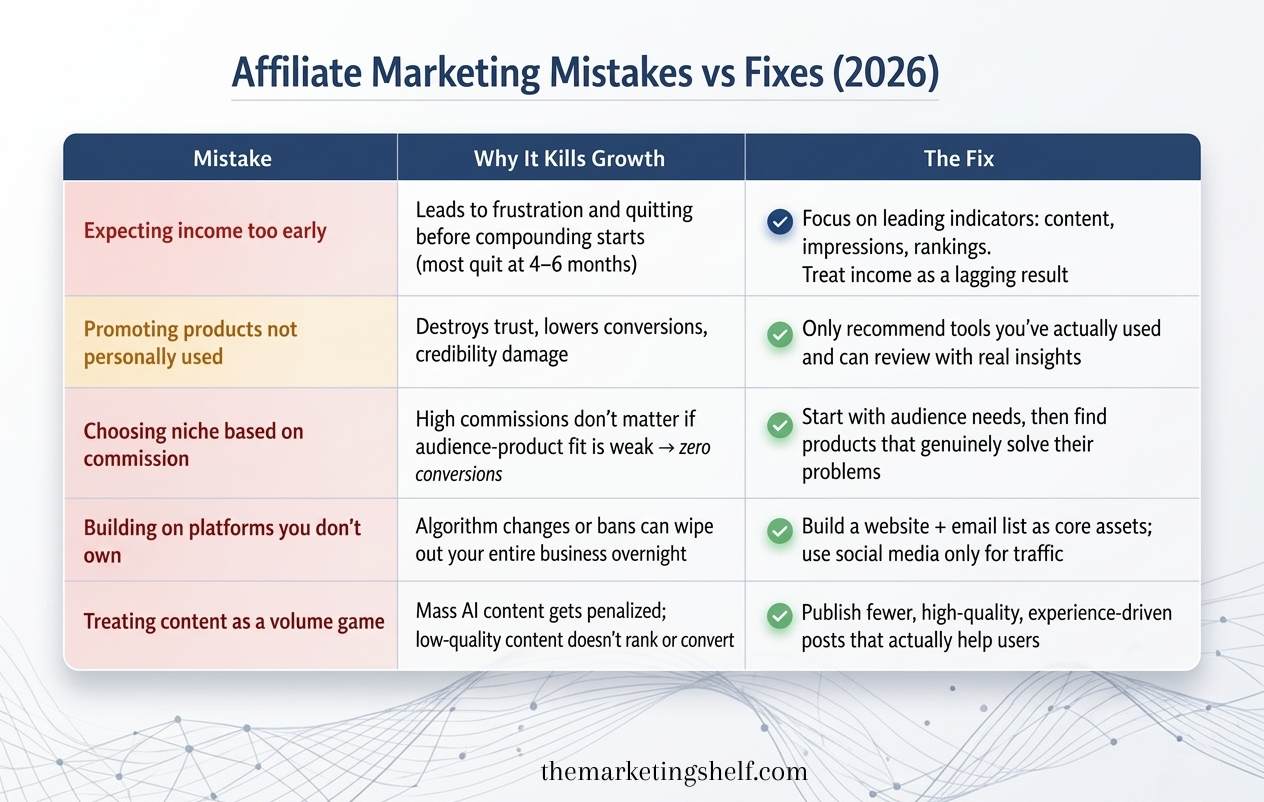
| Mistake | Why It Kills | The Fix |
|---|---|---|
| Expecting income too early | Unrealistic expectations lead to early burnout | Focus on consistency and long-term compounding |
| Promoting untested products | Destroys audience trust permanently | Only recommend tools with genuine first-hand experience |
| Chasing commission rates | Wrong products for wrong audience | Start from audience need, work backwards to product |
| Building on borrowed platforms | One algorithm change wipes the business | Website + email list as primary asset |
| Volume over quality | Google penalises mass thin content | Fewer, higher-quality posts compound more reliably |
The Bottom Line
Affiliate marketing fails for most people not because the model is broken but because the expectations are wrong.
The $18 billion industry and the 80% of brands running affiliate programs are not there by accident. There is real money moving through this channel to real people who create real value for real audiences. The 5% earning that money are not uniquely talented or lucky. They simply understood the timeline, built trust before asking for anything, and stayed consistent long enough for the compound effect to work in their favour.
The 95% who quit mostly failed in month four, right before everything was about to change.
FAQs
Q: Why do most affiliate marketers fail?
The primary reasons are unrealistic income expectations, promoting products without genuine experience, choosing products based on commission rates rather than audience fit, building on social platforms instead of owned assets, and publishing low-quality content at high volume. All five mistakes are avoidable with the right understanding of how content-based affiliate marketing actually works.
Q: How long does it take to earn from affiliate marketing?
Most consistent affiliate marketers see their first commissions between month 3 and month 6. Meaningful monthly income typically develops between month 6 and month 12 with consistent publishing of two quality posts per week. The first year is primarily an investment period.
Q: Is affiliate marketing still worth starting in 2026?
Yes. The global affiliate marketing industry reached $18 billion in 2026 with over 80% of brands running affiliate programs. The opportunity is larger than ever. The difference is that generic low-effort content no longer works. Original, honest, experience-backed content in a specific niche continues to produce strong results.
Q: What is the biggest mistake beginner affiliate marketers make?
Expecting income before building trust. Most beginners treat the first commission as the measure of whether the approach is working. In reality, the first six months are a content investment period where the foundation for future income is being built. Quitting before month six means quitting before the compound effect begins.
Q: How many affiliate marketers actually succeed?
Industry data from 2026 consistently shows approximately 5% of people who start affiliate marketing build sustainable income from it. The 95% who do not succeed primarily fail due to quitting too early, wrong expectations about the timeline, and building on strategies that require shortcuts rather than genuine trust-building over time.