


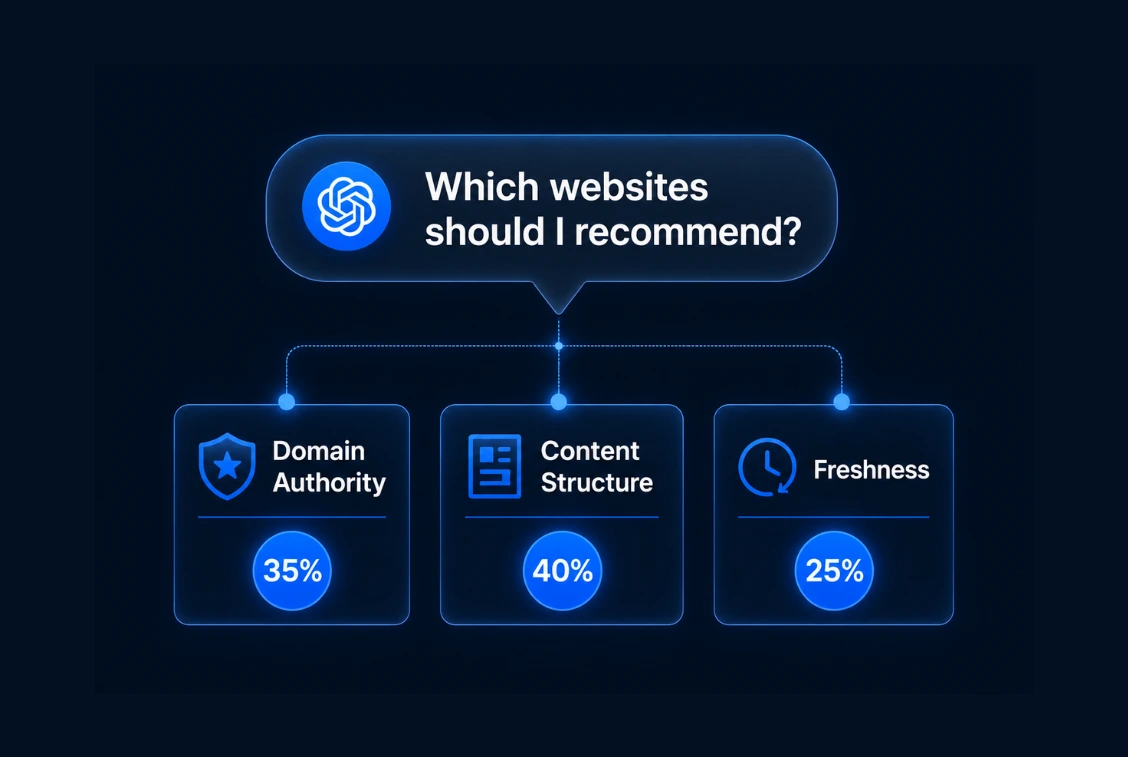
Here is a number that should stop every marketer cold.
ChatGPT cites only 15 percent of the pages it actually retrieves during a search session. An AirOps study analysing 548,534 pages across 15,000 prompts confirmed this. The model pulls your content into its process, evaluates it, and then discards it 85 percent of the time without ever mentioning it in the answer.
You could have a page ranking in the top three on Google. You could have thousands of backlinks. You could have published yesterday. And ChatGPT can still pass over your content entirely and cite a competitor instead.
This is the fundamental shift in search visibility that most marketers have not fully reckoned with. ChatGPT now handles 5.72 billion monthly visits, accounts for roughly 20 percent of search-related traffic worldwide as of early 2026 and drives referral conversions at 15.9 percent compared to 1.76 percent for traditional organic search. The audience is large, growing, and converting at dramatically higher rates. And the selection criteria are completely different from what you have spent years optimizing for.
ChatGPT does not have a ranking algorithm in the traditional SEO sense. There is no PageRank equivalent running in real time. A BrightEdge study found that ChatGPT and Google disagree on recommendations 62 percent of the time. Only 12 percent of URLs cited by ChatGPT also rank in Google’s top 10 for the same query. And 44 percent of SaaS brands with strong Google rankings have zero ChatGPT visibility at all.
This post explains exactly how the selection process works, the specific factors that determine whether your content gets cited or discarded, and the concrete steps you can take to change that outcome.
How ChatGPT Actually Retrieves and Selects Sources
Before getting into the individual ranking factors, understanding the mechanics of how ChatGPT processes a search query is essential. Most optimisation advice skips this step and jumps straight to tactics. The tactics make far more sense once you understand the process they are trying to influence.
The Two Layers – Training Data and Live Retrieval
ChatGPT operates on two layers when generating a response that includes website recommendations.
The first layer is training data. ChatGPT was trained on a massive snapshot of the internet. If your website, brand, or content was frequently mentioned, cited, or discussed in that training data, ChatGPT is statistically more likely to recommend you. This is the static layer it was determined at training time and cannot be changed retroactively. It is why established brands with years of online presence have a natural advantage in AI citations regardless of their current content strategy.
The second layer is live web retrieval. When ChatGPT uses its browsing functionality which is triggered by approximately 31 percent of prompts according to Nectiv’s analysis of over 8,500 prompts it performs real-time web searches through Bing’s index and synthesizes results into a response. This is the dynamic layer, and it is the one you can actively influence through your current content and technical strategy.
Both layers contribute to what users see. Optimising for both gives you the best AI visibility, but the live retrieval layer is where most of the actionable optimisation work happens.
The Query Fan-Out Process
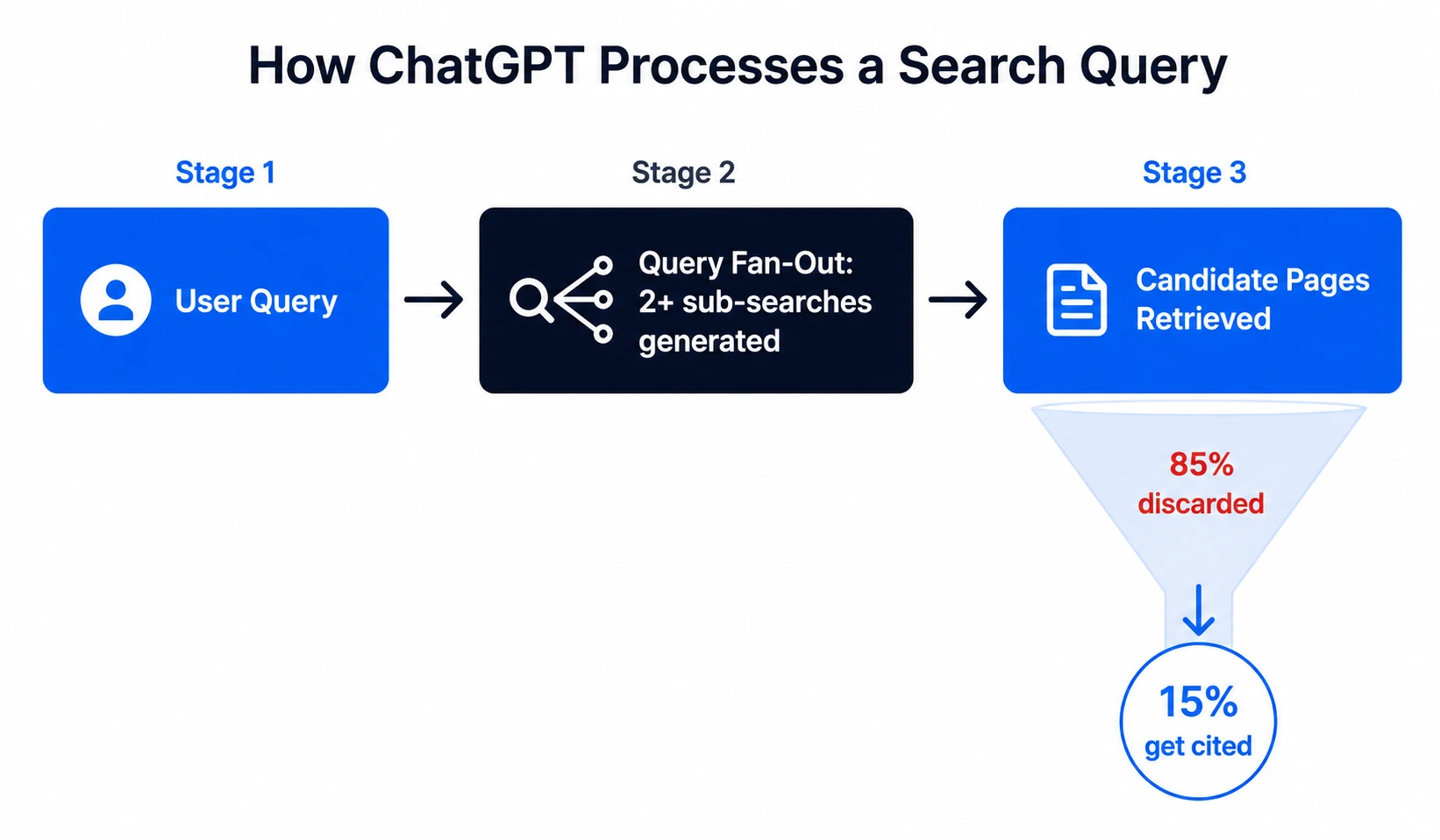
ChatGPT does not search once and cite what it finds. According to SE Ranking’s analysis, 89.6 percent of prompts trigger two or more additional searches before an answer is returned. On average, ChatGPT performs two searches per query, each typically five to six words long. This process is called query fan-out the model expands the original question into multiple sub-questions to build a more complete answer.
This matters for your content strategy because it means a single page ranking for one query may be retrieved for several related sub-queries during the same ChatGPT session. Content that covers a topic comprehensively addressing the question and its likely follow-up questions in the same document is significantly more likely to be selected across multiple sub-queries in the fan-out process.
Retrieval vs Citation – The Critical Distinction
The most important concept in ChatGPT optimisation is understanding the difference between being retrieved and being cited. These are not the same thing.
ChatGPT cites only 15 percent of the pages it retrieves. Being retrieved means the model pulled your page as a candidate. Being cited means it actually referenced your content in the answer. The selection criteria that determine citation are what this post is about.
The distinction between retrieval and citation is the most important thing to understand about ChatGPT optimization in 2026. An enormous amount of optimization effort is focused on getting into the retrieval pool and that matters but the real leverage is in the structural and authority signals that move you from retrieved to cited.
The Core Ranking Factors That Determine ChatGPT Citations
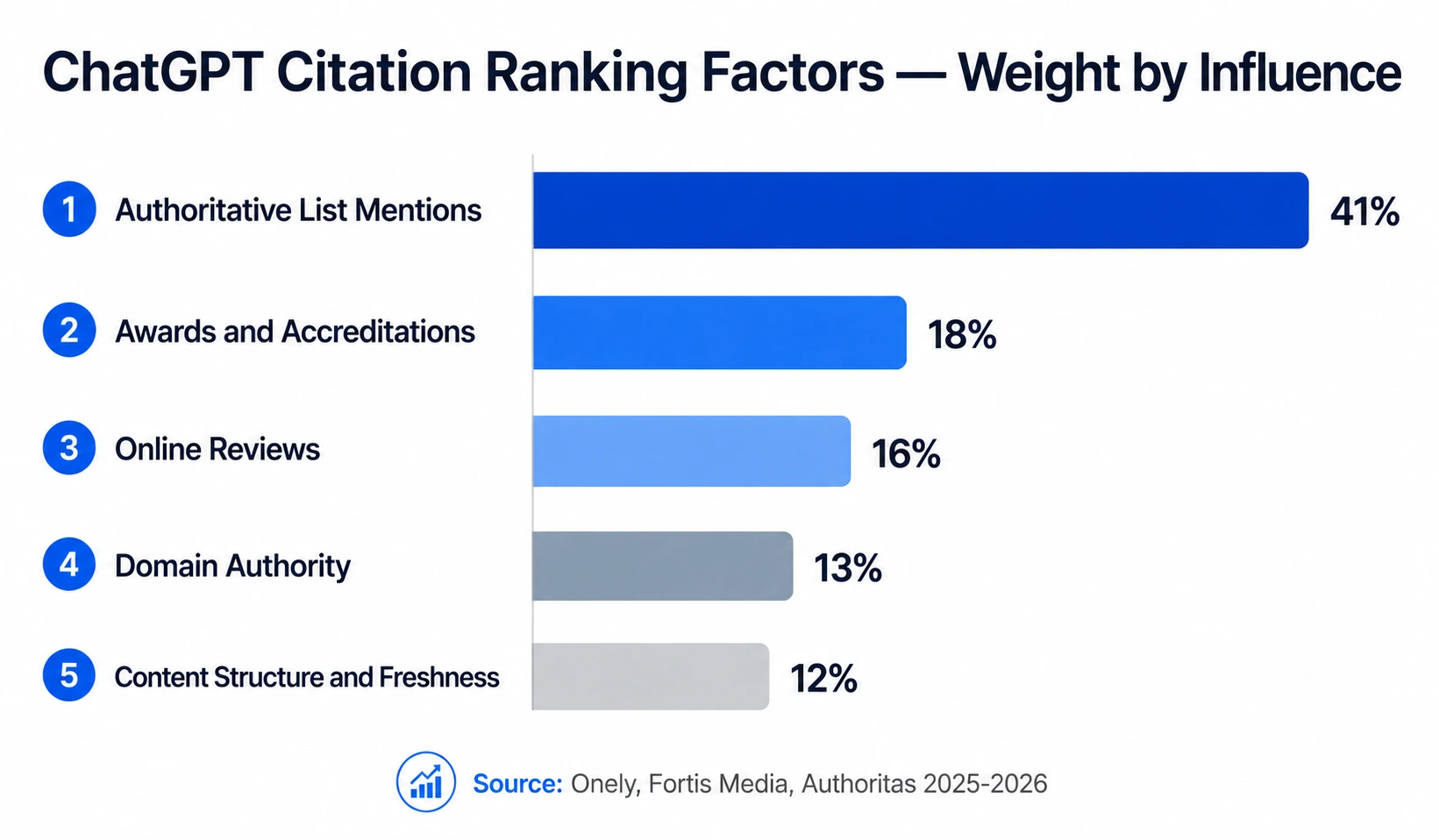
Multiple independent research teams Authoritas, Fortis Media, Onely, BrightEdge, AirOps, and SE Ranking have converged on a consistent set of factors that determine whether ChatGPT cites a page. Here they are in order of influence.
Factor 1 – Authoritative List Mentions (41% of Influence)
This is the single most important factor for ChatGPT recommendations, and it surprises most marketers who expect content quality or backlinks to top the list.
Research aggregated by Onely shows that authoritative list mentions account for 41 percent of influence on ChatGPT recommendations. Awards and accreditations account for 18 percent. Online reviews account for 16 percent. The remaining weight falls across reviews, brand mentions, and content authority.
When ChatGPT is asked to recommend a product, service, or tool, it retrieves content from high authority “best of” articles, comparison pages, and curated directories and then mirrors those recommendations in its output. XLR8 AI’s analysis of citation patterns found that brands appearing in the top three to five positions on high-authority list articles are cited by ChatGPT in over 80 percent of relevant queries.
The practical implication is significant. Getting featured in industry roundups, “best tools” lists, and curated directories on high-authority domains is not a nice-to-have. It is the highest-leverage single action you can take for ChatGPT visibility. Traditional link building will not produce this result. Digital PR actively pitching to get included in existing list articles and directories is the specific strategy this factor rewards.
Wikipedia accounts for 47.9 percent of ChatGPT’s top citation sources. If your brand is notable enough to warrant a Wikipedia entry or mention, that single placement has outsized impact on ChatGPT visibility across a broad range of queries.
Factor 2 – Domain Authority (3.5x Multiplier)
Domain authority matters for ChatGPT, but it manifests differently than in Google’s algorithm. Sites with over 32,000 referring domains are 3.5 times more likely to be cited by ChatGPT than sites with fewer than 200 referring domains, according to Fortis Media’s research.
This creates what researchers call an authority trust cliff. In traditional Google search, a site with moderate authority can still rank for long-tail keywords if the content is directly relevant. In ChatGPT, the model is risk-averse. It prefers sources it can confidently attribute. The link graph functions as a credibility signal rather than just a ranking factor and the effect is steep rather than gradual.
The practical takeaway is not that you need 32,000 referring domains to appear in ChatGPT answers. It is that domain authority matters more for entry into the citation pool than for selection within it. Getting your first hundred quality backlinks from relevant, credible sources significantly improves your chances of being retrieved at all. The selection between retrieved candidates is then determined more by content structure than by backlink count.
Third-party review profiles amplify this signal independently. Domains with active profiles on platforms such as Trustpilot, G2, Capterra, and Yelp have 3 times higher citation probability compared to sites without such presence.
Factor 3 – Content Structure (40% Citation Lift)
Content structure is the factor most within your direct control, and it has a large measurable impact. Pages with FAQ schema and inline citations are weighted approximately 40 percent higher in ChatGPT source selection than pages without these elements, according to Authoritas’ 2025 research.
ChatGPT selects citation sources using a process called retrieval-augmented generation RAG where the model retrieves external documents and ranks them by cosine similarity to the query before generating a response. Content that is structured for easy extraction scores higher on cosine similarity because the model can quickly find and parse the specific answer it needs.
The most important structural change you can make is answering the question at the top of each section. ChatGPT reads the first 40 to 60 words of each section and decides whether to cite it. If your content buries the answer under preamble, qualifications, or background, the model moves to the next source. Direct answer first, every time.
Additionally, 44.2 percent of all LLM citations come from the first 30 percent of a piece of text the introduction. This means the opening paragraphs of your post are doing the most citation work. They deserve the most structural attention.
Pages with three or more schema types have a 13 percent higher likelihood of being cited by AI systems, according to the 2026 State of AI Search report. At minimum, implement Article schema, FAQ schema, and Author schema. For comparison pages, add Table schema. For step-by-step content, add HowTo schema.
Factor 4 – Content Freshness (3.2x Citation Rate)
Content updated within the last 30 days receives 3.2 times more citations than older material, according to Digital Bloom’s analysis of over 7,000 AI citations. Citation velocity how recently and frequently a brand is mentioned was identified as one of ChatGPT’s 2026 algorithm updates by Zero to Nine Marketing’s December 2025 research.
The recommended refresh cadence for content you want ChatGPT to actively cite is every 30 to 90 days. Pages that have not been updated in six months or more are significantly less likely to be selected. This does not mean rewriting the post from scratch. Updating statistics, adding new data, refreshing examples, and adding sections covering recent developments all count as meaningful freshness signals.
ChatGPT injects temporal modifiers like “best,” “top,” and “reviews” into its sub-queries, which means it is actively seeking recent content for commercial and recommendation queries. Content that includes 2026 data and current-year statistics has a structural advantage for exactly the query types where ChatGPT visibility matters most.
Factor 5 – Branded Web Mentions and Off-Site Presence
YouTube mentions and branded web mentions are the top factors that correlate with AI brand visibility in ChatGPT, AI Mode, and AI Overviews, according to Ahrefs’ December 2025 research. This finding fundamentally changes how off-page strategy should be approached for AI visibility.
Traditional SEO rewards backlinks a link from another site to yours. ChatGPT visibility rewards brand mentions any reference to your brand name on a credible platform, whether or not it includes a clickable link. Reddit threads where users recommend your tool. LinkedIn posts discussing your content. YouTube videos reviewing your product. News articles that mention your brand in context. All of these feed into how AI systems perceive and cite your authority.
Distributing content to a wide range of publications can increase AI citations by up to 325 percent compared to only publishing content on your own site, according to Stacker’s December 2025 research. This is one of the most actionable statistics in AI visibility research: the same piece of content, syndicated to multiple relevant publications, generates dramatically more AI citations than it would as a single post on your own domain.
The most honest framing for this factor comes from Scott Baradell writing for Entrepreneur in April 2026: you cannot content-market your way to AI visibility. What works is the patient pursuit of external validation from sources that carry genuine authority. Media coverage, analyst citations, verified reviews, original research picked up by trade outlets all of it becomes part of your inbound trust record.
What ChatGPT Ignores – The Signals That Do Not Transfer from Google
Understanding what does not work for ChatGPT visibility is as important as understanding what does. Several factors that are central to traditional Google SEO have weak or no correlation with ChatGPT citations.
Keyword density has no equivalent in ChatGPT’s selection process. ChatGPT uses semantic understanding and cosine similarity to evaluate content relevance, not keyword matching. Content that is naturally and comprehensively written about a topic will score higher than content engineered around keyword placement.
Google ranking position matters, but not in the way most people assume. Pages ranking in position 1 on Google are cited by ChatGPT 3.5 times more often than pages outside the top 20. However, 80 percent of LLM citations do not rank anywhere in Google’s top 100. Strong Google SEO is a contributing factor, not a guarantee and the correlation is weaker than most SEO professionals expect.
Meta tags, title tags, and on-page keyword optimisation signals that Google weighs heavily have little direct influence on ChatGPT citations. The model does not evaluate your title tag when deciding whether to cite your content. It evaluates the extractable quality of your content itself.
Exact-match anchor text in backlinks a significant Google ranking signal does not appear to correlate with ChatGPT citation frequency. The brand mention signal is more important than the link itself.
The Content Formats ChatGPT Cites Most Often
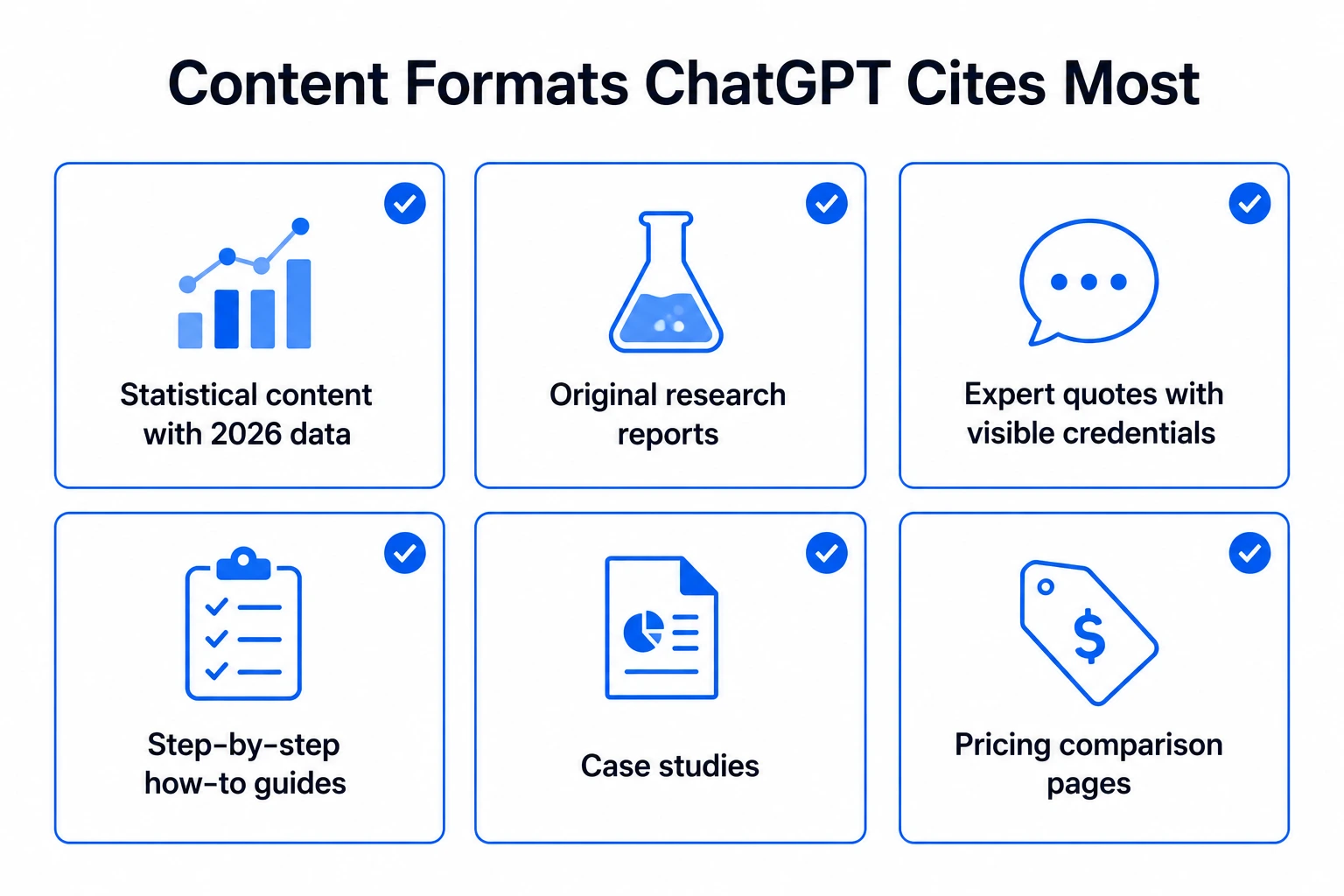
Research consistently shows that certain content formats are cited significantly more often than others. Understanding these formats shapes how you should structure every post you publish.
Statistical content with current-year data is among the most-cited format types. ChatGPT favours quantified claims with sources. Use current-year numbers, cite the original research, and add one sentence of context explaining what the number means. A statistic without context is extractable but less useful. A statistic with a clear “what this means” sentence is both extractable and directly useful to the answer being synthesized.
Original research reports stand out because the information is not widely duplicated. A proprietary survey, benchmark study, or original experiment signals to AI systems that your content contains information not available elsewhere. ChatGPT cannot get your original data from any other source, which makes it highly citable. Link methodology and include assumptions so the research is verifiable.
Expert-driven analysis with visible credentials performs significantly better than generic opinions. When including quotes or expert perspectives, make the expert’s credentials explicitly visible in the content not just in the author bio. “According to [Name], a [specific credential]” is more citable than an unattributed claim.
Comprehensive how-to guides with clear numbered steps, checklists, and “do this first” ordering are consistently cited because they are easy for AI systems to extract accurately. The structured format maps cleanly to what the model needs to generate a useful answer.
Case studies and pricing pages are identified by Siege Media’s September 2025 research as the best content types for driving AI traffic, while top-of-funnel content “what is X,” basic how-tos, and broad guides saw significant drops in AI-referred traffic over the past two years. This is a counterintuitive finding worth paying attention to: the content most likely to be replaced by AI-generated answers is the same content most likely to be overlooked by AI as a citation source.
Technical Requirements – Making Your Site Accessible to ChatGPT
Beyond content and authority signals, several technical requirements determine whether ChatGPT can read and process your content at all. Being excluded from the technical retrieval process means none of your content or authority signals matter.
Allow AI Crawlers in robots.txt
ChatGPT uses a dedicated crawler called GPTBot. If your robots.txt file blocks GPTBot either explicitly or through blanket bot blocking rules ChatGPT cannot crawl your content and it will not appear in live retrieval results. Check your robots.txt file and ensure GPTBot is permitted.
The same applies to other AI crawlers. Google-Extended (Google’s AI training crawler), Anthropic’s crawler, and Perplexity’s crawler all have specific user-agent strings. If you want visibility across multiple AI platforms, review your robots.txt for each.
Core Content Must Load in Plain HTML
46 percent of ChatGPT bot visits begin in reading mode, which accesses a plain HTML version of your page with no CSS, JavaScript, or images. If your core content depends on JavaScript to render a common issue with React or Vue-based sites AI crawlers may retrieve a page that contains no usable content at all.
Test your key pages by disabling JavaScript in your browser and checking whether the main content is still visible. If it is not, your content may be invisible to AI systems regardless of how well it is optimised.
Page Speed and Accessibility
AI crawlers behave similarly to low-powered browser instances. Pages that are slow to respond, have aggressive security challenges like CAPTCHAs, or redirect through multiple hops are more likely to be abandoned before the content is read. Core Web Vitals performance improvements that benefit traditional Google SEO also benefit AI crawler accessibility.
The llms.txt File – The Emerging Standard
An emerging standard called llms.txt functions as a structured signal to AI systems about what content is available on your domain and how it should be interpreted. This is roughly analogous to a sitemap for AI crawlers. While not yet universally adopted, maintaining an accurate llms.txt file is identified by multiple 2026 research sources as a signal of AI-readiness that crawler’s factor into source selection.
How to Track Your ChatGPT Visibility
One of the practical challenges of optimizing for ChatGPT is that you cannot open a dashboard and see your “ChatGPT rank.” Because AI answers do not expose traditional rankings, visibility is best measured through citations, appearances, and prompt-level performance not classic search position.
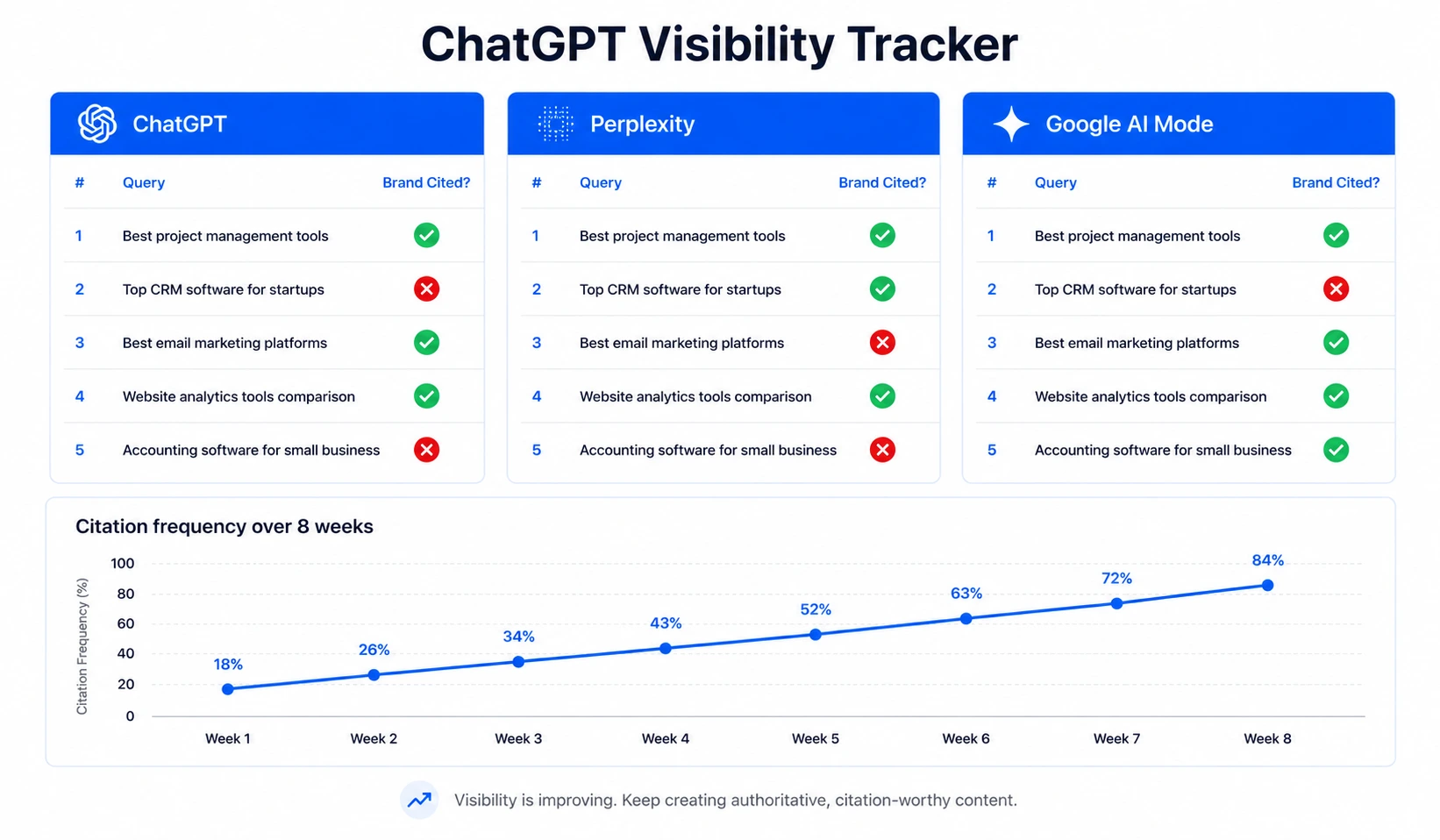
The most reliable starting method is manual testing. Build a list of 20 to 30 queries your target audience would type into ChatGPT questions about your niche, your product category, or the problems you solve. Run each query in ChatGPT, Perplexity, and Google AI Mode weekly. Note whether your brand or content is mentioned. Track whether citation frequency changes over time as you implement the optimization strategies in this post.
The consistency of ChatGPT recommendations is strikingly low. SparkToro’s January 2026 research found there is less than a 1 in 100 chance that ChatGPT will give you the same list of brands in any two responses to the same query. Between 40 and 60 percent of cited sources change month to month across Google AI Mode and ChatGPT. This means weekly tracking over multiple months is the only way to get a meaningful picture of your average citation frequency.
Dedicated tools including AI Clicks, Otterly, and Wellows now provide automated tracking of AI citation frequency across multiple platforms. These tools monitor whether your brand appears in AI answers for specified queries and track changes over time the equivalent of rank tracking, but for AI citation visibility.
If you want to test how multiple AI models respond to queries in your niche ChatGPT, Claude, and Gemini side by side Merlin AI lets you query all of them from one dashboard without switching tabs
A Practical Action Plan – What to Do This Week
The research points to a clear priority order for improving ChatGPT citation visibility. Here is the specific sequence.
Step one: audit your technical accessibility. Check your robots.txt file for GPTBot and ensure it is not blocked. Test your key pages with JavaScript disabled. If your content does not render, address this before anything else. No content strategy overcomes being technically invisible.
Step two: restructure your top ten pages for direct answer extraction. Every H2 and H3 section should answer its implied question in the first one to two sentences. Move your most important information to the top of each section. Add a FAQ section to every post with five to ten questions answered in two to four sentences each. Implement Article schema, FAQ schema, and Author schema.
Step three: build your off-site presence deliberately. Identify the top five to ten “best of” lists and industry roundups in your niche. Find the editors or owners. Reach out to get included. Create profiles on Trustpilot, G2, Capterra, or whichever review platforms are relevant to your category. Actively ask satisfied customers or readers to leave detailed reviews.
Step four: refresh your highest-priority content every 30 to 90 days. Update statistics, add new data points from recent research, and add sections covering recent developments. Content freshness is a measurable ranking factor and one of the easiest to address.
Step five: start tracking your ChatGPT visibility manually. Build your list of target queries. Run them weekly. Establish your baseline. Measure the impact of every change you make.
The Honest Limitations of ChatGPT Optimisation
Most guides on this topic present ChatGPT optimisation as more predictable and controllable than the evidence supports. Here is the honest picture.
67 percent of ChatGPT citations are what Status Labs calls “dead citations” references that point to third-party content like Wikipedia, Reddit, and news sites that brands cannot directly influence. If your brand is being discussed positively in those channels, you benefit. If it is not, no amount of on-page optimization changes that outcome.
AI citations are volatile. Unlike a Google ranking that tends to be relatively stable week to week, AI citation patterns shift significantly with model updates, training data changes, and the evolving set of sources ChatGPT trusts. The SparkToro finding less than 1 in 100 chance of consistent recommendations across two responses is not a bug. It is a feature of how probabilistic language models work.
The investment timeline is long. The brands appearing in AI-generated answers did not hack anything. They spent years building third-party validation media coverage, analyst citations, review profiles, community presence. The content and technical optimizations in this post matter, but they are most effective as a layer on top of existing brand authority rather than a substitute for it.
None of this means the effort is not worthwhile. AI-referred visitors convert at 15.9 percent compared to 1.76 percent for organic search. The revenue impact of even modest ChatGPT visibility is significant. The point is to pursue it with accurate expectations about the timeline and the factors that are and are not within your control.
CONCLUSION:
ChatGPT’s citation selection is not arbitrary, but it is not Google either. The factors that determine whether your content gets recommended authoritative list mentions, domain trust signals, direct-answer content structure, freshness, and branded off-site mentions are a different set of priorities than traditional SEO has trained marketers to focus on.
The practical starting point is simple. Get your technical house in order so ChatGPT can actually read your content. Structure every piece of content so the answer comes first, not last. Pursue mentions on credible external sources more aggressively than you pursue backlinks. Refresh your content regularly. Track your citation frequency weekly and measure what changes.
The sites that appear consistently in ChatGPT answers have something in common: they are trusted by the broader internet, not just indexed by Google. Building that trust through original research, genuine expertise, third-party validation, and real brand presence across platforms is both the hardest and most durable path to AI search visibility.
FAQs
Q: How does ChatGPT decide which websites to recommend?
A: ChatGPT recommends websites based on five main factors: authoritative list mentions (41% of influence), awards and accreditations (18%), online reviews (16%), domain authority measured by referring domains, and content structure including FAQ schema and direct answer formatting. It also heavily weights content freshness, with pages updated within 30 days receiving 3.2 times more citations than older content.
Q: Does ranking on Google help you appear in ChatGPT answers?
A: Google rankings partially contribute to ChatGPT visibility but are not a reliable predictor. Pages ranking in position 1 on Google are cited by ChatGPT 3.5 times more often than pages outside the top 20. However, 80 percent of ChatGPT citations do not rank anywhere in Google’s top 100, and ChatGPT and Google disagree on recommendations 62 percent of the time. Strong SEO helps but does not guarantee ChatGPT visibility.
Q: How can I get my website cited by ChatGPT?
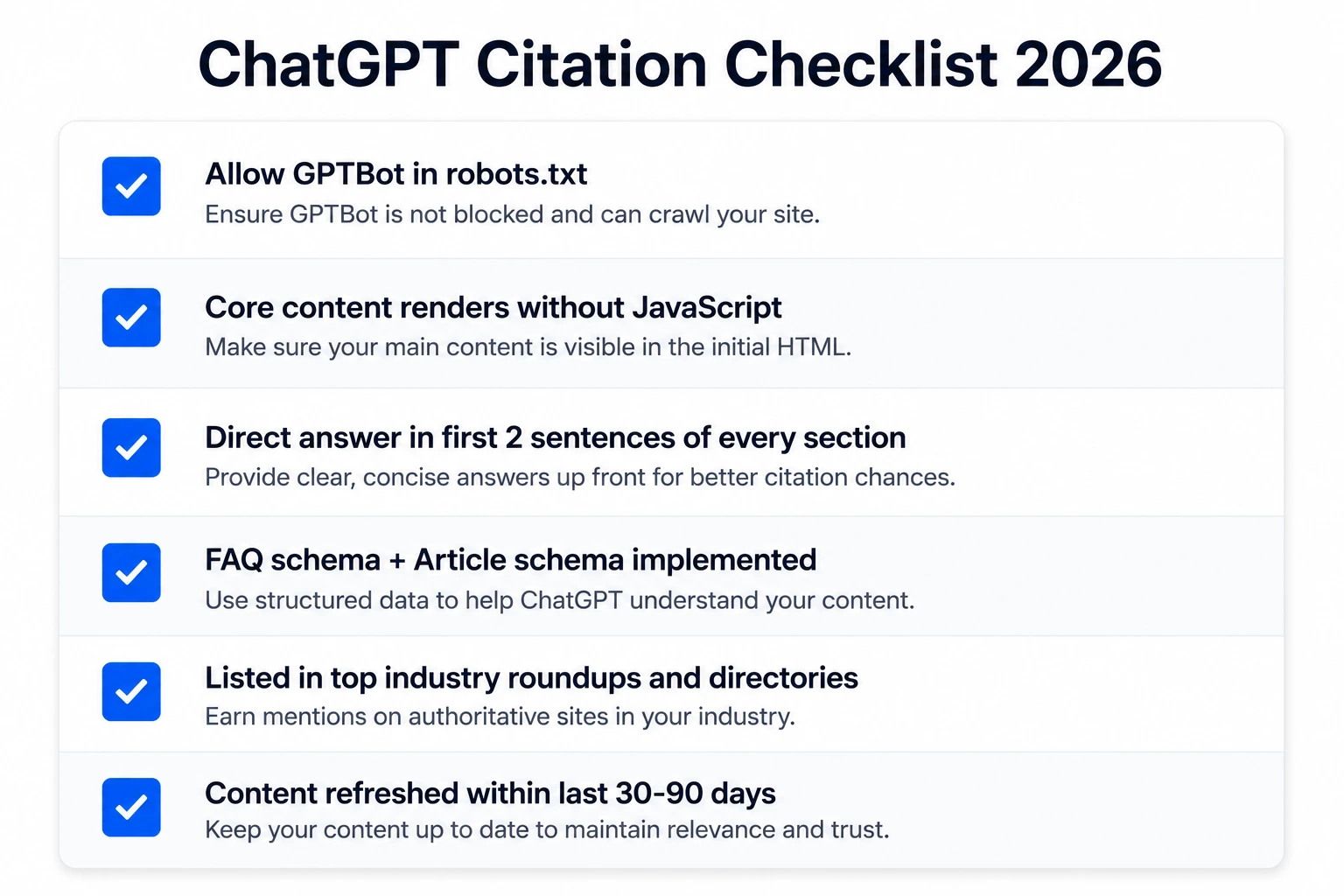
A: To improve your ChatGPT citation rate: allow GPTBot in your robots.txt file, ensure core content renders in plain HTML without JavaScript, structure content with direct answers at the start of each section, implement FAQ and Article schema markup, get your brand listed in authoritative industry roundups and directories, build review profiles on G2 or Trustpilot, earn brand mentions across Reddit, YouTube, and credible publications, and refresh content every 30 to 90 days.
Q: What percentage of pages does ChatGPT actually cite?
A: ChatGPT cites only 15 percent of the pages it retrieves during a search session. An AirOps study analyzing 548,534 pages across 15,000 prompts confirmed this. The model pulls pages into its evaluation process and discards 85 percent without citing them in the answer. This makes content structure and authority signals which determine citation after retrieval the most important optimization focus.
Q: How do I track my ChatGPT citation visibility?
A: Build a list of 20 to 30 queries your audience would ask ChatGPT in your niche. Run each query weekly in ChatGPT, Perplexity, and Google AI Mode and note whether your brand is cited. Track frequency over time to measure the impact of optimisation changes. Dedicated tools including AI Clicks, Otterly, and Wellows provide automated tracking of AI citation frequency across platforms.