


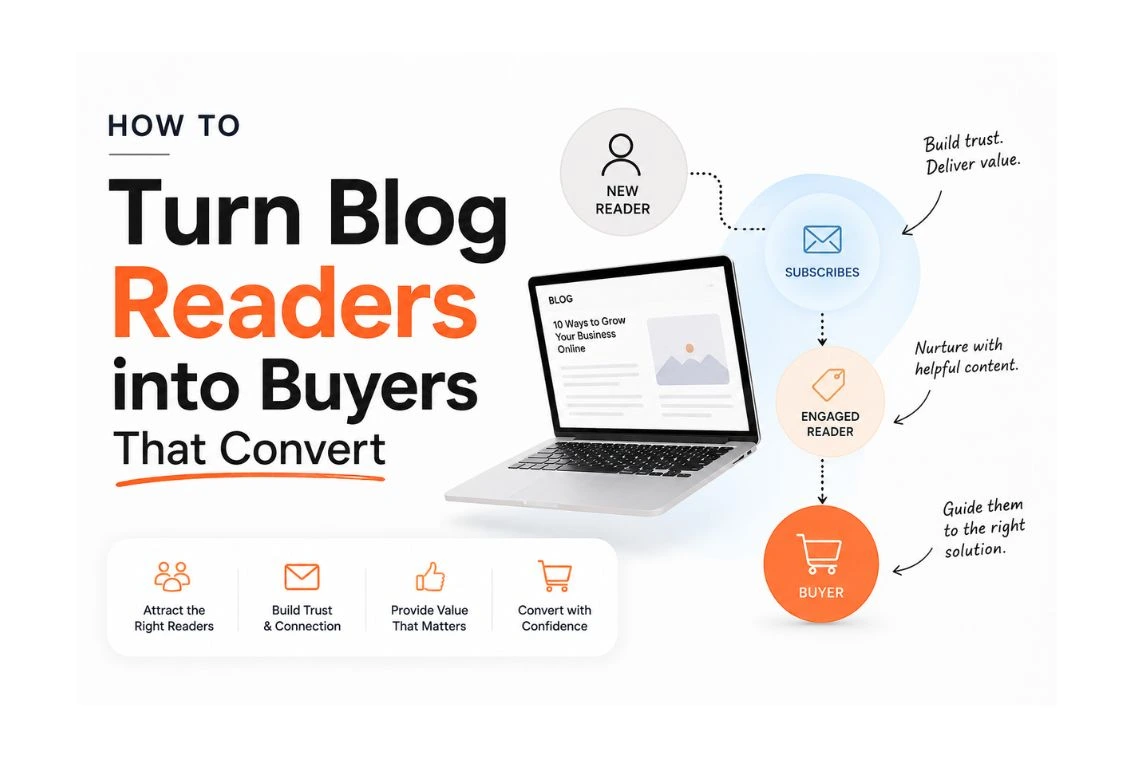
Most blogs have a traffic problem disguised as a conversion problem.
The traffic exists. People find the posts, read them, and leave. The problem is not that readers are not interested. It is that nothing in the blog is designed to move them anywhere. They came, they read, they closed the tab.
72% of B2B buyers say that blog posts are the most valuable format at early stages of the buyer journey. That is an enormous opportunity sitting at the top of your funnel. But most blogs waste it entirely by treating every post as a standalone piece of content with no connection to what the reader should do next.
The average sales funnel conversion rate has risen to 3.1% across all industries in 2026, according to Unbounce’s analysis of 264 million conversions across 44,000 landing pages. For blogs specifically, that 3.1% is the ceiling for most sites because they are sending readers into a funnel that was never built. The floor is zero. Most blogs are closer to the floor.
This post is the conversion strategy guide for content sites in 2026. Not generic advice about writing better CTAs. A specific, structured approach to building the funnel that moves readers from first visit to email subscriber to paying customer, with each stage mapped to the content and tools that make it work.
The Marketing Shelf monetizes primarily through affiliate partnerships. The same principles that work for any product-based business apply here. The mechanics of moving a reader to a buyer are identical whether you are selling your own product or earning a commission on someone else’s.
Why Most Blogs Never Convert – The Diagnosis
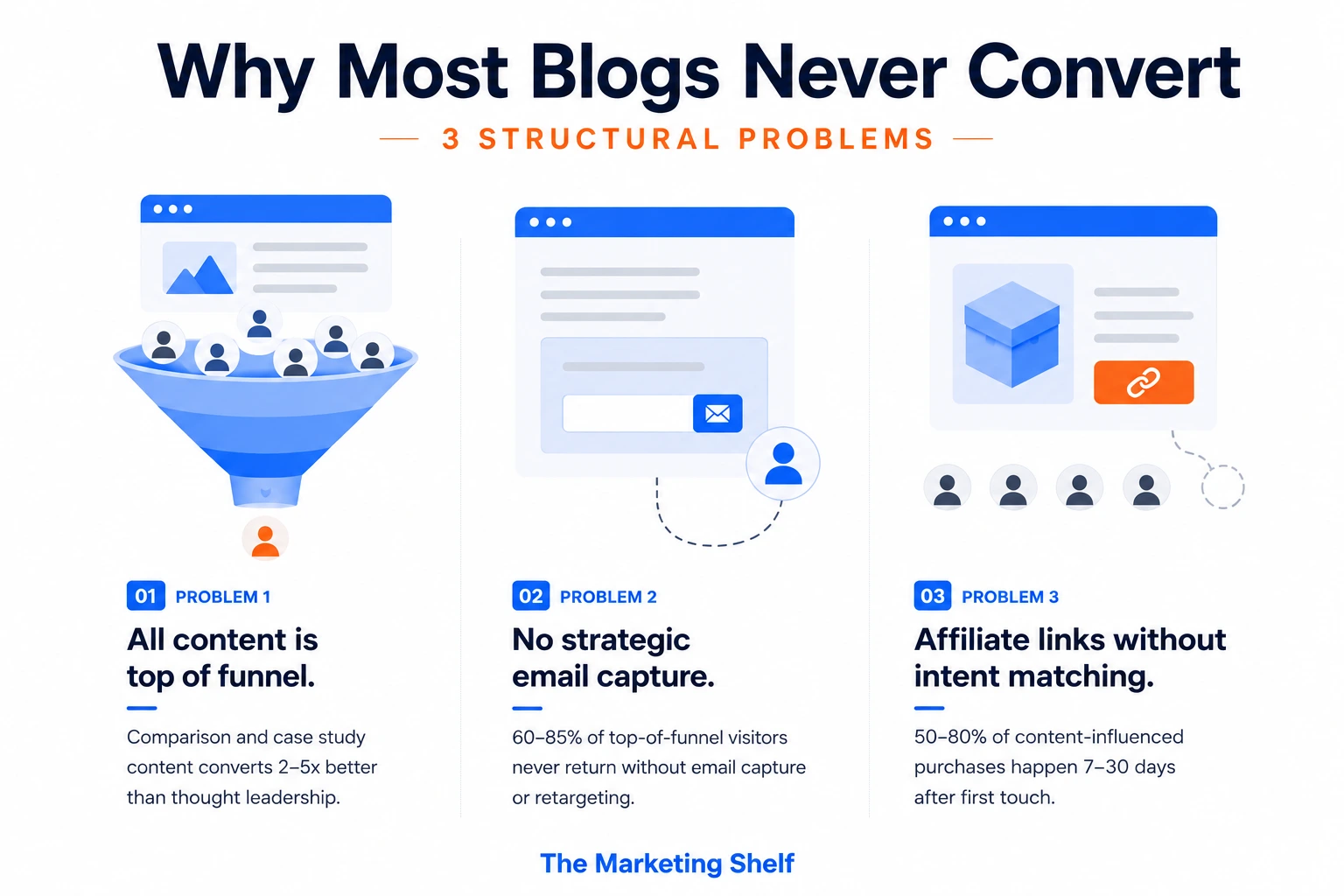
Before building the funnel, understanding exactly why the current approach fails matters. There are three structural problems that prevent most blogs from converting readers into buyers, and they are all fixable.
Problem 1 – All Content Is Top of Funnel
B2B mid-funnel assets like comparisons and case studies convert 2x to 5x better than general thought leadership posts. Yet most blogs are almost entirely thought leadership and informational content with no mid funnel or decision stage content in sight.
A reader who arrives at an informational post learns something. That is good. But learning something does not create buying intent. Buying intent comes from decision stage content, posts that compare specific options, evaluate specific tools, present a case study with a real outcome, or directly address the question “which one should I buy and why.”
If your content library is 90% informational and 10% decision stage, your conversion rate will reflect that ratio. The fix is not to stop writing informational content. It is to build a deliberate path from each informational post to a relevant decision stage piece.
Problem 2 – No Email Capture on High-Traffic Pages
60% to 85% of top of funnel visitors never return without retargeting or email capture. This is the single most expensive leak in most content site funnels. A reader who finds your post, reads it, and leaves without subscribing is almost certainly never coming back.
Most blogs treat email capture as an afterthought. A generic popup that fires after 30 seconds. A sidebar widget that nobody scrolls to. A footer form that gets zero impressions because readers never reach the footer of a long post.
The problem is not that readers do not want to hear from you. It is that the offer is not compelling enough and the placement is not strategic enough to capture them at the moment they are most engaged.
Problem 3 – Affiliate Links Placed Without Intent Matching
The third structural problem is specific to affiliate and product based content sites. Affiliate links get placed in posts regardless of whether the reader is at a stage where they are ready to click and buy. A link to a paid tool inside an introductory “what is” post will almost never convert because the reader is not in buying mode. They are in learning mode.
B2C purchase cycles are shorter, with 50% to 80% of content-influenced purchases happening within 7 to 30 days of first touch. The implication is that first touch content needs to move the reader toward a relationship, not a transaction. The transaction comes later, in later touch content, when the reader has decided they trust your judgment and they are ready to act on it.
The Three-Stage Blog Funnel – Building the Path from Reader to Buyer
The solution to all three structural problems is the same: build a deliberate three-stage funnel where every piece of content has a clearly defined role and a clearly defined next step.
The three stages are awareness, consideration, and decision. Most blogs have plenty of awareness stage content and almost none of the other two. The engine that converts readers into buyers requires all three, connected to each other in a way that moves people forward without requiring them to figure out the path themselves.
Stage 1 – Awareness Content (Top of Funnel)
Awareness content is what most blogs already produce. Informational posts, how-to guides, explainers, and listicles that answer the questions readers are actively searching for. This content builds trust and positions you as a knowledgeable source. It should not be trying to sell anything.
The job of awareness content is not conversion. It is capture. Every awareness post should have one clear next step for the reader, and that next step is usually subscribing to your email list in exchange for something genuinely useful.
The lead magnet at this stage should be closely related to the post the reader just read. A post about AI SEO should offer a downloadable AI SEO checklist or a content brief template. A post about affiliate marketing should offer a commission tracking spreadsheet or a niche selection guide. The relevance of the offer to the content just consumed is the primary driver of opt-in rate.
In B2B, newsletter signups are frequently the primary conversion on top of funnel content, accounting for 40% to 70% of tracked conversions from blog traffic. For content sites monetizing through affiliate commissions, email capture at this stage is the most important conversion action. Everything else follows from it.
Stage 2 – Consideration Content (Mid Funnel)
Consideration content is where most blogs have the largest gap. This is the content that moves a reader from “I find this topic interesting” to “I am evaluating specific options to solve a specific problem.”
Case studies convert 1.5x to 3x better than general blog content on high-intent pages. Comparison pages frequently deliver 2x to 5x higher conversion than general content.
Consideration content includes tool comparisons, case studies with documented results, workflow breakdowns showing how specific tools produce specific outcomes, and “is this right for me” style posts that help readers self-select based on their situation. These posts should include affiliate links, but placed contextually within a comparison or recommendation, not generically in every paragraph.
The flow from awareness to consideration should be built into your content structure. Every awareness post should link to one or two relevant consideration posts. A post explaining what AI SEO is should link to a post comparing specific AI SEO tools. A post explaining how content marketing works should link to a case study showing what it produced for a real site. The reader who follows these links is moving themselves down the funnel because they are interested, not because they were pushed.
Stage 3 – Decision Content (Bottom of Funnel)
Decision content is where readers who are ready to buy need one final piece of clarity before they act. This is specific tool reviews with honest pros and cons, direct recommendations for specific use cases, pricing breakdowns, and posts that directly answer “should I buy this specific thing.”
B2C category guides and buyer’s guides often produce 1.5x to 3x higher revenue per visit than lifestyle content when intent is to drive purchase.
Decision content has the highest affiliate conversion rate of any content type because it matches reader intent perfectly. A reader who arrives at a specific tool review has already decided they want a tool in this category. They are choosing between options. A well-structured review that gives them the clarity they need to choose will convert at dramatically higher rates than any amount of affiliate links embedded in awareness content.
Email Capture – The Bridge Between Traffic and Revenue
Email is the mechanism that makes the three-stage funnel work over time. Without it, each reader is a single visit with no path back to your content. With it, each reader becomes a relationship that can deepen across multiple touchpoints until they are ready to buy.
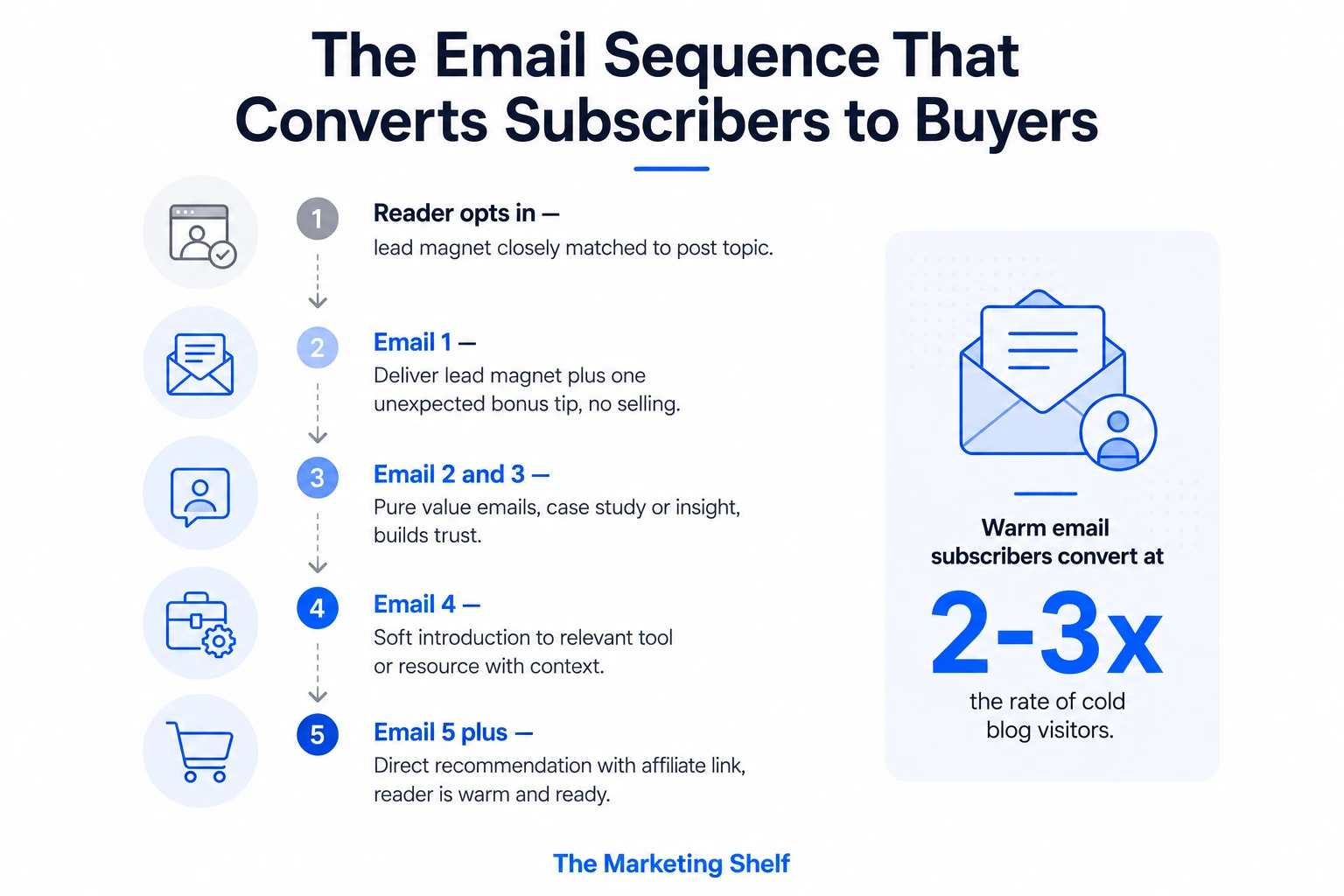
The conversion data on email is consistently stronger than any other owned channel. Email newsletters convert subscribers at 2x to 3x the rate of cold blog traffic for affiliate offers because the subscriber has already demonstrated enough interest to opt in and has been warmed through subsequent emails.
Getting the email capture right requires three specific things.
The offer must be genuinely useful and closely matched to the content the reader just consumed. A generic “subscribe for updates” offer gets ignored. A “download the exact content brief template I use for every AI SEO post” offer converts because it delivers immediate value connected to the reason the reader came in the first place.
The placement must catch the reader at peak engagement. Research from ContentSquare shows that when a CTA is placed only at the bottom of a long post, 80% of readers never see it because they do not scroll that far. Placing an inline opt-in offer within the first third of the content, immediately after delivering a specific piece of value, catches the reader while engagement is highest.
The follow-up sequence must continue delivering value before asking for a purchase. A new subscriber who receives three genuinely useful emails before any affiliate recommendation converts at dramatically higher rates than a subscriber who receives a product recommendation in their first email. The sequence builds trust. Trust drives the eventual purchase.
CTA Strategy – How to Ask Without Being Pushy
Most blog CTAs fail for one of two reasons. They either ask too much too early, a “buy now” CTA inside an informational post targeted at readers who are nowhere near a purchasing decision. Or they ask too weakly, a vague “check this out” link with no reason for the reader to click.
A CTA that converts has four components: a specific action, a specific reason to take that action now, evidence that the action delivers what it promises, and an extremely low friction path to taking it.
The action should be the smallest possible next step. For a first-time reader, that next step is usually subscribing, not buying. For a consideration stage reader, it might be “read the full comparison” or “see the pricing breakdown.” For a decision stage reader, it can be a direct affiliate link with a clear recommendation.
AI-assisted multichannel follow-up sequences increase contact-to-meeting conversion rates by 67.4% compared to manual follow-up cadences, with teams using five-or-more-touch workflows closing significantly more deals. The same principle applies to content funnels. A reader who has five touchpoints with your content before seeing an affiliate recommendation will convert at higher rates than a reader seeing that same recommendation on their first visit, regardless of how well-written the CTA is.
For affiliate content specifically, the CTAs that convert consistently share a specific characteristic: they are contextually embedded inside a recommendation, not appended after the fact. “I use Holo AI for every content brief I create at The Marketing Shelf, and here is exactly why” followed by a link converts because it is a recommendation from a specific source for a specific purpose. “Check out this tool (affiliate link)” converts at a fraction of the rate because it is a generic ask with no context, no reason, and no credibility behind it.
This is also why building a personal voice and specific perspective in your content is a conversion strategy, not just a writing style preference. A reader who trusts your judgment will act on your recommendations. A reader who sees you as a generic content source will not.
Content Formats That Convert at Each Funnel Stage
Different content formats produce dramatically different conversion rates at different funnel stages. Using the wrong format at the wrong stage is one of the most common and most correctable conversion mistakes.
At the awareness stage, the highest converting formats for email capture are how-to guides and informational listicles with an inline lead magnet offer. Readers are in learning mode and are receptive to a useful freebie that extends what they just learned.
At the consideration stage, the highest converting formats for affiliate clicks are comparison posts and case studies. A post structured as “I tested these three tools for 30 days and here is what happened” with documented results converts because it gives the reader a specific, credible basis for their decision. The affiliate link inside that post is not an interruption. It is the logical conclusion of the comparison.
At the decision stage, the highest converting format is a specific tool review that directly answers the question the reader arrived with. A reader who searches “Holo AI review” and finds a detailed, honest review that covers pricing, what it does well, what it does not do well, and who it is for has already made most of their decision before clicking the affiliate link. The review does not need to sell. It needs to provide the clarity that lets the reader sell themselves.
One format deserves special mention for affiliate content specifically: the “what I actually use” post. A personal workflow breakdown, this is my exact stack for creating content at The Marketing Shelf and why I chose each tool, converts at exceptional rates because it combines all three conversion elements simultaneously. It delivers value, it demonstrates credibility, and it makes a specific recommendation with a clear reason. This is the format where the highest-converting affiliate placements belong.
Using AI to Scale Conversion-Focused Content Without Losing Quality
Building a three-stage content funnel requires more content than most solo creators or small teams can produce manually at the required quality level. This is where AI tools change the economics significantly, but with a specific caveat that matters for conversion.
AI can produce a structurally complete post faster than any human writer. What it cannot produce is the personal credibility, the specific first-hand observation, and the genuine recommendation that make conversion-focused content actually convert.
This means the AI-assisted workflow for a conversion-focused content site looks different from a traffic-focused workflow. For awareness content, AI handles research and drafting, and human editing adds one original observation or data point. For consideration content, AI handles the structural comparison, and human editing adds the genuine “I tested this and here is what happened” layer. For decision content, the human layer is most important of all, because the review or recommendation needs to feel like it comes from someone who actually used the thing.
If you want to scale your conversion-focused content creation without sacrificing the editorial quality that makes readers trust your recommendations, Merlin AI is built specifically for content creators who need to produce structured, on-brand content at volume. I have used it to build out content briefs and first drafts for The Marketing Shelf, and it handles the structural and research-heavy parts of the workflow faster than any alternative I have tested.
The workflow that produces the best conversion results: use AI for research, outline, and first draft. Spend your human time on the elements that require personal credibility: the specific recommendation, the honest assessment of what does not work, and the first-person experience layer that makes the reader trust the conclusion.
Measuring What Actually Matters – Conversion Metrics for Content Sites
Most content sites measure the wrong things. Traffic, page views, and social shares are vanity metrics for a conversion focused operation. They tell you how many people showed up. They tell you nothing about how many of them moved forward.
The metrics that matter for a blog to buyer funnel are specific and a layer deeper than most analytics dashboards surface by default.
Email opt-in rate by post is the most important top of funnel metric. Not overall site opt-in rate, which averages together high-performing and low-performing posts and tells you nothing actionable. Opt-in rate by post tells you which posts attract readers who are hungry enough for more content to give you, their email address. These are your highest-leverage posts for investment and for internal linking from newer content.
Click-through rate on affiliate links by post and by funnel stage tells you whether your placements are working and whether readers at each stage are responding to your recommendations. A high click rate on awareness content with low conversion suggests readers are curious but not ready to buy. A high click rate on decision stage content with high conversion confirms the format and placement are correctly matched to intent.
Email sequence open rate and click rate at each stage of the follow-up sequence tells you where readers are dropping off before they reach a recommendation. If open rates fall sharply after email two, the content is not delivering enough value to justify the continued inbox presence.
A blog post published today continues generating organic traffic and leads for an average of 3.5 years. This means measurement needs to look at lifetime value per post, not just monthly performance. A post that converts one email subscriber per day for three years at a 5% eventual purchase rate is worth far more than its traffic numbers alone suggest. Building the measurement framework to see this lifetime value is what separates content operations that compound from ones that plateau.
The Conversion Audit – What to Fix First on Your Existing Blog
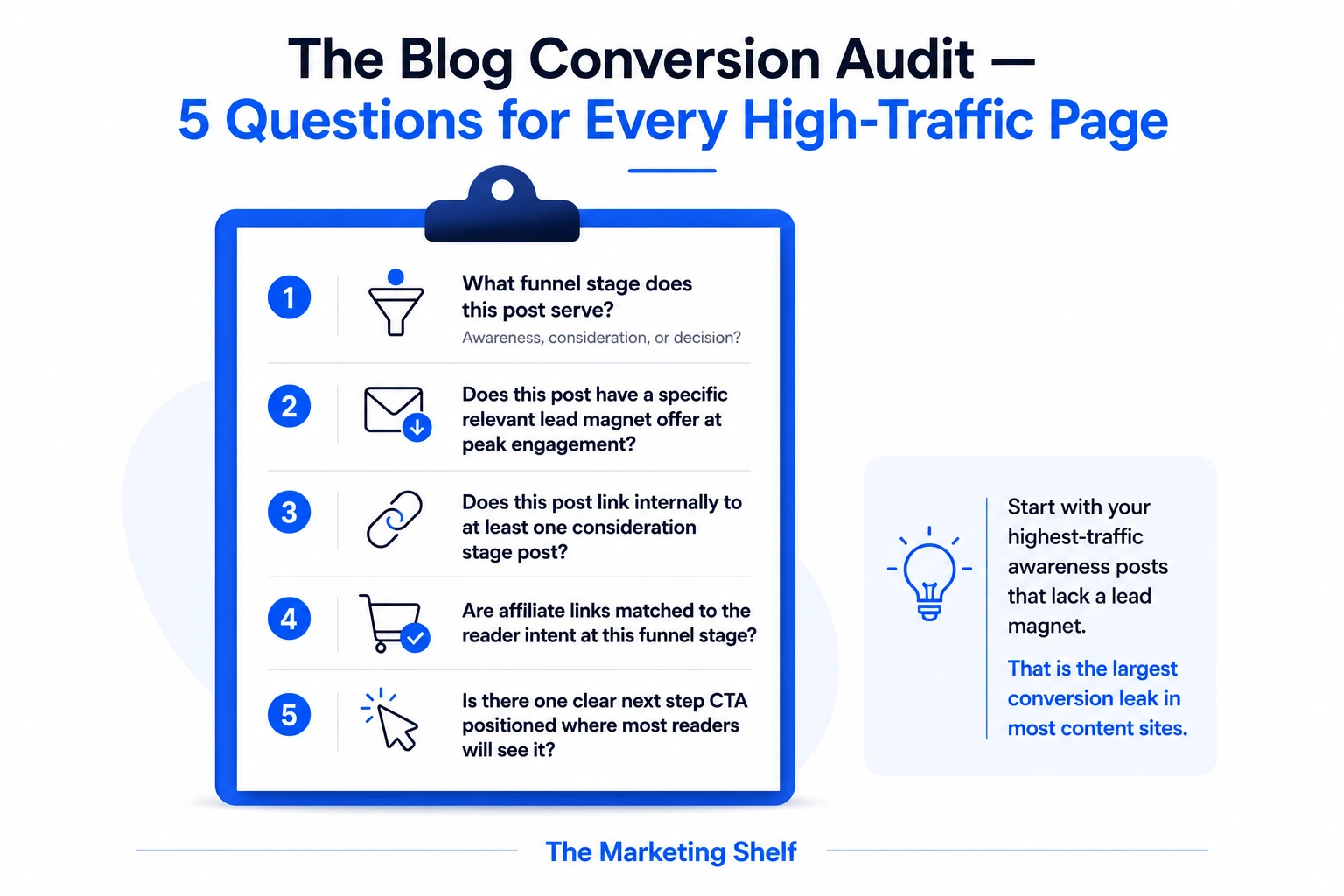
If you have an existing blog with traffic but poor conversion, the fastest path to improvement is an audit of your highest-traffic pages against the three-stage funnel framework.
Pull your top ten traffic pages from Google Search Console. For each one, answer five questions.
- What funnel stage does this post serve? Awareness, consideration, or decision? If you cannot answer this, the post does not have a clearly defined role in your funnel, and readers have no clear next step.
- Does this post have a relevant, specific lead magnet offer? Not a generic newsletter popup, a specific freebie closely matched to what the reader just learned. If not, you are sending 60% to 85% of these readers away forever.
- Where does this post link internally? Does it connect to at least one consideration stage post that is relevant to a reader who just consumed this awareness content? If not, you are trapping readers in awareness stage content with no path forward.
- Are the affiliate links in this post matched to the reader’s intent at this stage? If the post is awareness content with affiliate links to paid tools, those links will almost never convert and are adding friction without adding value.
- Does this post have a clear single next step CTA, positioned where most readers will see it before they stop reading? If the only CTA is at the bottom of a 3,000 word post, most readers are not reaching it.
The answers to these five questions will immediately surface the highest leverage fixes for your existing content. Start with the highest-traffic awareness posts that lack a relevant lead magnet offer. That is the largest conversion leak in most content sites and the fastest to fix.
CONCLUSION:
Most blogs are one structural change away from converting significantly better than they do today.
The traffic exists. The reader interest exists. What is missing is the funnel, the deliberate connection of content to email capture to consideration stage content to decision stage content to a contextual affiliate recommendation, built around a reader relationship rather than a one-visit transaction.
Build the three-stage content structure. Place lead magnets at peak engagement moments. Build an email sequence that delivers value before it asks for a purchase. Reserve affiliate links for content where the reader’s intent matches the recommendation. Measure opt-in rate by post, not just total traffic.
A blog post that converts 2% of readers to email subscribers and converts 5% of those subscribers to buyers over a 30-day email sequence, at a $50 average affiliate commission, generates meaningful recurring revenue from the same traffic you already have. No additional SEO work. No additional content volume. Just the funnel your current traffic has been waiting for.
The readers are already there. Build the path.
FAQs
Q: How do you convert blog readers into buyers?
A: Converting blog readers into buyers requires a three-stage content funnel. Awareness content captures email subscribers through relevant lead magnet offers. Consideration content, including comparisons and case studies, warms subscribers toward a specific recommendation. Decision content, including tool reviews and personal workflow posts, closes the conversion with a contextual affiliate link or direct purchase. Without all three stages connected by email capture, most readers leave after one visit and never return.
Q: What is the best content type for affiliate conversions?
A: Comparison posts and specific tool reviews consistently produce the highest affiliate conversion rates because they match reader intent precisely. Comparison posts convert 2x to 5x better than general blog content according to 2026 research. Personal workflow posts that document exactly which tools a creator uses and why also convert at high rates because they combine genuine credibility with a specific recommendation. Both formats should be built as consideration or decision stage content, not awareness content.
Q: How important is email capture for blog monetisation?
A: Email capture is the single most important conversion action on a content site because 60% to 85% of top of funnel visitors never return without email capture or retargeting. Warm email subscribers convert at 2x to 3x the rate of cold blog traffic for affiliate offers. For a blog monetising through affiliate commissions, the primary conversion goal on every awareness post should be email opt-in, with affiliate conversions happening through subsequent emails and decision stage content.
Q: Where should I place affiliate links in my blog posts?
A: Affiliate links convert best when placed inside consideration and decision stage content where reader intent matches the recommendation. Inside a specific tool comparison with documented results, inside a personal workflow breakdown explaining which tools you actually use, and inside an honest tool review covering pros cons and ideal use cases are the three highest-converting placements. Affiliate links in pure awareness content, informational or how-to posts, convert at a fraction of the rate because readers are in learning mode rather than buying mode.
Q: How long does it take for blog content to generate consistent affiliate revenue?
A: Blog content generates traffic and leads for an average of 3.5 years after publication, according to Digital Applied’s 2026 content marketing data. Initial affiliate revenue from new content typically appears within 30 to 90 days as posts gain rankings and email subscribers begin receiving follow-up sequences. Consistent affiliate revenue at a meaningful scale generally requires 6 to 12 months of building the full three-stage funnel with a consistent publishing cadence and email list that is large enough to produce regular conversions.