


There is a specific kind of exhaustion that comes from prompting AI tools all day.
You open ChatGPT for a headline. You open Claude for a first draft. You open Perplexity for research. You switch to another tool for the social copy. Then you do it again tomorrow. And the day after. The AI is handling the execution but you are still the coordinator, the scheduler, the one deciding what to do next at every single step.
That model is already becoming obsolete.
In 2026, the shift happening across serious marketing operations is not from manual to AI-assisted. It is from AI-assisted to agentic. An AI marketing agent does not wait for your next prompt. You give it an outcome and it figures out the steps, chains them together, executes across your tools, and surfaces a decision for human review only when genuine judgment is required.
According to McKinsey’s 2026 State of AI report, 78% of organisations now use AI in at least one core function, with marketing leading adoption. But the majority of that adoption is still tool-level: one prompt, one output, one task at a time. The organisations pulling ahead are the ones that have moved one level up, from using AI tools to deploying AI agents that run workflows end to end.
Agencies using an AI agent-first model report up to 80% cost reduction in execution tasks and a ten times increase in content output without scaling headcount. Hybrid agentic models, where machines handle execution and humans handle strategy, produce 40% better performance than either fully automated or fully manual approaches.
This post is the complete guide for building and deploying your first autonomous AI marketing agent. Not a theoretical overview of what agents are. A specific, step-by-step framework covering how agents actually work, what you need before deploying one, how to build the workflow, how to set the guardrails that keep it on track, and how to scale from one agent to a coordinated system.
What an AI Marketing Agent Actually Is & What It Is Not
Most content about AI agents conflates two very different things. Getting this distinction right before building anything saves significant time and prevents the most common deployment failures.
The Difference Between a Tool and an Agent
A tool is reactive. You prompt it, it returns an output, the loop ends. Every AI tool you currently use, ChatGPT, Claude, Perplexity, Midjourney, falls into this category. You provide the instruction. It executes. It stops.
An agent is goal-oriented. You define an outcome and the agent plans the steps needed to reach it, selects which tools to use at each step, executes those steps in sequence, evaluates the output of each step before proceeding, and runs the workflow to completion. The defining property is not that it uses AI. It is that it reasons about what to do next rather than waiting to be told.
The practical difference looks like this. Using a tool: you open Claude, write a prompt asking for a blog outline on a specific keyword, receive the outline, then open Perplexity to research the statistics, then return to Claude to write the first draft, then switch to your publishing platform. Each step requires your decision to initiate it. Using an agent: you define the goal (“produce a research-backed 2,000-word blog post on this keyword, optimised for AI Overview citation, and schedule it for Tuesday”) and the agent handles the research, drafting, optimisation checks, and scheduling without requiring you to initiate each step.
What Agentic AI Is Not
Agentic AI is not magic and it is not fully autonomous in the way science fiction suggests. The organisations struggling most with agentic AI deployment in 2026 have one thing in common: they deployed autonomous systems on top of broken foundations.
Fragmented data. Disconnected tools. No shared definition of what success looks like. The result is not smart automation. It is chaos moving faster. If you cannot give a human enough context to make a good decision in a given area, an AI agent will fail there too. The agent is only as smart as the information it has access to and the boundaries you define for it.
Agentic AI also does not replace human strategy or creative direction. The organisations seeing the best results in 2026 are not removing humans from marketing. They are building hybrid models where machines handle execution and humans focus on strategy, creative judgment, and decisions that require genuine understanding of context that the agent does not have.
The Four Foundations You Need Before Building Anything
The most expensive mistake in agentic AI deployment is starting with the agent before the foundations are in place. These four things must exist before any autonomous system is worth building on top of them.
Foundation 1 – Unified, Accessible Data
An AI agent makes decisions based on the data it can access. If your keyword data is in Ahrefs, your content performance data is in Google Search Console, your audience data is in your email platform, and none of these talk to each other, the agent is operating with partial information at every step.
Before deploying a marketing agent, identify every data source relevant to the workflows you want to automate and ensure the agent can access them through APIs or direct integrations. The agent’s decision quality is a direct function of data completeness. Partial data produces confident but wrong decisions, which is worse than no automation at all.
Foundation 2 – Documented Workflows
An agent cannot automate a workflow that has not been documented. The step-by-step process for producing a blog post, distributing a piece of content, qualifying a lead, or optimising a campaign needs to exist in writing before it can be handed to an agent.
If your current workflow lives in your head or in informal team knowledge, the first investment is documenting it. Write out every step, every decision point, every tool used, and every quality check. This documentation becomes the blueprint the agent follows, and it also reveals which steps require genuine human judgment and which are purely mechanical, a distinction that determines where to place your human escalation triggers.
Foundation 3 – Clear Success Definitions
An agent optimises toward a measurable objective. If you have not defined what success looks like in specific, measurable terms, the agent will optimise toward whatever proxy metric it can measure, which may not be what you actually care about.
For a content marketing agent, success might be defined as “publish two posts per week that achieve a Google Search Console impression count above 500 within 30 days.” For a social distribution agent, it might be “schedule posts across three platforms, maintaining engagement rate above 3%.” The specificity of the success definition determines how well the agent can evaluate its own output and course-correct.
Foundation 4 – Human Escalation Triggers
This is the most critical safety layer in any agentic system and the one most commonly skipped in the rush to deploy. Human escalation triggers are the defined conditions under which the agent stops autonomous execution and surfaces a decision for human review.
Human escalation triggers must be designed into the workflow before deployment. Deal stage sensitivity, personalisation accuracy, compliance review, and brand safety checks are the checkpoints requiring a human gate rather than autonomous continuation. Any decision that involves reputational risk, significant budget, or irreversible action belongs behind a human review gate regardless of how confident the agent is in its recommendation.
How an AI Marketing Agent Works – The Loop That Powers It
Understanding the operational loop of an agentic system tells you exactly how to design one that works reliably.
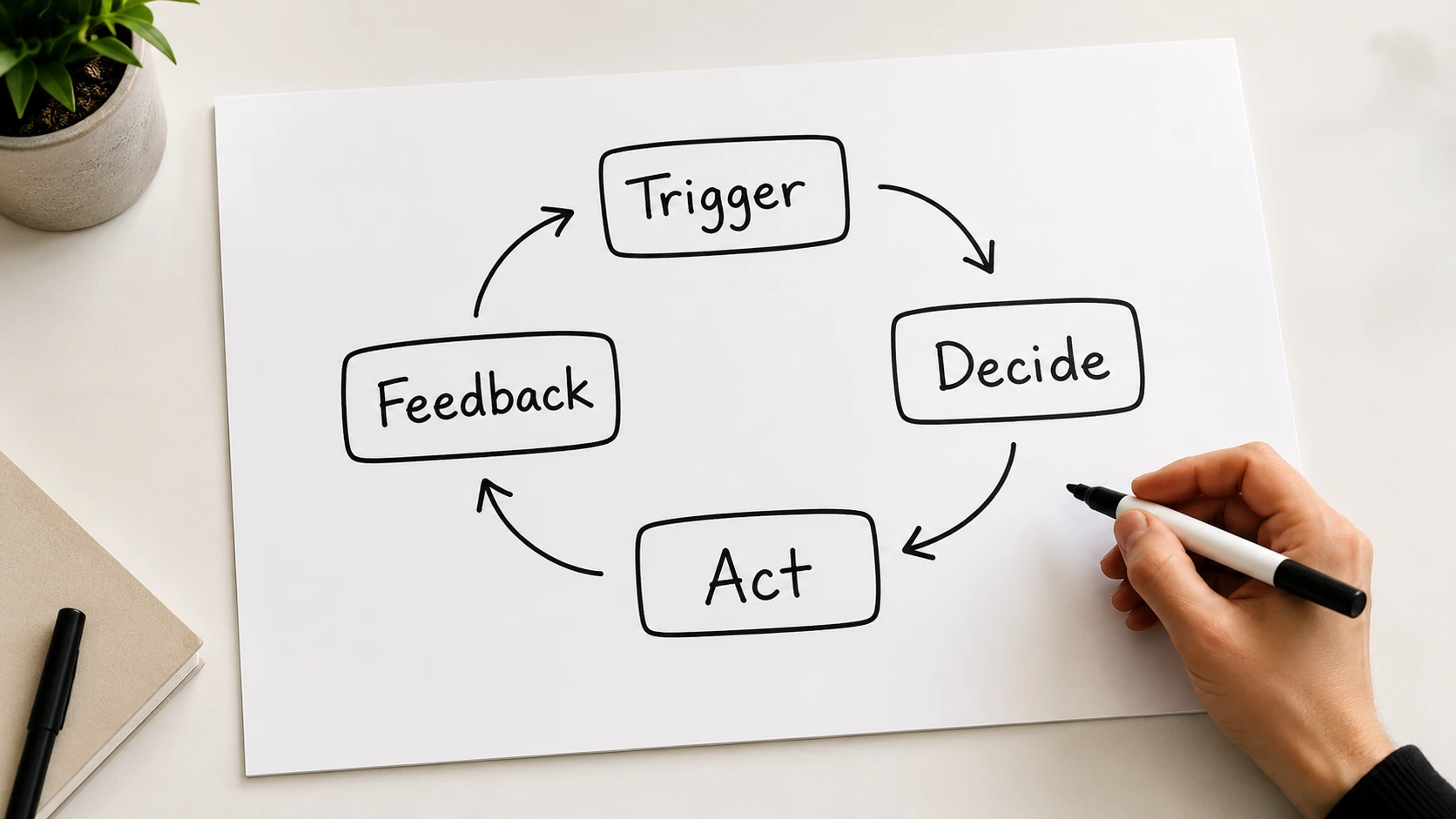
The Trigger-Decide-Act-Feedback Loop
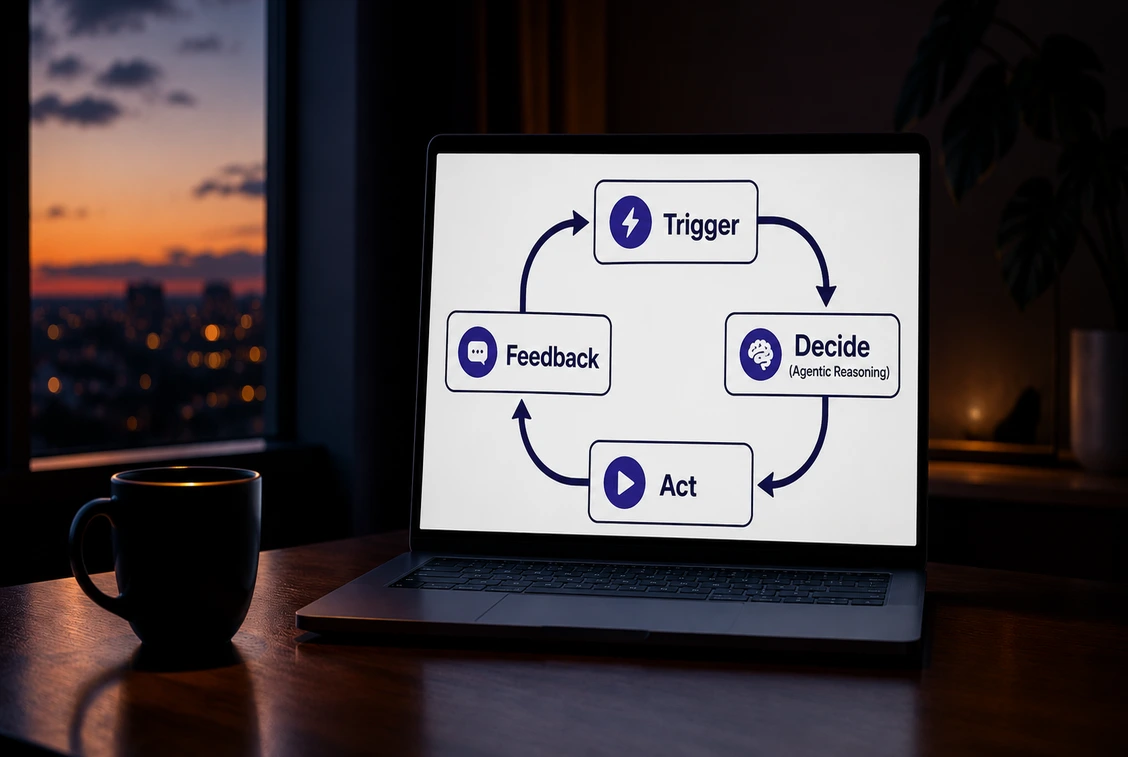
Agentic AI workflows for marketing operate on a trigger, decision, action, and feedback loop. The agent responds to an event, selects a tool, executes an action, and updates its context for the next step.
The trigger is the event that initiates the workflow. It could be a scheduled time, an incoming form submission, a keyword entering or dropping from a ranking position, a content performance metric crossing a threshold, or a human instruction. The trigger defines when the agent wakes up and starts working.
The decision layer is where the agent reasons about what to do next given the current state of the workflow. It evaluates available information, compares the current state against the success definition, and selects the action most likely to move toward the goal. This is the reasoning layer that distinguishes an agent from a simple automation rule.
The action layer is where the agent executes. It calls tools, writes content, sends requests to APIs, updates records, or moves to the next step in the workflow. Each action changes the state of the workflow and provides new information for the next decision cycle.
The feedback layer is where the agent evaluates the result of its action and updates its understanding of the current state. If the action produced the expected outcome, the agent continues. If not, it adjusts its approach for the next cycle. This self-evaluation loop is what allows well-designed agents to course-correct without human intervention.
Memory – How Agents Maintain Context
One of the most important and least discussed properties of agentic systems is memory. A single-turn AI interaction has no memory of previous interactions. An agent needs to maintain context across multiple steps and multiple sessions to execute a workflow coherently.
There are three types of memory in agentic systems. In-context memory is information held within a single conversation or workflow session. External memory is information stored in a connected database or file system that the agent can query. Procedural memory is the set of learned patterns about how to approach specific types of tasks, which improves with use over time.
Designing your agent’s memory architecture, deciding what information it needs to persist across sessions and where that information is stored, is a step that most guides skip but that significantly affects whether the agent produces consistent, coherent output or loses context and starts over with each session.
Step-by-Step – Building Your First AI Marketing Agent
With foundations in place and the operational loop understood, here is the specific build sequence.
Step 1 – Choose the Right Starting Workflow
Not every marketing workflow is a good first agent. The best starting point is a workflow that is high-frequency, rule-based, time-consuming, and low-risk. High-frequency because the automation ROI compounds fastest on tasks you repeat most often. Rule-based because agents excel at clear, defined decision criteria rather than ambiguous judgment calls. Time-consuming because the efficiency gain needs to be meaningful. Low-risk because your first agent will make mistakes, and you want those mistakes to be recoverable.
The highest-ROI entry points for first marketing agents in 2026 are content production workflows, where the same brief must produce multiple assets including blog, email, social, and ad copy with consistent brand voice. Lead qualification workflows are also strong, where autonomous prospect research, ICP scoring, and outreach sequencing collapse hours of work into minutes when designed around structured decision criteria. Content distribution workflows are another strong starting point, where a published post automatically triggers social scheduling, newsletter inclusion, and indexing requests across platforms.
Step 2 – Map the Workflow in Full Before Building
Take your chosen workflow and map every single step. Every decision point. Every tool used. Every quality check. Every condition under which a step might fail and what should happen next.
This mapping exercise reveals three things you need to know before building. First, which steps are purely mechanical and can be automated with high confidence. Second, which steps involve a judgment call that the agent cannot make reliably without context it does not have. Third, which steps have interdependencies that must be completed in a specific order.
The map is also where you place your human escalation triggers. At the points where a human judgment call is required, the map should show the agent surfacing a summary and a recommended action to a human reviewer rather than proceeding autonomously.
Step 3 – Choose Your Tech Stack
There are two broad approaches to building a marketing agent: no-code platforms and code-based orchestration. The right choice depends on your technical capability and the complexity of the workflow.
For no-code deployment, platforms like n8n, Relevance AI, MindStudio, and Gumloop allow you to build agentic workflows through visual interfaces without writing code. These are the right starting point for most marketers and content teams. n8n in particular has become the most widely recommended orchestration layer for agentic marketing workflows in 2026, combining flexibility with accessibility.
For code-based orchestration, frameworks like LangChain, CrewAI, and AutoGen give developers fine-grained control over agent behaviour, memory, and tool selection. These are the right choice for complex multi-agent systems where precise control over each decision point matters more than deployment speed.
The LLM backbone powering your agent’s reasoning layer matters as much as the orchestration layer. Claude is widely recommended for agentic workflows because of its strong performance on multi-step reasoning and its larger context window, which helps the agent maintain coherent context across complex workflows. GPT-4o and Gemini are also commonly used depending on the specific capability requirements of the workflow.
Step 4 – Write the Agent’s System Prompt and Tool Access
Your agent needs two things to function: a system prompt that defines its role, objective, constraints, and decision criteria, and access to the tools it needs to execute each step in the workflow.
The system prompt for a marketing agent is more structured than a brand voice prompt. It should define the agent’s specific objective in measurable terms, the scope of decisions it is authorised to make autonomously, the conditions that require human escalation, the tools it has access to and when to use each one, the format and structure expected for each output, and the success criteria it should evaluate its own output against before proceeding.
Tool access means connecting the agent to the APIs or platforms it needs. A content agent might need access to a keyword research API, a content brief template, a writing model, a plagiarism checker, a CMS for publishing, and a social scheduling platform. Each connection needs to be set up, tested, and scoped so the agent has the permissions it needs and no more.
Step 5 – Deploy in a Controlled Environment First
The biggest deployment mistake is pushing an agent to production on the first run. Every new agent should go through a controlled testing phase where it executes the full workflow on test data, with every output reviewed by a human before any action becomes live.
During this phase you are looking for three categories of failure. Decision failures, where the agent makes choices that a human reviewer would not make given the same information. Quality failures, where the output meets the technical criteria but is off-brand, inaccurate, or missing context. Scope failures, where the agent attempts to take actions outside the boundaries defined in the system prompt.
Each failure type informs a specific refinement. Decision failures usually point to gaps in the decision criteria in the system prompt. Quality failures usually point to gaps in the few-shot examples or brand voice constraints. Scope failures usually point to gaps in the boundary definitions that need to be made more explicit.
Run the agent in test mode until it completes the full workflow without any failure requiring human correction in at least five consecutive runs. Then move to a limited live deployment where the agent runs the real workflow but every output goes through a human review gate before publishing or sending. Only after this phase should the human review gates be relaxed to allow truly autonomous execution on lower-risk steps.
Scaling From One Agent to a Multi-Agent System
Once your first agent is running reliably, the natural next step is expanding to a coordinated system where multiple specialized agents handle different parts of your marketing operation.
Specialized Agents vs General Agents
The most effective multi-agent architectures use specialized agents rather than trying to make one general agent handle everything. A research agent focused entirely on finding, evaluating, and structuring information produces better research output than a general agent that also writes, schedules, and reports. A writing agent trained specifically on your brand voice and content formats produces better drafts than a general agent asked to write as part of a longer workflow.
Marketing content workflows benefit from agentic orchestration particularly when the same brief must produce multiple assets, including blog, email, social, and ad copy, with consistent brand voice. A single model prompt cannot maintain coherence across that surface without a structured workflow layer. The solution is a brief-to-multi-asset pipeline where a coordinator agent receives the brief and distributes it to specialised sub-agents for each asset type, each operating with the brand voice system prompt described in the previous guide.
The Coordinator Agent Layer
In a multi-agent system, you need a coordinator agent whose job is not to execute tasks but to manage the other agents. The coordinator receives the high-level goal, breaks it into sub-tasks, assigns each sub-task to the appropriate specialised agent, monitors progress, and assembles the outputs into a coherent final deliverable.
This orchestration layer is what allows a multi-agent system to produce output that is more coherent than the sum of its parts. Without coordination, specialised agents produce outputs that are each excellent in isolation but that do not fit together into a consistent campaign. With coordination, the outputs are explicitly checked for consistency and coherence before being assembled and delivered.
Monitoring and Improving Agent Performance Over Time
An agent deployed without ongoing monitoring is an agent that will gradually drift from its intended behaviour as the information environment it operates in changes. Content agents need to be updated when your brand voice evolves. Research agents need to be updated when new tools or sources become available. Distribution agents need to be updated when platform APIs change or new channels become relevant.
Establish a monthly agent review process that mirrors the content review cycle described in the content engine guide. Review a sample of recent agent outputs against the success criteria. Identify the categories of output that are consistently below standard. Update the system prompt and few-shot examples based on what you find. Retest before returning to full autonomous operation.
The agent that runs quietly in the background with no human review is not a mature deployment. It is a liability waiting to surface a problem at the worst possible moment. The goal is an agent that operates autonomously on routine decisions and surfaces non-routine decisions for human review, with a regular calibration cycle that keeps the boundary between the two accurately positioned.
How Autonomous Agents Connect to AI Search Visibility
This section matters specifically for content and SEO-focused marketing operations, because autonomous agents are now being used not just for content production but for optimising content specifically for AI search citation.
Agents That Optimize for GEO, Not Just SEO
The most forward-thinking marketing operations in 2026 are deploying agents that evaluate content against both traditional SEO criteria and GEO criteria simultaneously. A content agent that checks keyword targeting and meta structure is table stakes. An agent that also checks whether the content contains a direct extractable answer in the first paragraph, whether FAQ schema is implemented, whether every factual claim is attributed to a source, and whether the author attribution is substantive, is operating at the current frontier of AI search optimization.
GEO is the new SEO. Ensuring that client content is structured to be directly cited by conversational search engines like ChatGPT and Perplexity is now a core deliverable for any marketing operation building for long-term organic visibility. An agent that checks for these signals at publication, rather than requiring a human to remember to do it, is the most reliable way to maintain GEO-ready content at scale.
Citation Monitoring Agents
A category of marketing agent that is becoming standard practice in advanced operations is the citation monitoring agent. This agent runs a defined set of queries across ChatGPT, Perplexity, and Google AI Mode on a weekly schedule, records whether the brand is cited in each response, tracks changes over time, and surfaces a report for human review when citation frequency changes significantly in either direction.
This is the AI search equivalent of rank tracking, applied to the second visibility channel that 84% of brands are still not measuring. An autonomous citation monitoring agent makes this tracking consistent and reliable without requiring a human to remember to check manually every week.
CONCLUSION:
The transition from AI-assisted to agentic marketing is not a distant future development. It is happening now, and the gap between operations that have made this transition and those still prompting tools one task at a time is widening every quarter.
The path is sequential. Get the four foundations right before building anything: unified data access, documented workflows, defined success criteria, and designed human escalation triggers. Start with one high-frequency, low-risk workflow. Map it completely before building. Choose a tech stack that matches your technical capability. Deploy in a controlled environment before going live. Then monitor, calibrate, and scale.
An autonomous marketing agent is not the goal. A reliable, well-calibrated hybrid system where machines handle execution at speed and humans handle strategy and judgment is the goal. The agent that runs reliably in the background is the one built on clear foundations with explicit boundaries and regular human calibration, not the one deployed fastest with the least preparation.
Build the foundations first. The agent runs better for it.
FAQs
Q: What is an autonomous AI marketing agent?
A: An autonomous AI marketing agent is a goal-oriented system that plans and executes multi-step marketing workflows without requiring human prompting at each step. Unlike AI tools that perform one isolated task per prompt, a marketing agent receives a defined outcome, reasons about what steps are needed to achieve it, selects and uses the appropriate tools at each step, and runs the workflow to completion, surfacing decisions for human review only where genuine judgment is required. Examples include content production agents that research, draft, and schedule posts, and distribution agents that automatically deploy content across multiple channels after publication.
Q: How do you build an AI marketing agent without coding?
A: The most accessible approach to building an AI marketing agent without coding is using no-code orchestration platforms including n8n, Relevance AI, MindStudio, and Gumloop. These platforms allow you to build agentic workflows through visual interfaces by connecting triggers, decision nodes, tool integrations, and output steps. Before building, you need four foundations: unified data access, a fully documented workflow, defined success criteria, and designed human escalation triggers. The platform handles the technical orchestration while you define the logic, the boundaries, and the quality criteria.
Q: What is the difference between AI automation and an AI agent?
A: AI automation follows fixed rules: if this happens, do that. It cannot adapt when conditions fall outside the rules it was programmed with. An AI agent is goal-oriented rather than rule-based: it reasons about what action to take given the current state of the workflow, selects from available tools, evaluates its own output, and adjusts its approach when the result does not match the expected outcome. The practical difference is that automation breaks when something unexpected happens, while an agent can reason its way through novel situations within its defined scope.
Q: What marketing workflows are best suited for autonomous AI agents?
A: The highest-ROI starting workflows for marketing agents are content production pipelines where a single brief must produce multiple assets including blog, email, social, and ad copy with consistent brand voice; lead qualification workflows where prospect research, ICP scoring, and outreach sequencing are high-volume and rule-based; and content distribution workflows where a published post automatically triggers scheduling, newsletter inclusion, and indexing requests. The best starting workflow is one that is high-frequency, rule-based, time-consuming, and low-risk, so automation ROI is clear and deployment mistakes are recoverable.
Q: How do AI marketing agents affect GEO and AI search visibility?
A: AI marketing agents are increasingly being used to optimise content for GEO, Generative Engine Optimisation, alongside traditional SEO. A content agent that checks for direct extractable answers in the first paragraph, FAQ schema implementation, attributed factual claims, and substantive author bylines before publication maintains GEO-ready content at scale without requiring humans to remember each check. Citation monitoring agents that run weekly queries across ChatGPT, Perplexity, and Google AI Mode and track brand citation frequency are also becoming standard for marketing operations serious about measuring and improving their AI search visibility.