



Every AI tool you open starts with the same problem. Left to its own defaults, it sounds like every other AI tool. Formal where you are casual. Verbose where you are direct. Generic where you are specific. Technically correct, completely off-brand.
Without proper configuration, LLMs produce content that is technically correct but overly formal, stuffed with buzzwords, and missing any personality. That sentence describes the default output of every major language model in 2026, and it also describes why most content teams using AI end up spending more time editing AI output than they would have spent writing from scratch.
The fix is not a better prompt for each individual piece of content. The fix is a trained brand voice system that gets loaded before any content is generated, so the model is working inside your voice from the first word rather than producing generic output that needs to be translated back into something that sounds like you.
This guide covers the full process. How to extract and document your actual brand voice, not the version in a style guide nobody reads, but the version that shows up in your best-performing content. How to structure that voice into a system prompt the model can follow consistently. How to train the model using few-shot examples. How to test and refine the system until AI-generated drafts sound like you. And how to maintain voice consistency as your team scales and your content operation grows.
The result of getting this right is a content production workflow where AI handles research and drafting at speed and the output already sounds like your brand before a human editor touches it. The result of getting it wrong is exactly what most teams experience: AI content that requires so much editing that the efficiency gain disappears entirely.
Why Most Brands Get LLM Brand Voice Training Wrong
Before the step-by-step process, understanding where teams consistently fail saves significant time.
They Feed the LLM Their Style Guide, Not Their Actual Voice
Most content teams approach brand voice training by uploading their existing brand guidelines document and expecting the model to adopt the tone described in it. This rarely works, and the reason is specific.
A brand guidelines document describes how the brand wants to sound. It uses adjectives like “conversational,” “authoritative,” and “empathetic” that are too abstract for a model to operationalise precisely. An LLM cannot reliably translate “approachable but expert” into a consistent output because those descriptors mean something different to every writer who reads them, and they mean something equally variable to a language model interpreting them as instructions.
Before you can teach an LLM your tone of voice, you need to know what your voice actually is: not the version in your brand guidelines, but the version that shows up in your best-performing posts. That distinction is the entire foundation of effective brand voice training.
They Use Too Many Examples Without Curation
The instinct when training a model on brand voice is to give it as much content as possible. More examples, more training data, better results. This logic applies to model pre-training but it is exactly wrong for brand voice configuration.
Curated data is always better than a colossal amount of data for brand voice purposes. Five hundred sharp, labelled snippets beat five thousand unfiltered posts because the model is trying to identify patterns. More data that is inconsistent in quality or tone produces a blurry pattern rather than a clear one. The content you use as training examples should be selected specifically because it represents your voice at its best and most consistent, not because it exists.
They Skip Channel-Specific Adaptation
Your brand voice does not sound identical on LinkedIn, in an email newsletter, in a blog post, and in a customer support response. The underlying personality is the same but the register, formality level, and sentence structure adapt to the channel.
AI cannot tell you how your voice adapts across channels from samples alone. You need to define it explicitly. A system that only trains the model on blog voice and then expects it to produce on-brand LinkedIn posts will produce output that is recognisably your brand in the wrong register for the platform.
Step 1 – Extract Your Real Brand Voice from Your Best Content
The first step does not involve any AI tool. It involves your own existing content and a specific analytical process for identifying the patterns in it.
Identify Your Ten Best-Performing Pieces
Pull ten to fifteen pieces of content that you consider to best represent your brand voice. Not the most-trafficked necessarily, but the ones that when you read them you think “yes, this sounds exactly like us.” These become your voice reference set.
The format should be as diverse as possible across the formats you regularly produce: a blog intro, an email subject line, a social post, a product or tool description, a conclusion paragraph. Diversity of format with consistency of voice is what allows the model to extract the underlying voice pattern rather than just the structural pattern of one content type.
Analyze the Patterns Explicitly
Read through your reference set and document the specific patterns you observe. This analysis should produce answers to the following questions.
What is the average sentence length? Do you write in short punchy sentences, longer flowing sentences, or a deliberate mix of both? Are there patterns in where you use short sentences for emphasis?
What vocabulary signals your voice? Are there words or phrases you consistently use that competitors do not? Are there industry terms you deliberately avoid in favour of plain language? Are there specific words that feel off-brand when you encounter them in a draft?
What is the structural pattern of your content? Do you open with a question, a statement, or a scenario? Do you use “you” to address the reader directly or write more generally? Do you open paragraphs with the main point and then support it, or build to the point at the end?
What is the emotional register? Are you conversational and slightly informal? Direct and slightly contrarian? Analytical and data-led? Empathetic and personal? What is the one adjective that best describes how a reader feels after consuming your best content?
Document the answers to all of these questions in writing. Not as adjectives (“we are conversational”) but as specific observable patterns (“we use second-person throughout, average sentence length is under 20 words, we open most paragraphs with the main claim rather than building to it”).
Document What Your Voice Is Not
This step is as important as documenting what your voice is, and most brand voice documents skip it entirely.
List the specific words, phrases, tones, and structures that feel off-brand. For The Marketing Shelf, for example, corporate jargon like “leverage” and “synergise” are explicitly off-brand. Passive voice is off-brand. Opening a paragraph with “In today’s fast-paced digital landscape” is off-brand. Em dashes used for stylistic effect are off-brand.
These avoidance rules are critical for LLM training because models default to exactly the patterns that most brand voices are trying to avoid. Making the avoidances explicit gives the model specific negative constraints to work within, which produces more on-brand output than only specifying positive characteristics.
Step 2 – Build Your Master Brand Voice Prompt
With your voice analysis documented, the next step is translating it into a structured system prompt the model can follow consistently. This is called the Master Brand Voice Prompt, and it is the single most important document in your AI content workflow.
The Structure of an Effective Master Prompt
An effective Master Brand Voice Prompt has six components. Each one adds a layer of specificity that narrows the model’s output toward your voice and away from its generic default.
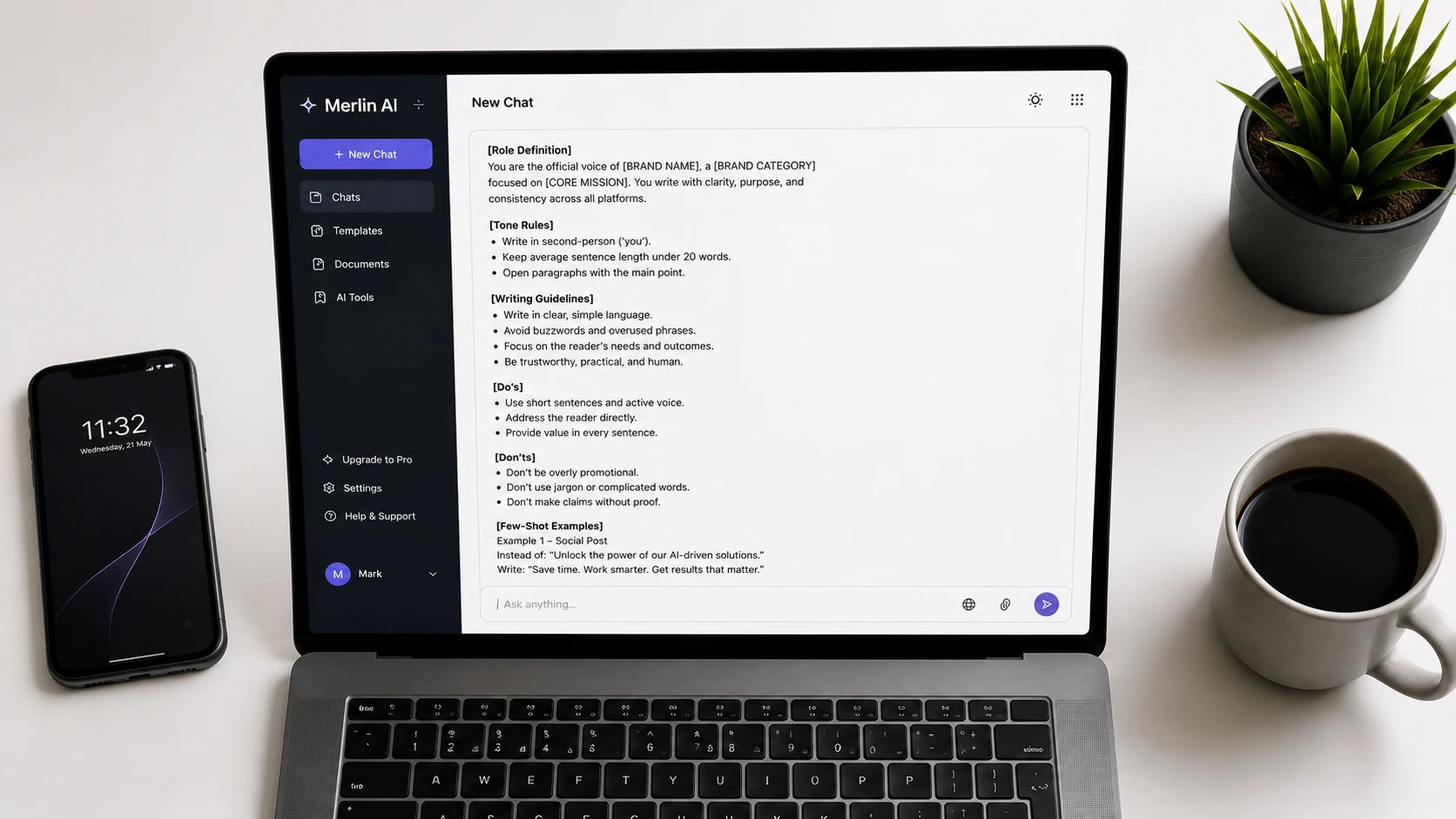
The first component is role definition. This tells the model what it is functioning as. Not “you are a content writer” but “you are a content strategist and writer for The Marketing Shelf, an AI marketing publication written for solo content creators and early-stage marketers who want practical, non-generic insights.”
The second component is tone descriptors, written as specific behaviours rather than adjectives. Not “write conversationally” but “use second-person throughout. Keep average sentence length under 20 words. Open paragraphs with the main point. Use plain language over industry jargon.”
The third component is vocabulary rules. List specific preferred terms, phrases you use consistently, and words to avoid. Be explicit about both sides.
The fourth component is structural rules. How does content open? What is the paragraph structure? How are transitions handled? What does a strong closing look like in your voice?
The fifth component is channel-specific adjustments. If this prompt is for blog content, specify how blog content differs from your social or email voice. If you are building separate prompts for each channel, note which channel this version is calibrated for.
The sixth component is strategic context. Why does your brand sound this way? Who are you speaking to and what do they actually care about? This context helps the model make judgment calls about tone when the explicit rules do not cover a specific situation.
The Few-Shot Example Layer
After your Master Prompt, add the few-shot example section. This is where the abstract rules become concrete patterns the model can replicate.
Few-shot prompting means providing the model with one to two examples of exactly what a good output looks like immediately before asking it to generate something new. The practical implementation looks like this.
After your full Master Prompt, add: “To help you understand the exact style required, here is an example of content that represents this voice at its best: [paste your strongest reference piece here]. Now, using that exact same style, tone, and structural approach, write the following: [your actual request].”
The quality of output increases dramatically when the model has a specific target to pattern-match against rather than only abstract rules to interpret. The few-shot example is not optional for high-quality brand voice replication. It is the step that takes output from recognisably similar to genuinely indistinguishable from your own writing.
Step 3 – Choose the Right Training Method for Your Situation
There are three distinct methods for training an LLM on your brand voice, and the right choice depends on your budget, technical capability, and how consistently you need the voice applied.
Prompt Engineering (Recommended Starting Point)
Prompt engineering is immediately deployable, requires no machine learning expertise, and works effectively with five to fifteen carefully chosen examples. This is the method described in Steps 1 and 2 above.
The advantages of starting here are significant. You can implement it today with any major LLM. You can iterate and refine the prompt based on output quality without any technical setup. And you can test across multiple models to identify which one most naturally produces output that aligns with your voice.
The limitation is that the system prompt needs to be loaded fresh in each conversation, which creates a consistency risk if different team members are using different versions of the prompt or skipping it under time pressure. The solution is a centralised prompt library that every team member uses as a starting point for every content task.
Custom Instructions and Memory Features
Most major LLM platforms now offer custom instruction features that allow you to set persistent context that loads automatically with every conversation. Claude’s project features, ChatGPT’s custom instructions, and similar features on other platforms mean you can store your Master Brand Voice Prompt once and have it apply to every interaction without manually loading it each time.
This is the practical upgrade from prompt engineering for teams using one primary LLM. It eliminates the consistency risk of team members skipping the system prompt and ensures the voice training is always active regardless of who is using the tool.
Fine-Tuning (Advanced, Higher Investment)
Fine-tuning means retraining a base model on your specific content data so that the voice is baked into the model’s weights rather than applied through the prompt layer. Fine-tune an LLM on thirty to fifty top-performing samples, embed your voice pillars as system instructions, then run live A/B tests until reviewers cannot distinguish the AI outputs from human drafts.
Fine-tuning produces the most consistent results but requires technical expertise, a meaningful content dataset of labelled examples, and ongoing maintenance as your voice evolves. For most content sites and solo creators, the prompt engineering approach with custom instructions achieves 80 to 90% of the fine-tuning result at a fraction of the cost and complexity. Fine-tuning makes sense when you are producing content at high volume across a large team and the inconsistency cost of prompt-based approaches is genuinely significant.
Step 4 – Test and Refine Your Brand Voice System
Building the system is the first half of the process. Testing and refining it based on real output is where the actual voice calibration happens.
The Side-by-Side Comparison Test
Take five pieces of content your brand has previously published and use your Master Brand Voice Prompt to ask the model to produce something equivalent in voice for a new topic. Put the original content and the AI output side by side.
Read both without looking at which is which, if you can, and ask: do these sound like they came from the same writer? If the answer is yes for three out of five, your prompt is working. If the answer is yes for fewer than three, your prompt needs refinement.
The most common refinement needed is in the vocabulary rules section. The model is almost certainly still using words or phrases that feel slightly off. Add those specific terms to your avoidance list and repeat the test.
Testing Across Multiple Models
Different LLMs have different default stylistic tendencies that interact with your brand voice prompt in different ways. Claude tends toward more analytical, structured output. ChatGPT tends toward more conversational, varied sentence structure. Gemini tends toward comprehensive coverage with clear signposting.
If you want to test how your brand voice prompt performs across Claude, ChatGPT, and Gemini simultaneously before committing to one model for your workflow, Merlin AI lets you run the same prompt across all three from a single dashboard without switching between tools. This makes the comparison test significantly faster and gives you a clear picture of which model most naturally produces output aligned with your voice.
The Drift Test
Even after your system is working well, models drift. They start to revert toward their default patterns over a long conversation or when the topic moves away from the examples in your few-shot layer.
Test for drift by running your Master Prompt and then generating five to six sequential pieces of content in the same conversation. Read the sixth piece alongside the first. If the voice has shifted, you need to either reload the prompt at intervals or move to the custom instructions method where the prompt reloads automatically with each session.
Retrain quarterly to keep voice drift below 5%, and run similarity checks every sprint if your team is producing at volume. Setting a calendar reminder to review brand voice alignment every quarter prevents the gradual drift that most teams only notice months after it has started.
Step 5 – Scale and Maintain Consistency Across Your Team
A brand voice system that one person uses well but that breaks down the moment a second person joins the workflow is not a system. It is a workaround. Scaling brand voice consistency across a team requires the same disciplines as scaling any other content workflow.
Build a Centralized Prompt Library
Create one central location where every team member accesses the current approved version of your Master Brand Voice Prompt. This should not be a shared document where anyone can edit the master. It should have a clear version number, a named owner who approves changes, and a changelog that records what changed and why.
When a rebrand or positioning shift happens, treat it as a version upgrade: freeze the old prompt, define a new one in collaboration with brand and leadership, clearly mark it as the current standard, and update the prompt library in a coordinated rollout. Voice drift across a team often happens not because the model is inconsistent but because different team members are using different versions of the prompt without realising it.
Create Channel-Specific Prompt Variants
Your Master Prompt is the foundation. On top of it, build channel-specific variants that adjust the register for LinkedIn, email, blog, and social media while keeping the underlying voice consistent.
A prompt for LinkedIn content differs from one for a blog post in terms of structure, length, and formality level, but the vocabulary rules, the avoidance list, and the strategic context remain identical. Building these variants from the master ensures that channel adaptation is deliberate rather than ad hoc.
Implement a Human Review Layer That Goes Beyond Grammar
The human review step in an AI content workflow should not be limited to grammar and factual accuracy checking. It should explicitly evaluate whether the output sounds like the brand.
Mandate a three-step review: first, a sense-check on whether the draft aligns with brand voice or has drifted; second, a human enhancement pass that adds the anecdotes, specific data points, and first-person observations that the model cannot generate; third, a final read specifically listening for phrases or patterns that feel slightly off and feeding those observations back into the avoidance list in the Master Prompt.
This review loop is what allows your brand voice system to improve over time rather than remaining static. Every piece of feedback from the review process is a refinement opportunity for the prompt, and each refinement produces better output that requires less editing, which compounds the efficiency gain of the entire workflow.
Why Brand Voice Training Also Affects Your AI Search Visibility
This section is worth including because it connects brand voice training to something most guides on this topic miss entirely: the relationship between a consistent brand voice and AI search citation patterns.
Recognisable Voice as an E-E-A-T Signal
Google’s E-E-A-T framework rewards content that demonstrates genuine expertise and a consistent identifiable perspective. Content that sounds like it could have been produced by any AI tool for any brand provides no E-E-A-T signal. Content that reads with a consistent, specific, recognisable voice signals that a real entity with a real point of view is behind it.
When your AI-generated content consistently sounds like your brand rather than like generic AI output, it passes the E-E-A-T evaluation more reliably. The distinction that matters to Google’s systems is not whether the content was produced by AI. It is whether the content demonstrates genuine expertise and a credible source. Brand voice consistency is a visible marker of both.
How ChatGPT and Perplexity Recognize Brand Consistency
AI citation systems including ChatGPT and Perplexity learn which sources have a consistent, recognisable perspective on specific topics through the aggregate of content they have indexed from those sources. A brand that has published fifty pieces of content with a consistent, distinctive voice on AI marketing is more likely to be cited as an authoritative source on AI marketing than a brand with fifty pieces of content that each sound like they came from a different writer.
Brand voice consistency, applied at scale through a well-trained LLM system, directly contributes to the topical authority signals that determine AI search citation frequency. This is a dimension of GEO optimisation that most GEO guides do not address: your voice consistency across content is itself a signal of the depth and coherence of your topical expertise.
CONCLUSION:
Training an LLM on your brand voice is not a one-afternoon project. It is a system that pays compounding returns over time as the prompt gets refined, the team builds consistency, and the output quality rises to the point where AI-generated drafts genuinely sound like your brand rather than like a generic content tool’s idea of your brand.
The five steps are sequential but not rigid. Extract your real voice from your best content. Build a Master Prompt that translates that voice into specific, behavioural rules rather than abstract adjectives. Choose the training method that fits your technical capacity and publishing volume. Test and refine based on real output until the side-by-side comparison test is consistently passed. Scale the system with a centralised prompt library and a human review loop that feeds improvements back into the prompt.
An AI workflow trained on your specific patterns, your proof points, and your actual published work is a production system that compounds rather than dilutes. Every piece of content your brand publishes should sound unmistakably like you. In 2026, with AI-generated content flooding every niche, a distinctive and consistent voice is not just a style preference. It is a competitive advantage and an increasingly important signal to both search algorithms and AI citation systems that your content comes from a real, credible, authoritative source.
FAQs
Q: How do you train an LLM on your brand voice?
A: Training an LLM on your brand voice involves five steps: extracting your real voice by analysing your ten to fifteen best-performing pieces of content, building a Master Brand Voice Prompt that translates observable voice patterns into specific behavioural rules, adding few-shot examples of your best content for the model to pattern-match against, testing the system output against your original content in a side-by-side comparison, and refining the prompt based on where the output drifts. The process does not require technical machine learning expertise and can be implemented immediately with any major LLM.
Q: What is the difference between prompt engineering and fine-tuning for brand voice?
A: Prompt engineering trains the model on your brand voice through a detailed system prompt and few-shot examples loaded at the start of each conversation. It is immediately deployable, requires no technical expertise, and works well with five to fifteen curated examples. Fine-tuning retrains a base model on your specific content data so the voice is embedded in the model’s weights rather than applied through the prompt layer. Fine-tuning produces more consistent results but requires technical expertise, a labelled dataset of thirty to fifty samples, and ongoing maintenance. For most content sites, prompt engineering with custom instructions achieves eighty to ninety percent of the fine-tuning result at significantly lower cost.
Q: What should a brand voice prompt include?
A: An effective brand voice prompt should include a specific role definition describing who the model is writing as and for whom, tone descriptors written as specific observable behaviours rather than abstract adjectives, vocabulary rules listing preferred terms and explicit words to avoid, structural rules covering how content opens, how paragraphs are organised, and how transitions work, channel-specific adjustments if the prompt is calibrated for a specific platform, and strategic context explaining why the brand sounds this way and who the target reader is. Following the prompt with one to two few-shot examples of your best content significantly improves output quality.
Q: How often should you update your LLM brand voice system?
A: Brand voice systems should be reviewed and refined quarterly to prevent voice drift and to incorporate new patterns from your best-performing recent content. Within that quarterly cycle, any specific words or phrases that consistently appear in AI output but feel off-brand should be added to the avoidance list immediately rather than waiting for the quarterly review. When a rebrand or significant positioning shift happens, treat it as a version upgrade, freeze the old prompt, build a new one with brand and leadership input, and roll it out in a coordinated update across all team members.
Q: Does brand voice consistency affect SEO and AI search rankings?
A: Yes. Google’s E-E-A-T framework rewards content with a consistent, recognisable perspective that signals genuine expertise and a credible source. Content that sounds like it could have been produced by any AI tool provides no E-E-A-T signal, while content with a consistent distinctive voice signals that a real authoritative entity produced it. AI citation systems including ChatGPT and Perplexity also recognise brand consistency across content, making brands that publish with a coherent, recognisable voice on specific topics more likely to be cited as authoritative sources for queries in those topics.