


65% of pages cited by Google AI Mode and 71% cited by ChatGPT include structured data, according to SE Ranking’s 2026 analysis of AI search citation patterns. Pages without schema markup are structurally harder for AI systems to evaluate, categorise, and cite.
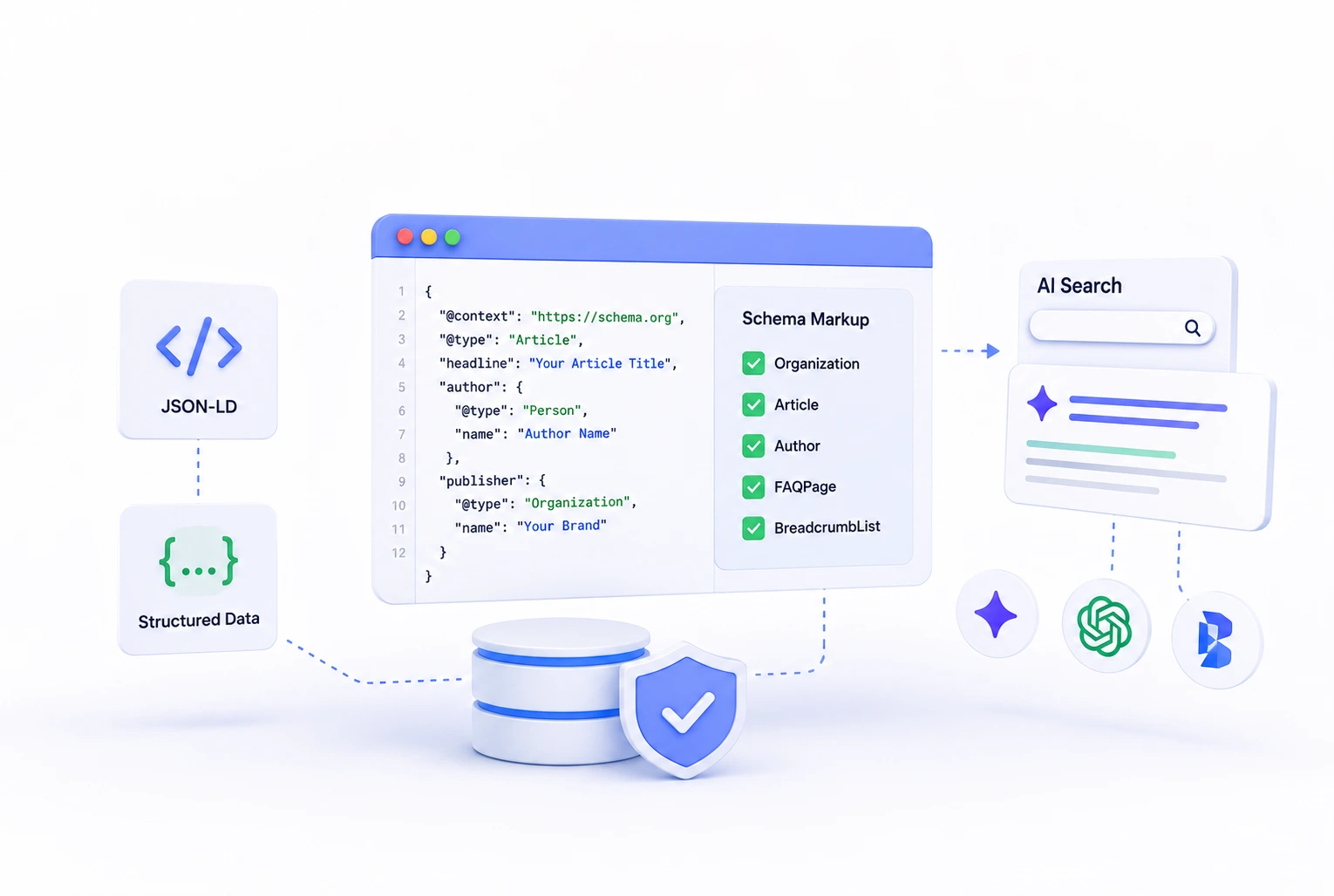
Schema markup is the technical layer that tells AI systems not just what your content says but what your content means. Without it, AI platforms must infer the type, author, topic, and credibility of your content from natural language alone. With it, you explicitly declare exactly what each piece of content represents, who wrote it, what entities it describes, and how it relates to other content on your site. That explicit declaration is what separates content AI systems cite from content they skip.
This guide covers every schema type that materially affects AI search visibility in 2026, with honest data on what works and what does not, the exact JSON-LD implementation code for each type, and the specific differences in how Google AI Overviews, ChatGPT, Perplexity, Claude, Grok, DeepSeek, and Meta AI use structured data.
One critical update before anything else: Google removed FAQ rich results from Search on May 7, 2026, and How-to rich results were deprecated on desktop in 2023. Most schema markup guides published before mid-2026 do not reflect this. Both schema types retain full value for Perplexity, Bing Copilot, ChatGPT Search, and other non-Google AI platforms. The value of FAQ Page and How-to schema in 2026 have shifted from earning Google rich results to improving AI citation eligibility across every platform that is not Google. That distinction matters for how you implement and priorities your schema strategy.
How AI Systems Actually Use Schema Markup – The Honest Picture
Schema markup boosts AI search visibility by providing explicit, machine-readable signals about content type, authorship, and entity relationships, but it amplifies existing authority rather than creating citation lift on its own.
An Ahrefs causal study tracking 1,885 pages that added JSON-LD schema between August 2025 and March 2026, matched against 4,000 control pages, found no major uplift in AI citations from schema alone.
Schema added to weak content on a weak domain produces weak results. Schema deployed as part of a complete content and entity strategy produces measurable gains, according to AI Growth Agent’s July 2026 analysis.
Why Schema Matters for RAG-Based Retrieval
Google AI Overviews, ChatGPT, Perplexity, and most major AI platforms use Retrieval Augmented Generation, or RAG, to synthesise answers. The RAG pipeline retrieves candidate pages, scores each passage by relevance and credibility, and generates a response using the highest-scoring sources. Schema markup improves a page’s score in this process in two specific ways.
First, schema provides explicit content-type signals that help AI systems correctly categorise a page before they have finished reading it. A page with Article schema is immediately identified as editorial content. A page with FAQPage schema is immediately identified as containing question-and-answer pairs eligible for direct extraction. Without these signals, the AI system must infer content type from the prose, which introduces ambiguity that reduces citation confidence.
Second, schema anchors your content to verified entities in the broader knowledge graph. Organisation schema with sameAs properties linking to your LinkedIn page, Wikipedia entry, or Wikidata profile tells AI systems that The Marketing Shelf is a real, identifiable entity, not an anonymous blog. Entity verification is a direct credibility signal in AI citation evaluation, according to WPRiders’ December 2025 analysis of AI citation patterns.
Where Schema Directly Helps and Where It Does Not
Schema directly improves AI citation probability on Google AI Overviews, Perplexity, and Bing Copilot, where structured data is a documented selection signal. Sites with complete Tier 1 schema see up to 40% more AI Overview appearances, according to Stackmatix’s 2026 analysis.
Schema has a more complex relationship with ChatGPT and Claude. Third-party LLM systems including ChatGPT, Claude, and Perplexity often fail to semantically parse JSON-LD during runtime retrieval in some implementations, according to AI Growth Agent’s 2026 technical analysis. The primary benefit of schema for ChatGPT citation is indirect: schema improves Google rankings, and 99.5% of ChatGPT citations come from pages that already hold top-3 Google positions, according to SE Ranking’s analysis of 100,000 queries. Schema’s value for ChatGPT visibility runs through Google ranking improvement rather than direct structured data parsing.
The practical conclusion: implement schema for its direct impact on Google AI Overviews and Perplexity citations, and for its indirect impact on the Google rankings that feed ChatGPT visibility. Do not expect schema alone to transform AI citation frequency on a low-authority domain with weak content. Schema amplifies authority. It does not create it.
The Schema Type Comparison Table – What Each Type Does Across Platforms
The table below maps each major schema type to its primary function, its value for each AI platform, its implementation priority, and whether it still earns Google rich results after the May 2026 changes.
| Schema Type | Primary Function | Google Rich Results | Google AI Overviews | ChatGPT | Perplexity | Implementation Priority |
| Organization | Entity identity and brand verification | No (sitelinks only) | High | High (indirect) | High | Implement first on every site |
| Article | Content type declaration | No (after 2026 updates) | High | Medium | High | Every blog post and guide |
| FAQPage | Q&A extraction and citation | No (removed May 2026) | Medium | Medium | High | Every post with 5+ FAQ pairs |
| HowTo | Step-by-step instruction markup | No (deprecated desktop 2023) | Medium | Medium | High | Tutorials and process guides |
| BreadcrumbList | Site hierarchy and navigation | Yes | Medium | Low | Low | Every page on the site |
| Author / Person | Author credibility and credentials | No | High | High | High | Every post with byline |
| ClaimReview | Fact-checking and verified claims | Yes (fact check) | High | High | High | Research and data posts |
| NewsArticle / ScholarlyArticle | Publication type and academic credibility | Yes (top stories) | High | Medium | Very High | Research-backed content |
| Product | Product details and pricing | Yes (shopping) | High | Medium | Medium | Tool reviews and comparisons |
| Review / AggregateRating | User review signals | Yes | High | Medium | High | Tool reviews and roundups |
The Priority Schema Types – What to Implement First
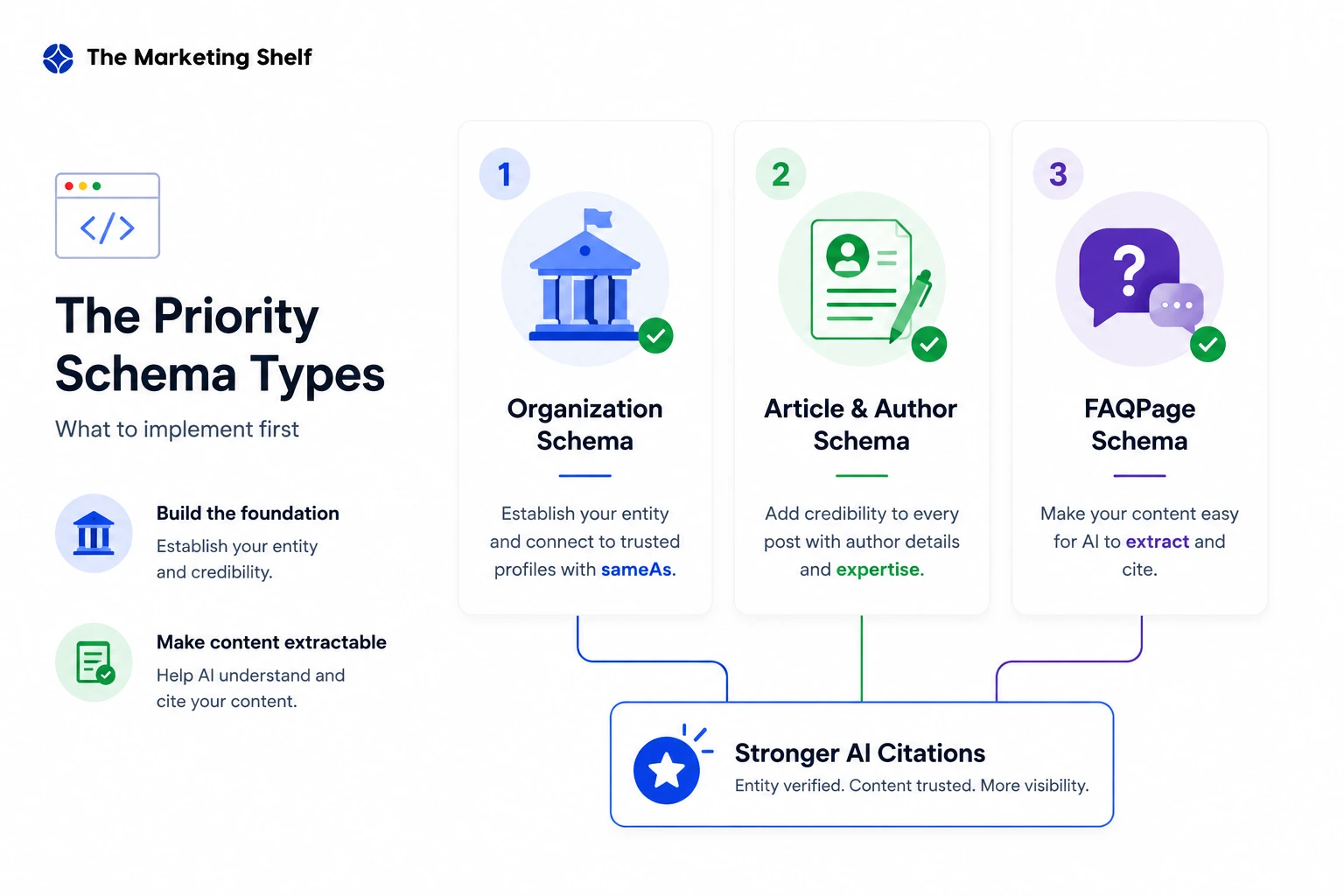
Implement Organization schema and FAQPage schema before anything else. Together they form the entity foundation and the content extraction layer that AI systems need most, according to WPRiders’ December 2025 analysis of the schema types with the clearest impact on AI citation eligibility.
Organization Schema – The Foundation of Your Entity Graph
Organization schema is the most important schema type for AI search visibility because it anchors every other schema type to a verified real-world entity. Without Organisation schema, AI systems have no machine-readable proof that The Marketing Shelf is a legitimate, identifiable brand rather than an anonymous collection of web pages.
The critical property in Organization schema for AI citation is sameAs. The sameAs property links your Organisation schema to verified external profiles including your LinkedIn company page, your Twitter or X profile, your Crunchbase listing, and ideally your Wikidata entry if one exists. These links tell AI systems that your brand exists independently of your website, which is the entity verification signal that directly improves citation confidence.
Adding a verified Organization schema with sameAs URLs linking to LinkedIn and the company website increased one brand’s appearance in ChatGPT-generated responses by 41%, according to NetWebMedia’s May 2026 case study.
The basic Organization schema for a content site looks like this in JSON-LD:
PASTE IN WORDPRESS CODE BLOCK:
{
“@context”: “https://schema.org”,
“@type”: “Organization”,
“@id”: “https://yourwebsite.com/#organization”,
“name”: “Your Brand Name”,
“url”: “https://yourwebsite.com”,
“logo”: {
“@type”: “ImageObject”,
“url”: “https://yourwebsite.com/logo.png”
},
“description”: “A short, clear summary of what your business or website does.”,
“sameAs”: [
“https://www.linkedin.com/company/yourbrand”,
“https://twitter.com/yourbrand”,
“https://www.instagram.com/yourbrand”
],
“knowsAbout”: [
“Topic 1”,
“Topic 2”,
“Topic 3”
]
}
The knowsAbout property explicitly declares your topical expertise to AI systems. This directly supports the topical authority signal that determines how AI platforms evaluate your content across all queries in your niche, according to AI Growth Agent’s July 2026 analysis.
Article and Author Schema – Credibility for Every Post
Article schema identifies your blog posts as editorial content and enables Author schema to declare the credentials of the person who wrote it. The combination of Article and Author schema is the primary E-E-A-T signal available through structured data, and it is the schema most directly linked to the author attribution gap that Digital Applied’s 2026 study identified in AI-generated content.
89% of pure AI-generated articles lack an identifiable expert author, compared to 29% of human-written articles, according to Digital Applied’s analysis of 4,200 articles in 2026. Author schema with a linked Person profile and explicit credential declaration closes this gap in a way that AI systems can verify directly.
Every Article on your site should include:
PASTE IN WORDPRESS CODE BLOCK:
{
“@context”: “https://schema.org”,
“@type”: “Article”,
“headline”: “Your Article Title Goes Here”,
“datePublished”: “2026-07-01”,
“dateModified”: “2026-07-15”,
“author”: {
“@type”: “Person”,
“name”: “Author Name”,
“url”: “https://yourwebsite.com/about-author”,
“sameAs”: [
“https://www.linkedin.com/in/authorprofile”,
“https://twitter.com/authorhandle”
],
“knowsAbout”: [“Topic 1”, “Topic 2”, “Topic 3”]
},
“publisher”: {
“@type”: “Organization”,
“name”: “Your Brand Name”,
“url”: “https://yourwebsite.com”,
“logo”: {
“@type”: “ImageObject”,
“url”: “https://yourwebsite.com/logo.png”
}
},
“mainEntityOfPage”: {
“@type”: “WebPage”,
“@id”: “https://yourwebsite.com/your-post-url”
}
}
The dateModified property is critical for AI citation freshness signals. Pages updated within the last 30 days receive 3.2 times more AI citations than older material, according to Digital Bloom’s 2025 analysis. The dateModified value should be updated every time you make a substantive change to the post content.
FAQ Page Schema Still Essential Despite Google’s May 2026 Change
FAQPage schema remains the single highest-leverage schema type for AI citation across Perplexity, Bing Copilot, ChatGPT, and non-Google AI platforms, even after Google removed FAQ rich results from Search on May 7, 2026. The value of FAQPage schema has not disappeared. It has shifted from earning a visual rich result in Google’s traditional SERP to improving AI extraction eligibility across every platform that is not Google.
What Changed and What Did Not
Google’s May 7, 2026 update removed the visual FAQ accordion that previously appeared below some search results. This change affects what users see in Google’s traditional results page. It does not affect whether Google AI Overviews use FAQ content for citation, whether Perplexity uses FAQPage markup to identify extractable Q&A pairs, or whether ChatGPT Search uses FAQ structure when evaluating passage relevance.
FAQPage schema retains full value for Perplexity, Bing Copilot, ChatGPT, and other non-Google AI platforms, according to GlobeRunner’s July 2026 analysis. Perplexity shows a 47% preference for content with ClaimReview schema combined with Author schema, but FAQPage remains one of the top three schema types for Perplexity citation eligibility, according to NetWebMedia’s May 2026 analysis.
How to Write FAQ Content That Gets Extracted
The FAQ answer must appear as visible text on the page, word for word matching what is in the schema. This is a validation requirement for FAQPage schema and also a content quality requirement. Every answer must be self-contained between 50 and 300 words and start with a direct one-sentence response, according to AI Growth Agent’s Perplexity citation guide published in July 2026.
FAQ Page JSON-LD implementation:
PASTE IN WORDPRESS CODE BLOCK:
{
“@context”: “https://schema.org”,
“@type”: “FAQPage”,
“mainEntity”: [
{
“@type”: “Question”,
“name”: “Your First Question Here?”,
“acceptedAnswer”: {
“@type”: “Answer”,
“text”: “Your direct, clear answer to the first question goes here.”
}
},
{
“@type”: “Question”,
“name”: “Your Second Question Here?”,
“acceptedAnswer”: {
“@type”: “Answer”,
“text”: “Your direct, clear answer to the second question goes here.”
}
}
]
}
Advanced Schema Types That Boost AI Citation Specifically
The schema types below produce the highest measured citation lifts for content sites specifically targeting AI search visibility rather than traditional Google rich results.
Claim Review Schema – The Most Underused Citation Signal
ClaimReview schema is used by fact-checking organisations to mark verified or debunked claims. In 2026, AI systems have adopted it as a credibility signal beyond its original fact-checking context. Perplexity shows a 47% preference for content with ClaimReview schema combined with Author schema, according to NetWebMedia’s May 2026 analysis of 658 citation sources.
For a content site, Claim Review is most appropriate on research-backed posts that contain specific verified factual claims, data analyses, or posts that explicitly confirm or refute common misconceptions in your niche. Every blog post on The Marketing Shelf that contains a specific researched claim, a statistics-based finding, or a myth-busting section is a candidate for Claim Review schema.
Scholarly Article Schema – The Perplexity Citation Multiplier
ScholarlyArticle is a subtype of Article that signals academic or research-grade content. After adding ScholarlyArticle schema with complete author credentials and educational organisation markup instead of standard Article schema, one site’s citation rate in Perplexity jumped from 12% to 34% of relevant queries within six weeks, according to NetWebMedia’s May 2026 case study.
For a content site, ScholarlyArticle is appropriate on posts that present original research, documented case studies with specific measurable outcomes, or comprehensive analytical pieces with full source attribution. It requires complete author credential markup including the author’s institutional affiliation or professional organisation, which for a personal brand site means explicitly declaring The Marketing Shelf as the publishing organisation and the author’s area of expertise as a knowsAbout property.
Breadcrumb List Schema – The Navigation Signal AI Systems Use
BreadcrumbList schema communicates your site’s content hierarchy to AI systems, telling them that a specific post belongs to a specific category within a specific niche. This hierarchy signal supports topical authority evaluation because it shows AI systems that the post is part of a structured, organised body of content rather than a standalone page.
Every page on your site should have BreadcrumbList schema. For a post titled “How to Write Snippet-Friendly Content That AI Overviews Cite” in the SEO and Content category on The Marketing Shelf, the BreadcrumbList would read: Home, SEO and Content, post title. This three-level hierarchy tells AI systems exactly where this content sits within your site’s topical structure.
How to Implement Schema Markup Without a Developer
Implementing schema markup correctly does not require coding expertise when you are using WordPress with a schema plugin. It does require understanding which fields matter for AI citation specifically, not just for traditional rich results.
Using AIOSEO for Schema Implementation
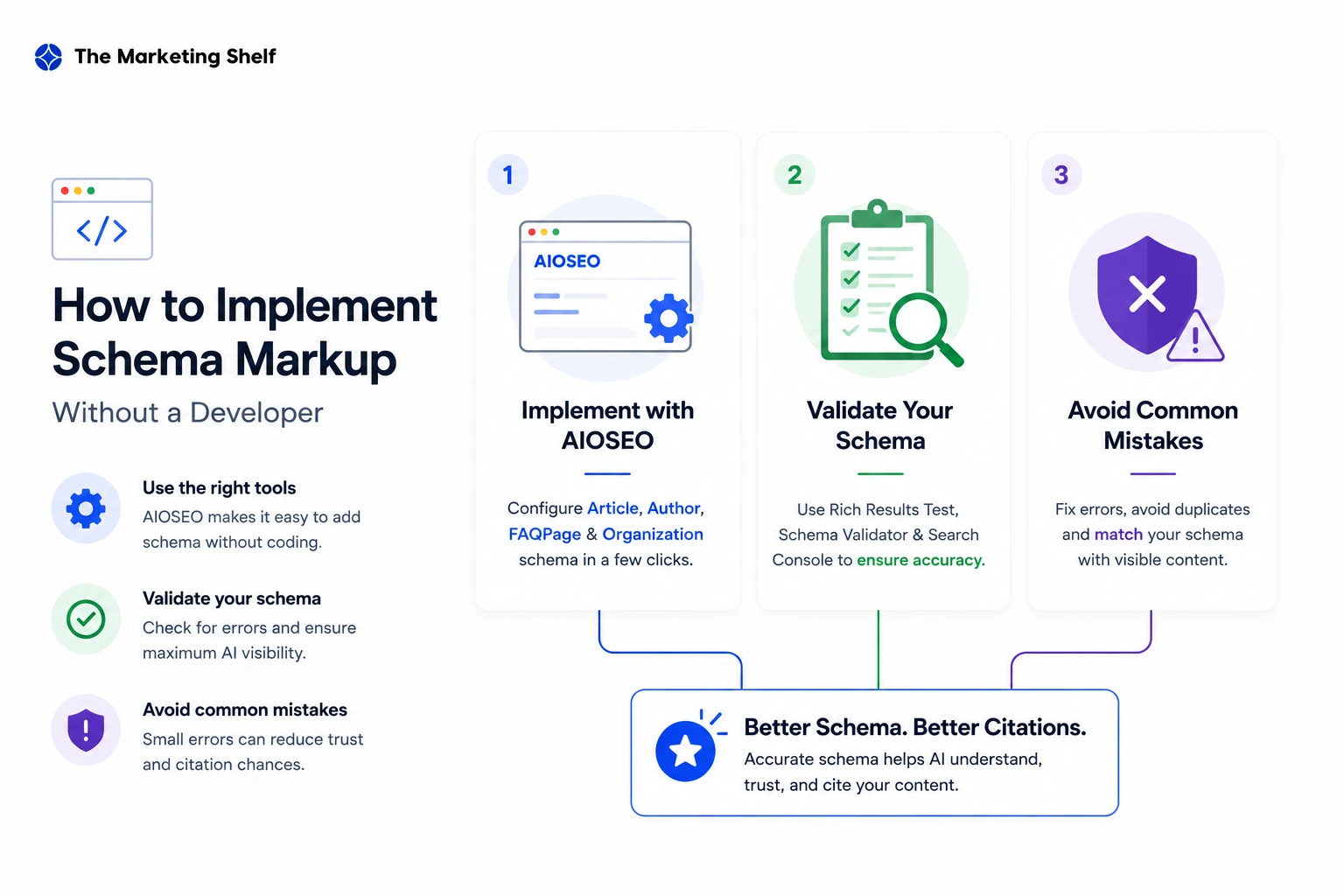
AIOSEO, which The Marketing Shelf uses, implements Article schema, Author schema, Breadcrumb List schema, and FAQ Page schema automatically for WordPress posts when configured correctly. The critical settings to verify in AIOSEO are these.
In the Schema tab for each post, set the schema type to Article and verify that the author field is populated with a real author name linked to a profile. This automatically generates the Article and Author JSON-LD that AI systems evaluate for E-E-A-T signals.
For FAQPage schema, AIOSEO includes a dedicated FAQ block that generates valid FAQPage JSON-LD when you add question-and-answer pairs through the block editor. Every FAQ block answer must match the visible text on the page exactly, with no paraphrasing or variation between the schema and the visible content.
For Organization schema, configure your site identity settings in AIOSEO’s General Settings with your site name, logo, and social media profile URLs. These populate the sameAs properties in the Organization schema automatically.
Validating Your Schema – The Tools That Matter
Use Google’s Rich Results Test to verify that your JSON-LD is syntactically correct and that your markup matches your visible content. Even though fewer schema types produce rich results in Google’s traditional SERP after May 2026, the Rich Results Test remains the most reliable syntax validator for JSON-LD implementation.
Use Schema.org’s validator at validator.schema.org to verify that your schema is correctly structured according to schema.org specifications. This is the standard that Perplexity, Bing Copilot, and other AI platforms use to evaluate schema validity, independent of Google’s rich result eligibility.
Use Google Search Console’s Rich Results report to identify schema errors and warnings across your entire site. Errors in your schema are not just missed opportunities. They can signal to AI systems that your structured data is unreliable, which reduces citation confidence for affected pages.
The Common Mistakes That Kill Schema Effectiveness
The most common schema implementation mistakes that reduce AI citation probability are specific and avoidable.
Missing required fields reduce schema validity. Every schema type has required properties defined by schema.org. An Article schema without a headline and datePublished, or a FAQPage schema with answers that do not appear in the visible page content, will fail validation and produce no citation benefit.
Duplicate schema types on the same page create ambiguity. If your theme generates Article schema automatically and your SEO plugin also generates Article schema, the AI system receives two conflicting declarations of the same content type. Remove duplicate schema generation from your theme or plugin settings.
Mismatched schema content reduces trust signals. The visible content on your page must match the content declared in your schema. An FAQ schema with an answer that differs from the visible FAQ answer is a trust signal violation that AI systems register as inconsistency between declared and actual content.
Implementing schema on weak content produces no uplift. Schema amplifies existing authority signals rather than creating citation lift on its own, according to Ahrefs’ causal study of 1,885 pages between August 2025 and March 2026. Before implementing schema on a page, verify that the content itself leads with direct answers, contains attributed statistics, and covers the topic comprehensively. Schema on structurally weak content produces the same weak result as no schema at all.
The Schema Implementation Audit – What to Check on Every Published Page
Apply this audit to every existing page on your site before publishing new content. Pages already ranking in positions 4 through 20 for their target queries are the highest-priority audit targets because schema improvements on near-top-ranking pages produce the fastest measurable citation impact.
The Five-Point Schema Audit
- Check one: Does the page have Organization schema with at least two sameAs properties linking to verified external profiles? If not, add it to your site-wide schema settings immediately. Organization schema is a site-level implementation, not a per-page one.
- Check two: Does every blog post have Article schema with datePublished, dateModified, and Author schema including a named person with a linked profile and at least one knowsAbout property? If not, update your AIOSEO schema settings to populate these fields automatically for all post types.
- Check three: Does every post with five or more FAQ pairs have FAQ Page schema implemented through a validated FAQ block? Verify that every schema answer matches the visible page content word for word.
- Check four: Does the page have Breadcrumb List schema reflecting its correct position in your site hierarchy? Verify this is being generated by your SEO plugin for every page type including categories and tags.
- Check five: For posts containing original research, verified statistics, or myth-busting content, has Claim Review or Scholarly Article schema been implemented where appropriate? These advanced schema types produce the highest measured citation lifts on Perplexity specifically and are almost universally skipped by content sites that only implement the basic schema types.
CONCLUSION:
Schema markup is the technical declaration that AI systems use to understand not just what your content says but what it means, who produced it, and how credible it is. The 65% to 71% citation rate for structured-data-enabled pages across Google AI Mode and ChatGPT, documented by SE Ranking’s 2026 analysis, reflects this: schema does not guarantee citation, but it significantly improves the probability that AI systems evaluate your content as citation-worthy.
The implementation priority is clear. Start with Organization schema and configure it site-wide with same As properties linking to every verified external profile your brand has. Add Article schema with Author credentials to every post. Implement FAQ Page schema on every post that contains five or more question-and-answer pairs, understanding that its value in 2026 is for AI platform citation rather than Google rich results after the May 2026 change. Add Claim Review and Scholarly Article schema to your most research-backed content to access the highest citation lift signals specifically for Perplexity.
Validate every implementation using Google’s Rich Results Test and schema.org’s validator. Check your Search Console Rich Results report monthly for errors. And remember the honest finding from Ahrefs’ causal study: schema amplifies existing authority. It works best when the content underneath it is already structured with direct answers, attributed statistics, and genuine expertise signals.
Schema is not a shortcut. It is the technical foundation that makes a strong content strategy machine-readable to every AI system that might otherwise read your content correctly but cite it incorrectly or not at all.
FAQs
Q: What schema markup types are most important for AI search visibility in 2026?
A: The most important schema types for AI search visibility in 2026 are Organization with sameAs entity linking, Article with full Author credentials and knowsAbout properties, FAQPage for Q&A extraction on Perplexity and ChatGPT, ClaimReview for verified factual content, and BreadcrumbList for site hierarchy signals. Sites with complete schema markup are 2.7 times more likely to be cited in Perplexity AI than sites without structured data, according to Cludo’s 2025 analysis of 12,000 European sites. Schema should always be implemented alongside strong content quality rather than as a substitute for it.
Q: Did Google remove FAQ schema in May 2026?
A: Google removed FAQ rich results from Search on May 7, 2026, meaning FAQPage schema no longer produces the visual accordion in Google’s traditional search results. However, FAQPage schema retains full citation value for Perplexity, Bing Copilot, ChatGPT Search, and Google AI Overviews. The schema type remains one of the highest-leverage AI citation signals on non-Google platforms. The change affects what users see in Google’s traditional SERP but does not affect AI platform citation eligibility or the value of FAQ content for AI extraction.
Q: How do you implement schema markup in WordPress without coding?
A: WordPress users can implement schema markup without coding using AIOSEO, Yoast SEO, or Rank Math. AIOSEO automatically generates Article, Author, BreadcrumbList, and Organisation schema when configured in General Settings and Post Schema settings. FAQPage schema is implemented by adding the FAQ block in the WordPress block editor and entering question-and-answer pairs directly. Every FAQ answer in the block editor must match the visible page content exactly. Validate all schema using Google’s Rich Results Test at search.google.com/test/rich-results and schema.org’s validator at validator.schema.org.
Q: Does schema markup directly cause AI platforms to cite your content?
A: Schema markup improves AI citation probability but does not directly cause citations on its own. An Ahrefs causal study of 1,885 pages that added JSON-LD schema between August 2025 and March 2026 found no major uplift in AI citations from schema alone. Schema amplifies existing authority signals rather than creating citation lift independently. The strongest citation results occur when schema is implemented alongside content that leads with direct answers, contains attributed statistics, has genuine author credentials, and covers topics comprehensively. Schema added to weak content on a low-authority domain produces the same weak result as no schema at all.
Q: What is the most effective schema type for Perplexity AI citations specifically?
A: For Perplexity AI citations specifically, ClaimReview schema combined with Author schema produces a 47% preference signal, according to NetWebMedia’s May 2026 analysis. ScholarlyArticle schema instead of standard Article schema increased one site’s Perplexity citation rate from 12% to 34% of relevant queries within six weeks in the same study. FAQPage schema also performs well on Perplexity because the platform averages 21 citations per response and specifically looks for structured Q&A content it can reference in its footnoted answer format. Sites with complete schema markup are 2.7 times more likely to be cited in Perplexity than unstructured equivalents, according to Cludo’s 2025 analysis.