


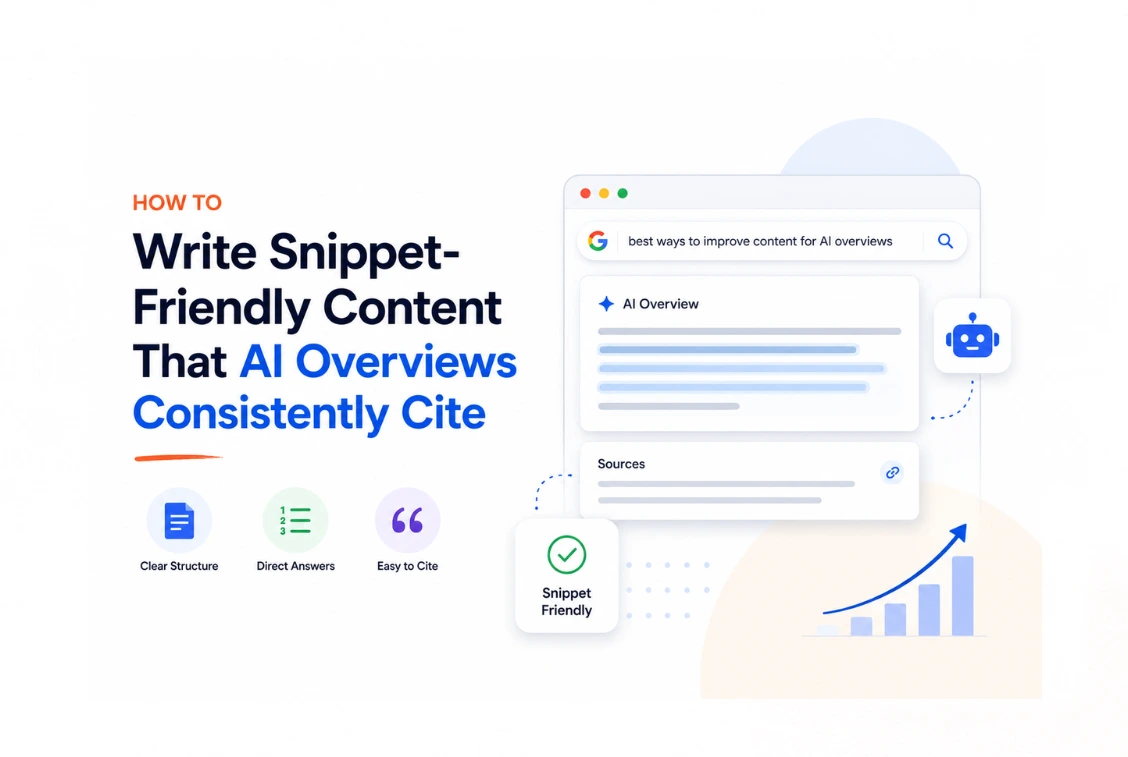
99.5% of sources cited in Google AI Overviews had previously held a featured snippet or a top-3 organic position, according to SE Ranking’s analysis of 100,000 Google queries in 2024 and confirmed again in 2026. That number is not a majority or a strong correlation. It is effectively the entire population.
What this means for your content strategy is specific and actionable. The path to being cited by Google AI Overviews, ChatGPT Search, Perplexity, Claude, Grok, DeepSeek, and Meta AI runs through one place: writing content that is structured the way AI extraction systems are built to read. Not longer content. Not more content. Structurally different content.
Most writers optimise for human readers. They build context, develop an argument, and deliver the answer after the reader has enough background to appreciate it. AI extraction systems work in reverse. They retrieve pages, score each section by how directly it answers the query, and extract the highest-scoring passage. A section that buries its answer under three paragraphs of context scores lower than a section that leads with the answer in the first sentence, regardless of which one a human would prefer to read.
This post is the complete writing system for snippet-friendly content in 2026. It covers exactly how Google AI Overviews, ChatGPT, Perplexity, Grok, Claude, DeepSeek, and Meta AI each evaluate and select citation sources, the specific structural techniques that improve extraction scores across all of them, the content formats that perform best on each platform, and the technical layer that makes your content machine-readable to every major AI crawler in 2026.
Every principle in this post applies directly to solo content creators and small blogs with no backlinks and no domain authority, because citation engineering is a content structure skill, not an authority metric. It is the one area where a well-structured post on a new domain genuinely competes with established sites.
Why Featured Snippets and AI Citations Are the Same Strategy
Featured snippet optimisation and AI Overview citation optimisation are not two separate workstreams. They are the same strategy applied to the same structural signals, and understanding why tells you exactly what to build.
The RAG Connection – Why Snippets Predict AI Citations
Google AI Overviews use a process called Retrieval Augmented Generation, or RAG. The system retrieves candidate pages from Google’s index, scores each retrieved passage by cosine similarity to the user’s query, and generates an answer by synthesising the highest-scoring passages. The pages that score highest in this retrieval process are the ones that already rank at the top of Google’s organic index, because the same topical authority, passage clarity, schema markup, and inbound link signals that Google uses to select a featured snippet are the same signals that the RAG pipeline uses to rank candidate passages.
A featured snippet is, in effect, a pre-vetted passage. It has already cleared Google’s relevance and quality bar. When the AI Overview system needs to retrieve a source, it starts from the same ranked corpus and the snippet-holding page sits at the top of it. This is why SE Ranking found 99.5% overlap between AI Overview citations and snippet or top-3 holders, according to their 2024 study of 100,000 queries.
How ChatGPT, Perplexity, Grok, Claude, DeepSeek, and Meta AI Differ
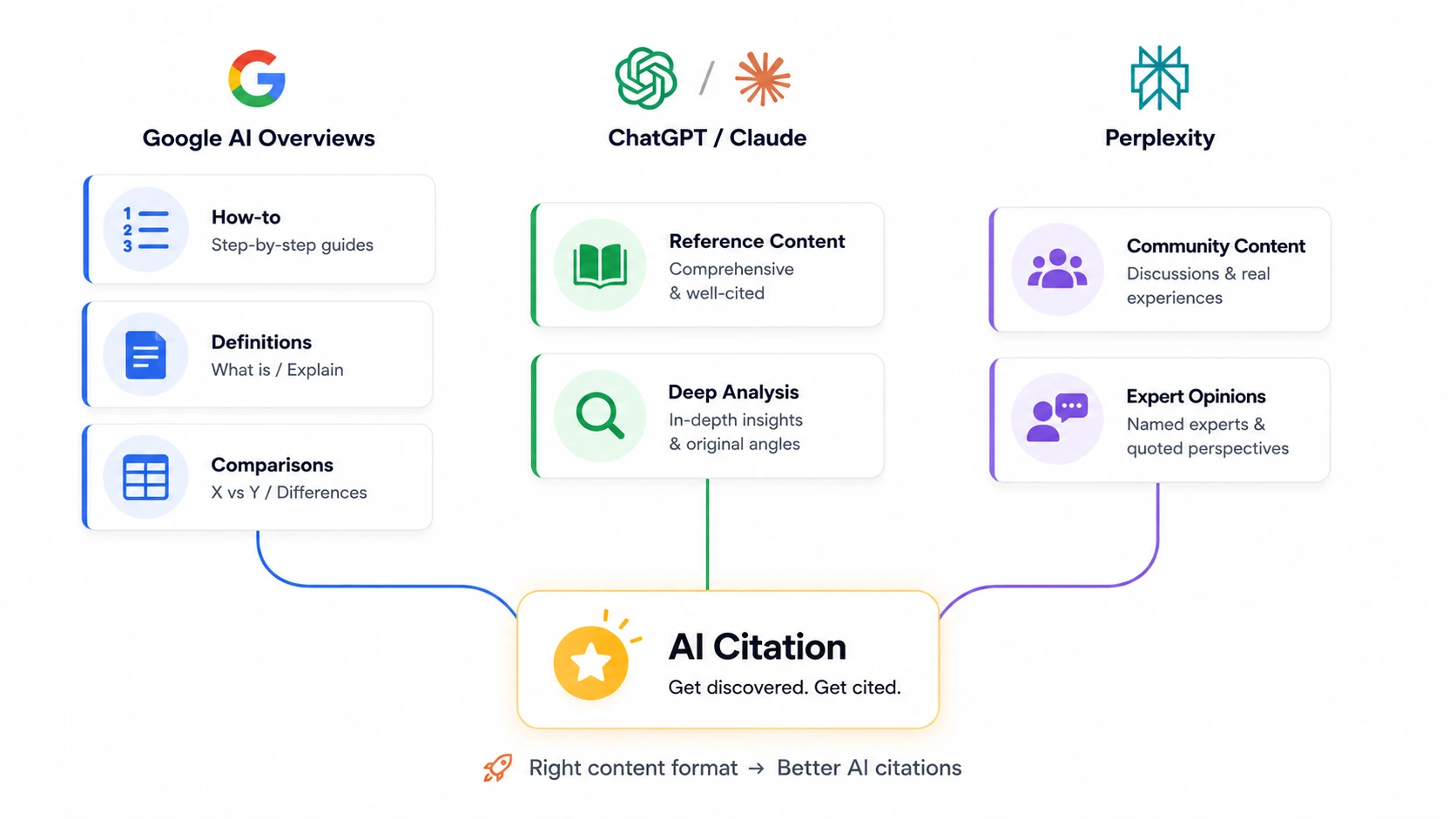
Each major AI platform uses a variation of the same retrieval logic but with different source preferences and different signal weighting. Understanding the differences tells you where to invest your optimisation effort.
Google AI Overviews draw from Google’s own index and heavily weight existing featured snippet holders and top-3 organic positions. Pages with valid schema markup are two to four times more likely to appear in AI Overviews, according to ResultFirst’s 2026 analysis. Content freshness, indicated by a visible last-updated timestamp and current-year data, is a direct selection signal.
ChatGPT Search uses Bing’s index as its live retrieval layer, with 89.6% of prompts triggering two or more additional sub-searches before an answer is returned, according to SE Ranking’s analysis of ChatGPT browsing behaviour. ChatGPT cites only 15% of the pages it retrieves, meaning content structure determines whether a retrieved page becomes a citation or gets discarded. Wikipedia accounts for 47.9% of ChatGPT’s top citations, which means encyclopaedic, comprehensive, neutrally framed reference content performs best here.
Perplexity AI averages 21 citations per response, the highest of any major platform, making individual citation slots less competitive than on ChatGPT. Perplexity heavily indexes Reddit at 46.7% of its top citation sources and favours content with question-format subheadings, cited statistics, and named expert sources. Research-oriented, fact-dense content with clear attribution performs best.
Claude draws on its training data and, when using web search tools, evaluates content for factual accuracy, source credibility, and answer completeness. Claude is particularly strong at identifying when a source is genuinely authoritative versus performing authority, making real expertise signals more important than formatting tricks.
Grok, Meta AI, and DeepSeek are each expanding their real-time retrieval capabilities in 2026. Grok indexes X posts and real-time web content, making it particularly responsive to timely, current-events-adjacent content. Meta AI draws on Facebook, Instagram, and open web content. DeepSeek has strong retrieval capabilities particularly for technical and research-oriented content. All three reward the same core structural signals: direct answers, attributed statistics, and entity completeness.
The Platform Citation Comparison Table
The table below maps each AI platform to its primary retrieval source, its strongest content format, its citation frequency, and the single most important optimisation signal for that platform. Use this as a decision framework for prioritising where to focus your content structure effort.
| AI Platform | Primary Source | Strongest Format | Citations Per Response | Top Optimisation Signal |
| Google AI Overviews | Google index | Featured snippets, FAQ schema, How-To lists | 3 to 5 | Schema markup + top-3 organic position |
| ChatGPT Search | Bing index + training data | Encyclopaedic reference content, listicles | 3 to 6 | Direct answer in first sentence + FAQ schema |
| Perplexity AI | Live web + Reddit | FAQ format, cited research, expert quotes | 21 average | Named source attribution every 150 words |
| Claude | Training data + web tools | Comprehensive analytical content | 2 to 4 | Genuine expertise signals + factual accuracy |
| Grok | X posts + real-time web | Timely, current-events adjacent content | 3 to 5 | Recency + real-time relevance |
| Meta AI | Facebook, Instagram, open web | Conversational, practical how-to content | 2 to 4 | Engagement signals + practical applicability |
| DeepSeek | Open web + research databases | Technical and research-oriented content | 2 to 5 | Factual density + research attribution |
The Answer-First Writing System – The Core Technique
The single most impactful structural change you can make to any existing piece of content is moving the direct answer to the first sentence of every section. This is the foundation of snippet-friendly writing and it affects citation probability on every major AI platform simultaneously.
What Answer-First Means in Practice
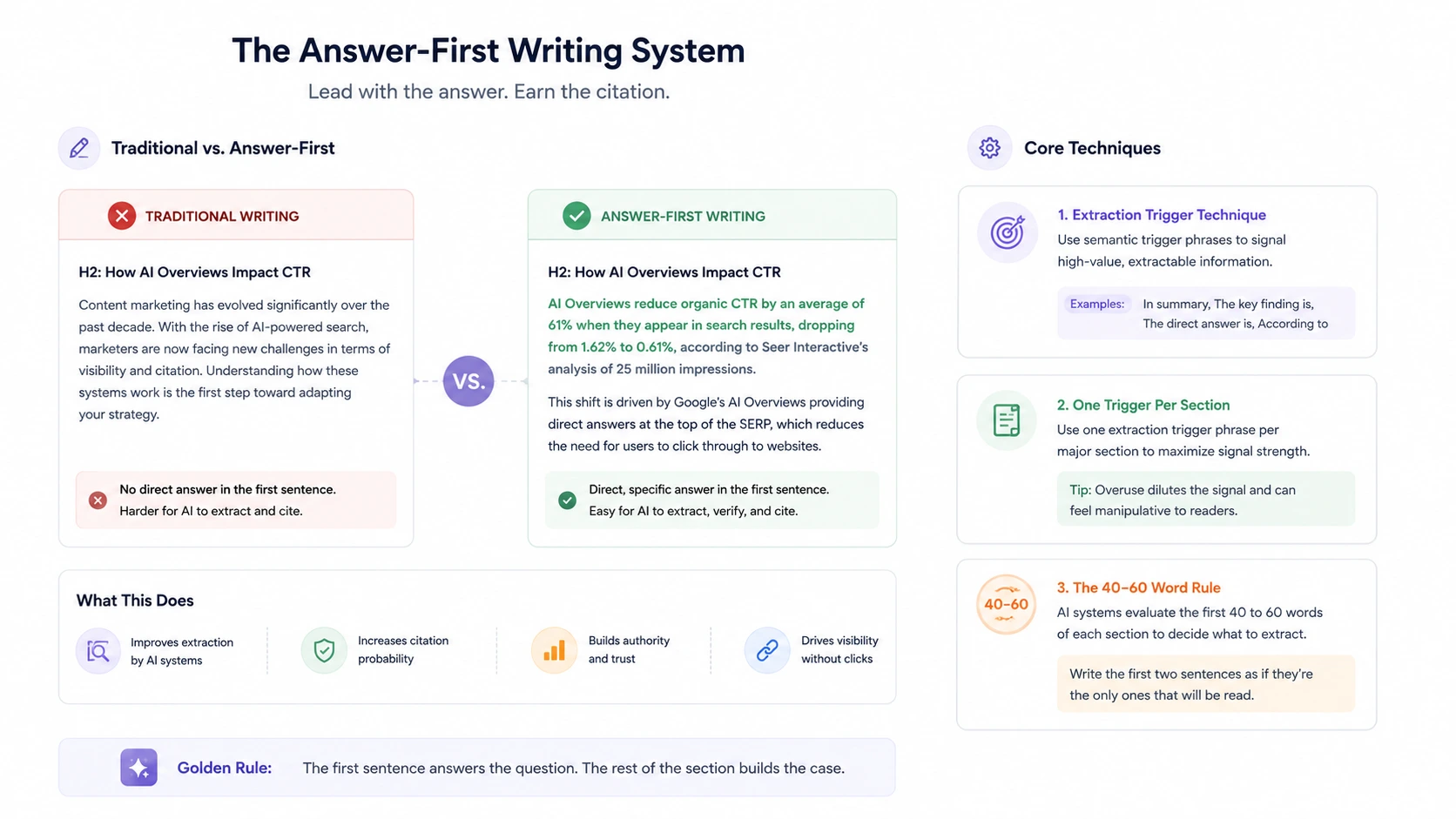
Answer-first writing means the first sentence of every H2 and H3 section directly and completely answers the question implied by that subheading. No preamble. No context-setting. No “in order to understand this, we first need to look at.” The answer comes first. The context, evidence, and elaboration follow.
Here is what the same content looks like written in the traditional way versus the answer-first way.
Traditional: “Content marketing has evolved significantly over the past decade. With the rise of AI-powered search, marketers are now facing new challenges in terms of visibility and citation. Understanding how these systems work is the first step toward adapting your strategy.”
Answer-first: “Content structured with direct answers in the first sentence of every section is cited by AI Overviews 40% more frequently than content that buries answers in context, according to BrightEdge’s 2026 analysis of 250 million content interactions.”
The traditional version contains zero information that an AI extraction system can use to answer a user query. The answer-first version contains a specific, attributable claim in the first sentence that any AI system can extract, verify, and cite. The rest of the section then provides the context and evidence that makes the claim credible.
The Extraction Trigger Technique
Semantic phrases that explicitly label summary information function as extraction triggers for AI systems. When an AI crawler scans a 2,000-word article, a sentence beginning with “In summary,” “The key finding is,” “The direct answer is,” or “According to” immediately signals high-value extractable content, according to Yarnit’s 2026 analysis of AI extraction patterns.
Using one extraction trigger phrase per major section increases the probability that the highest-value sentence in that section gets pulled into an AI-generated response. The key rule is one per section. Overuse dilutes the signal and reads as manipulative to human readers.
Section Length and the 40 to 60 Word Rule
AI systems evaluate the first 40 to 60 words of each section when deciding whether to extract from it, according to AirOps’ analysis of 548,534 pages across 15,000 prompts. This means the entire argument for why a section deserves to be cited must be made within those first 40 to 60 words. A section that spends its first 60 words on background context has effectively made itself invisible to AI extraction regardless of what follows.
The practical implication: write the first two sentences of every section as if they are the only sentences that will ever be read. They often are, by the systems that matter most for your citation strategy.
The Six Structural Techniques That Maximise Citation Probability
These six techniques work across every major AI platform simultaneously. Applying all six to a single piece of content produces the maximum possible citation surface area.
Technique 1 – Question-Format Subheadings
Using the exact phrasing of a user query as an H2 or H3 subheading is the most direct way to match content to a specific retrieval query. When a user asks ChatGPT “what content formats does Google AI Overviews cite most,” a page with an H2 subheading that reads “What Content Formats Does Google AI Overviews Cite Most?” has a structurally higher cosine similarity score to that query than a page with a subheading that reads “Popular Content Formats.”
The query match does not need to be exact. It needs to use the same entities and intent signals. Use Google’s People Also Ask results for your target topic to find the exact phrasing real users are searching. Those are your H2 and H3 subheadings.
Technique 2 – Attributed Statistics Every 150 Words
Content with statistics and citations achieves 30 to 40% higher visibility in AI responses compared to content without them, according to Superlines’ 2026 analysis of AI search statistics. The reason is that LLMs are trained to evaluate source credibility partially based on whether claims are verifiable and attributed. A specific, named statistic is verifiable. A general assertion is not.
The target density is one attributed factual claim every 150 to 200 words throughout the post. The attribution must include the source name and the year. “Studies show that featured snippets correlate with AI citations” is not citable. “SE Ranking’s analysis of 100,000 queries in 2024 found that 99.5% of Google AI Overview citations came from featured snippet or top-3 holders” is citable.
Technique 3 – Entity Completeness
A post about AI Overview citations that fails to mention Google AI Overviews, ChatGPT Search, Perplexity, featured snippets, RAG, cosine similarity, schema markup, AEO, GEO, and llms.txt is not a comprehensive reference document on the topic. LLMs evaluate entity coverage as a proxy for topical expertise. Missing entities signal surface-level coverage and reduce citation probability.
Before publishing any post intended for AI citation, list every major entity relevant to the topic and verify that each one appears accurately and in appropriate context in the content. This is the entity completeness audit and it takes less than ten minutes but meaningfully increases how AI systems evaluate the post’s authority on the topic.
Technique 4 – FAQ Schema Implementation
Pages with valid FAQ schema are two to four times more likely to appear in AI Overviews and featured snippets, according to ResultFirst’s 2026 analysis. FAQ schema tells AI crawlers that specific sections of your content are intended as direct question-and-answer pairs and makes them structurally eligible for direct extraction.
Every FAQ answer must be complete in 40 to 80 words. It must directly answer the question without requiring surrounding context. It must start with the answer, not with a qualification or a restatement of the question. Five to ten well-structured FAQ pairs at the end of every post, implemented with FAQPage JSON-LD schema, is the single most efficient technical addition for improving AI citation probability across all platforms.
Technique 5 – Author Attribution with Visible Credentials
89% of pure AI-generated articles lack an identifiable expert author, compared to 29% of human-written articles, according to Digital Applied’s 2026 analysis of 4,200 articles. AI systems evaluate author attribution as a trust signal. A post with a named author, a linked professional profile, and explicitly stated relevant credentials scores higher on the E-E-A-T dimension that all major AI platforms use to evaluate source credibility.
The author byline must be visible on the page, not only in a separate About page. The credentials must be stated in relation to the topic, not generically. “Written by [Name], who has been covering AI marketing strategy for The Marketing Shelf since 2024” is an E-E-A-T signal. “Written by [Name]” with no context is not.
Technique 6 – Content Freshness Signals
Pages updated within the last 30 days receive 3.2 times more AI citations than older material, according to Digital Bloom’s analysis of over 7,000 AI citations in 2025. ChatGPT specifically injects temporal modifiers including “best,” “top,” “latest,” and “2026” into its sub-queries, meaning it is actively seeking recent content for recommendation queries.
The practical implementation has two parts. First, add a visible “Last Updated” timestamp to every published post. Second, update the post’s statistics, examples, and any time-sensitive claims every 60 to 90 days. A substantive update, meaning new data or a new section, not just a date change, is what triggers the freshness signal that AI crawlers register as a recency indicator.
The Content Formats That Get Cited Most by Platform
Different content formats produce different citation rates on different platforms. Writing the right content type for the platform you are optimising for is as important as applying the structural techniques above.
Formats That Win on Google AI Overviews
How-to guides with numbered steps trigger ordered list snippets and are consistently cited in Google AI Overviews for procedural queries. Each step must be a specific action stated as a verb phrase. “Step 1: Add FAQPage schema to your post” is extractable. “Step 1: Schema implementation” is not.
Definition paragraphs win for “what is” queries. The optimal definition format is a one to two sentence direct definition followed by a three to five sentence explanation, followed by a concrete example. This three-part structure maps directly to what Google’s AI Overview generator looks for when synthesizing an answer to a definitional query.
Comparison tables win for “X vs Y” and “difference between X and Y” queries. Tables are natively extractable, meaning the AI can lift a row or column from the table and present it as a structured answer without reformatting. Every comparison table should have a clear winner stated in the caption or in the paragraph immediately above it.
Formats That Win on ChatGPT and Claude
Encyclopaedic reference content performs best on ChatGPT because Wikipedia, which accounts for 47.9% of ChatGPT citations, sets the standard for the format ChatGPT is trained to prefer. Content that reads like a comprehensive, neutrally framed, well-cited reference document on a specific topic scores higher in ChatGPT’s retrieval evaluation than content written in a more conversational or opinionated style.
Claude performs best with content that demonstrates genuine analytical depth rather than surface-level comprehensiveness. A 1,500-word post that takes one specific angle and develops it with real precision outperforms a 3,000-word post that covers the same topic shallowly. Claude is particularly good at detecting when a source is genuinely knowledgeable versus performing knowledge, making authentic firsthand expertise the most important signal.
Formats That Win on Perplexity
Community-sourced and debate-driven content performs disproportionately well on Perplexity because Reddit accounts for 46.7% of Perplexity’s top citation sources. Content that addresses genuine disagreements and open questions in a niche, rather than only providing settled answers, aligns with the type of discussion content Perplexity is trained to surface.
Expert roundups with named contributors and specific quoted perspectives are highly citable on Perplexity because they contain the kind of attributed human opinion that Perplexity’s audience specifically values over generic advice. Every expert quote must include the expert’s name, their specific credential, and the context in which they made the statement to be citation-eligible.
The Technical Layer – Making Your Content Machine-Readable
Content structure determines whether an AI system wants to cite you. Technical accessibility determines whether it can. Both must be in place for citations to happen.
robots.txt – Allow Every AI Crawler
Every major AI platform operates a dedicated web crawler. GPTBot is ChatGPT’s crawler. Google-Extended is Google’s AI training and retrieval crawler. Anthropic’s crawler serves Claude. PerplexityBot serves Perplexity. Grok’s crawler is operated by xAI. Meta’s crawler is operated by Meta AI. DeepSeek operates its own crawler.
Check your robots.txt file and verify that none of these crawlers are blocked, either by name or by blanket bot-blocking rules. A site that blocks any of these crawlers is invisible to that platform’s AI citation system regardless of content quality. This is a five-minute check that most site owners never perform and that has an immediate impact on citation eligibility.
Core Content Must Render in Plain HTML
46% of ChatGPT bot visits access pages in reading mode, which strips CSS, JavaScript, and images and reads only the plain HTML content of the page, according to SE Ranking’s analysis of ChatGPT browsing behaviour. If your site uses JavaScript to render the core content, meaning the page appears blank when JavaScript is disabled in a browser, AI crawlers may retrieve a page with no readable content regardless of what a human visitor sees.
Test every high-priority page by disabling JavaScript in your browser and checking whether the main content is still visible. If it is not, your site may be invisible to AI crawlers in reading mode.
llms.txt – The Emerging Standard for AI Readability
An emerging standard called llms.txt functions as a structured signal to AI systems about the content available on your domain and how it is organised. It is analogous to a sitemap but specifically designed to communicate content structure to LLM crawlers rather than to traditional search bots.
Maintaining an accurate llms.txt file is identified in multiple 2026 research sources as a factor that LLM crawlers use in source selection. It signals AI-readiness and communicates the scope and structure of your topical coverage in a format that AI systems can parse directly. For a content site building for AI citation, implementing llms.txt is a low-effort technical addition with a meaningful signal benefit.
Page Speed and Core Web Vitals
AI crawlers behave similarly to low-powered browser instances and abandon pages that respond slowly. A page loading in one second converts at three times the rate of a page loading in five seconds and is significantly less likely to be abandoned by AI crawlers before the content is fully read. Core Web Vitals improvements that benefit traditional Google SEO simultaneously improve AI crawler accessibility.
Testing Whether Your Content Is Being Cited – The Weekly Protocol
Writing snippet-friendly content is only half the system. Testing whether it is working closes the loop.
The 20-Query Weekly Test
Build a list of 20 to 30 queries your target audience would type into each major AI platform. Run each query weekly across Google AI Overviews, ChatGPT, Perplexity, and at least one of Grok, Claude, or Meta AI. Note whether The Marketing Shelf is cited in the response, whether it is mentioned without a direct citation, or whether it is absent entirely.
Track this weekly over at least eight weeks before drawing conclusions. Between 40 and 60% of cited sources change month to month across Google AI Mode and ChatGPT, according to Profound’s 2026 analysis of AI citation patterns. Short-term absence does not indicate the strategy is failing. A consistent upward trend in citation frequency over eight weeks confirms it is working.
Testing Across Multiple Models Simultaneously
If you want to test whether a specific piece of content is being retrieved and cited across ChatGPT, Claude, and Gemini simultaneously rather than checking each platform separately, Merlin AI lets you run the same prompt across all three models from one dashboard. This makes the weekly testing protocol significantly faster and gives you a side-by-side view of which model is citing your content, and which is not, which tells you exactly which platform to prioritize for your next round of structural improvements.
Branded Search as the Citation Proxy Metric
Direct citation tracking requires manual testing. Branded search volume is the automated proxy metric that confirms zero-click AI citations are generating brand recall. When your content is cited in an AI Overview or a ChatGPT response, users who do not click through may search your brand name later. A consistent upward trend in branded search volume in Google Search Console, tracked monthly, confirms that AI citations are working even when organic click-through rates do not reflect it.
The Content Audit: Applying This System to Posts You Have Already Published
New content built with this system from scratch is the long-term strategy. Existing content retrofitted with these techniques is the short-term opportunity. Pages that are already ranking in positions 4 through 20 for their target queries are the highest-priority retrofit targets because they are close enough to the top to earn snippet selection with targeted structural improvements.
The Five-Point Retrofit Checklist
For every existing post you want to make snippet-friendly, apply these five changes in this order.
- Rewrite the first sentence of every H2 and H3 section to lead with the direct answer. Do not change the rest of the section. Just move the answer to the first sentence.
- Identify every factual claim in the post that is not currently attributed to a named source and year. Add attribution or remove the claim. Unattributed claims reduce citation probability for the entire post, not just the sentence they appear in.
- Add a FAQ section of five to ten questions at the end of the post with answers of 40 to 80 words each. Implement FAQ Page schema. This is the single highest-ROI addition for improving AI Overview citation probability on an existing post.
- Add or update the author byline to include specific relevant credentials stated in relation to the post’s topic.
- Add a visible last-updated timestamp and update at least one statistic in the post to a 2026 source. Submit to Google Search Console for reindexing immediately after the update.
These five changes can be applied to a single post in under 60 minutes and consistently produce measurable improvements in snippet eligibility within four to six weeks of the update being reindexed.
CONCLUSION:
Snippet-friendly content is not a style choice. It is a structural discipline that determines whether your writing is readable by the systems that now mediate between your content and your audience.
The core principle is simple: AI systems extract the clearest, most direct, most factually grounded answer available for any given query. Content that leads with the answer, attributes every claim, covers every relevant entity, and is technically accessible to every major crawler will be extracted and cited more frequently than equivalent content that is well-written but structurally opaque to AI retrieval.
The 99.5% overlap between AI Overview citations and featured snippet holders, documented by SE Ranking across 100,000 queries, is the most important number in this post. It means the path to being cited by every AI platform, Google AI Overviews, ChatGPT, Perplexity, Claude, Grok, DeepSeek, and Meta AI, runs through the same place. Write content that earns featured snippets. The AI citations follow.
Apply the answer-first technique to every section. Add attributed statistics every 150 words. Use question-format subheadings that mirror real user queries. Implement FAQ schema. Make your author attribution credible and visible. Update content every 60 to 90 days. Allow every AI crawler in your robots.txt. Test your citation frequency weekly across every major platform.
This system is what gets solo content creators cited alongside established sites in AI-generated answers. Not domain authority. Not backlinks. Structure, specificity, and consistency.
FAQs
Q: What percentage of Google AI Overview citations come from featured snippet holders?
A: 99.5% of sources cited in Google AI Overviews had previously held a featured snippet or a top-3 organic position, according to SE Ranking’s analysis of 100,000 Google queries conducted in 2024 and confirmed in 2026. This means that earning a featured snippet is the most reliable path to being cited in Google AI Overviews, because both signals rely on the same underlying content quality and structure indicators that Google’s retrieval systems use to evaluate citation-worthiness.
Q: How do you write content that gets cited by AI Overviews?
A: To write content that gets cited by AI Overviews, apply six specific structural techniques: lead every section with a direct complete answer in the first sentence, include one attributed statistic from a named source every 150 to 200 words, use question-format H2 and H3 subheadings that mirror exact user query phrasing, implement FAQPage schema with answers of 40 to 80 words each, include a named author byline with credentials relevant to the topic, and update content with current-year data every 60 to 90 days. Pages with valid schema markup are two to four times more likely to appear in AI Overviews according to ResultFirst’s 2026 analysis.
Q: What is the difference between how ChatGPT and Perplexity select citation sources?
A: ChatGPT uses Bing’s index as its live retrieval layer, cites only 15% of pages it retrieves, and favours encyclopaedic reference content modelled on Wikipedia’s comprehensive neutral style. Perplexity averages 21 citations per response, significantly more than ChatGPT, and favours content with question-format subheadings, cited research, and named expert sources. Reddit accounts for 46.7% of Perplexity’s top citation sources. Only 11% of domains are cited by both ChatGPT and Perplexity, making platform-specific optimisation necessary for comprehensive AI search visibility across both.
Q: What technical settings affect whether AI platforms can cite your content?
A: Four technical settings directly affect AI citation eligibility. Your robots.txt file must allow the crawlers for each platform including GPTBot for ChatGPT, Google-Extended for Google AI, PerplexityBot for Perplexity, and crawlers for Anthropic, xAI, Meta, and DeepSeek. Core content must render in plain HTML without requiring JavaScript because 46% of ChatGPT bot visits access pages in reading mode that strips JavaScript. An llms.txt file signals content structure to AI crawlers and is identified as a source selection factor in 2026 research. Page speed must be sufficient to prevent crawler abandonment before content is fully read.
Q: How do you test whether your content is being cited by AI platforms?
A: Build a list of 20 to 30 queries your target audience would search on each major AI platform. Run each query weekly across Google AI Overviews, ChatGPT, Perplexity, Claude, and Grok, and note whether your brand or content is cited. Track citation frequency over at least eight weeks before drawing conclusions, as between 40 and 60% of cited sources change month to month across major platforms according to Profound’s 2026 analysis. Track branded search volume in Google Search Console as a proxy metric confirming that zero-click AI citations are generating brand recall even without direct click-through attribution.