


You built the road. Nobody is driving on it.
That is what zero-click search feels like in 2026. Your content ranks. Google extracts an answer from it. The user gets what they came for. Nobody clicks. Your analytics registers nothing. Your affiliate link earns nothing. Your email opt-in triggers nothing.
68% of all Google searches now end without a user clicking through to any website, according to Similarweb’s June 2026 zero-click study conducted with Rand Fishkin of SparkToro. Ten years ago that number was 45%.
The acceleration in the last two years is driven almost entirely by the rollout of Google AI Overviews, which now appear in 48% of all searches and cut organic click-through rates from 1.62% to 0.61% when they are present, a 61% reduction according to Seer Interactive’s analysis of 25 million impressions.
For every 1,000 Google searches in the United States, only around 360 result in a visit to a website that is not owned by Google or paid for through Google Ads, according to Datos and SparkToro research from early 2026.
The instinct is to panic. The practical response is to reframe.
Zero-click search does not mean your content has zero value. It means the metric you used to measure that value, the click, is decoupling from the actual business outcome you care about.
A user who reads a Google AI Overview that says “according to The Marketing Shelf, AI referral traffic converts at 14.2% compared to Google organic at 1.76%” has encountered your brand in a credible context, associated with a specific claim, without visiting your site. If that person is the right buyer, they will search your brand name later.
This post is the monetization strategy for the zero-click world. Not how to get more clicks in a world that is structurally reducing them. How to build a content and revenue operation that is specifically designed to generate outcomes when users are not clicking through to your site.
Understanding the Zero-Click Landscape – The Numbers You Need to Know
Before building a monetization strategy for zero-click search, the full picture of where search traffic is going matters.
The Three Surfaces Absorbing Your Clicks
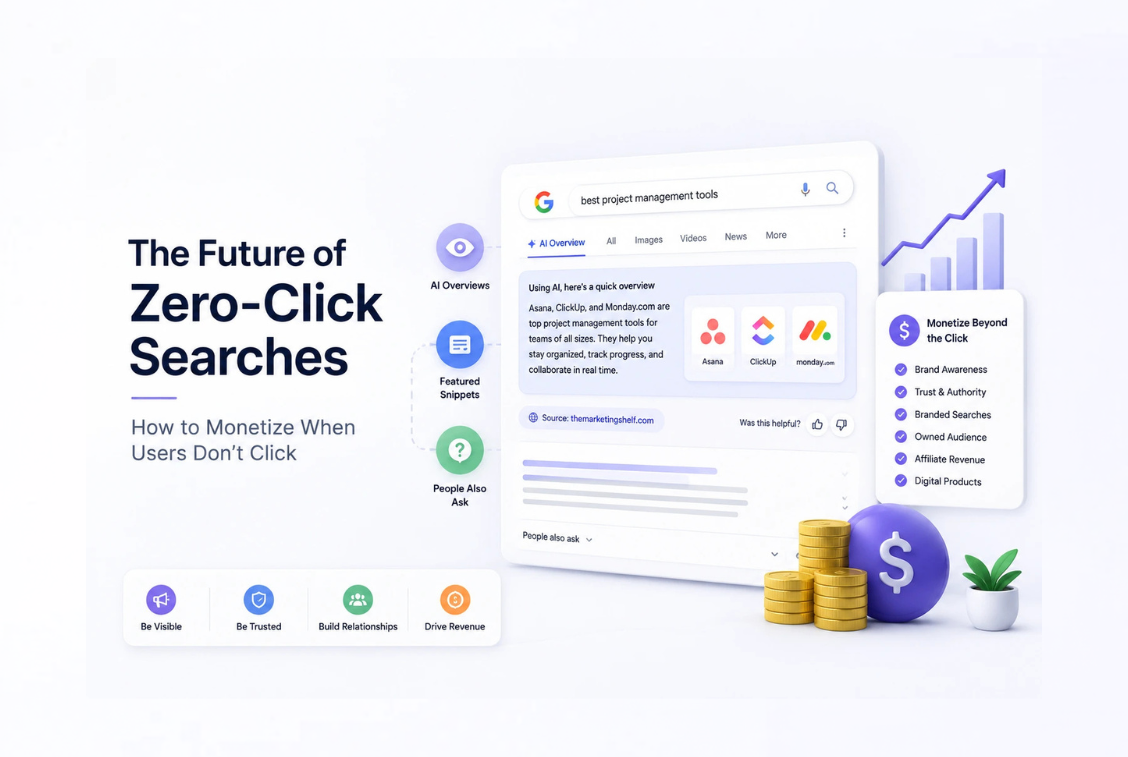
Three distinct surfaces are extracting text from your content and presenting it without requiring a click. Understanding each one tells you exactly where to optimize.
- Google AI Overviews appear in 48% of searches as of February 2026, up 58% year over year, peaking at 83% in the education sector, according to BrightEdge’s February 2026 measurement. When an AI Overview appears, organic CTR drops from 1.62% to 0.61%. The Overview absorbs the click by answering the question before the user needs to scroll to the traditional results.
- Featured snippets and People Also Ask boxes to have operated on the same principle since 2014 but now work in combination with AI Overviews to create multiple zero-click layers on the same SERP. A query can simultaneously trigger a featured snippet, a PAA box, and an AI Overview, creating up to three surfaces that answer the question before any traditional organic result is visible.
- Agentic search is the newest and most significant frontier. Zero-click search means a human searched without clicking. Agentic search means a human did not search at all: they delegated the task to an AI agent that searched, researched, compared, and in some cases transacted on their behalf. In an agentic search, your content may be retrieved, evaluated, and acted on without any human ever being aware of it. The click is not missing because the user did not want to click. The click is missing because there was no human in the loop to click.
The Query Types Most Affected
Not every query type is equally affected by zero-click rates. Understanding which of your content’s target queries are most exposed tells you where to prioritize your monetization shift.
- Informational queries, the “what is” and “how to” queries that drive most content marketing traffic, have the highest zero-click rates. These are the queries where AI Overviews are most capable of generating a complete, satisfying answer directly on the SERP. The educational and research-oriented content that most content sites produce in highest volume is the most structurally exposed.
- Transactional and navigational queries remain more resistant to zero-click. A user searching “buy Holo AI” or “The Marketing Shelf blog” is expressing a specific intent to reach a destination that AI cannot replace. These query types are more protected and represent a strategic priority for content that needs to drive clicks.
- Commercial investigation queries, the “best tool for X” and “X vs Y” comparisons, sit in the middle. They are increasingly attracting AI Overviews, but the depth of comparison required means users are more likely to click through for detailed human-reviewed analysis than for a pure information query.
The Zero-Click Monetization Framework – Four Pillars
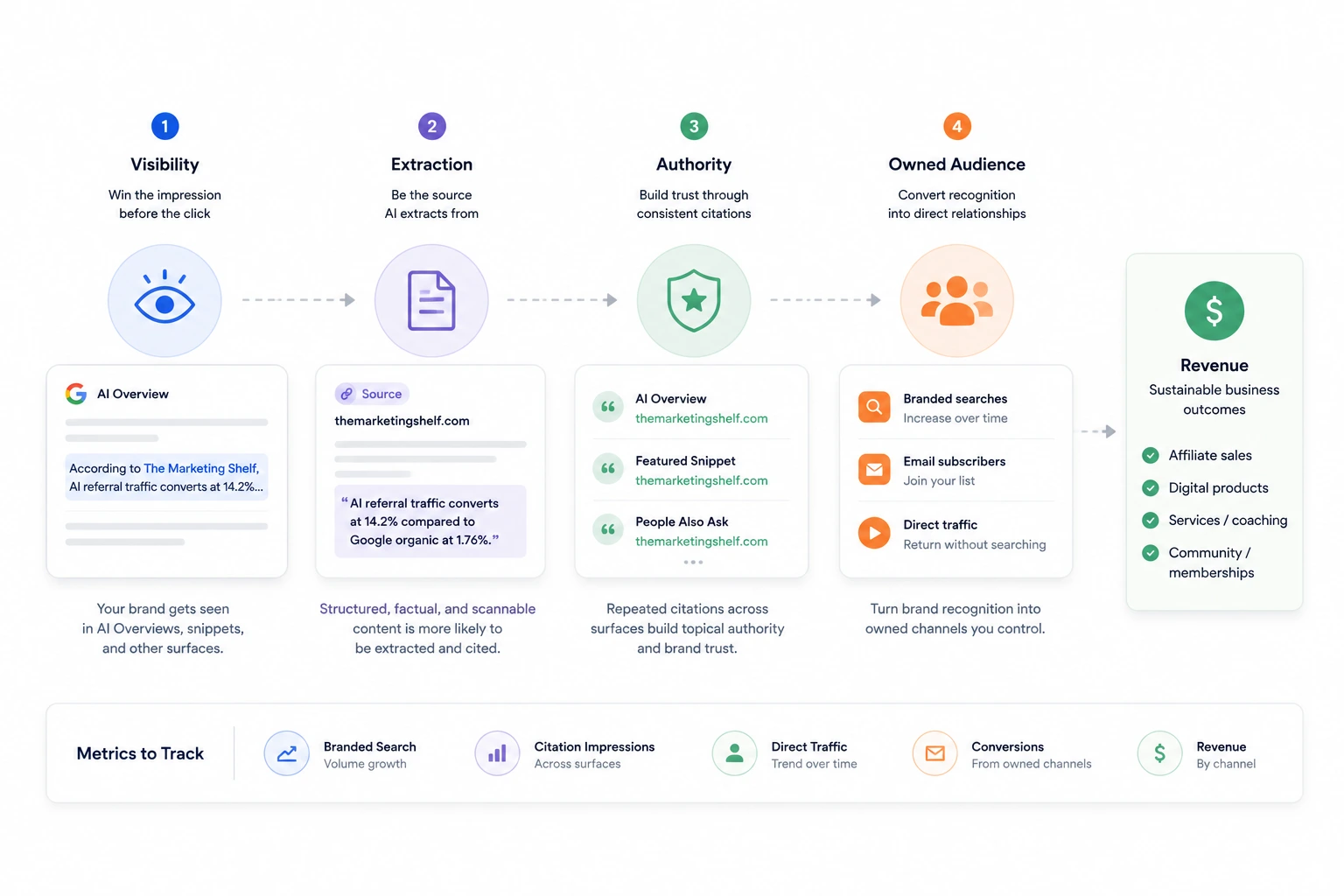
The brands winning in the zero-click era are not trying to recover their lost clicks. They are measuring and monetizing a different set of outcomes. The framework has four pillars: visibility, extraction, authority, and owned audience. Each one compounds the others.
Pillar 1 – Visibility: Win the Impression Before the Click
The billboard does not send people to your website either, but nobody questions whether billboards build brands. A SERP citation works the same way. The brand that appears in an AI Overview or a featured snippet for a query your target audience is asking has made an impression, established a credibility association, and planted a brand name in working memory, all without a click.
The measurement shift that reflects this reality is tracking branded search volume alongside traditional click metrics. A user who encounters your brand in an AI Overview and does not click may return three days later and search your brand name directly. That branded search is the deferred conversion from the zero-click impression. Brands building zero-click strategies that measure branded search lift as a KPI are capturing this outcome. Brands measuring only sessions are not.
The measurement shift that reflects this reality is tracking branded search volume alongside traditional click metrics. A user who encounters your brand in an AI Overview and does not click may return three days later and search your brand name directly. That branded search is the deferred conversion from the zero-click impression. Brands building zero-click strategies that measure branded search lift as a KPI are capturing this outcome. Brands measuring only sessions are not.
Citation share, meaning how often your brand or content is referenced across Google AI Overviews, ChatGPT, and Perplexity for your target queries, is the new share of voice metric. It captures the impressions your content is generating in AI search surfaces where click attribution is structurally unavailable. Running a monthly tracking protocol across your 20 to 30 most important queries in all three platforms, and measuring citation frequency over time, gives you the data to demonstrate zero-click ROI to anyone who asks.
Citation share, meaning how often your brand or content is referenced across Google AI Overviews, ChatGPT, and Perplexity for your target queries, is the new share of voice metric. It captures the impressions your content is generating in AI search surfaces where click attribution is structurally unavailable. Running a monthly tracking protocol across your 20 to 30 most important queries in all three platforms, and measuring citation frequency over time, gives you the data to demonstrate zero-click ROI to anyone who asks.
Pillar 2 – Extraction: Structure Your Content to Be Cited
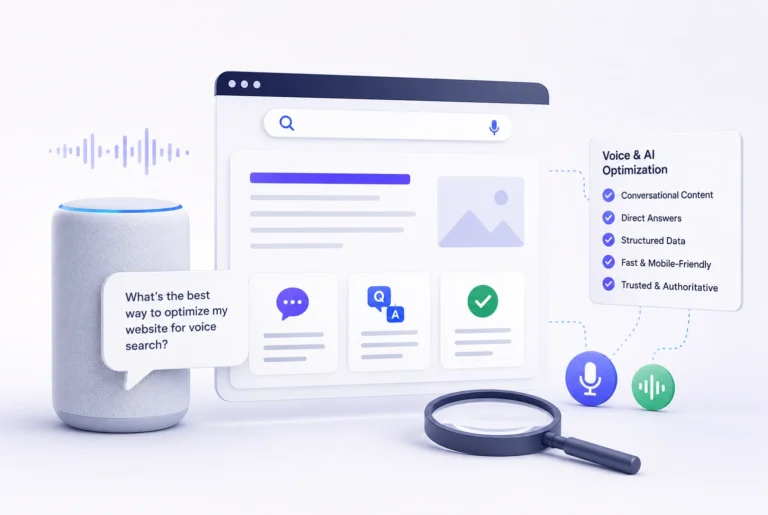
Being indexed is no longer sufficient. Your content needs to be structured so that AI systems can extract specific, quotable, factually grounded answers from it and surface them in AI Overview citations, featured snippets, and AI chat responses.
The content that gets extracted and cited shares five structural characteristics. It places a direct, complete answer to the page’s primary question within the first 150 words of each section. It includes attributed statistics every 150 to 200 words, meaning every factual claim is tied to a named source and a date.
It uses question-format H2 and H3 subheadings that mirror the exact phrasing of the queries the content targets. It implements FAQ schema so that AI systems can identify and extract question-answer pairs directly. And it covers every entity relevant to the topic in a way that signals comprehensive subject expertise rather than surface-level coverage.
This structural approach is GEO, Generative Engine Optimisation, applied to zero-click content strategy. The goal is not ranking in a traditional list. The goal is being extracted into the answer itself. A brand that is extracted into the answer earns the impression without requiring the click, and those impressions compound into brand authority over time.
Pillar 3 – Authority: Make Your Brand the Cited Source
The specific mechanism by which zero-click generates downstream revenue is brand authority. A user who repeatedly encounters a brand cited in authoritative AI answers develops a credibility association with that brand that influences purchase decisions when they eventually reach the buying stage.
Agencies and brands using this approach report that being cited in 20 or more AI Overviews for target queries correlates with a measurable lift in branded search volume and direct traffic over a 90-day window, according to 2Point Agency’s 2026 client analysis. The impression creates the brand recall. The brand recall drives the later click.
Original research is the most powerful authority-building content in the zero-click era. A statistic that exists only on your site creates a mandatory citation. When an AI system wants to include that data point in an answer, it must attribute it to you.
This gives your brand a citation that cannot be replicated by any competitor regardless of their domain authority. Publishing one original research piece per quarter, built around a specific proprietary data point from your own experience or audience, creates a citation anchor that compounds over time.
Pillar 4 – Owned Audience: Monetize Outside the SERP
The most robust zero-click monetization strategy does not rely on search at all at the conversion stage. It uses search for discovery and brand authority, then converts within owned channels where zero-click dynamics do not apply.
An email subscriber is not subject to zero-click rates. A newsletter reader is not subject to AI Overview absorption. A community member is not subject to CTR fluctuations driven by Google’s feature rollout decisions. Building owned audience channels alongside your search presence creates a monetization layer that is structurally insulated from zero-click dynamics.
The practical implication is investing in email capture as aggressively as you invest in ranking. Every high-traffic page that currently drives zero email opt-ins is a zero-click exposure that is also failing to build a protected revenue channel.
The monetization path in the zero-click era runs from SERP citation to brand recall to direct visit or branded search to email capture to owned audience to affiliate conversion or product sale. Skipping the email capture step means the entire journey from SERP impression to revenue depends on the user remembering to come back, which most of them do not.
The Zero-Click Monetization Comparison Table
The table below maps each content strategy to its click dependency, its primary monetization mechanism in the zero-click era, and its LLM citation potential. This is designed as a decision framework for prioritizing where to invest your content production effort.
| Content Type | Click Dependency | Zero-Click Monetization Mechanism | LLM Citation Potential |
| Informational blog posts | High | Brand impressions, GEO citations, branded search lift | High when structured with direct answers and attributed stats |
| Original research and proprietary data | Low | Mandatory citations drive authority, branded search | Very high – AI must cite the source to use the data |
| Comparison and vs articles | Medium | Commercial investigation clicks, affiliate conversions | Medium – AI cites structured comparisons with clear winners |
| FAQ pages with schema | Low | Featured snippet ownership, AI Overview citations | Very high – FAQ schema is the most extractable format |
| Email capture lead magnets | Zero | Email list growth, owned audience monetization | None directly but feeds the owned channel that converts |
| Case studies with documented results | Low | Trust signals, social proof, branded search lift | High – specific documented outcomes are cited as evidence |
| Tool reviews with transparent pricing | Medium | Affiliate conversions from commercial intent clicks | Medium-high – specific pricing data gets extracted |
| Newsletter content | Zero | Direct audience monetization, affiliate, sponsorships | None in search but high in email-to-purchase conversion |
How to Optimize Content Specifically for LLM Citation – The Technical Layer
This section goes beyond standard GEO advice and addresses specifically how to structure content so that large language models, including ChatGPT, Claude, Gemini, and Perplexity, use it to answer user queries.
Write for the Inference Layer, Not the Ranking Algorithm
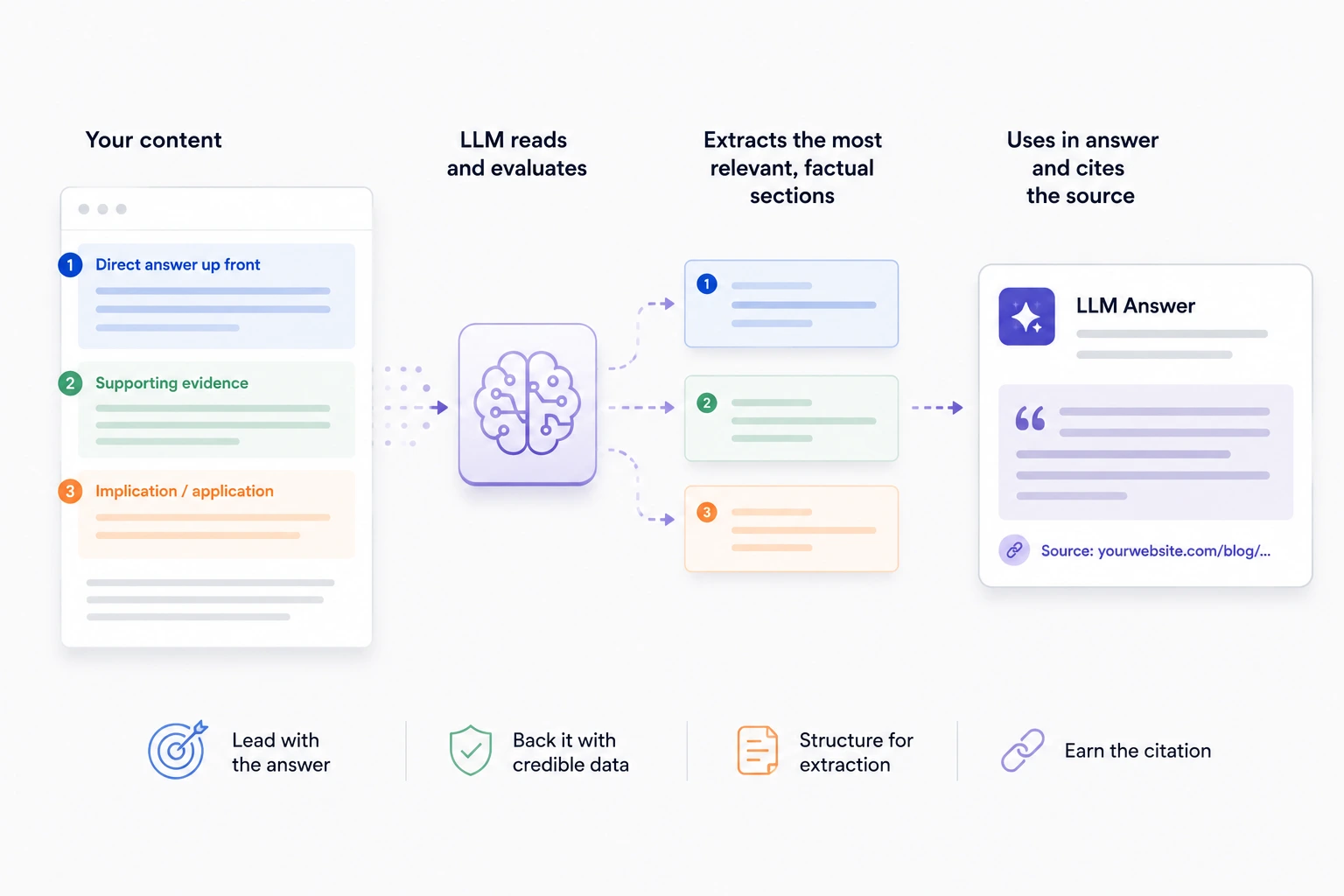
Traditional SEO writes for a ranking algorithm that scores relevance based on keyword signals, backlinks, and authority metrics. LLM citation writes for an inference layer that evaluates content based on how cleanly it can extract a coherent, factually grounded, contextually appropriate answer from the page.
The practical difference in writing style is significant. A piece written for traditional SEO might open a section with background context, build toward the main point, and conclude with a key takeaway at the end.
A piece written for LLM citation opens with the main point stated as a direct, complete sentence, provides the supporting evidence in the next two to three sentences, and closes the section with a clear implication or application. The answer comes first, every time, in every section.
LLMs retrieve candidate pages, score them by cosine similarity to the query, and extract from the highest-scoring sections. A section that buries its answer under context has a lower similarity score for the specific query the user asked than a section that leads with the direct answer. Leading with the answer is not just a readability choice. It is a citation optimisation choice.
Factual Density Is the Strongest LLM Citation Signal
Content that contains attributed statistics, named research sources, and specific quantified claims at regular intervals outperforms content that relies on general assertions in LLM citation patterns.
Content with statistics and citations achieves 30 to 40% higher visibility in AI responses compared to content without them, according to Superlines’ 2026 analysis of AI search statistics.
The reason is straightforward. LLMs are trained to synthesise credible information. Content that contains verifiable, attributed data points is evaluated as more credible than content that makes equivalent claims without attribution. The specific density target is one attributed factual claim every 150 to 200 words throughout the post. This is not about padding the post with statistics. It is about replacing unattributed assertions with verified claims.
“Zero-click searches are increasing” becomes “Zero-click searches now represent 68% of all Google searches, according to Similarweb’s June 2026 clickstream analysis.” Both sentences convey the same information. One is extractable and citable. The other is not.
Entity Completeness Signals Topical Authority to LLMs
LLMs understand content through entities: the specific people, organisations, tools, concepts, and data points mentioned in a piece and how they relate to each other. A post about zero-click search that naturally and accurately references Google AI Overviews, Similarweb, SparkToro, BrightEdge, GEO, AEO, featured snippets, PAA boxes, and CTR data signals comprehensive subject expertise to LLM citation systems.
A post that mentions only one or two of these entities signals surface-level coverage and is less likely to be retrieved as a comprehensive source for queries on the topic. Before publishing any piece of content intended for LLM citation, audit the entity coverage. Every major entity relevant to the topic should appear naturally in the content. Missing entities are opportunities the content is leaving on the table.
llms.txt – The Emerging Technical Standard
An emerging technical standard called llms.txt functions as a structured signal to AI systems about what content is available on your domain and how it should be interpreted. It is roughly analogous to a sitemap but specifically designed to communicate your site’s content structure to LLM crawlers.
Maintaining an accurate llms.txt file signals AI-readiness and is identified in 2026 research as a factor that LLM crawlers use in source selection. Combined with ensuring GPTBot and other AI crawlers are permitted in your robots.txt file and that your core content renders in plain HTML without JavaScript dependency, the technical layer of LLM citation optimisation is achievable for any content site without advanced development resources.
Practical Monetization Strategies That Work Without Clicks
Sponsorships and Brand Partnerships Based on Impression Metrics
If your content is being cited in AI Overviews and appearing in featured snippets for high-volume queries, you have documented reach that does not show up in your Google Analytics session count. Brands that sponsor newsletters and content sites in 2026 increasingly accept impression-based and citation-based metrics alongside traditional traffic data.
Building a media kit that documents your AI citation frequency alongside your traffic, email subscriber count, and social reach gives you a more complete picture of your actual audience reach and makes the case for sponsorship pricing that reflects zero-click impression value.
Email-First Monetization Architecture
The affiliate marketing and content monetization model that survives the zero-click era is the one built around email, not around click-through rates from search. An email subscriber who found your site through a branded search, triggered by a zero-click impression three weeks earlier, is a fundamentally different and more valuable relationship than an anonymous visitor who arrived from an organic click and bounced.
Building this architecture requires investing in lead magnet creation specifically for your highest-impression, lowest-CTR informational pages. These are the pages Google’s AI is already treating as authoritative enough to extract answers from. They are not converting organic clicks because the AI is absorbing them. But they can convert email subscribers if the lead magnet offer is relevant and the opt-in placement is at peak engagement rather than at the bottom of the page.
Scaling Content for GEO and Citation at Volume
The economics of the zero-click era reward volume of high-quality, structured, citation-ready content more than ever before because each piece of content that earns an AI citation is a brand impression that compounds without requiring ongoing traffic maintenance. A post that earns 50 AI Overview citations per week is delivering 50 brand impressions per week indefinitely, without any additional investment after publication.
Community and Direct Audience Models
The most structurally protected monetization model in the zero-click era is the one that operates entirely outside search. A paid community, a subscription newsletter, a cohort course, or a direct membership bypasses zero-click dynamics entirely because it monetizes an audience relationship rather than a search traffic flow.
Building toward a direct audience model does not mean abandoning SEO. It means using SEO and GEO for top-of-funnel discovery and brand authority, and building the owned audience channels that convert the impressions SEO generates into a revenue relationship that search engine feature changes cannot disrupt.
Measuring Zero-Click Success – The New KPI Stack
Traditional SEO KPIs measured click-dependent outcomes. The zero-click era requires an expanded KPI stack that captures value being generated by content that users are not clicking through to.
The Two-Track Measurement System
Run two measurement tracks simultaneously, reviewed on the same monthly cadence.
Track one covers traditional search performance: organic sessions, keyword rankings, click-through rates per page category, and email opt-in rate by high-traffic page. These metrics remain relevant because clicks still happen, especially for commercial and navigational queries, and the trend in CTR by query type tells you which parts of your content strategy are most exposed to continued zero-click acceleration.
Track two covers zero-click performance: branded search volume trend, direct traffic trend, AI citation frequency across ChatGPT, Perplexity, and Google AI Mode for your 20 to 30 most important queries, and email list growth rate. These metrics capture the impressions and authority that zero-click content is generating without showing up in session counts.
The relationship between the two tracks tells the full story. If organic sessions are flat or declining while branded search volume and direct traffic are growing, your zero-click content strategy is working: search impressions are building brand recall that converts outside the SERP. If both tracks are declining simultaneously, the content is neither ranking nor generating impressions worth measuring.
Citation Share as the New Share of Voice
Citation share is the zero-click equivalent of keyword ranking. It measures how often your brand is referenced when your target queries are submitted to AI search platforms. A brand cited in response to 15 of its 30 target queries in ChatGPT has a 50% citation share for that query set, which is a meaningful, trackable metric that reflects your presence in the search environment your audience actually uses.
Tracking citation share monthly, by platform and by query cluster, gives you the data to demonstrate that zero-click content investment is producing measurable brand presence even when click-through rates do not reflect it. It is the metric that bridges the gap between traditional traffic measurement and the new reality of how content generates value in 2026.
CONCLUSION:
Zero-click search is not going to reverse. The 68% figure from Similarweb’s June 2026 study will be higher in twelve months. The expansion of Google AI Overviews across more query types, combined with the growth of agentic search that removes the human from the loop entirely, is a structural trend that content strategies must account for, not wait out.
The monetization model that survives this environment has four components working together. Visibility through SERP citations and AI impressions that build brand authority without requiring clicks. Extraction through content structured for LLM citation with direct answers, attributed statistics, and entity completeness. Authority through original research and consistent topical coverage that makes citation mandatory rather than optional. Owned audience through email and direct channels that monetize brand recall generated by zero-click impressions.
The click was never the goal. The click was the most convenient proxy for measuring whether content was generating business value. In 2026, that proxy is breaking down. The brands that replace it with a measurement framework that captures impression value, citation share, branded search lift, and owned audience growth are the ones that will demonstrate that content marketing still works, even when users do not click.
Build for citations. Build for impressions. Build for owned audiences. The clicks will follow where they can, and the revenue will come from somewhere better where they cannot.
FAQs
Q: What percentage of Google searches end without a click in 2026?
A: 68% of all Google searches end without a click to any external website, according to Similarweb’s June 2026 clickstream analysis conducted with Rand Fishkin of SparkToro. This is up from 45% ten years ago, with the steepest acceleration in the last two years driven by the expansion of Google AI Overviews. AI Overviews now appear in 48% of all searches and cut organic click-through rates from 1.62% to 0.61% when they are present, a 61% reduction according to Seer Interactive’s analysis of 25 million impressions.
Q: How do you monetize content when users are not clicking?
A: Monetizing in the zero-click era requires shifting from click-dependent revenue models to a four-pillar framework: visibility through SERP citations and AI impressions that build brand authority, extraction through content structured for LLM citation, authority through original research that creates mandatory citations, and owned audience through email and direct channels that monetize brand recall generated by zero-click impressions. The monetization path runs from SERP citation to brand recall to branded search to email capture to affiliate conversion or product sale, replacing direct click-through at the conversion stage.
Q: What content types have the lowest click dependency in 2026?
A: Original research with proprietary data has the lowest click dependency because AI systems must cite the source to use the data, generating mandatory citations that build authority without requiring clicks. FAQ pages with schema markup are also low click-dependency because they generate featured snippet and AI Overview citations. Email capture lead magnets have zero click dependency because they monetize within an owned channel. Case studies with documented results have low click dependency because specific outcomes are cited as evidence by AI systems. By contrast, informational blog posts have the highest click dependency and are most exposed to zero-click absorption.
Q: How do you optimise content for LLM citation specifically?
A: To optimise content for LLM citation, place a direct complete answer to the section’s primary question in the first sentence of every section rather than building to the answer. Include one attributed factual claim every 150 to 200 words, meaning every statistic tied to a named source and date. Use question-format H2 and H3 subheadings that mirror exact query phrasing. Implement FAQ schema. Cover all major entities relevant to the topic to signal comprehensive subject expertise. Ensure GPTBot is permitted in your robots.txt file and that core content renders in plain HTML without JavaScript dependency. Maintain an llms.txt file as a structured signal to AI crawlers about your content structure.
Q: How do you measure zero-click content performance?
A: Zero-click content performance requires a two-track measurement system. Track one covers traditional search performance: organic sessions, keyword rankings, and click-through rates by page category. Track two covers zero-click performance: branded search volume trend, direct traffic trend, AI citation frequency across ChatGPT, Perplexity, and Google AI Mode for your target queries, and email list growth rate. Citation share, how often your brand is referenced when target queries are submitted to AI platforms, is the primary zero-click KPI and the metric that demonstrates content is generating brand impressions even when click-through rates do not reflect it.