


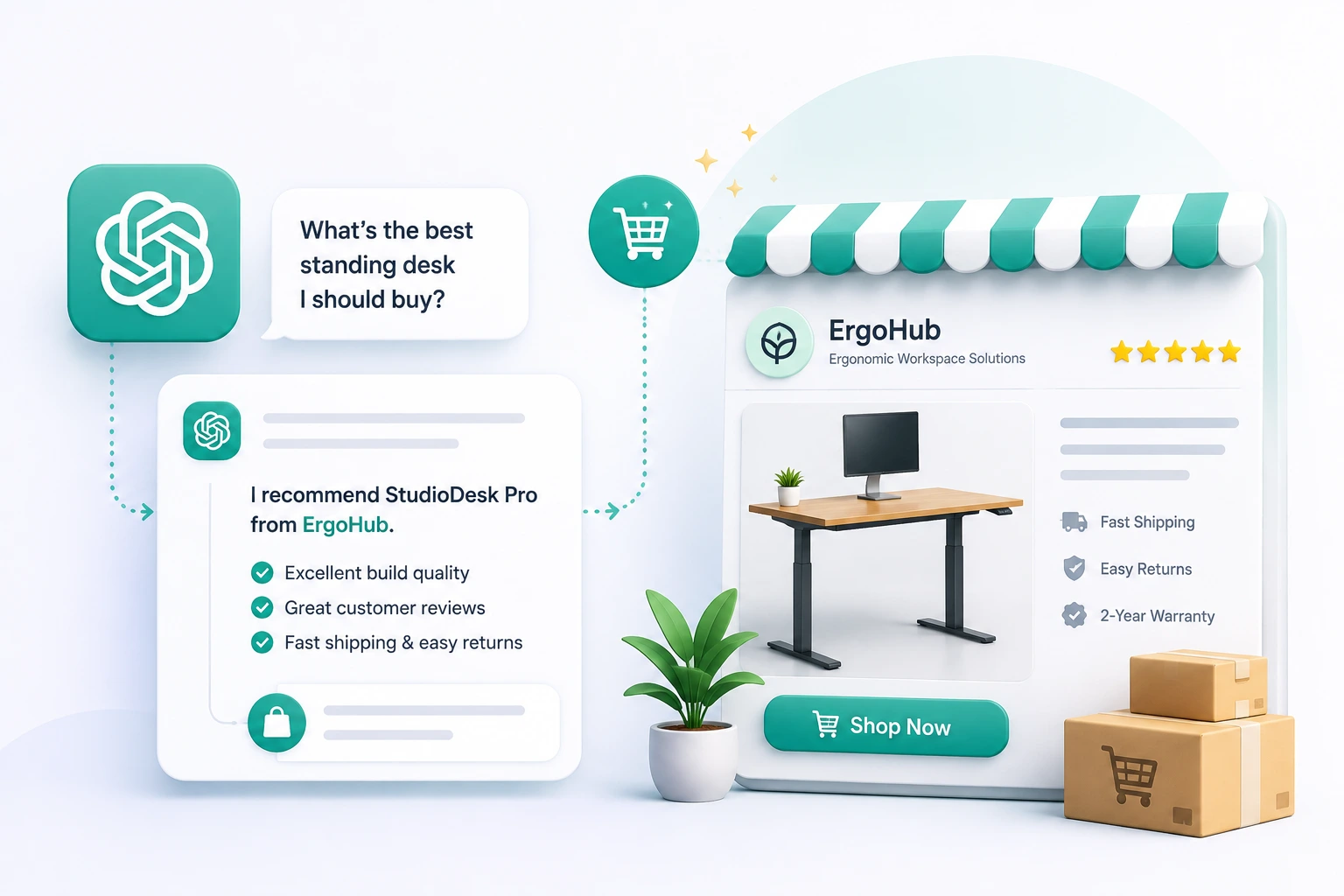
ChatGPT now processes 50 million shopping queries every day, making it one of the fastest-growing product discovery surfaces in e-commerce, according to alhena.ai’s July 2026 analysis of ChatGPT Shopping activity. Unlike Google Ads, there is no paid placement in ChatGPT recommendations. Every recommendation is earned, not bought.
This matters more than most shop owners realise. AI-attributed referral orders on Shopify grew 11 times year over year in early 2026, according to FactoryJet’s June 2026 analysis citing Shopify’s own data.
With 40% of Bing searches now going to Microsoft Copilot and 31% of Google product research bypassing traditional search for Gemini, AI recommendation visibility is no longer optional for shops that depend on online discovery, according to cited.so’s May 2026 analysis of AI shopping behaviour.
The good news is that the path to ChatGPT recommendations is specific and actionable. It runs through three distinct systems working together: a structured product feed submitted directly to OpenAI’s merchant program, a clean content and schema layer on your website that AI systems can read and extract from, and a review and mention presence across the third-party platforms that ChatGPT sources when forming recommendations.
This post covers all three systems with the specific steps required for each, the exact URL where you register your store, what the product feed needs to contain, which schema types matter most, and which review platforms ChatGPT weights most heavily. The recommendations apply to Shopify and Etsy stores, WooCommerce stores, and content sites or service businesses that want AI recommendation visibility even without a traditional product catalog.
How ChatGPT Shopping Actually Works: The Mechanism Behind Recommendations
ChatGPT selects product and shop recommendations through a specialised shopping model that uses two data sources simultaneously: structured product feeds submitted directly by merchants and third-party review and authority signals gathered from across the web. Understanding both sources tells you exactly where to invest your optimisation effort.
The ChatGPT Shopping Model
A specialised variant of GPT-5 mini, trained specifically for shopping tasks, powers ChatGPT Shopping Research. This model achieves 52% product accuracy on complex multi-constraint queries compared to 37% for standard ChatGPT Search, according to OpenAI’s own benchmarks cited in HubSpot’s April 2026 analysis.
The shopping model uses semantic reasoning rather than keyword matching, meaning it evaluates whether a product genuinely fits a buyer’s described need rather than simply matching search terms.
ChatGPT also has a direct integration with Google Shopping data. ChatGPT sources 83% of its carousel product recommendations from Google Shopping via shopping query fan-outs, according to Athos Commerce’s March 2026 analysis citing Search Engine Land’s original research. This means Google Merchant Center has become a critical infrastructure layer for ChatGPT Shopping visibility even for merchants not yet enrolled directly in OpenAI’s merchant program.
The Two-Mechanism System
ChatGPT operates through two distinct mechanisms when generating recommendations. The training data mechanism uses information incorporated during model training to recommend brands and products it has encountered across the web. The browsing mode mechanism uses real-time web retrieval to gather current information about products, pricing, and availability when a user submits a shopping query.
For training data visibility, the strategy is building brand presence across authoritative external sources so that ChatGPT has encountered your brand in credible contexts during training. For browsing mode visibility, the strategy is ensuring your product pages are structured for clean extraction and that your merchant feed is live and current. Both mechanisms require separate but complementary actions.
Instant Checkout and the Agentic Commerce Protocol
OpenAI’s Merchant Program includes Instant Checkout, allowing users to purchase products directly within ChatGPT without visiting the merchant’s website. The Agentic Commerce Protocol, or ACP, powers this in-chat purchasing using integrations with verified payment processors including Stripe, according to Lengow’s January 2026 analysis of the ChatGPT product feed specification.
Shopify and Etsy stores are already auto-enrolled in ChatGPT’s commerce ecosystem with no separate application required, according to TJ Robertson’s July 2026 product feed guide. WooCommerce, BigCommerce, and all other platforms must apply separately through the merchant program. Instant Checkout currently supports single-item purchases as of mid-2026, with multi-item cart support confirmed on OpenAI’s roadmap for later in 2026, according to TJ Robertson’s analysis.
System 1: The ChatGPT Merchant Program and Product Feed
Submitting a product feed directly to OpenAI’s merchant program is the most direct path to appearing in ChatGPT Shopping recommendations. It puts your product data under merchant control rather than leaving it to passive crawling, which means your pricing, availability, and descriptions are always accurate.
How to Register Your Store
Visit chatgpt.com/merchants and create a merchant account. There is no fee to join. OpenAI charges a small transaction fee on each sale made through Instant Checkout rather than a subscription or listing fee, according to TJ Robertson’s July 2026 guide to product feed setup. The program is currently US-only, with global expansion planned by OpenAI, according to the same source.
Shopify and Etsy store owners are already auto-enrolled and do not need to submit a separate application. WooCommerce and BigCommerce store owners must complete the merchant program application. Once enrolled, you submit a product feed that ChatGPT uses as its primary source of truth for all product data displayed in shopping recommendations.
What Your Product Feed Must Contain
The ChatGPT Shopping product feed is a distinct data specification from your Google Shopping export, and treating it as the same file is the most common merchant mistake. Google Shopping uses keyword matching and daily refreshes. ChatGPT uses semantic reasoning and accepts refreshes as frequently as every 15 minutes, according to alhena.ai’s July 2026 product feed analysis.
The feed accepts CSV, TSV, XML, or JSON formats. The fields that ChatGPT’s shopping model weights most heavily are product title, description written for conversational natural-language search, GTIN or unique identifier, real-time pricing, availability status, product images, and performance signals including popularity scores and return rates, according to Lengow’s January 2026 product feed specification analysis.
The biggest mistake merchants make in their feed is using generic or duplicate titles like “Blue Shirt” rather than specific conversational titles like “Organic Cotton Blue Oxford Shirt for Men, Machine Washable.”
Generic titles get skipped in conversational queries where specificity determines relevance, according to Athos Commerce’s March 2026 analysis. Incomplete attributes, meaning missing material, fit, or care instruction fields, leave ChatGPT’s shopping agent unable to compare your products against competitors, which causes it to either hallucinate an answer or skip your product entirely.
Google Merchant Center: The Infrastructure Layer You Cannot Skip
Google Merchant Center quietly became the connective infrastructure for AI shopping across all major platforms in 2026. It now powers ChatGPT Shopping, Google AI Mode, Google AI Overviews, and Perplexity Shopping simultaneously, according to Evolve Media’s May 2026 analysis of the AI shopping ecosystem.
Brands without an optimised Merchant Center feed are invisible to AI shopping queries even when their content, schema, and entity signals are otherwise strong, according to the same source. If you sell physical products and do not have a complete, daily-refreshed Google Merchant Center feed, configuring it is the highest-priority action in this entire guide before anything else.
System 2: Website Content and Schema That ChatGPT Can Read
Having a merchant feed is necessary for product-level recommendations. Having a website that ChatGPT can read and extract from is necessary for brand-level recommendations, where a user asks “which shop should I buy from for X” rather than searching for a specific product. Both types of recommendation require different optimisation approaches.
Product Schema on Every Product Page
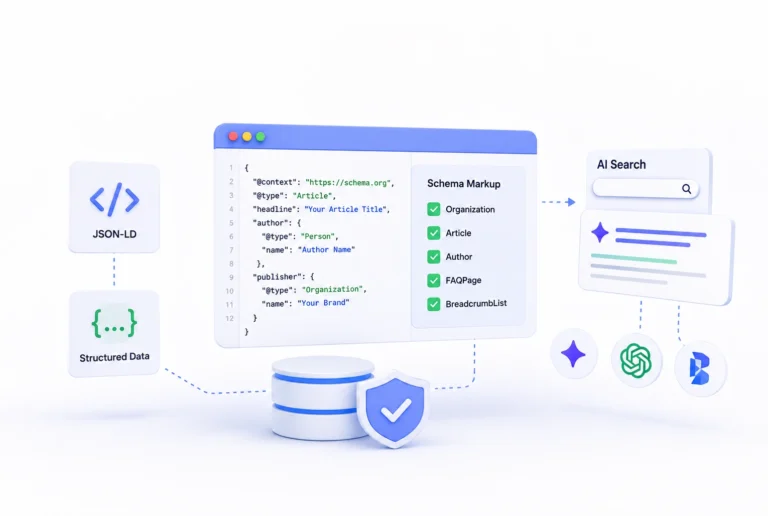
Product schema is the technical declaration that tells AI crawlers exactly what each page on your site represents. It includes the product name, description, pricing, availability, SKU, brand, and review data in a machine-readable format that ChatGPT’s browsing agent can extract directly without parsing prose.
Every product page should have Product schema with the following fields as a minimum: name, description, image, sku, brand, offers with price, currency, availability, and priceCurrency, and aggregateRating if you have reviews, according to HubSpot’s April 2026 e-commerce schema analysis.
Pages with complete Product schema provide ChatGPT’s shopping agent with a structured alternative to prose extraction, which is faster and more accurate, improving the probability that your product data appears correctly in recommendations.
Organization Schema with Consistent NAP Data
Brand-level recommendations from ChatGPT depend on consistent entity signals across the web. ChatGPT evaluates whether your business is mentioned consistently and positively across multiple independent, authoritative sources, including reviews, news articles, industry directories, and social mentions, according to Tebeau Group’s June 2026 analysis of ChatGPT recommendation signals.
Organization schema with verified sameAs properties linking your business profile to LinkedIn, Google Business Profile, relevant directories, and any social platforms where you have a presence tells ChatGPT that your brand is a real, identifiable entity with an established web presence. Consistent NAP data, meaning your business name, address, and phone number appear identically across every platform you are listed on, is the foundational consistency signal that AI evaluation systems rely on.
Content That Answers Buyer Questions Directly
ChatGPT recommendations for brand-level queries are heavily influenced by how clearly and directly your website answers the specific questions buyers ask before making a purchase decision. Questions like “what is your return policy,” “how long does shipping take,” “what sizes do you carry,” and “what are your products made of” should each have a dedicated, directly answered page or section that ChatGPT can extract a complete answer from.
Answer-first content structure applies to e-commerce content exactly as it does to informational content. A returns page that leads with “We offer free returns within 30 days on all orders” is extractable. A returns page that leads with three paragraphs of brand history before explaining the policy is not. Organise content with clear headings that contain the question and answers that appear in the first sentence of each section, according to cited.so’s May 2026 analysis of what makes businesses recommendable by ChatGPT.
The AI Shopping Platform Comparison Table
The table below maps each major AI shopping platform to its data source, its merchant enrollment process, the schema types that improve visibility on that platform, and whether it supports in-chat purchasing. Use this to prioritize which platforms to optimize for first based on where your audience shops.
| Platform | Primary Data Source | Merchant Enrollment | Key Schema | In-Chat Purchase |
| ChatGPT Shopping | OpenAI merchant feed + Google Shopping graph | chatgpt.com/merchants Shopify and Etsy auto-enrolled | Product, Organization, Review | Yes – Instant Checkout via ACP and Stripe |
| Google AI Mode | Google Merchant Center | Google Merchant Center account | Product, Offer, Aggregate Rating | Native Checkout via UCP – expanding roll-out |
| Google AI Overviews | Google Merchant Center + web content | Google Merchant Center account | Product, FAQPage, HowTo | No – links to product page |
| Perplexity Shopping | Google Shopping format feed + live web | Perplexity merchant program (accepts Google Shopping export) | Product, Review, ClaimReview | No – links to product page |
| Microsoft Copilot Shopping | Bing Merchant Center | Bing Merchant Center – parallel to Google | Product, Offer | In development |
| Meta AI Shopping | Facebook and Instagram shops + open web | Facebook Commerce Manager | Product | Yes – via Facebook Shops checkout |
System 3: Reviews and Third-Party Mentions That ChatGPT Trusts
ChatGPT product recommendations are heavily influenced by what authoritative external sources say about your product, especially third-party review sites, according to HubSpot’s April 2026 analysis. This means your social proof strategy needs to extend beyond your own website into the specific platforms that ChatGPT’s retrieval system weights most heavily.
The Review Platforms That Matter Most
For physical product e-commerce, the highest-weighted review platforms in ChatGPT’s product recommendation system are Google Reviews through your Google Business Profile, Amazon reviews if your products are listed there, Trustpilot for brand-level trust signals, and niche-specific review sites relevant to your product category.
For digital products, SaaS tools, and services, the highest-weighted platforms are G2 and Capterra for software tools, with a target of at least 50 reviews and an average rating of 4.0 or above on G2 to reach recommendation threshold, according to HubSpot’s April 2026 e-commerce recommendation guide. Trustpilot and Google Reviews apply across all business types.
The minimum viable review presence for ChatGPT brand-level recommendation eligibility requires consistent positive reviews across at least two of these platforms, with recent reviews that demonstrate the brand is actively serving customers in 2026 rather than only in previous years. Stale reviews from 2022 are significantly less influential than a smaller number of current 2026 reviews, according to Velonova’s July 2026 analysis of ChatGPT recommendation signals.
Editorial Mentions and Directory Listings
ChatGPT evaluates whether your business is mentioned positively across multiple independent, authoritative sources beyond review platforms. Editorial mentions in relevant publications, inclusion in industry-specific directories, and coverage in roundup articles that compare products in your category all contribute to the consensus signal that ChatGPT uses to evaluate brand trustworthiness.
For a shop owner with no PR budget, the most accessible path to authoritative mentions is getting listed in niche directories relevant to your product category, submitting to product roundup opportunities on relevant blogs and publications, and ensuring your business appears consistently on business listing platforms including Yelp, Better Business Bureau, and any trade association directories relevant to your industry.
Building Brand Signals Through Social Content
Social media presence contributes to the broader brand signal ecosystem that ChatGPT evaluates when forming recommendations for brand-level queries. A shop with an active, consistent presence on relevant platforms where its audience gathers demonstrates to AI systems that it is a real, operating business serving real customers, according to cited.so’s May 2026 analysis.
For shops that need to maintain active social content without a dedicated content team, Predis AI generates social media ad creatives and product content from your existing product information and website content. Building consistent social content across TikTok, Instagram, and Pinterest simultaneously is a brand signal strategy that supports AI recommendation visibility in addition to its direct traffic and conversion benefits. Explore our in‑depth Predis.ai review
What to Expect: Realistic Timeline for ChatGPT Recommendation Visibility
ChatGPT recommendation visibility does not happen overnight, and any service promising top ChatGPT placement within two weeks should be evaluated with the same scepticism as a two-week Google ranking guarantee, according to Velonova’s July 2026 analysis.
The Two-Phase Timeline
Specific answer visibility, where ChatGPT answers a precise question about your shop such as “what is the return policy at The Marketing Shelf” or “how much does product X cost at shop Y,” can appear within weeks of a well-structured site going live with correct schema and a verified merchant feed, according to Velonova’s July 2026 analysis. This phase depends on technical completeness, not authority accumulation.
Open-ended recommendation visibility, where ChatGPT recommends your shop unprompted when a user asks “what is the best shop for X category,” is a six to twelve month build in most categories, according to the same source. This phase depends on accumulating reviews, editorial mentions, and topical depth across external platforms. It cannot be accelerated by technical improvements alone.
Businesses That See the Fastest Results
High-consideration purchases, including web design, legal services, financial planning, contractors, and marketing agencies, see the highest relative value from AI recommendation visibility because buyers research these categories extensively before committing, according to FactoryJet’s June 2026 analysis of AI recommendation impact by business type. For lower-consideration, high-frequency purchases, AI recommendation is less impactful relative to other channels.
E-commerce stores benefit most from AI recommendation when they sell products where buyers ask “which brand should I buy from” rather than searching for a specific product name. A buyer asking “where should I buy organic cotton bedding” is a recommendation query. A buyer searching “Brooklinen linen duvet” is a navigational query. ChatGPT’s recommendation system captures the former. Your existing Google SEO captures the latter.
The Action Priority List: What to Do First
The three systems described in this guide require different levels of effort and produce results on different timelines. This priority sequence allocates your effort where it produces the fastest impact first.
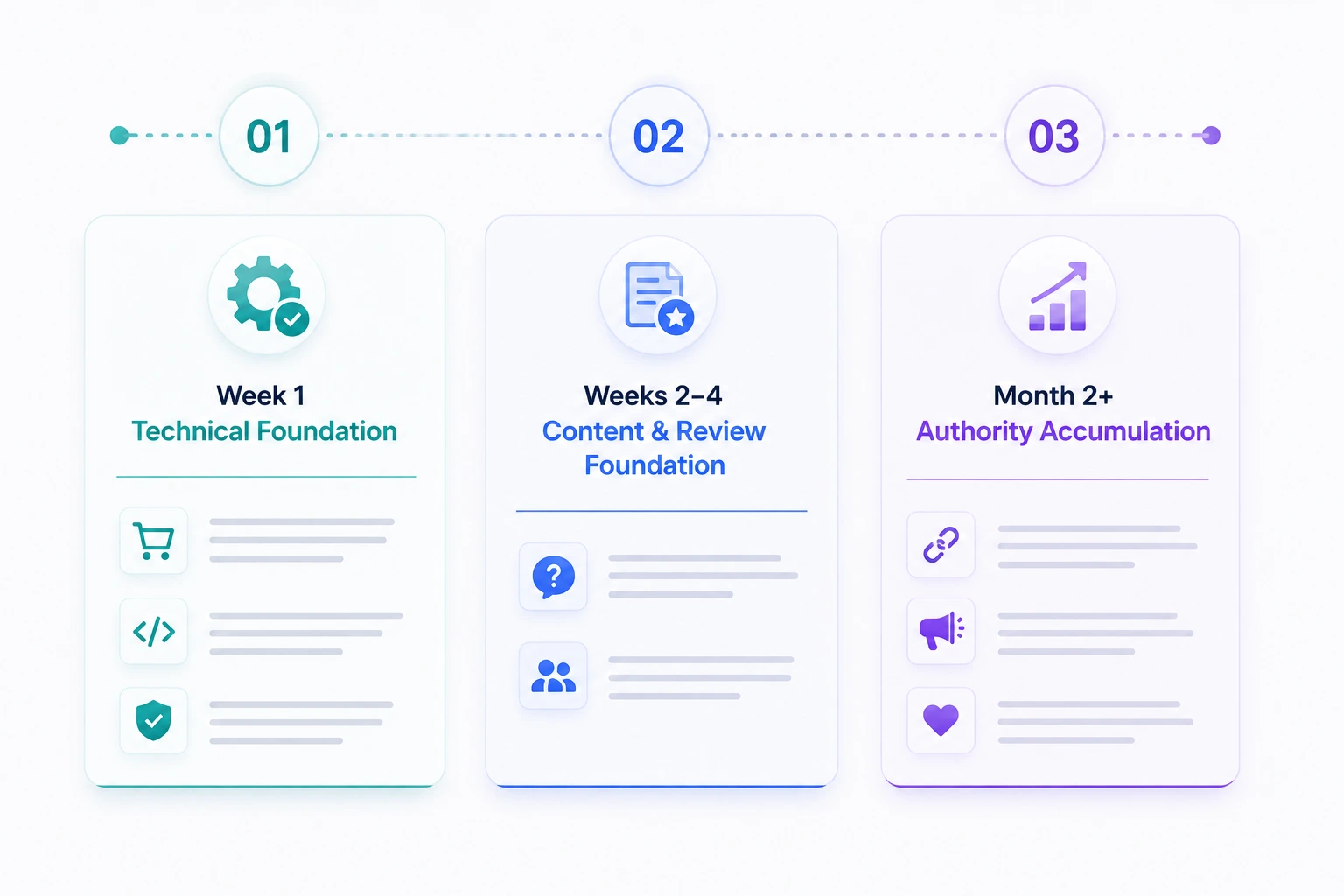
Week 1: Technical Foundation
Set up Google Merchant Center if you have not already and submit a complete, accurate product feed with all required fields populated. This single action makes your products visible to ChatGPT Shopping, Google AI Mode, Google AI Overviews, and Perplexity Shopping simultaneously, because Google Merchant Center is the common infrastructure layer for all four platforms.
If you are on Shopify or Etsy, verify that your store is appearing correctly in ChatGPT Shopping by running a few test queries for your product category. If you are on WooCommerce or another platform, submit your merchant program application at chatgpt.com/merchants this week.
Implement Product schema on every product page and Organization schema with sameAs properties site-wide. Use Google’s Rich Results Test to validate both.
Week 2 to 4: Content and Review Foundation
Audit every buyer-intent question your customers ask before purchasing and ensure each one has a directly answered page or section on your site with the answer in the first sentence. Returns, shipping, sizing, materials, and warranty are the five most common pre-purchase questions across all product categories.
Launch a systematic review request process. After every order confirmation or delivery, send a request asking buyers to leave a review on Google and whichever secondary platform is most relevant to your category. The goal is at least 20 recent, verified reviews across two platforms within the first 30 days of this system being active.
Month 2 and Beyond: Authority Accumulation
Submit your business to three to five niche-specific directories relevant to your product category. Identify two to three roundup publications or blogs in your niche that publish product comparison articles and submit your product for consideration. Each mention in an authoritative external source adds to the consensus signal that eventually makes your shop recommendable by ChatGPT for open-ended category queries.
Maintain a consistent social content schedule that reflects your brand’s active operation. Even two posts per week on the platforms your audience uses most demonstrates ongoing business activity to the AI systems that evaluate brand signals as part of recommendation eligibility.
CONCLUSION:
ChatGPT processes 50 million shopping queries every day and 11 times more Shopify orders were attributed to AI referrals in early 2026 than the year before. The channel is growing fast and the brands establishing AI recommendation visibility now are building an advantage that later movers will find expensive to close, according to FactoryJet’s June 2026 analysis.
The three-system framework produces compounding results. Each product feed submission improves structured data accuracy. Each schema implementation improves AI extraction quality. Each review strengthens the authority consensus. Each editorial mention adds to the third-party validation that ChatGPT weighs when forming brand-level recommendations. Each improvement makes the next one more effective.
Getting ChatGPT to recommend your shop is not about finding a trick or a shortcut. It is about executing the same foundational digital marketing strategy that builds authority everywhere, but applied specifically to the data formats, schema types, and review platforms that AI shopping systems evaluate. The technical layer is the fastest to implement. The authority layer is the most durable once built.
Start with Google Merchant Center and the ChatGPT merchant program this week. Build the review presence over the next month. Let the editorial mentions accumulate over the following quarter. The recommendation visibility will follow.
FAQs
Q: How do you get ChatGPT to recommend your shop when people ask what to buy?
A: Getting ChatGPT to recommend your shop requires three systems working together. First, submit a structured product feed through OpenAI’s merchant program at chatgpt.com/merchants and ensure your Google Merchant Center feed is complete and daily-refreshed. Second, implement Product schema and Organization schema on your website so ChatGPT’s browsing agent can extract accurate product and brand data. Third, build a review presence across Google, Trustpilot, and category-relevant review platforms, and earn editorial mentions in authoritative external sources. Shopify and Etsy stores are already auto-enrolled in ChatGPT’s commerce ecosystem, according to TJ Robertson’s July 2026 product feed guide.
Q: How many shopping queries does ChatGPT process per day in 2026?
A: ChatGPT processes 50 million shopping queries every day as of 2026, making it one of the fastest-growing product discovery surfaces in e-commerce, according to alhena.ai’s July 2026 analysis of ChatGPT Shopping activity. AI-attributed referral orders on Shopify grew 11 times year over year in early 2026, according to FactoryJet’s June 2026 analysis citing Shopify’s own data. ChatGPT Shopping is powered by a specialised variant of GPT-5 mini trained specifically for shopping tasks, achieving 52% product accuracy on complex multi-constraint queries according to OpenAI’s own benchmarks.
Q: What is the ChatGPT merchant program and how do you join?
A: The ChatGPT merchant program is OpenAI’s direct merchant enrollment system that allows businesses to submit product feeds for use in ChatGPT Shopping recommendations and Instant Checkout. Visit chatgpt.com/merchants to create a merchant account at no subscription cost. OpenAI charges a small transaction fee per sale made through Instant Checkout rather than a listing fee. Shopify and Etsy stores are already auto-enrolled and do not need to apply separately. WooCommerce, BigCommerce, and other platform merchants must complete the application. The program is currently US-only with global expansion planned, according to TJ Robertson’s July 2026 guide.
Q: Does Google Merchant Center affect ChatGPT Shopping recommendations?
A: Yes. Google Merchant Center has become the connective infrastructure for AI shopping across multiple platforms in 2026. ChatGPT sources 83% of its carousel product recommendations from Google Shopping via shopping query fan-outs, according to Athos Commerce’s March 2026 analysis. Google Merchant Center simultaneously powers ChatGPT Shopping, Google AI Mode, Google AI Overviews, and Perplexity Shopping, according to Evolve Media’s May 2026 analysis. Brands without an optimized, daily refreshed Google Merchant Center feed are invisible to AI shopping queries on all four platforms, even when their website content and schema are otherwise strong.
Q: How long does it take to get recommended by ChatGPT?
A: ChatGPT recommendation visibility operates on two different timelines. Specific answer visibility, where ChatGPT answers precise questions about your shop such as pricing, return policy, and availability, can appear within weeks of implementing complete schema markup and a verified merchant feed, according to Velonova’s July 2026 analysis. Open-ended recommendation visibility, where ChatGPT recommends your shop unprompted for category queries, is a six to twelve month build that depends on accumulating reviews, editorial mentions, and external platform presence. Building the authority signals that consistently earn AI recommendations is an ongoing process where businesses with existing strong digital foundations see faster results.