


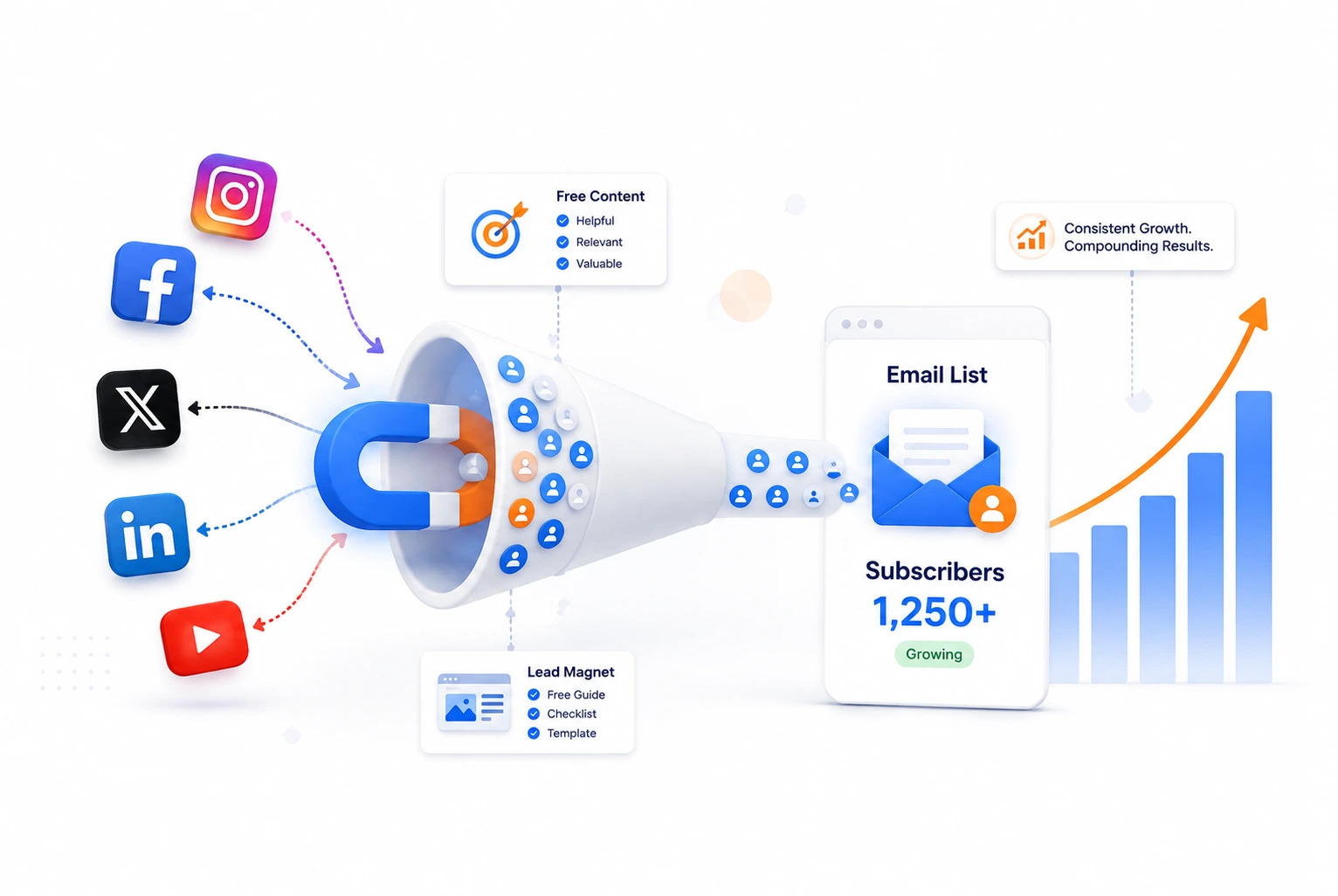
Email delivers an average return of $36 for every $1 spent, outperforming social media, SEO, and paid ads for direct revenue conversion. Your social media followers are rented. Your email list is owned.
That distinction matters more in 2026 than it ever has. Social media platforms change their algorithms constantly. Your reach on Instagram or LinkedIn can drop significantly overnight with no warning and no recourse. When someone gives you their email address, they are saying something categorically different from when they follow you. They are granting access to a channel that only you control and that no algorithm update can take away.
The mistake most beginners make is treating email list building as something that happens naturally once they have built a social following. It does not. Social followings and email lists are built through completely different mechanisms, and a creator with 10,000 Instagram followers and zero email subscribers has built an audience they do not own on a platform they do not control.
This post is the complete system for building your first 1,000 email subscribers from zero using free social media traffic. It covers the lead magnet that makes strangers want to give you their email address, the opt-in infrastructure that captures them when they arrive, the specific social media tactics that drive consistent traffic to that infrastructure, and the compounding mechanisms that accelerate growth once the initial flywheel is moving.
No paid ads. No existing audience required. Just a system that works when executed consistently.
Build the Asset Before You Drive the Traffic
The most common list-building mistake is driving traffic before having a compelling reason for that traffic to subscribe. Most beginners set up a generic “subscribe for updates” form and then wonder why nobody subscribes. Nobody subscribes because nobody wakes up wanting more email. They subscribe when you offer them something specific that solves a specific problem, they have right now.
What a Lead Magnet Actually Needs to Do
A lead magnet is a free resource you offer in exchange for an email address. The word “free” is doing less work than most people think. A bad free resource still converts badly because the real exchange is not money for content. It is attention and inbox access for value. A stranger is deciding whether the resource you are offering is worth the ongoing relationship that subscribing implies. The bar is higher than most lead magnets clear.
The lead magnets that consistently convert in 2026 share one property: they solve one specific, urgent problem in under ten minutes. Not a general guide to a broad topic. A specific solution to a specific situation. The difference between “The Complete Guide to Email Marketing” converting at two percent and “The 5-Minute Email Checklist for Solo Creators Who Keep Landing in Spam” converting at fifteen percent is entirely that specificity.
The formats that work best are templates that save meaningful time, checklists that remove decision fatigue from a repeatable task, short PDF guides that solve a named problem, and quiz lead magnets that give the reader a personalised result. Quiz lead magnets convert at 30 to 50 percent on dedicated landing pages, according to EmailEarn’s June 2026 list-building analysis, because they feel interactive and personal rather than passive.
The One Lead Magnet Rule for New Creators
When you are starting from zero, you do not need five lead magnets. You need one that is genuinely good. A creator with one lead magnet converting at twenty percent will grow their list faster than a creator with five lead magnets each converting at four percent, because the resources they save on creation go into promoting the single strong offer instead.
For The Marketing Shelf specifically, the right lead magnet is something in the AI SEO or content strategy space that a solo creator or marketer can use immediately. A Notion template for building a content cluster. A checklist for making any existing blog post AI citation-ready. A one-page reference card for the schema markup types that matter most in 2026. Any of these solves a specific problem, delivers value in under ten minutes, and is directly connected to the content the site publishes.
Where to Host Your Lead Magnet
You need a landing page that exists specifically to collect email addresses in exchange for the lead magnet. Not your homepage with a form in the sidebar. A dedicated page with one goal: getting the visitor to subscribe.
Brevo and MailerLite both offer free landing page builders as part of their free plans. The page needs four elements: a headline that names the specific problem the lead magnet solves, two to three bullet points explaining exactly what the reader will have or be able to do after consuming it, a simple form asking for an email address only, and a submit button. No navigation menu. No distracting links. One page, one goal.
Set Up the Infrastructure That Captures Subscribers
Your lead magnet and landing page are the destination. The infrastructure is the system that delivers the lead magnet, stores the subscriber’s information, and sends them the first email automatically. All of this can be set up for free before you have a single subscriber.
Choose Your Email Platform
Brevo’s free plan handles unlimited contacts and 300 emails per day, which is sufficient for the entire first year of building a list for most solo creators. MailerLite’s free plan covers up to 1,000 subscribers with 12,000 monthly sends. Kit, formerly ConvertKit, offers a free plan up to 10,000 subscribers with creator-focused automation that is particularly well-suited for content creators building a newsletter alongside a blog. All three are genuinely good starting points. Pick one and start with it. The cost of switching platforms later is real but manageable. The cost of not starting because you cannot decide is larger.
Build a Three-Email Welcome Sequence Before You Launch
The welcome sequence is the most important email marketing asset you will ever build and most new list builders skip it entirely. The sequence runs automatically when someone subscribes, delivering a consistent first impression regardless of when they join.
Email one delivers the lead magnet immediately and adds one unexpected insight that was not promised. This sets the tone that you give more than you take. Email two arrives two days later and tells your story: why you started The Marketing Shelf, what you personally found frustrating about the topic, and what you are specifically trying to help subscribers achieve.
This is the email that builds trust faster than any amount of valuable content, because it reveals a real person behind the newsletter rather than a content machine. Email three arrives three days after that and delivers one genuinely useful tactical piece with no selling. Something they can apply this week. At this point the subscriber has received genuine value three times before you have asked them for anything.
This three-email sequence is what separates a list that converts from a list that sits there. It is also what protects your deliverability, because subscribers who engage with the first three emails establish you as a trusted sender in their inbox.
Use Social Media as the Bridge, Not the Destination
Social media is not where your audience lives permanently. It is where you interrupt them temporarily on the way to somewhere else. The goal of every piece of social content in a list-building strategy is to give enough value in the post to earn the click to the landing page. Not to go viral. Not to build followers. To earn the click.
This reframe changes how you think about social content entirely. You are not trying to make content that performs well on the platform. You are trying to make content that reaches the right people and makes them curious enough about the lead magnet to leave the platform and subscribe.
The Micro-Tip Plus CTA Formula
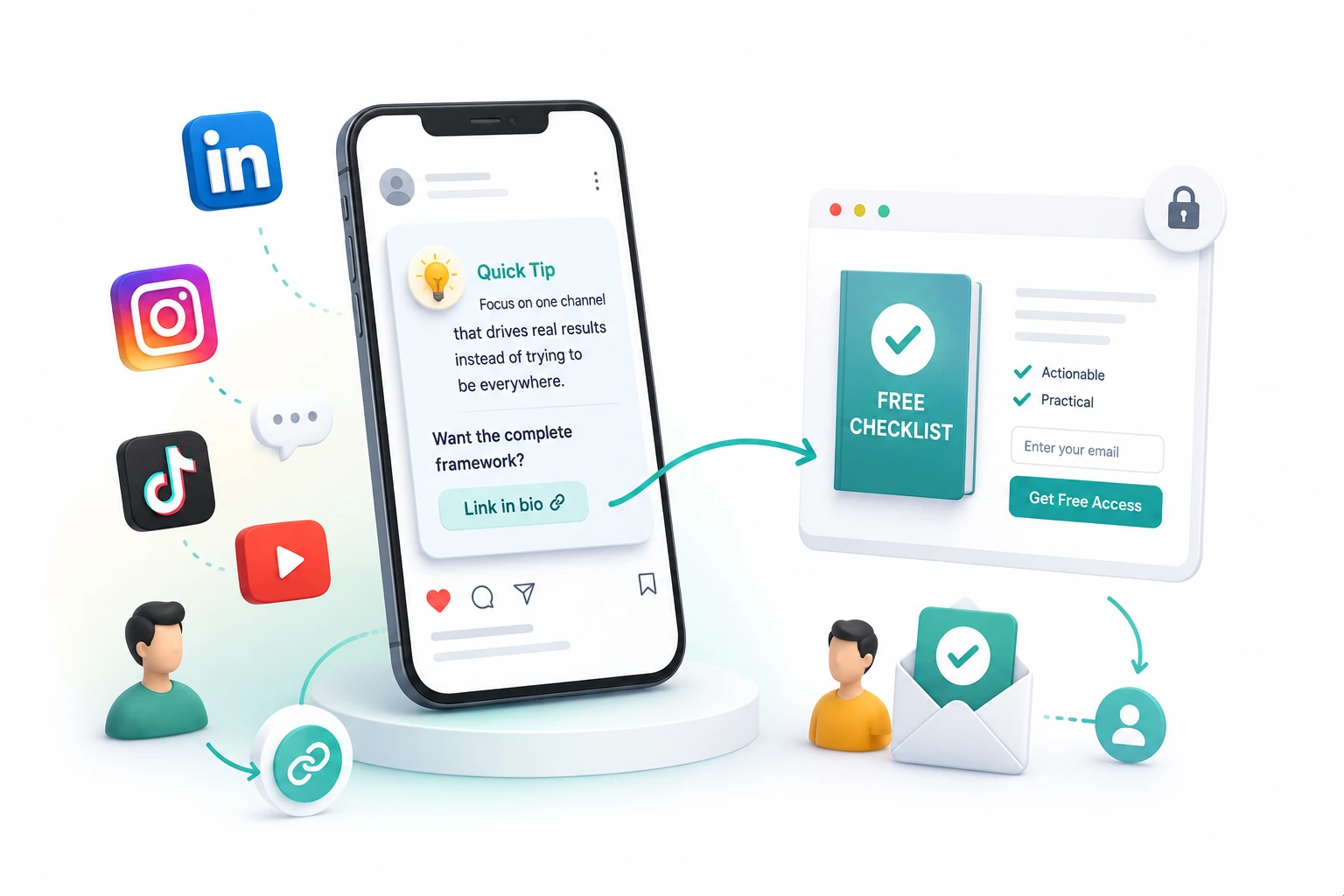
The social media tactic that drives the most consistent traffic to landing pages in 2026 is the micro-tip post. This is a post that delivers one specific, immediately useful piece of insight in the body of the post and then tells readers that the full checklist, template, or guide is available via the link in bio.
The post does real value first. Not a teaser that promises value without delivering it. Actual useful information that stands alone as worth reading. The CTA at the end works because the reader has already received value and is now predisposed to believe the full resource is worth their email address.
On LinkedIn, this looks like a short post of 150 to 250 words sharing one specific finding or tactical recommendation from The Marketing Shelf’s niche, ending with “I put the complete framework in a free checklist. Link in bio.” On Instagram, it is a carousel where slides two through five deliver the insight and the final slide has the CTA. On Threads it is a short conversational thread where each reply adds one piece of value and the final reply has the link.
The Bio Link Is Your Most Valuable Social Real Estate
Every platform gives you one link in your bio. That link should point directly to your lead magnet landing page, not to your homepage or a Linktree with five options. Every option you add to that link page reduces the probability that the visitor takes the action that matters most. One link, one destination, one goal.
Update the bio link whenever you create a new lead magnet or run a time-sensitive campaign. The bio link is what converts followers into subscribers, and it is the one piece of social infrastructure that works continuously without requiring you to create new content.
Platform-Specific Tactics That Actually Work in 2026
On Instagram, carousels consistently outperform single images and Reels for driving profile visits, which then convert to bio link clicks. A carousel that teaches something specific in six to eight slides, with the last slide containing the CTA, produces the best ratio of engagement to landing page traffic of any Instagram format.
On LinkedIn, long-form text posts that open with a counterintuitive statement or a specific number perform significantly better than generic advice posts. The LinkedIn algorithm favours content that keeps people on the platform, which means posts that deliver complete value rather than teasing it tend to reach more people, which in turn produces more bio link clicks from people who engaged with the full post.
On TikTok and YouTube Shorts, the strategy is slightly different because video content requires more production effort. The highest-leverage approach for a solo creator is one video per week that answers a specific question from your niche audience, with a spoken CTA at the end directing viewers to the free resource in the bio. Video builds trust faster than any other format because the viewer hears your voice and sees your perspective in a way that text cannot replicate.
On Threads and X, the reply game is more effective than original posts for a new account with low followers. Finding threads in your niche where you can add a genuinely useful comment, not a promotional one, builds visibility with the right audience and gradually drives profile visits from people who want to see more of your thinking.
If you want to produce social content consistently across multiple platforms without spending hours on design and copywriting for each post, Predis AI generates platform-ready content from your existing blog posts and product information. It is particularly useful for maintaining posting consistency during weeks when writing new content takes all your available time.
Add Content Upgrades to Your Blog Posts
Content upgrades are the highest-converting list-building mechanism available to a content site, and they require no additional social media effort once they are set up. A content upgrade is a lead magnet that is specifically matched to the content of one blog post, offered inline within that post to readers who want to go deeper.
Why Content Upgrades Convert Better Than Generic Lead Magnets
A generic lead magnet on your homepage converts at one to three percent of visitors on average. A content upgrade embedded within a relevant blog post converts at eight to fifteen percent of that post’s readers, according to HubSpot’s 2026 list-building guide citing content-matched CTA data.
The reason is intent matching: a reader who just finished reading a post about schema markup is experiencing high interest in that exact topic at that exact moment. Offering them a schema markup checklist at that moment is not interrupting their experience. It is extending it.
Content upgrades compound over time. Each blog post you publish is an opportunity to add a matched lead magnet. Twenty well-optimised blog posts with relevant content upgrades can produce 200 to 600 new subscribers per month from organic search alone, according to EmailEarn’s June 2026 analysis of list-building at scale. That number grows as the posts accumulate traffic without any additional creation effort.
The Easiest Content Upgrade to Create
The fastest content upgrade to build for any existing post is a PDF checklist that summarises the post’s key action steps. Write the post, identify the five to ten most actionable takeaways, format them as a checklist in Canva or Google Docs, export as a PDF, and upload it to your email platform as the delivery asset for a new opt-in form. Total creation time is under 30 minutes for a post you have already written.
Place the opt-in form inline within the post after the section that delivers the most immediate value, not at the end of the post where most readers have already left. The reader who reaches the most valuable section of your post is at peak engagement. That is the moment to offer them something that extends that value.
Compound the Growth with Partnership Tactics
The tactics in steps one through four produce consistent, compounding growth from your own content and social presence. Once those systems are running, partnership tactics can dramatically accelerate the timeline to your first 1,000 subscribers without requiring additional content creation.
Newsletter Cross-Promotions
Newsletter cross-promotions are the highest-leverage free partnership tactic available in 2026. Find two to four newsletters in adjacent niches with similar or slightly larger audience sizes. Propose a simple swap: you recommend their newsletter to your subscribers, they recommend yours to theirs.
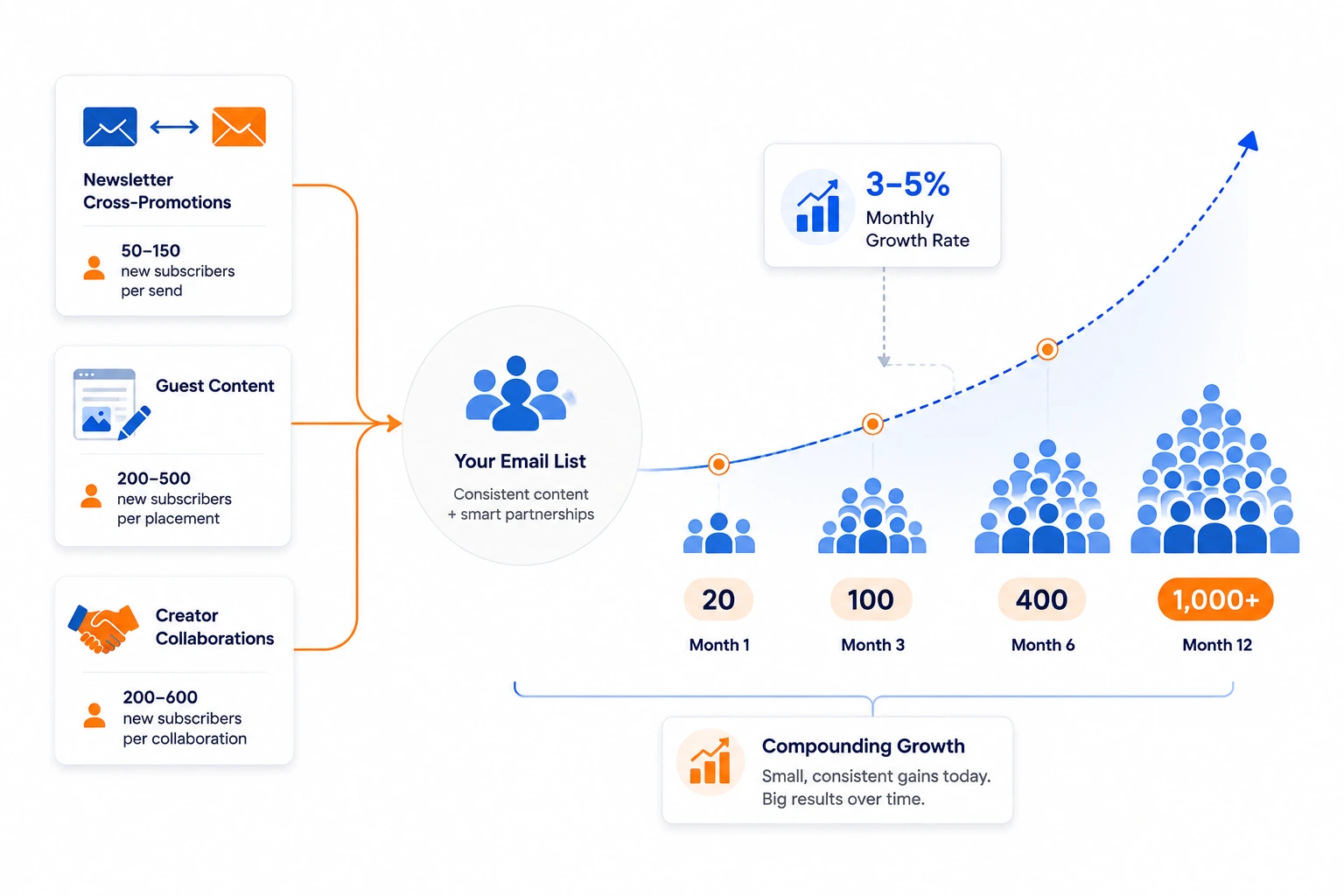
A single well-placed cross-promotion with a newsletter of 5,000 subscribers can deliver 50 to 150 new subscribers in a single send, according to EmailEarn’s June 2026 analysis. At that rate, four cross-promotions per month produces 200 to 600 additional subscribers on top of organic growth.
The key to making cross-promotions work is choosing newsletters whose audience closely overlaps with yours. A marketing newsletter crossing with a general business newsletter produces weak results because the overlap is too broad. A marketing newsletter crossing with an AI tools newsletter or a solo creator newsletter produces strong results because the audiences are specifically relevant to each other.
Guest Content in Other Creators’ Formats
A single well-placed guest post in a publication your target audience reads can drive 200 to 500 new subscribers, according to HubSpot’s 2026 list-building analysis. The mechanism is straightforward: you deliver value to someone else’s audience, include your lead magnet in the author bio or within the content, and capture the readers who want more of your perspective.
Guest content does not have to be a traditional guest post. A featured contribution to a newsletter roundup, a quoted expert perspective in a niche publication, or a collaboration with another creator on a piece of content that both of you promote delivers the same subscriber growth mechanics with different format and effort requirements.
What Realistic Growth Looks Like
Building an email list from zero to 1,000 subscribers typically takes three to six months for creators who publish two to three blog posts per week with embedded content upgrades, or six to twelve months for creators relying primarily on social media traffic without organic search.
The 90-Day Realistic Benchmark
If your site currently receives around 1,000 monthly visitors, a realistic 90-day goal is 200 to 500 subscribers, depending on lead magnet quality and opt-in form placement. That assumes a lead magnet converting at ten percent of relevant traffic, consistent social posting of three to five times per week, and at least two to three blog posts published per month with embedded content upgrades.
This is not a pessimistic forecast. It is an honest one. The mistake most beginners make is expecting list growth to be linear and fast from day one, and losing momentum when the first month produces twenty subscribers instead of two hundred.
Twenty subscribers in month one from a standing start is a working system. The compounding effect that turns twenty into forty into one hundred and forty into four hundred happens over months, not weeks, and it happens to everyone who keeps the system running.
The One Metric That Tells You the System Is Working
The metric that tells you your list-building system is working is not total subscriber count. It is monthly growth rate. A three to five percent monthly growth rate on whatever your current list size is represents a healthy, compounding system.
A list of 100 subscribers growing at five percent per month reaches 163 in six months and 265 in twelve months purely from compounding before any acceleration tactics are applied. Add cross-promotions, content upgrades, and consistent social driving and the curve steepens considerably.
CONCLUSION:
Building an email list from scratch using free social media traffic is a five-step system, not a collection of random tactics. Build one genuinely good lead magnet. Set up the infrastructure that captures and welcomes subscribers automatically.
Use social media as a bridge that drives traffic to the landing page rather than as a destination where you broadcast content hoping people will eventually find your email form. Add content upgrades to your existing blog posts. Compound the growth with cross-promotions once the organic system is running.
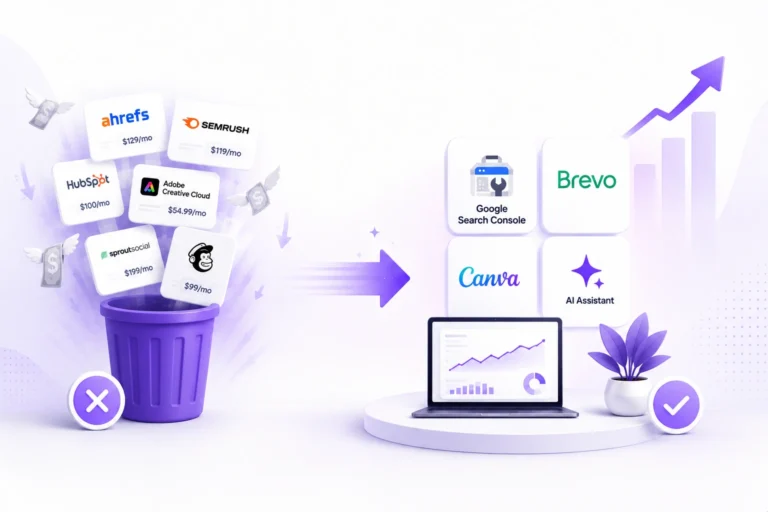
Every one of these steps is achievable with zero budget. Brevo’s free plan stores your subscribers. Canva’s free plan builds your lead magnet. Your Instagram, LinkedIn, or Threads account drives the traffic. The only resource the system requires is consistent execution.
The subscribers you build through this system are a fundamentally different asset from social followers. They opted in for a specific reason. They received value before being asked for anything. They know who you are and why they are on your list. Those are the subscribers who open emails, click links, and buy things when you recommend them.
Social followers are borrowed. Email subscribers are yours. Build the list.
FAQs
Q: How do you build an email list from scratch with no money?
A: Building an email list from scratch with no money requires four free components working together. First, a lead magnet that solves one specific urgent problem, formatted as a checklist, template, or short guide. Second, a free landing page built on Brevo or MailerLite’s free plan with a single opt-in form. Third, consistent social media content that delivers micro-value and directs readers to the lead magnet via the bio link. Fourth, content upgrades embedded within existing blog posts that convert readers at eight to fifteen percent compared to one to three percent for generic homepage forms. Building an email list from zero to 1,000 subscribers takes three to six months with consistent execution across all four components.
Q: What is the best lead magnet for building an email list in 2026?
A: The best lead magnets in 2026 solve one specific urgent problem and can be consumed in under ten minutes. Templates convert at fifteen to thirty percent of traffic because they have immediate tangible utility. Short PDF checklists convert at ten to twenty percent when they solve a named specific problem. Quiz lead magnets convert at thirty to fifty percent on dedicated landing pages because they feel interactive and deliver personalised results. Generic lead magnets like “the complete guide to marketing” convert at two to five percent because they solve no specific problem for any specific person. The more specific and immediately applicable the lead magnet, the higher the conversion rate regardless of format.
Q: How do you use social media to grow an email list for free?
A: Use social media as a bridge rather than a destination. Post micro-tip content that delivers one specific useful insight within the post itself, then directs readers to a free resource via the bio link. Point your bio link directly at your lead magnet landing page rather than your homepage or a multi-link page. On Instagram use carousels that teach something specific across six to eight slides with a CTA on the final slide. On LinkedIn write complete value posts that open with a specific number or counterintuitive statement. On TikTok and YouTube Shorts, answer one specific question per video with a spoken CTA directing viewers to the free resource. The bio link is your most valuable social real estate and should point to your lead magnet at all times.
Q: What is a content upgrade and how does it build an email list?
A: A content upgrade is a lead magnet specifically matched to the topic of one blog post, offered inline within that post to readers who want to go deeper. Where a generic homepage opt-in form converts at one to three percent of visitors, a content upgrade embedded within a relevant post converts at eight to fifteen percent of that post’s readers because it is offered at the exact moment the reader is most interested in the topic. The fastest content upgrade to create is a PDF checklist summarising the key action steps from an existing post. Twenty blog posts with relevant content upgrades can produce 200 to 600 new subscribers per month from organic search alone as the posts accumulate traffic over time.
Q: How long does it take to build an email list to 1,000 subscribers?
A: Building from zero to 1,000 email subscribers takes three to six months for creators publishing two to three blog posts per week with embedded content upgrades, or six to twelve months for creators relying primarily on social media traffic without organic search support, according to EmailEarn’s June 2026 benchmark analysis. With monthly traffic of around 1,000 visitors, a realistic 90-day goal is 200 to 500 subscribers depending on lead magnet quality. A healthy growth rate is three to five percent per month of your current list size. This compounds significantly over time: a 100-subscriber list growing at five percent monthly reaches 265 subscribers in twelve months from compounding alone, before any acceleration tactics are added.