


Merriam-Webster named “slop” its word of the year for 2025, defining it as the glut of low-quality, generic, or meaningless content generated in bulk by AI, according to TechTarget’s July 2026 analysis of the AI content landscape. The word exists because the phenomenon is now visible enough to name.
The percentage of marketers not using AI for blog creation dropped from 65% to just 5% in two years, according to Typeface’s 2026 industry survey. That means 95 out of every 100 pieces of content in your niche is now AI-assisted. Using AI is no longer an advantage. It is the baseline requirement for participation and most of that 95% is producing content that sounds exactly like everyone else, not because the tool is bad, but because the people using it never gave the tool anything genuinely specific to work with, according to White Beard Strategies’ May 2026 analysis of AI content differentiation.
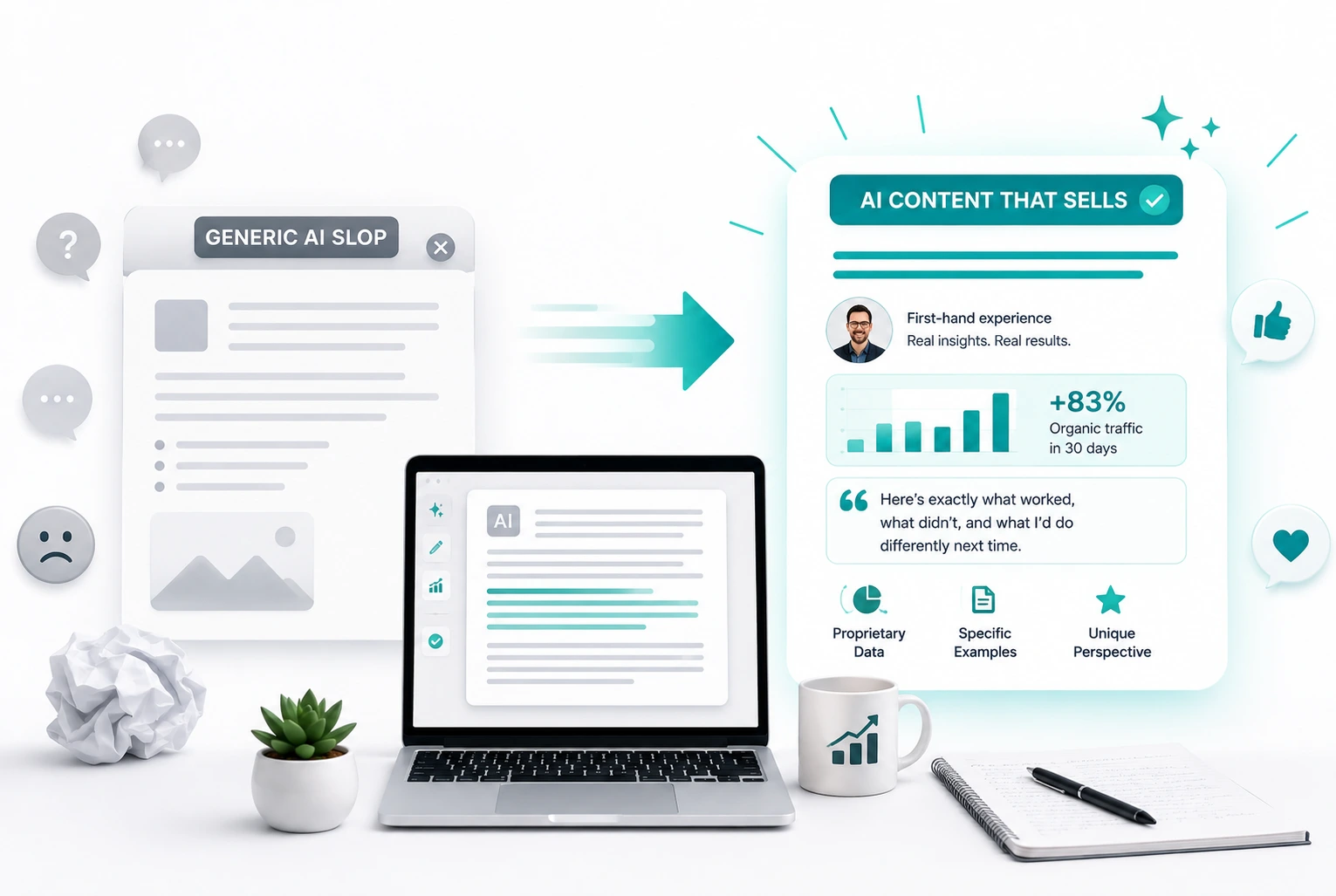
This post is about the gap between AI content that exists and AI content that sells. They are not the same thing and in 2026 they are getting further apart. Content that sounds like it was written by a committee of robots, what practitioners now call the AI Ick, the uncanny valley feeling a reader gets when prose is technically correct but emotionally hollow, does not build trust, does not earn citations from AI systems, and does not convert readers into buyers, according to LogicBalls’ July 2026 analysis of AI content marketing trends.
The solution is specific and learnable. It is not about using less AI. It is about what you bring to the process that the AI cannot generate on its own. This post covers exactly what that is, how to add it systematically, and how to test whether what you are producing has crossed from generic to genuinely useful.
Why Generic AI Content Fails
Generic AI content fails commercially because AI is trained on existing content, which means it produces more of what already exists, with no edge, no perspective, and no differentiation, according to the Elevate It Now content strategy analysis published in May 2026. Safe content does not sell. And AI, left to its own defaults, produces safe content.
AI Predicts Language, Not Outcomes
AI tools generate outputs based on patterns, not true strategic thinking or intent, according to Harvard Business Review’s analysis of generative AI limitations, cited in Elevate It Now’s May 2026 content strategy guide. When you prompt an AI without giving it something genuinely specific to work with, it synthesizes the average of everything it has read on the topic. The result is content that is accurate, comprehensive, and indistinguishable from every other accurate, comprehensive piece on the same subject.
This is the structural problem with generic AI content. It is not wrong. It is invisible. A reader who finds your post and your competitor’s post both covering the same topic in the same way has no reason to choose you, remember you, or link to you. Brands that fail to differentiate their messaging struggle to drive growth and customer loyalty, according to McKinsey research cited in Elevate It Now’s May 2026 analysis. In a content landscape where AI has commoditized adequate, adequate is indistinguishable from absent.
The AI Ick and Why It Kills Conversions
The AI Ick is the reader’s subconscious detection of content that sounds produced rather than experienced. It manifests as prose that is technically fluent but emotionally flat, arguments that cover every side of a topic without committing to a position, and recommendations that feel like they were written for nobody in particular.
52% of social users are concerned about brands posting AI-generated content without disclosing it, according to PostEverywhere’s 2026 analysis cited in Marketing Agent Blog’s April 2026 content strategy report. This concern is not primarily about ethics. It is about trust. A reader who detects the AI Ick stops trusting the recommendation. A reader who stops trusting the recommendation does not click the affiliate link.
Pages with demonstrably human expertise signals, including specific author credentials, named frameworks, and first-person case studies, outperformed generic AI content by 34% in organic search performance and by 41% in time on page, according to BrightEdge research tracking AI-assisted versus traditionally written content, cited in White Beard Strategies’ May 2026 analysis. The signal that Google, ChatGPT, and readers all respond to most strongly is the same: evidence that a real person with genuine experience produced this.
The Audit Question That Exposes Generic Content
The single most useful diagnostic for whether your AI content is generic is this: if you removed your name and your brand from the content, would your audience know it was you, according to White Beard Strategies’ May 2026 analysis of AI differentiation.
If the answer is no, you are producing generic content regardless of how well-written it is. The goal is not just well-written. The goal is unmistakably yours.
The Five Ingredients That Make AI Content Actually Sell
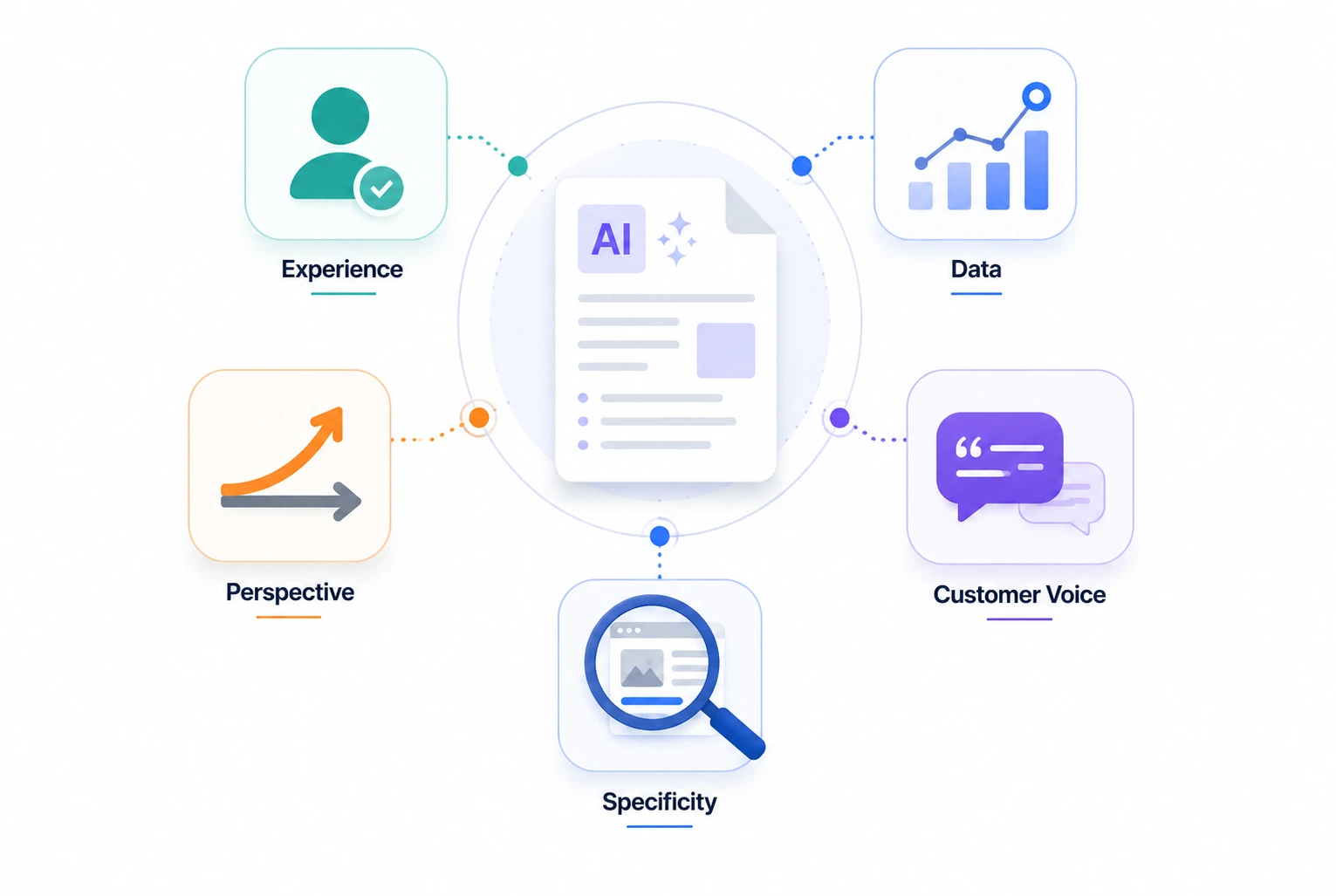
Content that sells in 2026 contains at least one of five ingredients that AI cannot generate on its own. The content that performs best is not the content produced fastest. It is the content that contains something genuinely valuable, including original research, real practitioner experience, a specific perspective, or proprietary data, that AI cannot synthesize because it does not exist anywhere in AI’s training data yet, according to Marketing Agent Blog’s April 2026 content strategy analysis.
Ingredient 1 – First-Person Specific Experience
The most commercially powerful addition to any AI-generated piece of content is a specific, verifiable, first-person account of experiencing the thing the content is about. Not “many marketers find that…” but “when I implemented this on The Marketing Shelf in July 2026 and checked Search Console four weeks later, here is exactly what changed.”
Content that converts consistently contains three properties, according to White Beard Strategies’ May 2026 analysis. First, it contains specific first-person experience from the author. Second, it includes data or evidence that is not generic industry knowledge. Third, it expresses a clear, specific point of view that goes beyond consensus thinking. A piece of content with all three properties is not just better than generic AI content. It is a different category of content entirely.
For The Marketing Shelf specifically, first-person experience means documenting what actually happened when implementing the strategies described in each post. Not what the strategy is supposed to do. What it did, in this niche, on this site, in this timeframe, with these specific numbers attached.
Ingredient 2 – Proprietary Data That Creates Mandatory Citations
If you are the only source of a specific insight, you are the only source that AI systems can cite to use it, according to LogicBalls’ July 2026 analysis of AI content differentiation. Original research is the most durable form of content differentiation because it cannot be replicated without doing the work, according to biz-intelligence’s May 2026 content strategy pivot analysis.
A survey of your newsletter subscribers asking one specific question produces proprietary data. A before-and-after metric from implementing a strategy produces proprietary data. A documented test of five tools against each other with specific outcome measurements produces proprietary data. None of these require a research budget. They require the discipline to document what you are already doing and publish the numbers honestly.
One proprietary data point per post is the target. It does not need to be statistically significant. It needs to be specific, plausible, and genuinely unreproducible from any other source. That specificity is what transforms a well-structured AI draft from a piece of content into a citation anchor.
Ingredient 3 – A Contrarian or Specific Point of View
Generic AI content covers all sides of every topic. It does not take sides because taking sides requires judgment, and judgment requires experience that the model does not have. The result is content that is scrupulously fair and completely forgettable.
By explicitly saying what your brand does not do, who your product is not for, and why you disagree with common industry practices, you create a voice that is distinctly human, according to LogicBalls’ July 2026 analysis. Friction is the only thing that prevents your brand from being flattened into the generic middle.
For The Marketing Shelf, this means having and stating opinions. Not “some marketers find backlinks useful while others focus on topical authority” but “backlinks matter less than most SEO guides tell you for new content sites in 2026, and here is the specific reason why based on what we have observed.” That sentence contains a position. A position is memorable. Memorable content gets shared, cited, and linked to.
Ingredient 4 – Real Customer Language
AI is trained on published content, not on the specific words your specific customers use when they describe their specific problem. Real customer language, the exact phrasing your buyers use in reviews, emails, support tickets, and social comments, is invisible to AI and uniquely available to you.
Winning content teams design content around moments of truth, real buyer friction, and clearly defined use cases, not fixed publishing schedules or generic automation, according to CMSWire’s February 2026 analysis of B2B content marketing trends. The practical implementation is simple: collect the exact sentences your readers use when describing the problem your content addresses and use those sentences as the opening of your post rather than the AI’s polished paraphrase of the same idea.
If someone emails you asking “why does my blog get impressions but no clicks” and you have heard that question ten times this month, that question is your headline. In their words. Not in the words that an AI trained on SEO content would generate.
Ingredient 5 – Specificity of Example
Generic AI content uses generic examples. A post about affiliate marketing will reference Amazon Associates and Commission Junction because those are the examples that appear most frequently in the training data. A post written by someone with genuine experience in affiliate marketing references the specific tool, the specific commission rate, the specific conversion rate from the specific audience, and the specific month those numbers were observed.
Specificity signals experience. Experience signals credibility. Credibility produces conversions. The editorial chain from specific example to commercial outcome is consistent and direct. Every generic example in an AI draft is an opportunity to replace it with something specific to your experience that no competitor can replicate.
The AI Content Workflow That Produces Differentiated Output
The right workflow treats AI as the production layer and the human as the intelligence layer. Teams that simply use a general-purpose chatbot to generate first drafts and then manually produce written content often find that the editorial burden of correcting off-brand tone and factual errors in the generated text exceeds the time saved, according to Clarity Ventures’ 2026 analysis of AI content platforms.
Platforms that allow brand intelligence to be loaded upfront, via uploaded style guides, approved messaging, and product data, consistently outperform chatbot-generated drafts on both quality and editing speed.
Step 1 – Load the Intelligence Before Generating
The differentiator in 2026 is not which AI tool you use. It is the quality and specificity of what you feed into it before hitting generate. Generic prompts produce generic content. Training your AI on your specific voice, stories, frameworks, and audience produces content that cannot be easily replicated, according to White Beard Strategies’ May 2026 analysis.
Before writing a single word of the AI brief, collect the following: the specific question your audience is asking in their exact words, one first-person observation from your own experience with the topic, one proprietary data point or documented outcome, and the one thing you genuinely believe about this topic that most people in your niche would not say publicly. These four inputs are what go into the prompt. Not just the keyword and word count.
Step 2 – Use AI for Structure and Research, Not for Ideas
The AI handles the parts of content production that do not require experience: competitive research, outline structure, statistical gathering, and first draft prose. The human handles the parts that do require experience: the opening hook drawn from a real observation, the proprietary data point, the contrarian position, and the specific example that only someone who has actually done the thing would know.
This division of labour produces the output quality of human-written content at the production speed of AI-assisted content. The editorial time is spent on the additions that create differentiation, not on correcting the generic elements that the AI handles adequately.
Step 3 – Test Your Output for the AI Ick Before Publishing
The final quality check before publishing any AI-assisted content is the AI Ick test: read the content aloud and listen for any sentence that could have been written by anyone who researched this topic for twenty minutes without any personal experience with it. Every sentence that passes that test gets replaced with something specific before the post goes live.
A practical way to speed up this test is to run your draft through multiple AI models and compare whether they produce nearly identical responses to the same prompt. If three different models all produce very similar first drafts on your topic, your final published version needs to be significantly more specific, personal, or contrarian than what any of the models produced, because anything they produce from the same brief is also producible by every competitor who runs the same brief.
If you want to run your content brief across Claude, ChatGPT, and Gemini simultaneously to identify where all three converge on the same generic output, that convergence is exactly where your human editorial layer needs to be most distinctive, Merlin AI lets you query all three models from one dashboard so you can compare outputs side by side in minutes rather than switching between tabs. Read our detailed Merlin AI review and see if it is right for you.
Step 4 – Review Every Claim Against Real Evidence
Review every claim and ask whether it can be supported by client experience, data, research, customer language, or a concrete example. Generic statements become credible when they are connected to evidence, according to Nova Growth’s July 2026 guide to avoiding generic AI content.
Do not limit editing to grammar and spelling. Ask whether the content could be recognized as yours, whether it reinforces your positioning, and whether it contains language another brand in your niche would be unlikely to use.
What Generic AI Content Looks Like vs What Differentiated AI Content Looks Like
The gap between generic and differentiated AI content is visible at the sentence level. The following examples show the same topic written both ways. The differences are specific enough to apply immediately to any draft.
Generic Version – What Most AI Output Sounds Like
“Content marketing is important for building brand awareness and driving traffic to your website. By consistently publishing high-quality content, businesses can establish themselves as thought leaders in their industry and attract potential customers. It is important to understand your target audience and create content that resonates with their needs and interests.”
No specific claim. No named source. No first-person experience. No position. Could have been written about any brand in any industry. A reader scans it in two seconds and learns nothing they did not already know.
Differentiated Version – What Sells
“The Marketing Shelf published 50 blogs in its first four months and generated 6,000 impressions with 13 clicks. The content was technically sound. The problem was structural: 90% of the posts targeted informational keywords in a category dominated by sites with five-year head starts and thousands of backlinks. The lesson that most content marketing guides do not say directly is that consistency matters less than targeting keywords where a new domain can actually rank. Here is the specific methodology for finding those keywords.”
This version contains a specific number, a specific site, a specific timeframe, a specific diagnosis, and a contrarian position stated directly. It is not more words. It is more specific words. A reader who finishes this paragraph has learned something they could not have found anywhere else and has a reason to keep reading.
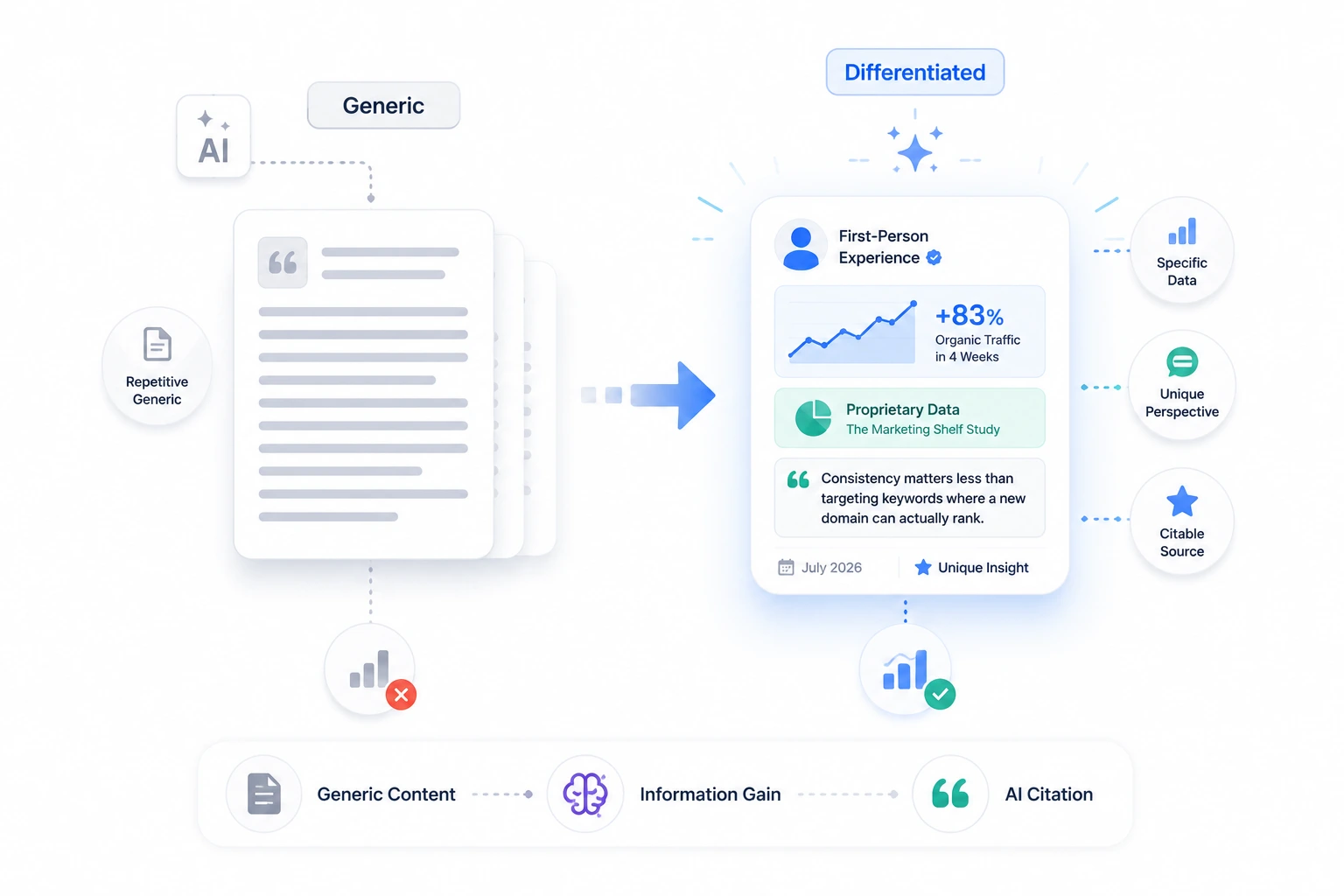
Why Differentiated AI Content Gets Cited by AI Systems
Differentiated AI content does not just sell better to human readers. It gets cited more frequently by AI search systems for a structural reason that is worth understanding.
AI citation systems retrieve candidate pages and score them by how much unique, extractable information they contain. A page that says what every other page says about a topic scores low on information gain, the measure of how much new value the page adds to the existing corpus of content on that topic. A page that contains a proprietary statistic, a first-person case study, or a specific contrarian position that does not appear in competitor content scores high on information gain. High information gain means high citation probability.
The content that gets cited by ChatGPT and Perplexity is not the best-written content on a topic. It is the most specifically informative content, which in 2026 means the content that contains things AI systems cannot synthesise from the rest of the web, according to the consistent finding across Leapd, Averi, and Ansly’s 2026 citation pattern analyses. Generic AI content fails the information gain test by definition because it contains nothing that the AI could not have generated itself.
The human editorial layer, the five ingredients described earlier, is therefore not just a conversion strategy. It is a citation engineering strategy. The same additions that make content sell better to human readers make it more likely to be cited by AI systems responding to readers who never visit your site at all.
CONCLUSION:
95% of content is now AI-assisted. That means the baseline has risen and the differentiation opportunity has simultaneously become clearer: the 5% of content that contains what AI cannot generate is the content that gets read, shared, cited, and converted.
The five ingredients that cross the line from generic to distinctive are first-person specific experience, proprietary data that creates mandatory citations, a contrarian or specific point of view, real customer language drawn from actual conversations, and specificity of example that only someone with genuine experience could provide.
The workflow that produces differentiated output treats AI as the production layer for structure, research, and draft prose, and the human as the intelligence layer for every element that requires genuine experience, judgment, or access to information that does not exist in the training data.
The audit question that exposes generic content is simple: if you removed your name from this post, would your audience know it was you? If the answer is no, the post needs more of you in it before it goes live. Not more words. More specific words. More real observations. More honest positions. More numbers from your own experience.
Generic AI content is everywhere. Content that sounds unmistakably like a specific person with genuine experience is scarce. Scarcity is the only reliable competitive advantage in a market where the cost of production has dropped to near zero for everyone. Protect yours.
FAQs
Q: What is AI slop content and why is it a problem in 2026?
A: AI slop is the term Merriam-Webster defined as its word of the year for 2025, referring to the glut of low-quality, generic, or meaningless content generated in bulk by AI, according to TechTarget’s July 2026 analysis. It is a commercial problem because AI is trained on existing content, meaning it produces more of what already exists with no differentiation. With 95% of marketers now using AI for blog creation according to Typeface’s 2026 survey, generic AI output is the default for most content in every niche. Content that sounds like everyone else’s is commercially invisible regardless of how well-written it is.
Q: How do you make AI content sound human and not generic?
A: Making AI content genuinely distinctive requires adding five elements that AI cannot generate from training data alone: specific first-person experience from your own documented outcomes, proprietary data points that do not exist anywhere else, a clear contrarian or specific point of view stated directly, real customer language drawn from actual conversations rather than paraphrased generalisations, and specific examples that only someone with genuine experience in the topic would know. Pages with demonstrably human expertise signals outperformed generic AI content by 34% in organic search performance and by 41% in time on page, according to BrightEdge research cited in White Beard Strategies’ May 2026 analysis.
Q: Does generic AI content rank on Google in 2026?
A: Generic AI content ranks less reliably in 2026 than content with demonstrable human expertise signals. Google’s E-E-A-T framework specifically rewards Experience, Expertise, Authoritativeness, and Trustworthiness, all of which are signalled by specific first-person content, named author credentials, original data, and documented outcomes. Generic AI content that covers a topic without adding anything new scores low on information gain, the measure of how much novel value a page adds to the existing corpus. Low information gain reduces both traditional Google ranking probability and AI search citation probability simultaneously.
Q: What is the AI Ick and how does it affect conversions?
A: The AI Ick is the uncanny valley feeling a reader experiences when content is technically fluent but emotionally hollow, written for nobody in particular without a genuine point of view or documented experience. It is detectable as prose that covers all sides of every argument without committing to a position, uses generic examples that could apply to any brand in any industry, and never contains anything the reader could not have found in five other articles on the same topic. The commercial consequence is trust erosion: 52% of social media users are concerned about brands posting AI-generated content without disclosing it and readers who detect the AI Ick stop trusting the recommendation, which eliminates the conversion.
Q: Why does differentiated AI content get cited by ChatGPT and Perplexity more often?
A: AI citation systems score candidate pages by information gain, the measure of how much unique value a page adds beyond what is already available in the existing corpus. A page containing a proprietary statistic, a first-person case study, or a specific contrarian position that does not appear in competitor content scores high on information gain and is more likely to be extracted and cited. Generic AI content fails the information gain test by definition because it contains nothing the AI system could not have synthesised itself from the rest of the web. The five ingredients that make content sell to human readers, first-person experience, proprietary data, specific POV, real customer language, and specific examples, are simultaneously the properties that make content citable by AI search systems.