


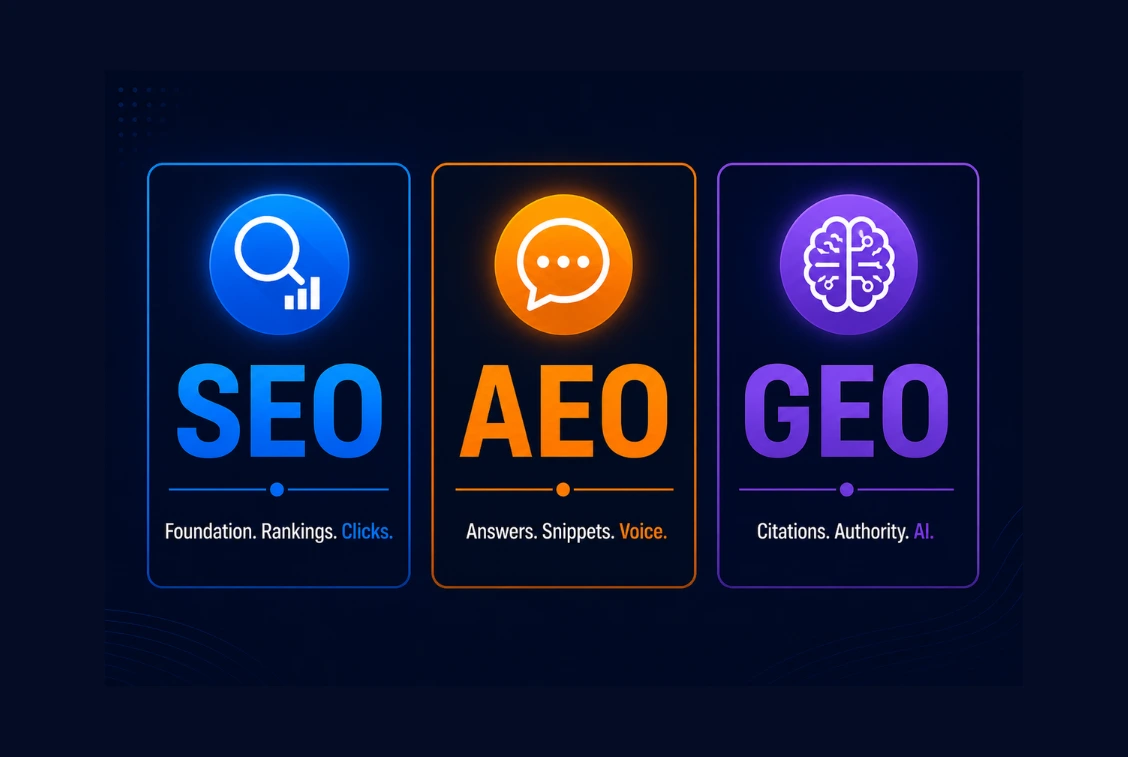
Three acronyms. Endless confusion. And behind every marketing LinkedIn post in 2026, at least one person confidently using all three as if they mean the same thing.
They do not.
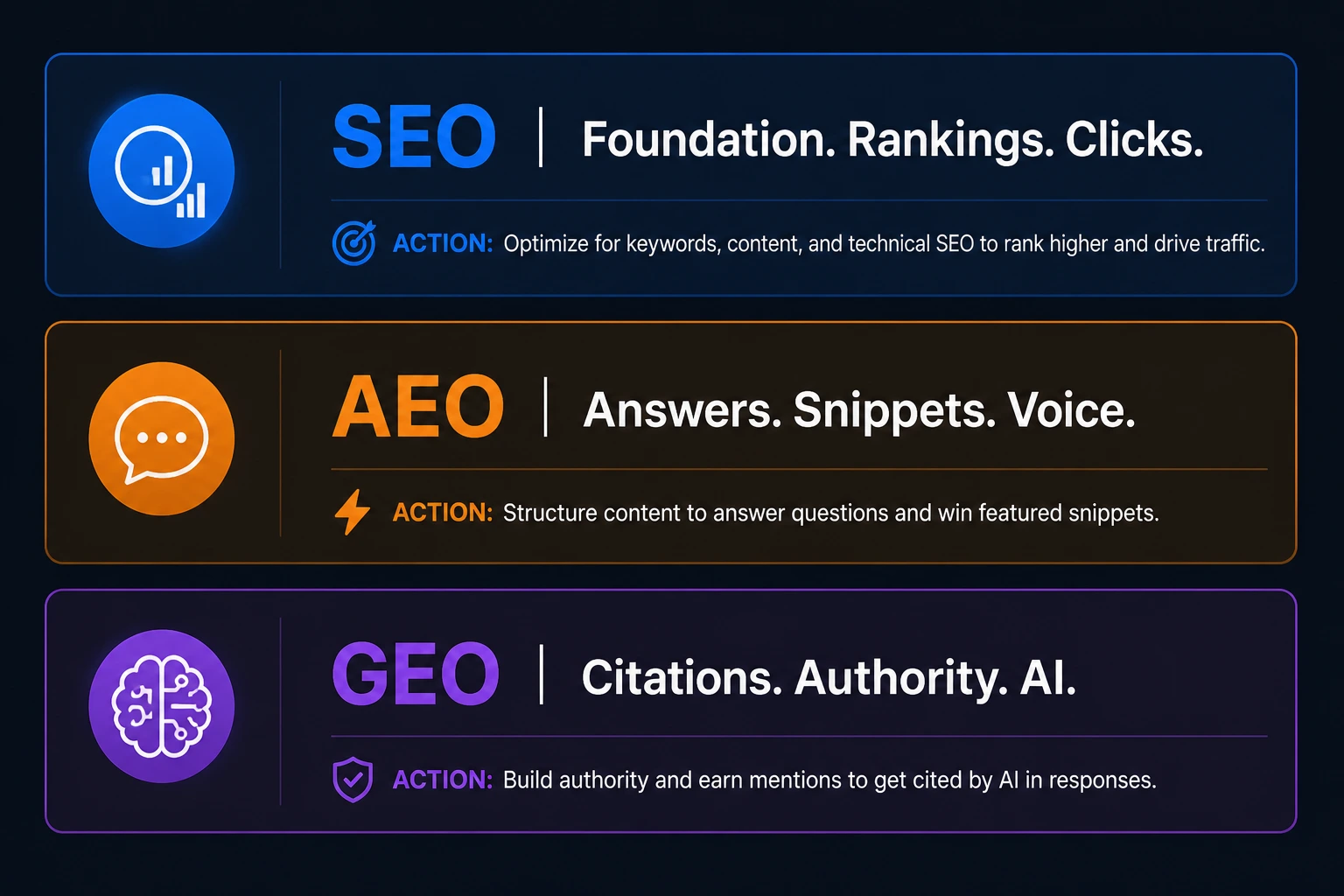
SEO, AEO, and GEO represent three distinct approaches to search visibility in a landscape that has fundamentally changed. SEO is about ranking in the traditional list of blue links. AEO is about being selected as the direct answer that appears before those links. GEO is about being cited by the AI that synthesises a completely new response and may not show any links at all.
The search game changed in three waves. First came featured snippets and zero-click results between 2014 and 2020, when Google started answering questions directly on the results page. Then came AI-powered search features AI Overviews, Google AI Mode from 2023 onwards. Now, in 2026, we are in the third wave: fully generative search where AI tools like ChatGPT and Perplexity synthesise custom answers from scratch and decide independently which sources to cite.
ChatGPT processes 2.5 billion prompts daily, 65 percent of which qualify as search queries. Nearly 31.3 percent of the US population will use generative AI search in 2026. And Ahrefs found that AI Overviews reduced click-through rates for top-ranking Google content by 58 percent.
None of these strategies is replacing the others. But the relationship between them has changed completely. This guide explains exactly what each one means, how they differ, what the data actually shows about each, and most importantly what actually works in 2026 if your goal is to grow a content site and earn consistent traffic and revenue from it.
What Is SEO? (And Why It Is Not Dead)
SEO – Search Engine Optimization is the practice of making your content rank higher in traditional search engine results. Keywords, backlinks, technical structure, authority signals. The goal is a click: your page appears in the list of results and the user chooses yours.
For 20 years, SEO was the only game in town. You optimised for Google, tracked your rankings, and fought for page one. Simple and predictable.
It still works. Let us be clear about that before anything else, because the 2026 marketing discourse loves to declare things dead before they are even close.
Nearly 40 percent of Google’s AI Overviews rank sources that appear in the top 10 organic search results, and nearly 70 percent rank sources from the top 100. This is the most important data point in this entire post for anyone tempted to abandon traditional SEO in favour of chasing AI citations. The sites that show up in AI-generated answers are overwhelmingly the same sites that rank well in traditional search. SEO is not dead. It is the foundation that makes everything else possible.
What has changed is that ranking well in traditional search is no longer sufficient on its own. A page ranking in position 4 through 10 now faces a new threat that did not exist three years ago: the AI Overview appearing above it on the same page, answering the user’s question without requiring a click.
H3: What SEO Still Gets Right
SEO remains the dominant channel by sheer volume. Google processes approximately 14 billion search queries per day. ChatGPT handles around 37.5 million daily. That is a ratio of 373 to 1 in Google’s favour. The traditional search audience is incomparably larger.
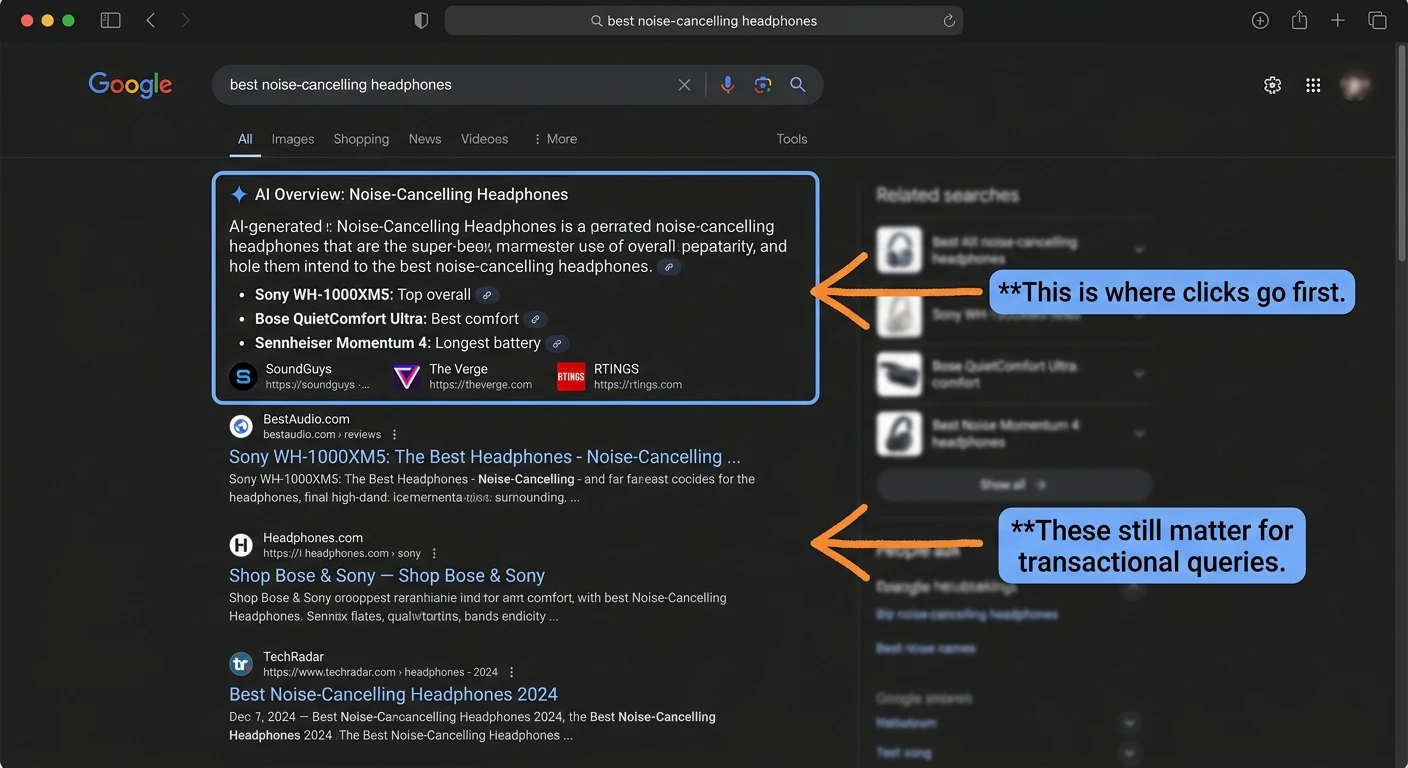
For transactional and commercial queries searches where users are close to making a purchase decision traditional SEO still dominates. For transactional, commercial, and local queries, traditional SEO still outperforms AEO and GEO. When someone searches “buy affiliate marketing course” or “Holo AI pricing,” they want a specific page to click through to, not a synthesised summary.
SEO also provides compounding returns over time. A well-optimised post published today continues to accumulate authority, backlinks, and topical credibility for months and years. The ROI timeline is longer but the returns are more stable than any of the newer channels.
Where SEO Falls Short in 2026
The gap in SEO’s coverage is informational queries searches where the user wants an answer, not a destination. “What is affiliate marketing” or “how does GEO work” are examples. For these query types, AI Overviews now absorb significant click volume by answering the question directly on the results page.
If a page is getting impressions but low clicks, it may be because a snippet or AI Overview is answering the query before users need to click. This is the most common diagnostic signal in Google Search Console right now for sites whose traffic has plateaued or declined despite maintaining rankings.
What Is AEO – Answer Engine Optimization?
AEO is a content strategy designed to help your site appear as a direct answer in search results Google snippets, People Also Ask boxes, and voice assistant responses.
Where traditional SEO aims to get your page into the list, AEO aims to get your content extracted and displayed as the answer itself, before the user even sees the list. This is “Position Zero” the featured snippet that appears above all organic results and, in many cases, answers the question so completely that no click is needed.
AEO is not a new concept. Featured snippets have existed since 2014. But in 2026, AEO has become significantly more important because the featured snippet is no longer just a box at the top of Google results. It feeds directly into AI Overviews, voice search responses, and AI assistant answers across multiple platforms.
How AEO Works in Practice
Instead of showing multiple links, answer engines pull a single, clear response from a highly structured website. Structured content, FAQ sections, and schema markup tell search engines what your content means and make it eligible for direct extraction.
The content structure for AEO is specific. Questions as H2 or H3 subheadings, followed immediately by a two-to-four sentence direct answer. No preamble, no context-setting before the answer. The answer first, every time.
FAQ schema markup signals to Google that specific sections of your content are intended as direct question-and-answer pairs. HowTo schema marks step-by-step instructions. These are the formats that AI extraction systems are built to recognise and surface.
AEO helps your content appear as a direct answer in search results. It works alongside your broader SEO efforts, including technical, on-page, and content optimization not in place of them.
Where AEO Wins and Where It Loses
For informational queries, brand awareness, and voice search, AEO outperforms traditional SEO. If someone asks Siri “what is the best AI tool for Instagram carousels” and your content is the featured snippet, that voice answer is your content being delivered to the user without them ever visiting your site. That is AEO working at its most effective.
The limitation of AEO is the same as its strength: it targets short, specific, directly answerable questions. Comprehensive topics that require depth “explain how to build an affiliate marketing strategy from scratch” are too complex for a featured snippet and require a different approach. GEO works better for comprehensive topics while AEO targets short, answerable questions.
What Is GEO – Generative Engine Optimisation?
Generative Engine Optimisation is the practice of structuring content and digital presence so that AI-powered platforms cite, recommend, or mention a brand when users ask questions. These platforms include ChatGPT, Google AI Overviews, Google Gemini, and Perplexity.
GEO is the newest of the three disciplines. GEO as a concept did not really exist until about a year ago, which means most of what is written about it is still based on early experimentation rather than proven long-term data. This is important context for evaluating any GEO claim including this one.
The fundamental difference between GEO and both SEO and AEO is the nature of the result being optimised for. SEO and AEO both result in your page appearing in some form on a search results page. GEO results in your content being synthesised into an AI-generated response that may or may not include a clickable link to your site at all.
Major publishers like Reuters and The Guardian receive less than 1 percent of referral traffic from AI platforms like ChatGPT and Perplexity despite being frequently cited. This is the honest starting point for GEO strategy: citation does not automatically mean traffic. The value of GEO citations is primarily brand visibility and authority, not direct traffic volume at least at the current stage of AI search adoption.
How Generative AI Decides What to Cite
Generative AI does not list websites. It reads them, synthesises the information, and generates a custom answer. It decides who to cite based on topical authority whether you cover your niche in depth trust signals including consistent brand mentions across directories and credible platforms, and context over keywords, meaning whether your content clearly defines who you are and what you do.
Reddit, LinkedIn, and YouTube ranked among the most-referenced domains by major large language models in October 2025. This tells you something important about GEO: it is not only about your website. The conversation happening about your brand and your ideas across social platforms, forums, and third-party publications all feeds into how AI systems perceive and cite your authority.
Between 40 and 60 percent of cited sources change month-to-month across Google AI Mode and ChatGPT, making GEO visibility far less stable than organic search rankings. This volatility is the most important honest caveat about GEO in 2026. Unlike a top-10 ranking that tends to be relatively stable, AI citations shift frequently and are harder to predict or maintain.
What GEO Requires from Your Content
GEO requires fact-density and citation-readiness. You are optimising for an AI’s internal reasoning process, not just a keyword filter. This means every claim backed by a source. Statistics attributed. Definitions precise. Content structured so an AI can extract a coherent answer from it without reading the surrounding context.
Content must not only be optimised to rank through keywords or topical relevance, but also hyper-aligned with the questions users ask. GEO ensures that content can be easily extracted and delivered in answer-first environments, with a focus on clarity, relevance, and immediate usefulness.
Technical accessibility matters more for GEO than most marketers realise. AI crawlers need to be able to read your content in plain HTML. Sites that block AI bots through robots.txt, or that rely on JavaScript to render core content, are significantly less likely to be cited regardless of content quality.
AEO vs SEO vs GEO – The Key Differences Side by Side
Understanding the distinctions clearly matters for deciding where to invest your time.
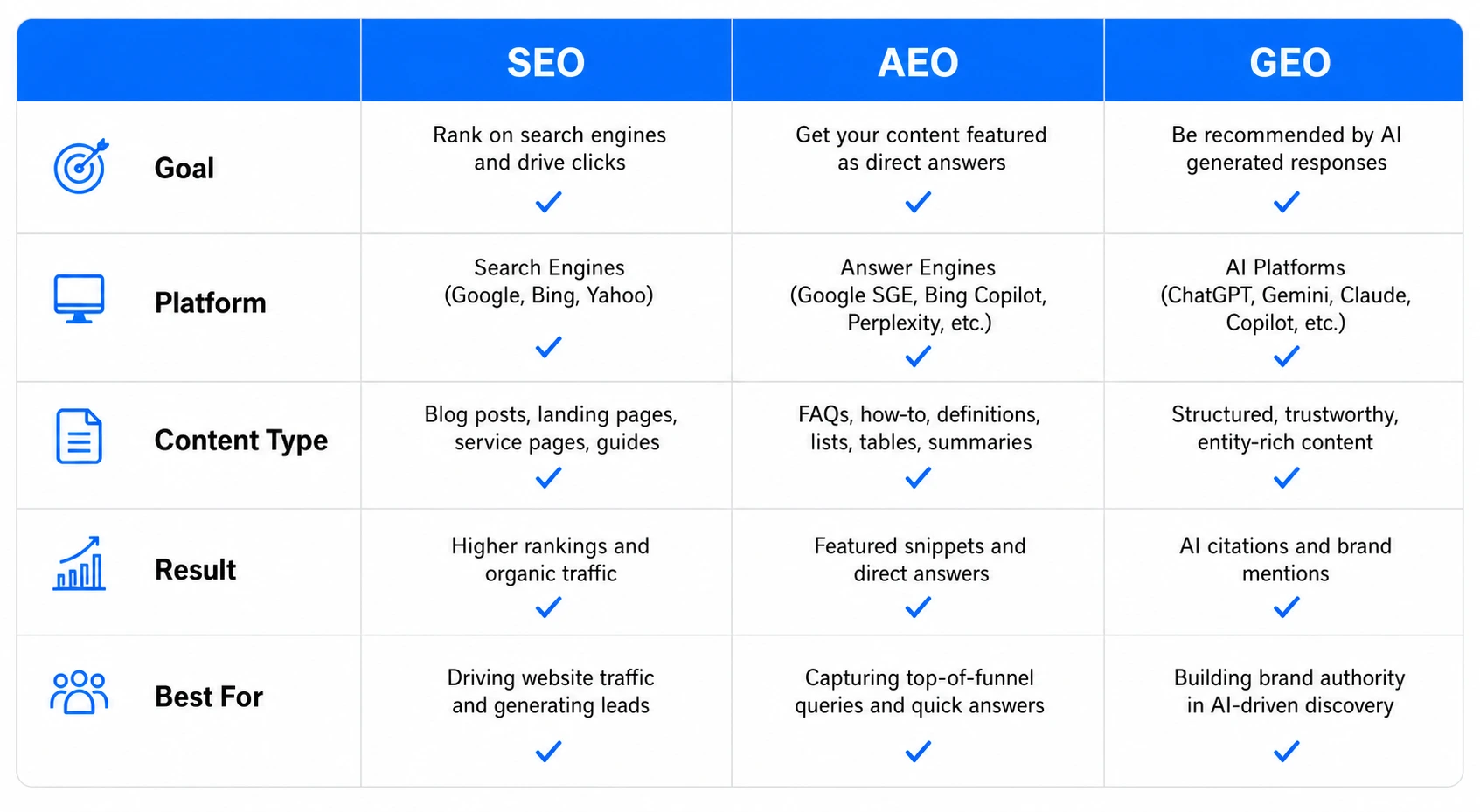
SEO goal: A ranked page that earns clicks from the traditional results list. The success metric is organic traffic and ranking position. The platform is Google, Bing, and other traditional search engines. The content format that works best is comprehensive long-form content with strong keyword targeting, backlinks, and technical health.
AEO goal: Being selected as the direct answer that appears before the organic list. The success metric is featured snippet ownership, People Also Ask appearances, and voice search citations. The platform is Google’s featured results, Bing Copilot, and voice assistants. The content format that works best is structured Q-and-A content with schema markup and direct, concise answers.
GEO goal: Being cited as a source inside an AI-generated response. The success metric is how often your brand is mentioned in AI answers for your target queries. The platform is ChatGPT, Perplexity, Google AI Overviews, and Gemini. The content format that works best is entity-rich, fact-dense, deeply authoritative content combined with broad brand presence across multiple platforms.
The biggest misconception about GEO is both that good GEO is identical to good SEO, and simultaneously that GEO is 100 percent different from SEO. The tactics recommended for both are strikingly similar, but the data does not confirm that following modern SEO best practices alone leads to GEO success. The truth sits in between: SEO creates the foundation, but GEO requires additional deliberate steps beyond ranking.
What Actually Works in 2026 – The Honest Assessment
Here is where most guides fail you. They describe all three disciplines, tell you to do all of them, and leave you to figure out the prioritisation yourself. Let us be more specific.
If You Are Building a New Content Site
Your priority order is SEO first, AEO second, GEO third.
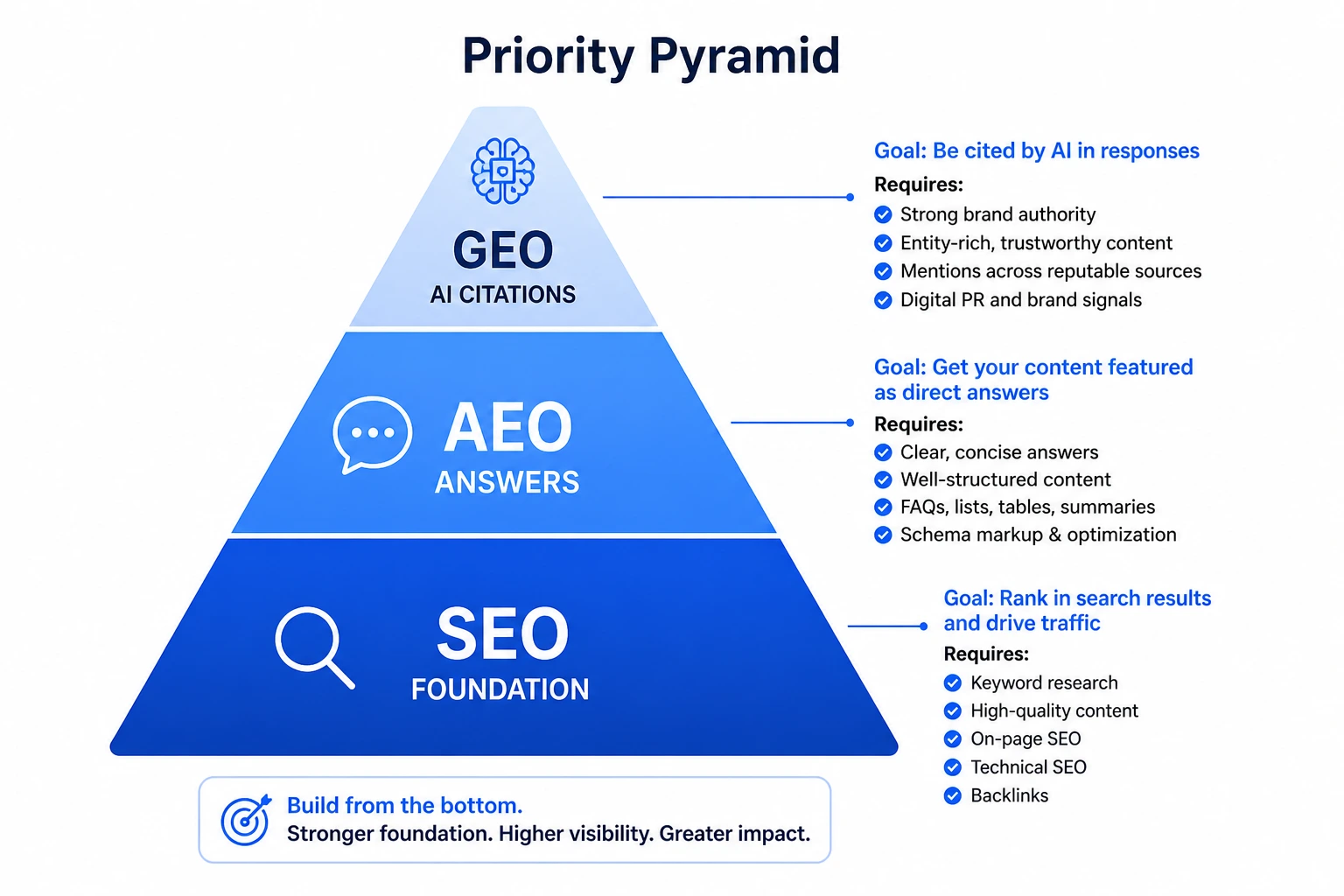
SEO is the foundation for everything else. SEO gets your content indexed, ranked, and discoverable through traditional search. AEO builds on SEO by structuring your content to be selected as direct answers. GEO extends your reach by positioning your content to be cited by generative AI tools. You cannot skip the foundation and build the roof first.
For a site under six months old, traditional SEO fundamentals topical content clusters, internal linking, technical health, and building the first backlinks will produce more measurable results than GEO optimisation. AI systems prefer to cite established, authoritative sources. A new site with minimal backlinks and brand presence will struggle to earn AI citations regardless of how well its content is structured for GEO.
If You Have an Established Site with Existing Traffic
Your priority shifts. At this stage, your site likely already has solid SEO fundamentals. The highest-leverage opportunity is retroactively applying AEO and GEO optimisation to your existing top-performing pages.
Find your pages with high impressions and low CTR in Google Search Console. These are the clearest signal that AI Overviews are absorbing the clicks you previously received. These pages need AEO treatment: add direct answers to the first paragraph, restructure subheadings as questions, add FAQ sections with schema markup.
Simultaneously, audit your top pages for GEO-readiness. Every factual claim should have a source. Every statistic should be attributed. The content should stand alone readable by an AI system without surrounding context and deliver a complete answer on the topic.
The Channel Breakdown That Makes Strategic Sense
A single, well-structured service or content page should accomplish all three: rank well on Google through strong SEO, answer common questions through AEO, and earn citations through GEO thanks to its clear structure and authority.
The most efficient approach in 2026 is not running three separate content strategies. It is building one excellent content strategy that checks all three boxes simultaneously. Every post you publish should: target a specific keyword cluster and be technically sound for SEO, include structured direct answers and FAQ sections for AEO, and demonstrate genuine expertise with cited facts and comprehensive depth for GEO.
This is more work per post than the average content approach from 2022. But it produces content that works across all three channels rather than content that works only in one and the compounding effect of that breadth significantly increases the lifetime value of each piece.
How to Optimise for All Three – A Practical Checklist
Rather than abstract advice, here are the specific actions that apply to every piece of content you publish in 2026.
SEO Checklist (Foundation)
Target a specific keyword with clear search intent. Write a meta title under 60 characters and meta description under 160 characters that include your focus keyword. Use H2 and H3 subheadings throughout the post. Include two to four internal links to related content on your site. Ensure fast page load time and mobile optimisation. Submit the URL to Google Search Console for indexing after publishing.
AEO Checklist (Answer Layer)
Write a direct, one-to-three sentence answer to your primary question within the first 150 words of the post. Use question-format H2 subheadings throughout the post exactly the way users phrase the question in search. Add a FAQ section at the end of every post with five to ten questions answered in two to four sentences each. Implement FAQ schema markup using AIOSEO or your preferred SEO plugin. Avoid clever or ambiguous language in answer sections plain, precise language is what AI extraction systems prefer.
GEO Checklist (AI Citation Layer)
Back every factual claim with a source. Attribute every statistic. Build comprehensive topical coverage a single excellent post on a topic contributes less to GEO visibility than an interconnected cluster of posts that signals topical authority to AI systems. Ensure your robots.txt file does not block AI crawlers including GPTBot, Google-Extended, and Perplexity’s bot. Earn brand mentions across platforms beyond your site social media, forums, guest posts, and press coverage all feed into how AI systems perceive your authority.
If you want to research how AI systems are responding to queries in your niche, Merlin AI lets you query multiple AI models ChatGPT, Claude, Gemini from one dashboard to compare how each answers your target topics.”
Tracking Results Across All Three Channels
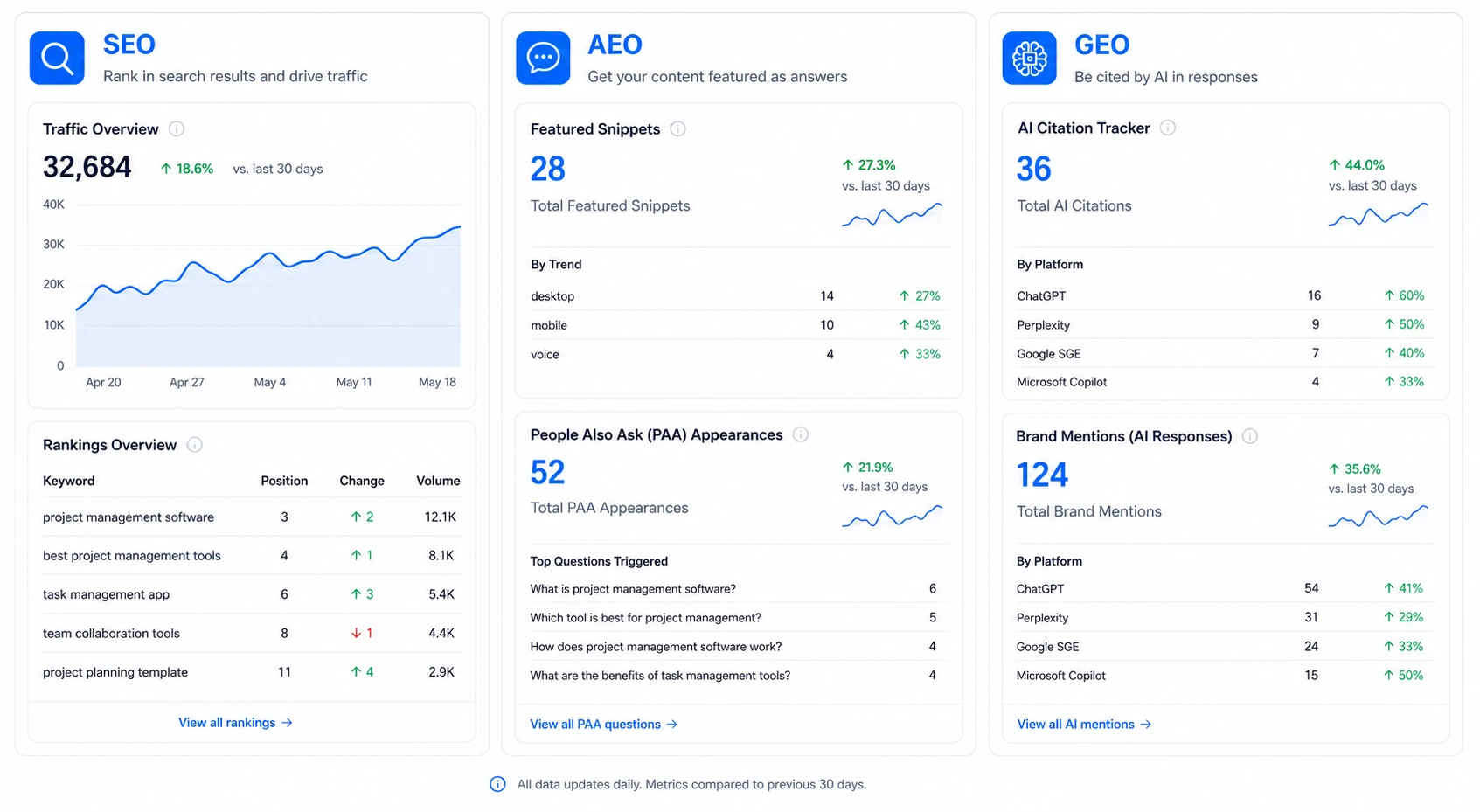
One of the practical challenges of the three-channel approach is that each requires different success metrics.
For SEO, track organic traffic, ranking positions for target keywords, and the number of pages in the top 10 and top 100. Google Search Console provides all of this for free.
For AEO, track featured snippet ownership for your target queries, People Also Ask appearances, and the pages in your Search Console that have high impressions but unusually low CTR the latter indicates an AI or featured result is answering before users need to click.
For GEO, track manually. Once per week, search your most important queries in ChatGPT, Perplexity, and Google AI Mode. Note whether your brand or content is mentioned in the response. Track whether this frequency changes over time as you publish more content and build more brand presence. New tools in 2026 allow you to see how often your brand is mentioned by models like GPT-4 or Claude, and tracking “share of voice” in AI responses is becoming the new equivalent of tracking backlinks.
Common Mistakes When Applying All Three
The most expensive mistake is treating these as three separate content strategies and producing three different types of posts for each. This multiplies your content production burden without multiplying your results. The goal is content that serves all three simultaneously, not content siloed into one channel.
The second mistake is abandoning SEO fundamentals because GEO sounds more exciting. Brands that abandon SEO for AEO or GEO will find their AEO and GEO performance suffers too, since answer engines and AI systems still prioritise authoritative, well-indexed domains. There is no shortcut that bypasses domain authority.
The third mistake specific to GEO is believing any vendor who claims to have definitively cracked it. Anyone who says they have the answer to GEO is either wildly overconfident or trying very hard to sell you something. GEO is less than two years old as a discipline. The honest answer is that best practices are still being established, and anyone claiming certainty should be treated with scepticism.
The fourth mistake is producing fully AI-generated content and calling it GEO-optimised. AI systems are trained partly on human-authored content and increasingly capable of identifying surface-level AI output. Content that demonstrates genuine firsthand expertise, original perspective, and real-world experience consistently outperforms generic AI-written content in both traditional rankings and AI citation frequency.
The Bottom Line – Which One Should You Focus On?
All three. But in the right order and with the right priorities for your stage of growth.
If you are in the first six months of building a content site, SEO fundamentals are your entire strategy. Build your content clusters. Get technically healthy. Earn your first backlinks. AEO and GEO will emerge naturally from good SEO practice at this stage.
If you have an established site with existing traffic, apply AEO to your top pages immediately. Add direct answers, FAQ sections, and schema markup. This is the fastest path to protecting your traffic from AI Overview absorption. Then layer GEO over time by deepening your topical coverage, building brand presence across platforms, and ensuring your content is technically accessible to AI crawlers.
SEO, AEO, and GEO are not three completely different marketing channels you need to manage separately. They are connected layers of modern search visibility. By doing SEO well, you are often laying the groundwork for AEO and GEO.
The search landscape is more complex than it was in 2022. But the underlying principle has not changed. The sites that win consistently in traditional search, in featured snippets, and in AI citations are the ones that publish genuinely useful, thoroughly researched, clearly structured content from an identifiable and credible source.
That was true in 2016. It is true in 2026. And it will still be true when the next set of acronyms arrives.
CONCLUSION:
The alphabet soup of modern search optimisation SEO, AEO, GEO is genuinely confusing, and the volume of confident but contradictory advice online makes it harder, not easier, to know what to actually do.
The honest answer is that none of them replaces the others. SEO is the foundation. AEO is the answer layer built on top of it. GEO is the authority layer that extends your visibility into AI-generated responses. Together, they represent a complete search visibility strategy for 2026.
Start where you are. If your SEO fundamentals are weak, fix those first. If you have solid rankings but falling CTR, apply AEO. If you have strong authority and want to build AI citation visibility, layer in GEO practices.
The goal has always been the same: be the most useful, credible, and accessible source of information on the topics you cover. The channels through which that usefulness is rewarded have multiplied. The underlying strategy has not.
FAQs
Q: What is the difference between SEO, AEO, and GEO?
A: SEO (Search Engine Optimisation) targets traditional search rankings and organic clicks from Google’s blue links. AEO (Answer Engine Optimisation) targets featured snippets, People Also Ask boxes, and voice search by structuring content as direct answers. GEO (Generative Engine Optimisation) targets AI-generated responses from platforms like ChatGPT, Perplexity, and Google AI Overviews by building topical authority and fact-dense content that AI systems cite.
Q: Does GEO replace SEO in 2026?
A: No. GEO does not replace SEO in 2026. Nearly 40 percent of Google AI Overview citations come from pages already ranking in the top 10 organic results, meaning SEO authority directly feeds GEO visibility. Traditional Google search still processes 373 times more queries per day than ChatGPT. SEO is the foundation that makes both AEO and GEO possible.
Q: What is AEO and how does it work?
A: Answer Engine Optimisation is the practice of structuring content to be extracted and displayed as a direct answer by Google featured snippets, voice assistants, and AI Overviews. It works by using question-format subheadings, writing direct concise answers immediately after each question, adding FAQ sections, and implementing schema markup so search engines can identify and extract your content as an answer.
Q: How do I optimise for GEO?
A: To optimise for GEO, write fact-dense content where every claim is sourced and attributed. Build topical authority through interconnected content clusters rather than isolated posts. Ensure your site allows AI crawlers through your robots.txt file. Earn brand mentions across social platforms, forums, and third-party publications. Avoid fully AI-generated content without human expertise added, as AI systems prefer to cite content that demonstrates genuine experience and authority.
Q: Which is more effective – SEO, AEO, or GEO?
A: Each is most effective for different outcomes. SEO drives the highest raw traffic volume, especially for transactional and commercial queries. AEO is most effective for informational queries, voice search, and building brand authority through featured snippet ownership. GEO is most effective for building AI citation visibility and brand recognition across AI search platforms. A complete 2026 search strategy integrates all three, with SEO as the foundation.