


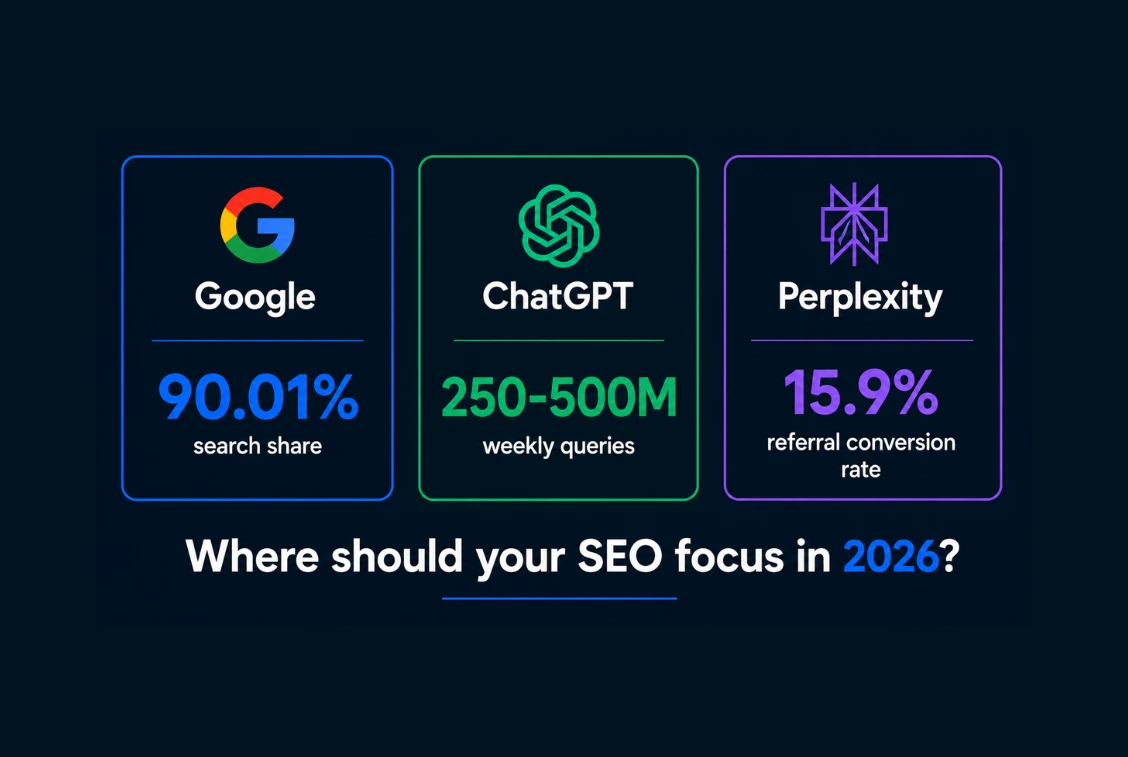
Here is the question every content marketer and SEO professional is asking in 2026. Google still dominates global search. But ChatGPT is growing exponentially. Perplexity converts referral traffic at rates that make traditional SEO look inefficient. And Google’s own AI Overviews are absorbing the click-through rates that previously drove organic traffic.
Where exactly should your time, budget, and content strategy be focused?
The honest answer requires looking at real data across all three platforms not the breathless “SEO is dead” takes that dominate marketing social media, and not the defensive “Google still rules” responses that ignore genuine structural change.
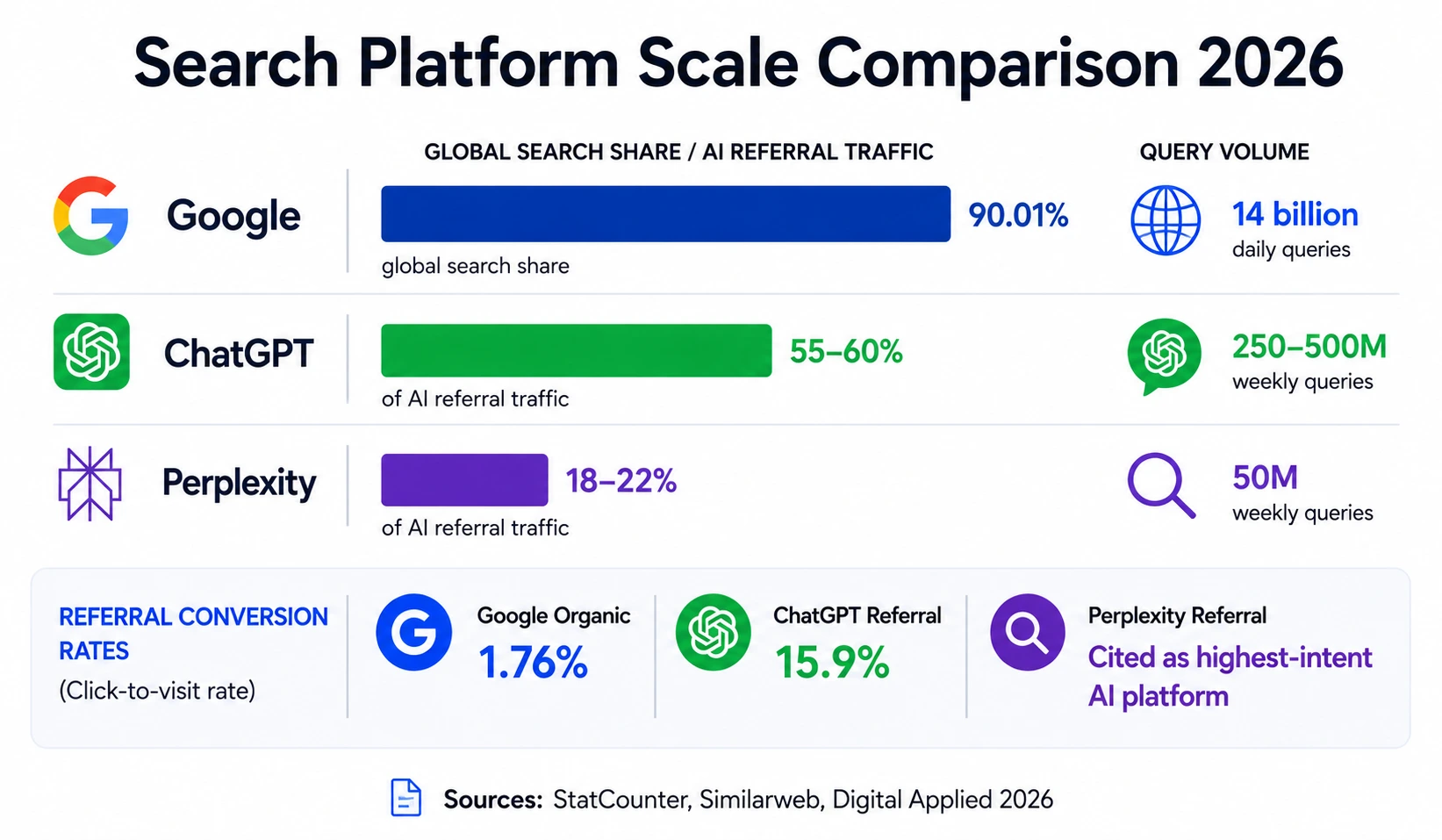
As of March 2026, StatCounter data shows Google at 90.01% of worldwide search traffic, with Bing at 4.98%, Yahoo at 1.39%, Yandex at 1.34%, DuckDuckGo at 0.76%, and Baidu at 0.55%. Google’s dominance in raw search volume is not meaningfully in question.
But Google still holds roughly 80% of search, but AI platforms are taking 15-20% of informational query volume. Google retains dominance on navigational and transactional queries, but ChatGPT Search, Perplexity, and Google AI Mode now capture a meaningful share of research, learning, and commercial investigation queries the exact segments that historically drove organic traffic to content sites.
That last sentence is the strategic insight that changes the conversation. Google is not losing search. It is losing the specific query types that content marketing sites depend on most.
This post breaks down exactly what each platform delivers, where each one is growing or declining, what the conversion and traffic data shows, and most importantly the specific allocation of SEO effort that makes sense for a content site in 2026.
The Current State of Each Platform – The Data First
Before getting to strategy, the data needs to be accurate. Here is where each platform actually stands as of May 2026.
Google – Still Dominant, But Structurally Changing
Google’s share has fluctuated between roughly 89% and 93% since 2015. It dipped below 90% in each of the final three months of 2024 and again in February 2026 before ticking back above that line in March. At Google’s scale, every tenth of a percent represents millions of searches.
The raw numbers confirm Google’s dominance. But the nature of Google’s search experience has fundamentally changed. Google AI Overviews now appear in over 25 percent of all searches. Google’s internal AI products AI Mode plus AI Overviews are the largest single source of organic traffic disruption for informational publishers, not the external competition from ChatGPT Search or Perplexity.
This is the critical distinction most SEO analysis misses. The biggest threat to your Google organic traffic is not ChatGPT or Perplexity taking your audience away. It is Google itself absorbing clicks that previously went to your pages through AI-generated answers on the results page.
Organic traffic from classic Google search is likely to decline by double-digit percentages over the next few years, with Gartner flagging a 25% drop by 2026 and other analyses pointing to 30-50% reductions in some verticals by 2028. These projections are for informational content specifically. Transactional and navigational queries remain more stable because users clicking to purchase or navigate to a specific site do not have their behaviour significantly altered by AI Overviews.
ChatGPT – The Breakout AI Search Leader
ChatGPT Search processes 250-500 million weekly queries and Perplexity around 50 million, per Similarweb 2026 AI Search report. ChatGPT Search alone has grown into one of the top five search properties globally by query volume.
For AI referral traffic specifically, ChatGPT leads with 55-60% share, followed by Perplexity at 18-22% (though declining), and Gemini at approximately 8.65% of global AI chatbot referral traffic.
The conversion data is where ChatGPT’s strategic value becomes clearest. AI search traffic converts at significantly higher rates than traditional organic search, making even smaller absolute traffic volumes economically significant for content and affiliate sites.
Profound’s analysis of 41 million results across ChatGPT, AI Overviews, Perplexity, and Copilot found ChatGPT results overlap only 12% with the Google SERP — and only 26% with Bing, even though ChatGPT browsing is Bing-powered. Ahrefs found 80% of LLM citations do not even rank in Google’s top 100.
That last statistic is the most important number in this entire post for understanding why a Google-only SEO strategy is now structurally incomplete. The sites ChatGPT recommends and the sites Google ranks are largely different sites. Optimising only for Google means being invisible on ChatGPT regardless of your ranking position.
Perplexity – Smaller but Higher Intent
Perplexity’s monthly active users more than doubled from 22M at the start of 2025. Monthly queries are projected to reach 1.2-1.5 billion per month by mid-2026. A notable shift in Perplexity’s geographic profile: India recently surpassed the United States as Perplexity’s largest market by traffic, driven by the Airtel Pro partnership that reportedly drove 640% user growth in Q2 2025.
However, Perplexity’s relative market share in AI referral traffic has been declining from a peak of 12.07% in April 2025, dropping by more than 40% as Google Gemini surged in AI chatbot referrals. The AI search market is consolidating rapidly, with ChatGPT and Gemini together controlling approximately 86% of market share.
Perplexity’s strategic position is as a high-intent research platform. Users who choose Perplexity are typically researchers, professionals, and detailed buyers who prefer cited, verifiable answers over conversational responses. This audience profile, combined with Perplexity’s average of 21 citations per response the highest of any major AI platform makes Perplexity disproportionately valuable for content sites targeting professional and research-oriented audiences despite its smaller overall scale.
The Query Type Split – Which Platform Owns What
The single most useful framework for deciding where to invest your SEO effort is understanding which platform dominates which query types. The platforms are not competing for the same queries. They have distinct strengths that correspond to different user intents.
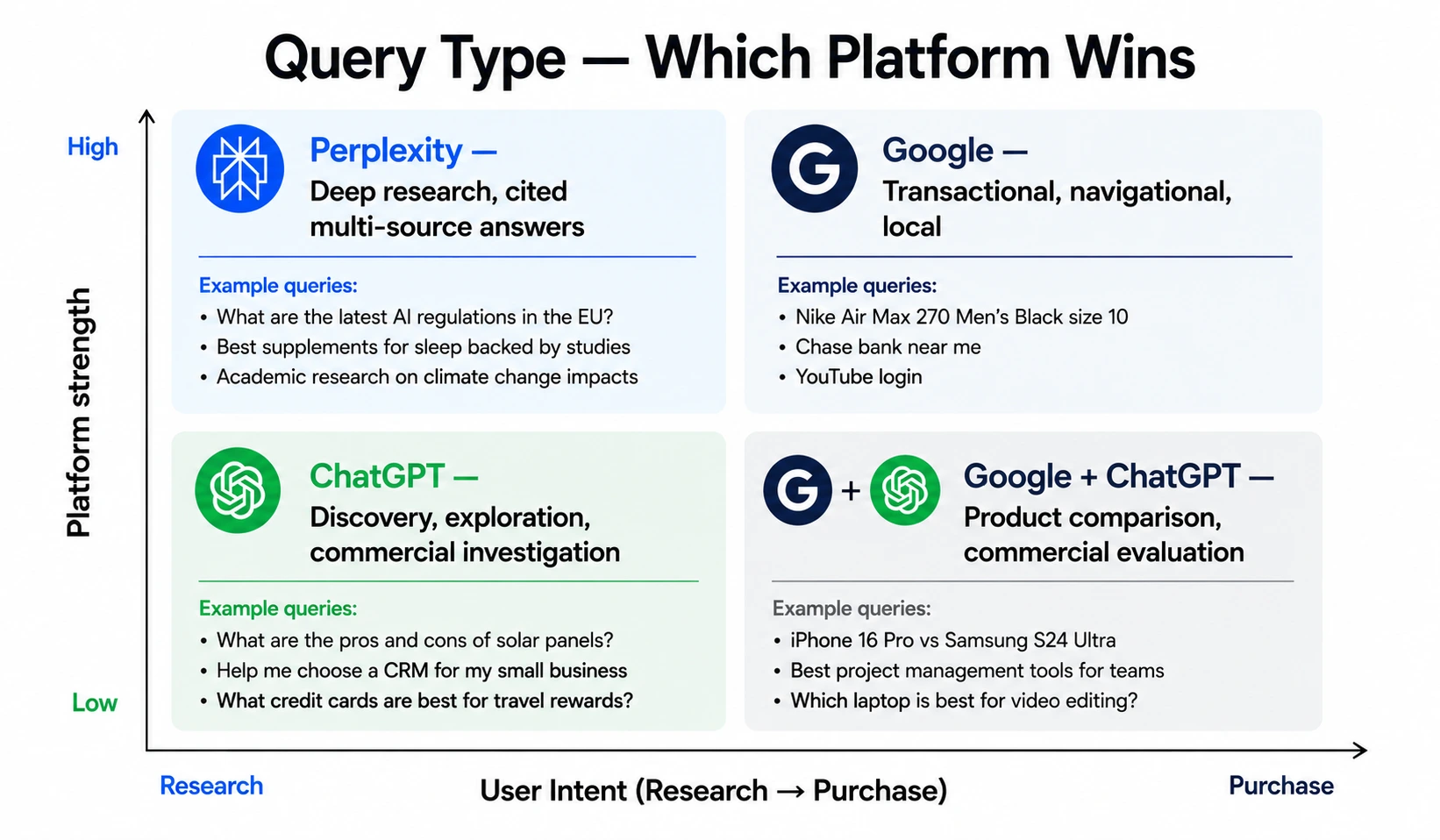
Google dominates navigational queries searches for a specific website, brand, or destination. It dominates transactional queries searches where the user intends to make a purchase. And it remains the default for local queries searches for nearby businesses, services, and places. For these three query types, Google’s dominance is not meaningfully threatened by AI platforms in 2026.
For the 65.5% of queries where ChatGPT does not activate search, responses come entirely from training data. Your AI visibility for those queries depends on whether your content was included in the training corpus, which correlates with domain authority and content freshness at the time of training data collection.
ChatGPT dominates discovery and research queries at the top of the funnel. When users ask “what is the best AI tool for creating Instagram carousels” or “explain how affiliate marketing works” these open-ended, exploratory queries are where ChatGPT’s conversational format excels. ChatGPT also dominates commercial investigation queries, where users are evaluating options before making a decision.
Industry breakdown for AI search traffic growth Q1 2026 versus year-over-year: Retail grew 693%, Travel 539%, Financial Services 266%, Tech and Software 120%, Media and Entertainment 92%. These growth rates reflect the categories where buyer research is shifting to AI-mediated discovery fastest.
Perplexity dominates deep research queries complex, multi-source questions where the user needs cited, verifiable information from multiple authoritative sources. Academic researchers, journalists, professionals, and advanced buyers gravitate toward Perplexity precisely because its cited-answer format is more reliable for serious research than conversational AI responses.
Understanding this split tells you exactly which queries on your target keyword list are most at risk from AI disruption and which are most stable. Informational queries in your content strategy are the most vulnerable. Transactional and navigational queries are the most stable.
The Traffic Blind Spot – Why 84% of Brands Are Flying Blind
Google Search Console, Ahrefs, Semrush, BrightEdge, Conductor every SEO tool you currently use measures Google. None of them, by default, tells you whether ChatGPT, Claude, Gemini, or Perplexity is recommending you, citing you, or describing you positively. For SMBs and agencies, this means 84% of brands are flying blind on the channel that already influences a third of buyer research.
This measurement gap is one of the most consequential practical problems in digital marketing in 2026. Brands are investing significant resources in content and SEO, measuring their performance exclusively through Google metrics, and remaining entirely unaware of whether they have any presence in AI search the channel that converts at dramatically higher rates.
HubSpot is the canary. Organic traffic fell from roughly 13.5 million monthly visits in November 2024 to under 7 million by December 2024 and stayed there through 2025 a 70-80% drop from peak. HubSpot’s traffic loss is the most cited example of what happens when informational content volume meets AI Overview absorption at scale. The lesson is not that content marketing fails. It is that a Google-only strategy for informational content is now structurally exposed.
The solution is not abandoning Google measurement. It is adding AI visibility measurement alongside it. This means weekly manual testing of your target queries in ChatGPT, Perplexity, and Google AI Mode. It means tracking referral traffic from AI platforms in your analytics. And it means treating share of AI citations how often your brand appears in AI-generated answers as a performance metric alongside traditional rankings.
The Citation Overlap Problem – Why You Cannot Rank Your Way to AI Visibility
The most important structural insight in the Google versus AI search debate is the citation overlap finding.
ChatGPT results overlap only 12% with the Google SERP and only 26% with Bing, even though ChatGPT browsing is Bing-powered. Ahrefs found 80% of LLM citations do not even rank in Google’s top 100.
These numbers require a complete reassessment of the assumption that good SEO automatically produces AI visibility. Ranking number one on Google does not make you visible to ChatGPT. Being in the top 100 on Google does not make you citable by AI systems. The selection criteria that determine ChatGPT citations authoritative list mentions, branded web mentions, domain trust signals, FAQ schema, content freshness are substantially different from the criteria that determine Google rankings.
ChatGPT also looks for authority signals when evaluating service providers. For “best nursing programs,” GPT-5.4’s fan-outs checked accreditation and pass rates. For “best SEO agency,” it checked industry award winners. This means having genuine credentials, certifications, and recognised industry validation directly influences your ChatGPT citation probability.
This finding from April 2026 analysis is particularly actionable. ChatGPT actively looks for third-party validation signals not just content quality. Being listed in industry roundups, earning verified reviews on platforms like G2 or Trustpilot, and accumulating media mentions are SEO activities that Google rewards modestly but that AI citation systems reward disproportionately.
GEO optimisation increases AI search citations by 40% compared to traditional SEO alone. This measured uplift from Generative Engine Optimisation the practice of structuring content specifically to earn AI citations is the clearest data point supporting investment in a dual strategy rather than a Google-only approach.
The Conversion Data – Why Smaller AI Traffic Is More Valuable
The most misunderstood aspect of the Google versus AI search comparison is the relationship between traffic volume and revenue impact. AI platforms deliver substantially smaller absolute traffic volumes than Google. But the conversion rates associated with AI-referred traffic change the economic calculation significantly.
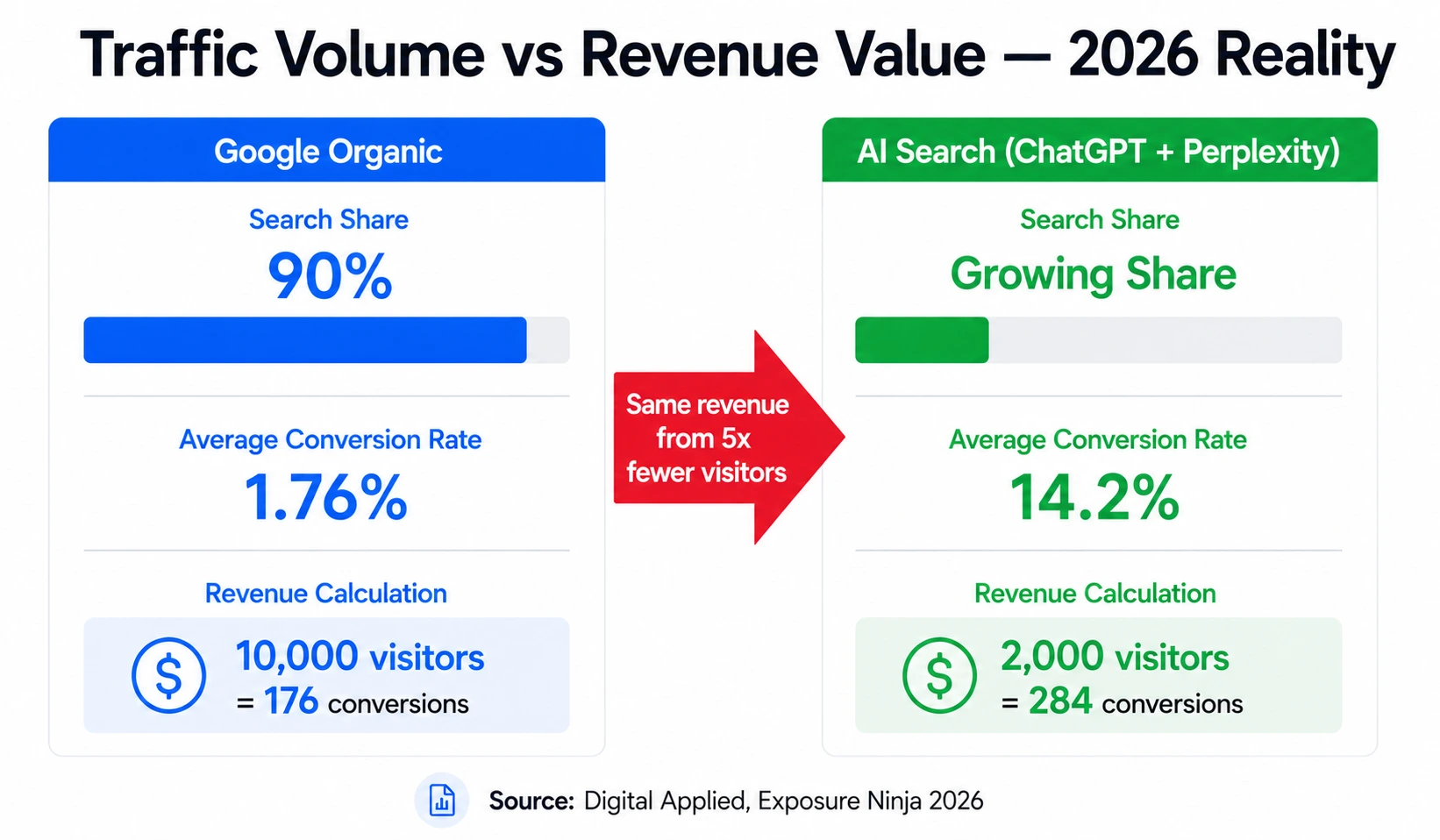
AI search traffic converts at 14.2 percent compared to Google organic at 2.8 percent. That is a 5.07 times higher conversion rate per visit. This means that 100 visitors from a ChatGPT citation produce the same revenue as roughly 500 visitors from Google organic search on equivalent pages.
The AI search market is consolidating rapidly, with ChatGPT and Gemini together controlling approximately 86% of market share. As the market consolidates, the efficiency of AI referral traffic makes it strategically valuable even at current volume levels and the compounding growth trajectory means that volume is not staying at current levels.
AI search engines and assistants ChatGPT, Gemini, Perplexity, Claude, Copilot are growing traffic at 50 to 100 percent year-on-year, collectively handling more queries and, by some forecasts, overtaking traditional search as a traffic driver around 2028.
The practical implication for content sites is that building AI visibility now when the barrier is lower and the competition for AI citations is less fierce is significantly less expensive than building it in 2027 or 2028 when the channel is more established and competitive.
The Strategic Framework – How to Allocate Your SEO Effort
The data points to a clear strategic framework, but the specific allocation depends on your site’s current position, audience, and content mix. Here is the framework that reflects the evidence.
If You Are a New Content Site (Under 12 Months Old)
Your priority is Google SEO. There is no shortcut around this. AI citation systems strongly prefer established, authoritative sources. A new site with minimal domain authority and few backlinks is unlikely to earn consistent AI citations regardless of how well its content is structured for GEO. Building domain authority through consistent content quality, internal linking, and earning your first editorial backlinks is the foundation that makes everything else possible.
Within this Google-first approach, build GEO-ready habits from the start. Use FAQ schema on every post. Write direct answers in the first paragraph of every section. Cite statistics. Structure content as listicles or FAQ pages where appropriate. These habits cost nothing extra and mean your content is GEO-ready when your authority level reaches the threshold where AI citations become achievable.
If You Have an Established Site with Existing Traffic
Your priority shifts to protecting your Google traffic while building AI visibility. The most urgent tactical action is identifying your informational content pages posts targeting “what is” and “how to” queries that are generating high impressions but declining click-through rates in Google Search Console. These pages are losing clicks to AI Overviews. Apply AEO treatment: add direct answers to the first paragraph, add FAQ sections, add FAQ schema. This both protects your traditional ranking and improves your AI Overview citation probability.
Simultaneously, audit your top twenty pages for GEO-readiness. Every factual claim should have a source. Every statistic should be attributed. The author byline should be substantive. These are the signals AI citation systems weight most heavily.
The Budget Allocation the Data Supports
The winning strategy in 2026 is a hybrid: keep traditional SEO for scale, while investing in GEO to increase the likelihood your brand is referenced by models powering ChatGPT-style experiences and Perplexity-style answer engines.
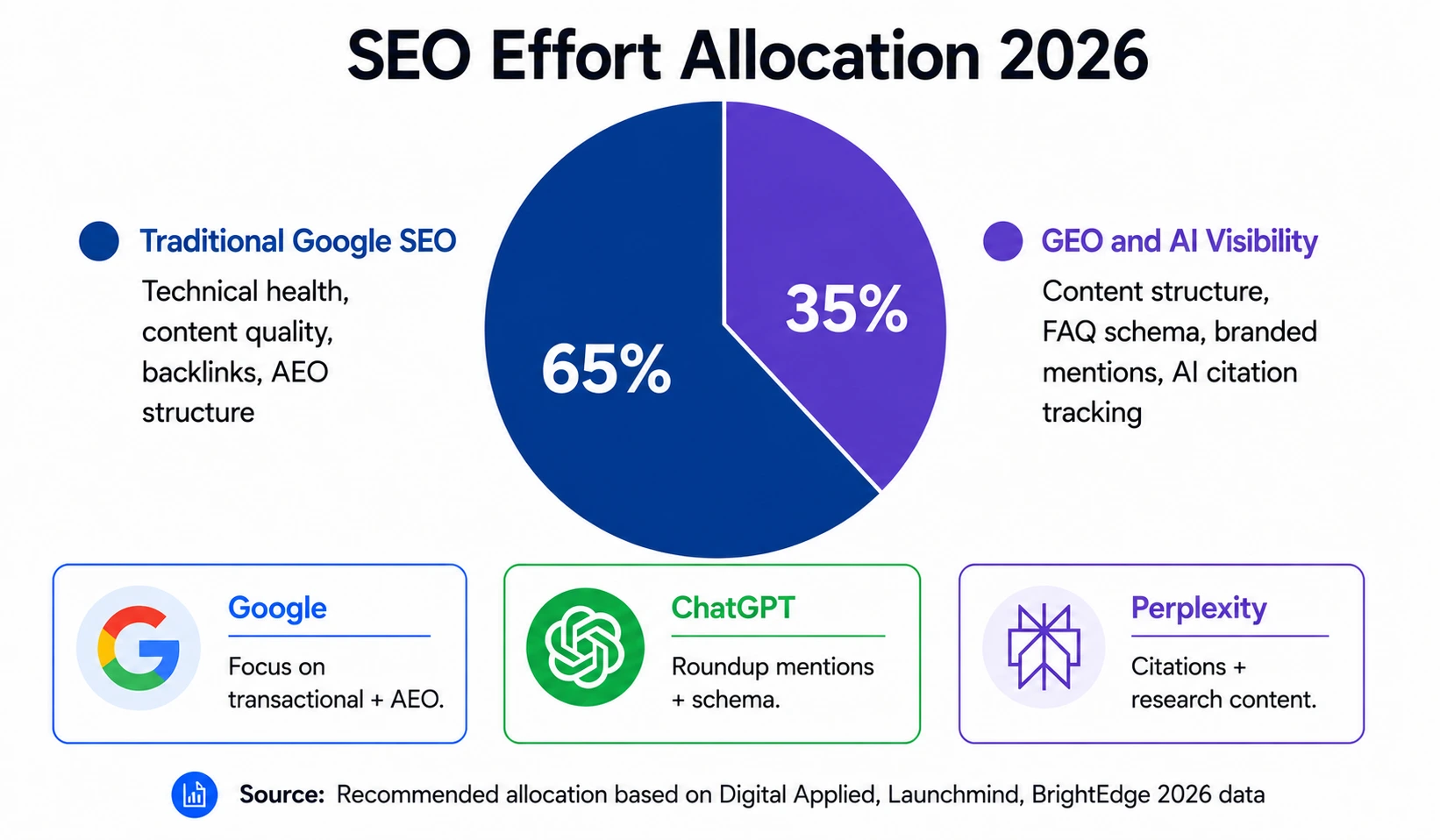
For most content sites in 2026, a reasonable allocation is 60 to 70 percent of SEO effort on traditional Google optimization technical health, content quality, backlink building and 30 to 40 percent on GEO and AI visibility activities content structure, FAQ schema, branded mention building, and AI citation tracking. The specific balance should shift toward AI visibility as your domain authority grows and as your Google traffic shows increasing exposure to AI Overview absorption.
The Platform-Specific Optimization Checklist
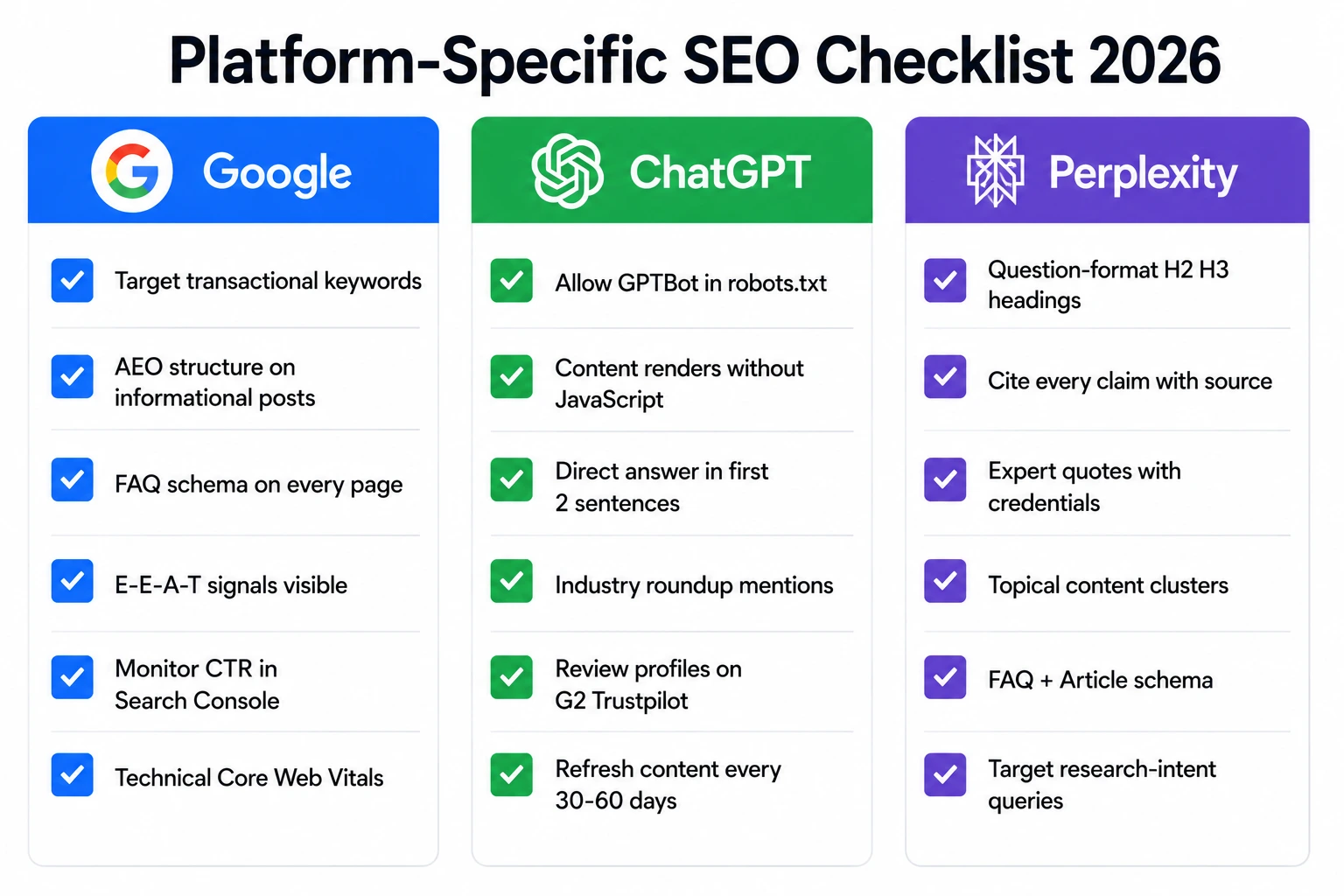
Each platform has distinct optimization requirements. Here is what works specifically for each.
Google Optimization in 2026
Target transactional and commercial keywords alongside informational content. Transactional queries are the most protected from AI Overview absorption. Apply AEO structure to all informational content direct answers, FAQ sections, FAQ schema to improve AI Overview citation probability within Google’s own ecosystem. Track your Search Console data for the specific CTR decline pattern that signals AI Overview absorption on your high-impression pages.
Ensure your content passes the E-E-A-T test: visible expert author, original data or insight, demonstrable experience with the subject, and trustworthiness signals including accurate attributions and transparent methodology.
ChatGPT Optimization in 2026
Allow GPTBot in your robots.txt file. Ensure your core content renders in plain HTML without JavaScript. Write direct, extractable answers in the first two sentences of every section. Implement Article schema and FAQ schema. Get your brand listed in authoritative industry roundups and directories authoritative list mentions account for 41 percent of ChatGPT’s citation weighting. Build review profiles on G2, Trustpilot, or whichever platform is relevant to your category. Refresh content every 30 to 60 days ChatGPT’s citation rate for content updated within 30 days is 3.2 times higher than for older material.
Perplexity Optimization in 2026
Structure every piece of content around specific questions with descriptive H2 and H3 subheadings. Cite every claim with a verifiable source Perplexity’s users specifically choose the platform because they value source transparency. Use expert quotes with visible credentials. Build topical authority through interconnected content clusters. Perplexity averages 21 citations per response the highest of any major platform meaning each individual citation slot is less competitive than on ChatGPT.
The Tracking Framework – Measuring Across All Three Platforms
The measurement gap is as important as the optimisation gap. Most sites measure only Google performance. Building a complete picture requires tracking all three channels.
For Google, track organic traffic, ranking positions for target keywords using Search Console, and critically the CTR trend on your highest-impression informational pages. Declining CTR on high-impression pages is the earliest signal that AI Overviews are absorbing your traffic. Catching this pattern early gives you time to apply AEO optimization before the traffic loss becomes significant.
For ChatGPT visibility, build a list of 20 to 30 queries your target audience would ask ChatGPT in your niche. Run each query weekly and note whether your brand is cited. Track frequency over time. Also monitor your Google Analytics referral traffic for visits originating from chat.openai.com this is visible in your traffic sources and provides a quantitative baseline for AI referral volume.
For Perplexity visibility, run the same query list in Perplexity weekly. Perplexity’s cited-source format makes it straightforward to see whether your content is appearing. Track your perplexity.ai referral traffic in analytics alongside ChatGPT referrals.
If you want to test your brand’s visibility across ChatGPT, Claude, and Gemini simultaneously without switching between tabs, Merlin AI lets you query all three models from one dashboard
For SMBs and agencies, 84% of brands are flying blind on the channel that already influences a third of buyer research. The brands that build measurement infrastructure for all three channels now will have a significant advantage over competitors who are still measuring only Google when the AI search channel reaches the scale where it becomes impossible to ignore.
CONCLUSION:
The question of where to focus your SEO strategy in 2026 does not have a single correct answer. It has a correct framework.
The strategic takeaway is not “SEO is dead,” but rather: Search is fragmenting. Google will remain huge, but AI engines and agents will control an ever-larger slice of discovery and decision-making.
Google remains the scale play. 90 percent of global search traffic is not a position that disappears quickly. For transactional and navigational queries, Google’s dominance is durable. For informational content, the structural exposure to AI Overview absorption is real and accelerating.
ChatGPT is the emerging discovery channel for research and commercial investigation queries. Its 12 percent overlap with Google rankings means you cannot rank your way to ChatGPT visibility. But you can build toward it systematically through structured content, authoritative list mentions, and brand presence across platforms.
Perplexity is the high-intent research platform with the highest-converting audience and the most citations per response. Its declining market share relative to ChatGPT and Gemini does not diminish its strategic value for content sites targeting professional and research-oriented audiences.
The brands that win in 2026 will treat AI visibility as a strategic asset: they will publish citable content, build authority signals, and measure share of answers — not just share of clicks.
The allocation: 60 to 70 percent traditional Google SEO, 30 to 40 percent GEO and AI visibility. Add AI citation tracking to your measurement stack immediately. Build the habits now that protect your position as the channel grows.
FAQs
Q: Should I focus on Google SEO or AI search optimisation in 2026?
A: Both, but in the right proportion. Google still holds 90.01% of global search traffic and should remain the primary focus for most content sites. However, AI platforms including ChatGPT and Perplexity now convert referral traffic at dramatically higher rates 14.2% versus Google’s 1.76% making AI visibility a high-value secondary investment. The recommended allocation is 60-70% traditional Google SEO and 30-40% GEO and AI visibility activities.
Q: Does ranking on Google help you appear in ChatGPT answers?
A: Not reliably. Profound’s analysis of 41 million results found ChatGPT results overlap only 12% with Google’s search results. Ahrefs found 80% of LLM citations do not rank anywhere in Google’s top 100. Strong Google rankings provide some foundation domain authority is a signal AI systems weight but optimising specifically for ChatGPT citations requires different actions including authoritative list mentions, FAQ schema, direct answer structure, and branded web mentions.
Q: What is the difference between ChatGPT and Perplexity for SEO?
A: ChatGPT dominates AI referral traffic with 55-60% share and excels at discovery and commercial investigation queries. Perplexity holds 18-22% of AI referral traffic and is strongest for deep research queries with its cited-answer format. Perplexity averages 21 citations per response versus fewer for other platforms, making individual citation slots less competitive. ChatGPT reaches a broader general audience while Perplexity attracts higher-intent research-oriented users.
Q: Is Google losing search market share to ChatGPT in 2026?
A: Google holds 90.01% of global search traffic as of March 2026 and its raw volume dominance is not meaningfully threatened. However, AI platforms are capturing 15-20% of informational query volume research, learning, and commercial investigation queries which are exactly the query types that drive organic traffic to content sites. Google’s own AI Overviews are the larger threat to organic traffic than external AI platforms, absorbing clicks from informational queries on the results page itself.
Q: How do I track my visibility on ChatGPT and Perplexity?
A: Build a list of 20-30 queries your audience would ask in your niche. Run them weekly in ChatGPT and Perplexity and note whether your brand appears. Track referral traffic from chat.openai.com and perplexity.ai in your Google Analytics or GA4 traffic sources. Monitor this weekly baseline to measure the impact of your GEO optimisation changes over time. Dedicated tools including AI Clicks, Otterly, and Wellows provide automated AI citation frequency tracking across platforms.